GateUser-5caa169c

vip
Age 0 Yıl
Peak Tier 0
No content yet
#FirstTradeOfTheWeek
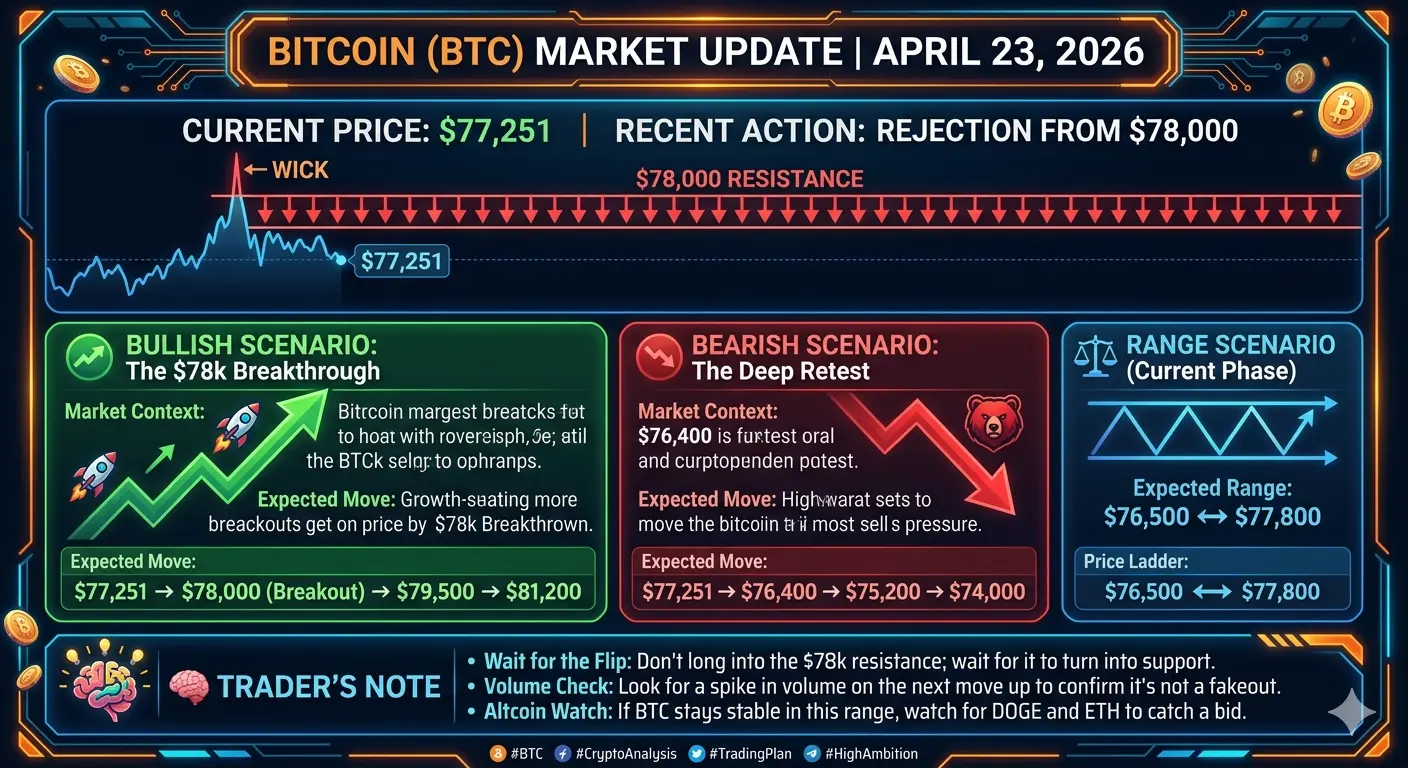
Bitcoin (BTC) Market Update | April 23, 2026

The market is showing some heavy resistance at the psychological $78,000 mark. After yesterday's touch and rejection, BTC is currently cooling off around $77,251.
This "wick" above $78k suggests that while the bulls have the strength to push high, sell pressure at that level is significant.

We are seeing a classic consolidation phase. As long as BTC holds above the $76,500 support, the structure remains bullish for another attempt at $78k.
However, if we lose $76k, we might see a deeper retest of the $74,500 zone before a
BTC-0,55%
DOGE1,85%
ETH-1,48%
HighAmbition
#FirstTradeOfTheWeek
Bitcoin (BTC) Market Update | April 23, 2026

The market is showing some heavy resistance at the psychological $78,000 mark. After yesterday's touch and rejection, BTC is currently cooling off around $77,251.
This "wick" above $78k suggests that while the bulls have the strength to push high, sell pressure at that level is significant.

We are seeing a classic consolidation phase. As long as BTC holds above the $76,500 support, the structure remains bullish for another attempt at $78k.
However, if we lose $76k, we might see a deeper retest of the $74,500 zone before any further upside.

🚀 BTC Technical Briefing | April 2026
​💰 Current Price: $77,251
📉 Recent Action: Rejection from $78,000

🟢 BULLISH SCENARIO: The $78k Breakthrough
​Market Context: * High volume consolidation below resistance.
​Positive funding rates and spot buying interest.
Expected Move:
​$77,251 → $78,000 (Breakout) → $79,500 → $81,200
Key Support: $76,500
Trigger: 4H Candle close above $78,200.

🔴 BEARISH SCENARIO: The Deep Retest
​Market Context:
​Exhaustion at the local top.
​BTC Dominance slipping as liquidity moves to Alts.
Expected Move:
​$77,251 → $76,400 → $75,200 → $74,000
Key Resistance: $78,000
Trigger: Breakdown below $76,000.

⚖️ RANGE SCENARIO (Current Phase)
​Expected Range: $76,500 ↔ $77,800
Behavior: * Side-ways movement to reset indicators (RSI/MACD).
​"Stop-hunting" both long and short positions.
​Best for scalping the extremes.

🧠 TRADER’S NOTE
​Wait for the Flip: Don't long into the $78k resistance; wait for it to turn into support.
​Volume Check: Look for a spike in volume on the next move up to confirm it's not a fakeout.
​Altcoin Watch: If BTC stays stable in this range, watch for DOGE and ETH to catch a bid.
repost-content-media
  • Reward
  • Comment
  • Repost
  • Share
#BTCMarketAnalysis
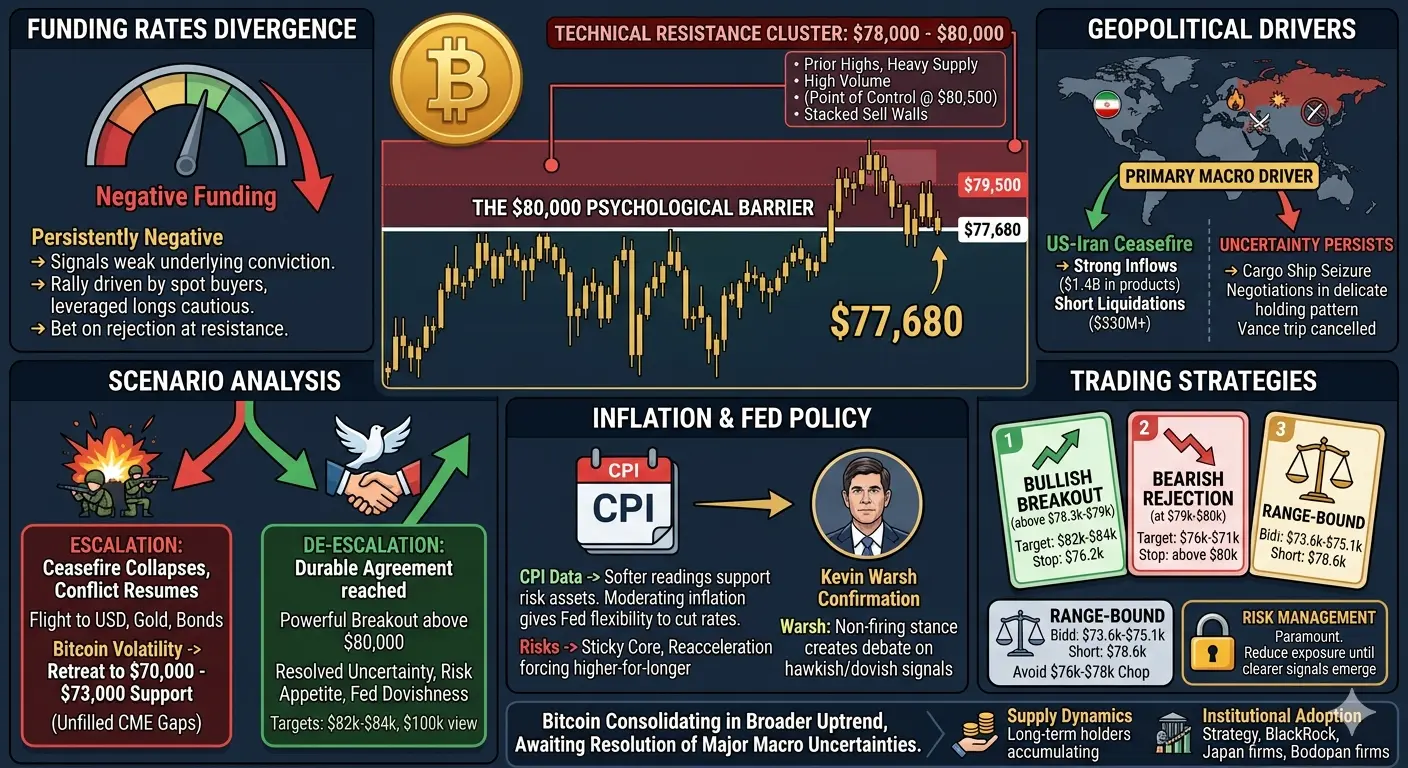
Bitcoin is currently trading around $77,680, after recently touching highs near $79,500 and failing to break the major $80,000 psychological resistance. This rejection is not just a simple pullback; it reflects a combination of technical pressure, liquidity barriers, and cautious market sentiment that is shaping the current market structure.
The $78,000 to $80,000 zone has become one of the most important resistance areas in the market right now. This region aligns with previous highs formed in late January and early February, which means a large number of traders previousl
BTC-0,55%
HighAmbition
#BTCMarketAnalysis
Bitcoin is currently trading around $77,680, after recently touching highs near $79,500 and failing to break the major $80,000 psychological resistance. This rejection is not just a simple pullback; it reflects a combination of technical pressure, liquidity barriers, and cautious market sentiment that is shaping the current market structure.
The $78,000 to $80,000 zone has become one of the most important resistance areas in the market right now. This region aligns with previous highs formed in late January and early February, which means a large number of traders previously entered positions here. As price revisits this zone, many of those participants are exiting their positions at breakeven or small profit, creating strong selling pressure. At the same time, volume profile analysis shows the Point of Control (POC) near $80,500, meaning this is where the highest trading activity occurred historically. Such levels often act as magnets for price but also require strong momentum to break through.
Liquidity data further strengthens this bearish pressure in the short term. There are heavy sell walls stacked between $80,000 and $84,000, indicating that even if Bitcoin manages to break $80K, it will not be an easy continuation. Without sustained institutional inflows and strong spot demand, any breakout attempt may face quick rejection.
Another critical signal comes from the derivatives market. Funding rates remain negative despite price moving upward toward $79K. This is an unusual divergence because, in strong bullish trends, funding typically turns positive. The current situation suggests that spot buyers are pushing the price up, while leveraged traders are either cautious or actively shorting the market. This creates a fragile rally structure where upward movement lacks strong conviction and can reverse quickly if buying pressure slows down.
At the macro level, geopolitical developments have become the dominant driver of Bitcoin’s recent price action. The temporary ceasefire between the United States and Iran triggered a strong risk-on move, pushing Bitcoin from the low $70,000 range to nearly $79,000 within a short time. This move was supported by approximately $1.4 billion in institutional inflows, highlighting how quickly sentiment can shift when global tensions ease. Additionally, the rally caused over $330 million in short liquidations, creating a chain reaction of forced buying that accelerated the upward move.
However, the situation remains unstable. Reports of renewed tensions, including the seizure of an Iranian cargo vessel, caused Bitcoin to briefly fall below $74,000, showing how sensitive the market currently is to geopolitical headlines. While temporary stability has returned, the lack of a permanent resolution keeps uncertainty high.
🔍 Scenario Breakdown:
🔴 Bearish Scenario (Geopolitical Escalation):
If tensions rise again or the ceasefire collapses, markets may shift into risk-off mode. In this case, Bitcoin could drop toward $73,000 – $70,000, especially as CME gaps remain open in that range. Initially, BTC may move in correlation with equities to the downside before stabilizing.
🟢 Bullish Scenario (De-escalation & Stability):
If peace talks progress and uncertainty fades, Bitcoin could break above $80,000 with strong momentum. This could open the path toward $82,000 – $84,000, and in an extended rally, the $90,000 – $100,000 range could come into focus as institutional demand strengthens.
📊 Inflation & Federal Reserve Influence:
Recent CPI data has shown signs of easing inflation, which supports risk assets like Bitcoin. Lower inflation increases the likelihood of future interest rate cuts, which improves liquidity conditions and supports bullish momentum.
However, risks still remain. Core inflation is still relatively sticky, and any unexpected increase could push the Federal Reserve to maintain higher interest rates for longer. This would reduce liquidity and potentially slow down Bitcoin’s upward movement.
In addition, discussions around potential Federal Reserve leadership changes and policy direction are adding another layer of uncertainty that traders must monitor closely.
📈 Trading Strategies:
Bullish Breakout Strategy:
Wait for a confirmed breakout above $78,300 – $79,000 with strong volume and rising open interest.
Targets: $80K → $82K → $84K
Stop Loss: Below $76,200 or $75,500
Confirmation: Funding turning positive + strong spot demand
Bearish Rejection Strategy:
Look for rejection signals near $79K – $80K (e.g., long wicks, bearish divergence).
Targets: $76K → $73.5K → $71K
Stop Loss: Above $80K
Range Trading Strategy:
Market is currently range-bound, so traders can:
Buy near $75,100 – $73,600
Sell near $78,600+
Avoid $76K – $78K zone due to choppy movement
📦 On-Chain & Market Structure:
On-chain data continues to show strong long-term confidence:
+303,000 BTC accumulated by long-term holders
-290,000 BTC reduced by short-term holders
This indicates a shift from weak hands to strong hands, which is typically a bullish sign for the long-term trend.
Institutional participation is also increasing, with major players and corporations continuing to accumulate Bitcoin, reinforcing the broader bullish structure.
⚠️ Risk Management:
The current market environment is highly sensitive and driven by external factors. Traders should:
Use proper position sizing
Avoid over-leveraging
Wait for confirmation before entering trades
Stay updated on geopolitical and macro developments
🔮 Final Outlook:
Bitcoin remains in a larger uptrend, but is currently facing a strong resistance barrier. The $80,000 level is the key trigger point for the next major move.
A strong breakout above this level could lead to rapid upside expansion, while repeated rejection may push price back toward the $70,000 support region.
In this phase, patience and discipline are more important than aggressive trading. The market is offering opportunities, but only to those who can manage risk and adapt quickly to changing conditions.
repost-content-media
  • Reward
  • Comment
  • Repost
  • Share
#USIranTalksProgress .
US-Iran Talks Progress: Current Situation and Market Impact Analysis
The negotiations between the United States and Iran have entered a critical phase in April 2026, with both sides sending mixed signals about the prospects for a lasting peace agreement. The talks, which began in April 2025 under the mediation of Oman and later moved to venues including Rome, Geneva, and most recently Islamabad, Pakistan, have faced numerous setbacks despite intermittent progress.
Current Status of Negotiations
The fourth round of negotiations in 2026 concluded on April 7, 2026, with bot
HighAmbition
#USIranTalksProgress .
US-Iran Talks Progress: Current Situation and Market Impact Analysis
The negotiations between the United States and Iran have entered a critical phase in April 2026, with both sides sending mixed signals about the prospects for a lasting peace agreement. The talks, which began in April 2025 under the mediation of Oman and later moved to venues including Rome, Geneva, and most recently Islamabad, Pakistan, have faced numerous setbacks despite intermittent progress.
Current Status of Negotiations
The fourth round of negotiations in 2026 concluded on April 7, 2026, with both sides agreeing to a two-week ceasefire. However, the situation remains volatile. President Trump has expressed confidence that a deal is close, stating that the US would acquire Iran's enriched uranium and that no money would exchange hands. Meanwhile, Iran's top negotiator Mohammad Bagher Ghalibaf has indicated progress in talks, though Iranian officials continue to criticize what they perceive as US violations of the ceasefire terms.
The core sticking points remain Iran's nuclear program and the US demand for comprehensive inspections. Iran has offered to build additional nuclear reactors as part of a broader agreement, but concerns persist about Tehran's commitment to transparency. The US naval blockade of Iranian ports continues despite Iran's announcement that the Strait of Hormuz is open for commercial shipping, creating confusion about the actual status of maritime traffic through this critical waterway.
Strait of Hormuz: The Geopolitical Flashpoint
The Strait of Hormuz remains the central flashpoint in this conflict. This narrow waterway handles approximately one-fifth of global crude oil shipments, making it one of the most strategically important maritime passages in the world. Iran has repeatedly opened and closed the strait in response to developments in negotiations, creating significant uncertainty for global energy markets.
The US has maintained a naval presence in the region, with reports indicating that American forces have turned back over 30 vessels attempting to violate the blockade. President Trump ordered the Navy to shoot and kill Iranian boats laying mines in the strait, raising tensions further. Iran has responded by seizing cargo ships and threatening retaliation against what it calls US armed piracy.
Iran's Strategic Calculations
Iran faces a complex strategic dilemma. On one hand, the country seeks relief from crippling economic sanctions and the US naval blockade that has severely impacted its oil exports. The war has pushed over 30 million Iranians back into poverty according to UN estimates, creating immense domestic pressure for a resolution. On the other hand, Iranian leadership remains deeply suspicious of US intentions, viewing the negotiations as potentially leading to a surrender rather than a genuine peace agreement.
The Iranian parliamentary speaker has criticized Trump for imposing what he calls a siege while claiming to seek peace, suggesting that Tehran views the US approach as contradictory. Iran's supreme leader has warned against enemy media operations, indicating concerns about internal stability during this sensitive period.
Bitcoin Market Analysis: Current Status
Bitcoin has demonstrated remarkable resilience amid the geopolitical turbulence, though it has experienced significant volatility. The cryptocurrency reached a monthly high of approximately $78,922 following the announcement of the ceasefire extension, representing a rally of about 10.4% in 24 hours. However, the price has since pulled back to around $74,000-$76,000 range as tensions flared again.
The current Bitcoin price stands at approximately $78,408, with modest 24-hour gains of 0.09%. The cryptocurrency has shown a 7-day increase of about 3.6% and a 30-day surge of nearly 14%, indicating underlying strength despite geopolitical headwinds. The Fear and Greed Index has reached 63, suggesting growing optimism among market participants.
Institutional adoption continues to provide support for Bitcoin prices. Spot Bitcoin ETFs have logged six consecutive days of inflows, with BlackRock's IBIT ETF leading with substantial daily purchases. MicroStrategy acquired 34,164 BTC on April 20, 2026, demonstrating continued corporate confidence in the asset. Total crypto market capitalization has risen above $2.7 trillion, reflecting broad-based strength across digital assets.
Oil Market Dynamics: XTI and Brent Prices
The oil market has experienced extreme volatility due to the Strait of Hormuz disruptions. Brent crude oil prices have surged above $95 per barrel, with some analysts predicting prices could reach $130 per barrel if disruptions continue through June 2026. West Texas Intermediate (WTI) crude is trading around $93-$96 per barrel, representing a significant premium over pre-conflict levels.
Citi analysts have outlined three scenarios for oil prices based on Strait of Hormuz developments. In the best-case scenario where ceasefire extension is signed and flows gradually resume, prices could stabilize around current levels. The worst-case scenario involves prolonged disruption lasting eight to nine weeks, which would push crude inventories to record lows and maintain prices around $130 per barrel until the third quarter.
The US Energy Information Administration has raised its 2026 oil price forecast significantly due to the supply disruptions. Major oil companies including Chevron and Shell have warned about the physical manifestations of the strait closure working their way through global supply chains. The impact extends beyond crude oil to affect fertilizer costs, transportation, and virtually every production chain worldwide.
Interconnected Market Dynamics
The relationship between geopolitical developments, oil prices, and cryptocurrency markets has become increasingly complex. Bitcoin has shown a decoupling from traditional risk assets, with smaller sell-offs during each Iran-related shock suggesting that crypto may have largely priced in geopolitical tail risk. This resilience contrasts with the more pronounced reactions in equity markets and oil prices.
Arthur Hayes and other prominent crypto analysts have suggested that the Federal Reserve may eventually need to print money to fund the Iran war, which could drive Bitcoin higher as a hedge against monetary expansion. Institutional investors appear to be actively using Bitcoin as protection against the contagion effects of the geopolitical crisis, with BlackRock and MicroStrategy engaged in what some observers describe as an arms race for remaining Bitcoin supply.
Potential Market Scenarios
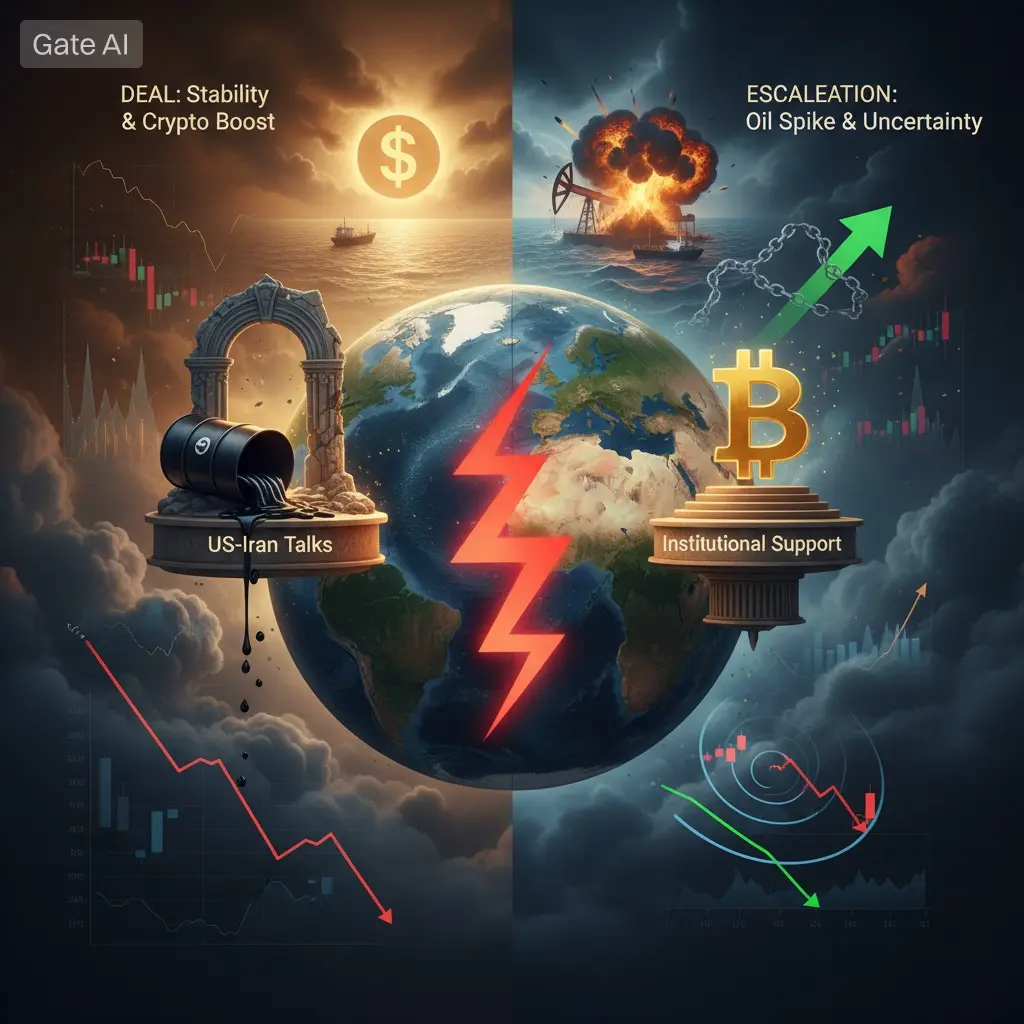
If the ceasefire proves successful and a comprehensive agreement is reached, several market outcomes appear likely. Bitcoin could experience a significant rally as geopolitical risk premium dissipates, potentially testing the $80,000 level and beyond. The cryptocurrency has shown resilience during previous de-escalations, and a lasting peace agreement could trigger renewed institutional interest.
Oil prices would likely decline substantially from current elevated levels, potentially returning to the $70-$80 per barrel range if Strait of Hormuz traffic normalizes. This would provide relief to global inflation pressures and support equity markets. Traditional safe-haven assets like gold and the US dollar might face headwinds as risk appetite returns.
Conversely, if negotiations fail and military escalation resumes, Bitcoin could face renewed selling pressure despite its recent resilience. Oil prices would likely spike above $100 per barrel and potentially reach the $130 level predicted by Citi analysts. Global equity markets would face significant headwinds, and recession probabilities would increase substantially.
Conclusion
The US-Iran negotiations represent a critical juncture for global markets. While both sides have expressed optimism about reaching an agreement, substantial obstacles remain. The Strait of Hormuz continues to serve as both a bargaining chip and a potential trigger for wider conflict. Bitcoin has demonstrated unexpected resilience amid the turmoil, though its ability to maintain current levels depends heavily on the negotiation outcome. Oil markets remain extremely sensitive to developments, with prices reflecting significant risk premium that could unwind quickly if peace is achieved or intensify further if conflict escalates. Investors across all asset classes are watching these negotiations with intense interest, understanding that the outcome will have profound implications for global economic stability in the months ahead.
repost-content-media
  • Reward
  • Comment
  • Repost
  • Share
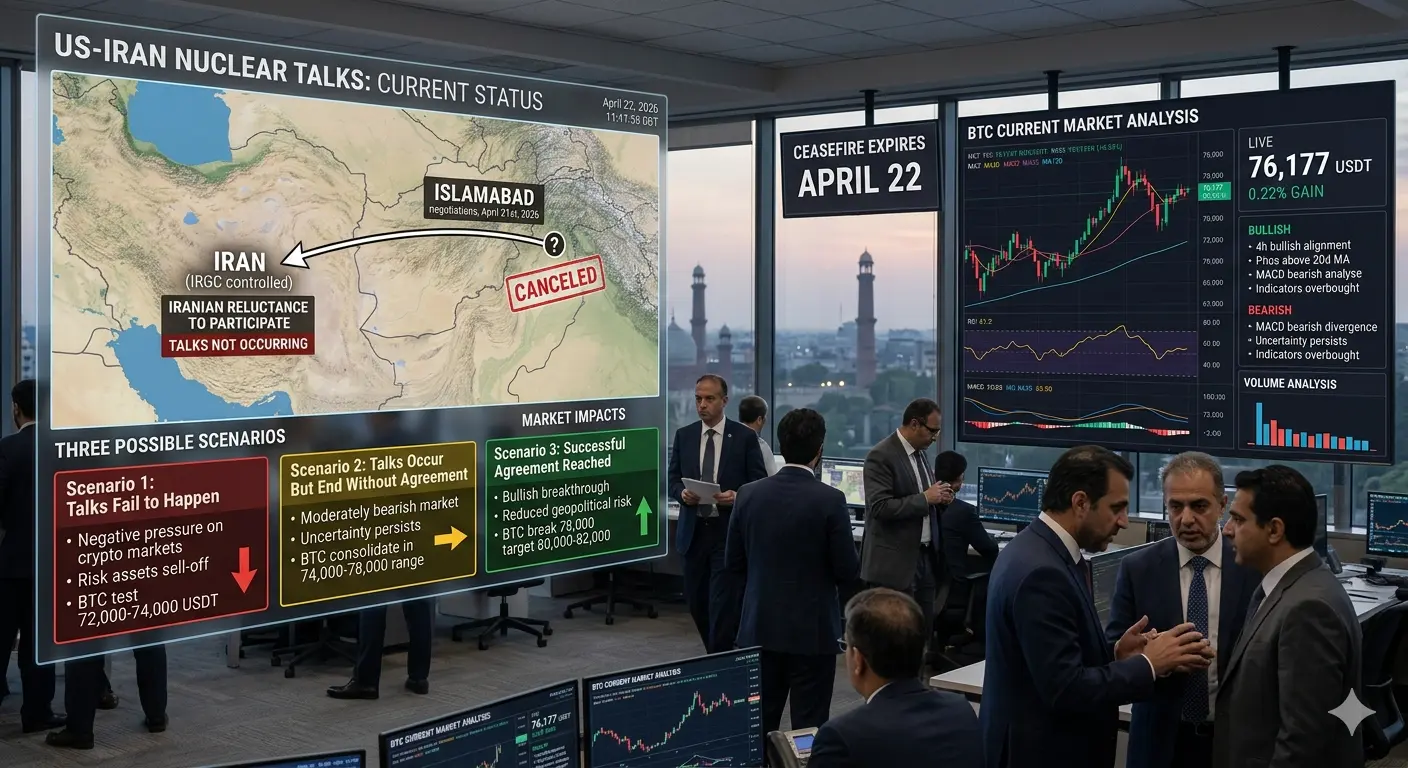
#US-IranTalksStall
The recent breakdown in negotiations between the United States and Iran represents one of the most significant geopolitical developments affecting global markets in 2026. The talks, which were held in Islamabad, Pakistan, collapsed after marathon 21-hour negotiations failed to produce a truce deal, with both sides trading accusations and escalating tensions.
Reasons Behind the Talks Stall
The primary sticking points that led to the collapse of negotiations are multifaceted. First and foremost, Iran's refusal to commit to abandoning its nuclear ambitions remains the central
BTC-0,55%
HighAmbition
#US-IranTalksStall
The recent breakdown in negotiations between the United States and Iran represents one of the most significant geopolitical developments affecting global markets in 2026. The talks, which were held in Islamabad, Pakistan, collapsed after marathon 21-hour negotiations failed to produce a truce deal, with both sides trading accusations and escalating tensions.
Reasons Behind the Talks Stall
The primary sticking points that led to the collapse of negotiations are multifaceted. First and foremost, Iran's refusal to commit to abandoning its nuclear ambitions remains the central obstacle. US Vice President JD Vance explicitly stated that Tehran would not accept Washington's terms regarding nuclear weapons development. The US demands an affirmative commitment that Iran will not seek nuclear weapons or the tools to quickly achieve them.
The Strait of Hormuz has emerged as another critical flashpoint. Iran continues to essentially control this vital waterway through which approximately 20 percent of global oil shipments pass. President Trump announced that the US would impose a naval blockade on Iranian ports in response to Iran's closure of the strait since the beginning of hostilities on February 28, 2026. This blockade has sent oil prices spiraling worldwide and created significant economic pressure on Iran.
Iran has expressed frustration over Trump's decision to maintain the naval blockade even after Tehran announced it would reopen the strait following a 10-day ceasefire between Israel and Lebanon. Iranian officials have threatened to forgo negotiations entirely after the US military seized an Iranian-flagged vessel attempting to defy the blockade over the weekend.
The scope of Iran's nuclear enrichment program has also been contentious. The proposed enrichment program was based on what analysts describe as an overly ambitious 10-year reactor plan, including enriching uranium up to 20 percent with advanced centrifuges. The International Atomic Energy Agency has tracked Iran's nuclear fuel and documented that Iran had 45.5 kilograms of uranium enriched to 20 percent, representing roughly a seven-to-eight-year supply for the reactor.
Why Iran is Stalling the Talks
Iran's negotiating position appears driven by several factors. The regime is seeking to maintain leverage by controlling the Strait of Hormuz, which gives them significant geopolitical power. Additionally, Iran views the US blockade as a violation of the ceasefire agreement, creating a Catch-22 situation where neither side is willing to make the first concession.
The Iranian leadership, under Supreme Leader Mojtaba Khamenei, faces domestic pressure to appear strong against American demands. The country's economy has been devastated by sanctions, and any deal that appears to capitulate to US demands could undermine the regime's legitimacy. Furthermore, Iran's strategic alliances with regional actors and its position within the Axis of Resistance create additional constraints on its negotiating flexibility.
Impact on Crypto Markets
The breakdown in US-Iran talks has created significant ripples throughout cryptocurrency markets. Bitcoin, which had touched the 79,000 USDT level, has retreated to approximately 77,700 USDT, reflecting the risk-off sentiment that typically accompanies geopolitical uncertainty.
The correlation between geopolitical tensions and crypto market volatility has become increasingly pronounced. When traditional safe-haven assets like gold and the US dollar strengthen during times of crisis, cryptocurrencies often experience sell pressure as investors seek liquidity and stability. The current situation is no exception, with Bitcoin struggling to maintain momentum above key resistance levels.
The Strait of Hormuz crisis has particular implications for crypto markets because it affects global energy prices. Higher oil prices typically lead to inflationary pressures, which can influence Federal Reserve policy decisions. Any indication that the Fed might maintain higher interest rates for longer due to inflation concerns tends to weigh on risk assets, including cryptocurrencies.
BTC Current Price Analysis and Forecast
Bitcoin is currently trading around 77,700 USDT, having retreated from the 79,000 USDT resistance level. Technical analysis reveals a mixed picture. On the 4-hour timeframe, moving averages show a bullish alignment with MA7 above MA30 above MA120, indicating an overall upward trend. However, there are concerning signals as well.
The 4-hour chart displays a MACD top divergence pattern, where price made a new high while the MACD histogram decreased, suggesting potential pullback risk. Daily indicators show overbought conditions with CCI at 114.97 and WR at negative 19.51, indicating the market may be due for a correction.
Short-term indicators on the 15-minute timeframe show oversold conditions with CCI at negative 153.55 and WR at negative 87.26, suggesting potential for a bounce. However, the price has fallen below the 20-period moving average, indicating short-term weakness.
Volume analysis shows significant participation with 24-hour trading volume exceeding 522 million USDT, suggesting strong market interest at current levels. The fear and greed index sits at 39, indicating a neutral to slightly fearful sentiment among market participants.
Trading Strategy and Price Targets
Given the current geopolitical uncertainty and technical setup, a cautious approach is warranted. The immediate support level to watch is around 76,900 USDT, which represents the recent low. If this level holds, Bitcoin could attempt another push toward the 79,000 USDT resistance.
However, if the US-Iran situation deteriorates further and oil prices spike, Bitcoin could face additional downside pressure. In a risk-off scenario, support levels at 75,000 USDT and 72,000 USDT come into play. The 200-day moving average around 73,000 USDT represents a critical long-term support zone.
For upside targets, a break above 79,000 USDT could open the door to 82,000 USDT and potentially 85,000 USDT. However, given the overbought daily conditions and geopolitical risks, the probability of immediate new highs appears limited.
Strategic Recommendations
Traders should consider reducing position sizes during periods of heightened geopolitical uncertainty. Setting stop-losses below the 76,000 USDT level would help protect against a deeper correction. For those looking to accumulate, dollar-cost averaging on dips toward the 75,000-76,000 USDT zone may be prudent.
The correlation between traditional markets and crypto has been increasing, so monitoring developments in oil prices, the US dollar index, and equity markets will provide valuable context for crypto trading decisions. Any resolution to the US-Iran tensions could spark a relief rally, while escalation could trigger a broader risk-off move affecting all asset classes.
In conclusion, the US-Iran talks stall represents a significant geopolitical risk factor for crypto markets in the near term. While Bitcoin's long-term fundamentals remain intact, short-term volatility is likely to persist until there is clarity on the diplomatic front. Traders should remain vigilant, manage risk appropriately, and be prepared for rapid shifts in market sentiment as the situation evolves.
repost-content-media
  • Reward
  • Comment
  • Repost
  • Share
#rsETHAttackUpdate :
The rsETH Attack: A $292M DeFi Shock That Redefined Crypto Security in 2026
The crypto market was violently shaken on April 18, 2026, when KelpDAO’s rsETH ecosystem suffered a devastating exploit worth approximately $292 million. This was not just another DeFi hack—it became a systemic stress test for the entire decentralized finance ecosystem, exposing structural weaknesses in cross-chain infrastructure, collateral design, and protocol interdependence.
What followed was not only a token collapse—but a liquidity shock, confidence crisis, and a forced global reassessment o
ETH-1,48%
AAVE1,75%
ARB0,7%
HighAmbition
#rsETHAttackUpdate :
The rsETH Attack: A $292M DeFi Shock That Redefined Crypto Security in 2026
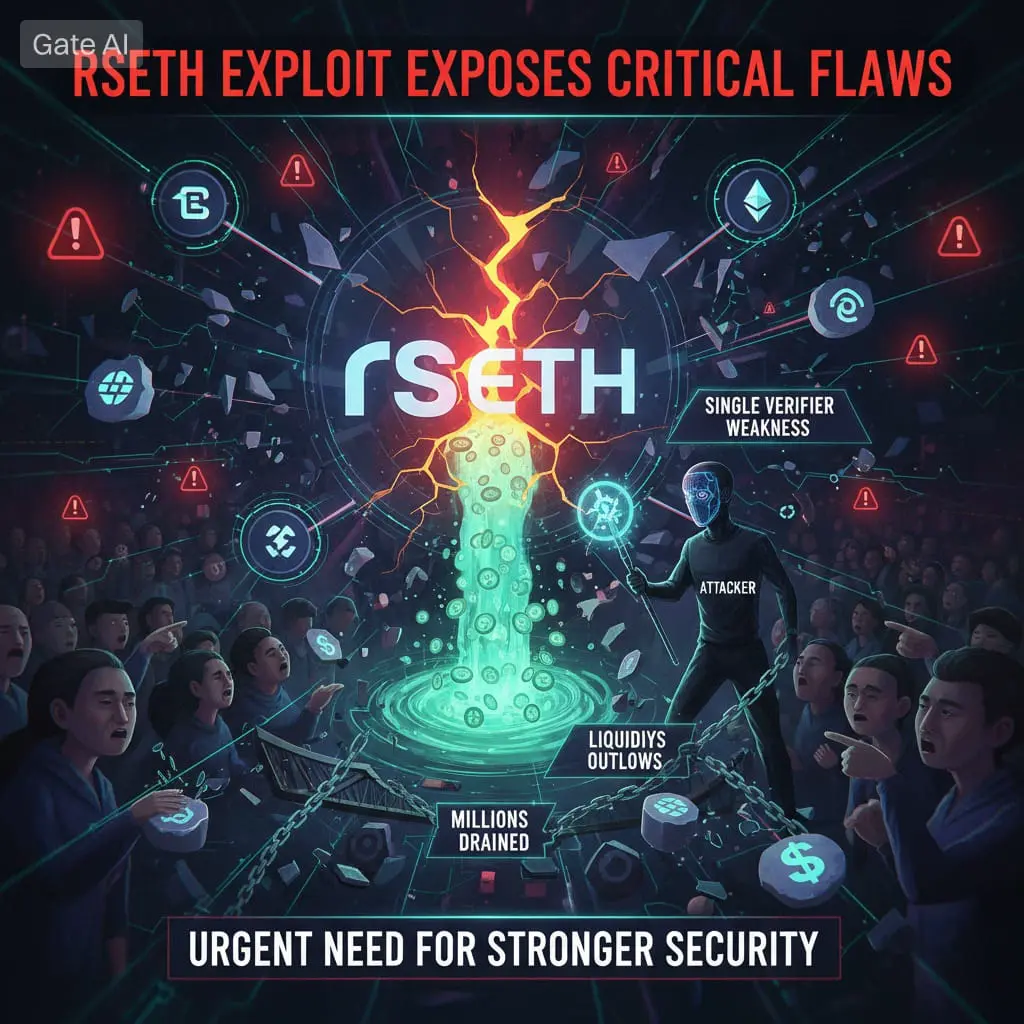
The crypto market was violently shaken on April 18, 2026, when KelpDAO’s rsETH ecosystem suffered a devastating exploit worth approximately $292 million. This was not just another DeFi hack—it became a systemic stress test for the entire decentralized finance ecosystem, exposing structural weaknesses in cross-chain infrastructure, collateral design, and protocol interdependence.
What followed was not only a token collapse—but a liquidity shock, confidence crisis, and a forced global reassessment of DeFi risk models.
🧠 Understanding rsETH and Its Role in DeFi
rsETH is a liquid restaking token issued by KelpDAO, allowing users to stake Ethereum while keeping liquidity active across DeFi platforms.
In simple terms:
Users stake ETH → receive rsETH
rsETH is used in lending, borrowing, and yield strategies
It acts as collateral across multiple DeFi ecosystems
This makes rsETH a systemically important asset in DeFi, meaning any instability affects not just one protocol—but many interconnected markets.
⚠️ How the $292M Exploit Happened
The attack exploited a critical flaw in KelpDAO’s cross-chain verification system, specifically within a LayerZero bridge adapter.
🔴 Core vulnerability:
KelpDAO used a single-verifier DVN (Decentralized Verifier Network) configuration.
Instead of requiring multiple independent confirmations, only one verifier approval was needed to validate cross-chain messages.
That single point of trust became the entry point for attackers.
🧨 Attack Execution Flow
The exploit unfolded in a highly structured sequence:
1. Fake Cross-Chain Messages
Attackers injected forged messages into the system, pretending legitimate deposits occurred across chains.
2. Minting Unbacked rsETH
The system incorrectly minted:
~116,500 rsETH tokens
Worth approximately $292 million
With no real ETH backing
3. DeFi Collateral Abuse
The attackers used rsETH as collateral on major lending protocols (including Aave) and borrowed real assets:
~52,834 WETH (Ethereum mainnet)
~29,782 WETH + 821 wstETH (Arbitrum)
4. Extraction of Real Liquidity
This created a massive imbalance between synthetic collateral and real assets, leading to systemic exposure.
📉 Immediate Market Reaction
The impact was instant:
rsETH sharply depegged from ETH
Ethereum experienced short-term pressure
DeFi tokens (especially lending protocols) dropped significantly
Trading volumes surged due to panic repositioning
Ethereum Price Context (Current Market)
At the time of market stabilization:
ETH Price: ~$2,320–$2,380 range
Market remained in a consolidation phase between $2,100–$2,400 zones
Despite the exploit, ETH remained structurally stable because the issue was not Ethereum itself—but a layered DeFi dependency failure.
💣 Systemic Impact: The DeFi Liquidity Shock
The most dangerous outcome was not the hack itself—but the liquidity chain reaction.
Key consequences:
Massive withdrawals from DeFi lending protocols
Sudden liquidity contraction across multiple chains
Collateral reassessment across lending platforms
Risk repricing across all synthetic assets
This resembled a “digital bank-run effect”, where fear spreads faster than technical fixes.
Aave and other lending platforms faced:
Rising bad debt exposure
Emergency asset freezes
Collateral re-evaluation processes
🛡️ Emergency Protocol Responses
🔹 KelpDAO Actions:
Paused rsETH minting and transfers
Suspended cross-chain operations
Began full reserve reconciliation
🔹 Aave Actions:
Froze rsETH collateral markets
Removed borrowing power from rsETH
Initiated risk containment procedures
🔹 Ecosystem Response:
Major DeFi players created emergency liquidity support pools to stabilize rsETH backing and reduce systemic damage.
📊 Ethereum Trading Strategy (Post-Exploit Market Structure)
Despite the chaos, ETH continues to trade within a structured macro range.
🟢 Current ETH Market Zone:
Range: $2,200 – $2,450
Bias: Neutral to slightly bearish consolidation
Volatility: Moderate, event-driven spikes
📈 ETH Trading Strategy (Simplified Institutional Approach)
1. Accumulation Zone Strategy
Range: $2,100 – $2,250
Considered long-term value accumulation zone
Suitable for gradual spot entry
Ideal for DCA (Dollar Cost Averaging)
2. Breakout Strategy
Trigger: Above $2,450
Confirms bullish expansion phase
Targets: $2,600 → $2,800
Momentum continuation likely if volume supports
3. Risk/Downside Strategy
If breakdown below $2,100:
Market enters deeper correction phase
Next support: $1,950–$2,000
Defensive positioning recommended
⚖️ Market Sentiment Shift After rsETH Attack
The event has permanently shifted market psychology:
Before:
High trust in cross-chain composability
Aggressive leverage usage
Strong confidence in synthetic collateral systems
After:
Increased skepticism toward bridged assets
Lower leverage appetite
Strong preference for native collateral (ETH, BTC)
Higher demand for protocol insurance models
🔍 Key Lessons for Crypto Investors
1. Composability is powerful—but fragile
One weak link can destabilize entire systems.
2. Cross-chain bridges remain high-risk infrastructure
Even advanced protocols can fail if verification is centralized.
3. Collateral ≠ safety
Synthetic assets require deeper risk analysis than native assets.
4. DeFi is now entering “risk maturity phase”
Security will matter more than speed or innovation.
📌 Final Outlook
The rsETH exploit is more than a hack—it is a defining moment for DeFi evolution.
While the immediate damage was severe, the long-term outcome may actually strengthen the ecosystem through:
Better bridge security standards
Improved collateral frameworks
Stronger risk management systems
More realistic leverage controls
Ethereum and DeFi markets have survived this shock—but the rules of the game are changing.
🚀 Closing Insight
In crypto, innovation always moves faster than regulation or security. The rsETH incident is a reminder that:
The future of DeFi will not be defined by how fast it grows—but by how well it survives its own complexity.
repost-content-media
  • Reward
  • Comment
  • Repost
  • Share
#CryptoMarketSeesVolatility
🚨 Crypto Market Enters High Volatility Phase Amid Iran Geopolitical Crisis, Institutional Liquidity Flow, and Structural Market Compression
The global cryptocurrency market is currently experiencing a sustained high-volatility environment, where price action is being influenced by a combination of geopolitical instability, macroeconomic risk repricing, derivatives positioning, and institutional accumulation patterns, creating a complex market structure in which short-term movements appear highly reactive while the underlying long-term trend remains dependent on li
HighAmbition
#CryptoMarketSeesVolatility
🚨 Crypto Market Enters High Volatility Phase Amid Iran Geopolitical Crisis, Institutional Liquidity Flow, and Structural Market Compression
The global cryptocurrency market is currently experiencing a sustained high-volatility environment, where price action is being influenced by a combination of geopolitical instability, macroeconomic risk repricing, derivatives positioning, and institutional accumulation patterns, creating a complex market structure in which short-term movements appear highly reactive while the underlying long-term trend remains dependent on liquidity absorption and macro resolution.
At present, Bitcoin is trading around $77,700, while Ethereum is trading near $2,300–$2,320, and both assets are showing completely different short-term behavior patterns despite sharing the same macro environment, which clearly indicates that market dynamics are being driven more by asset-specific liquidity conditions and positioning structures rather than uniform directional sentiment across the entire crypto sector.
📊 Current Market Structure and Price Behavior Analysis
Bitcoin continues to trade in a relatively tight but volatile range between $76,900 and $78,600, where price repeatedly tests both support and resistance levels without establishing a sustained breakout direction, suggesting that the market is currently in a liquidity compression phase, where both buyers and sellers are actively defending key levels while larger institutional participants gradually absorb supply in the background.
Ethereum, on the other hand, is showing slightly weaker short-term momentum as it fluctuates within the range of $2,285 to $2,358, reflecting mild downside pressure of approximately -1% in the last 24 hours, however this movement does not represent structural breakdown but rather short-term repositioning within a broader accumulation structure where staking activity and long-term holding behavior continue to provide underlying price stability.
The overall market condition can therefore be described as sideways consolidation with high intraday volatility spikes, where price remains range-bound but reacts sharply to external macro triggers, which is a typical characteristic of markets transitioning between uncertainty-driven contraction and liquidity-driven expansion phases.
🌍 Geopolitical Shock: Iran–US Tension as Primary Macro Catalyst
The dominant driver behind current market volatility remains the escalating geopolitical tension between the United States and Iran, particularly following the breakdown of nuclear negotiations and increasing instability in the Strait of Hormuz, which plays a critical role in global oil transportation and energy supply chains, and any disruption in this region has historically resulted in immediate risk repricing across global financial markets including equities, commodities, and digital assets.
This situation has created a global risk-off sentiment environment, where capital temporarily shifts away from high-volatility assets such as cryptocurrencies and moves toward safer instruments, while at the same time increasing volatility due to rapid repositioning of leveraged positions, derivatives exposure adjustments, and liquidity redistribution across exchanges.
As a result, crypto markets are not reacting in isolation but are instead behaving as part of a broader macro liquidity system where geopolitical uncertainty directly influences risk appetite and capital allocation behavior.
🧠 Market Sentiment: Fear Zone but Early Accumulation Behavior Emerging
The Fear and Greed Index currently sitting at 39 (Fear Zone) indicates that market sentiment is cautious and uncertain, however historically such levels have often coincided with early accumulation phases rather than deep capitulation events, especially when supported by strong institutional inflows and declining exchange reserves.
This creates a critical divergence between retail sentiment and institutional behavior, where retail participants are primarily reacting to uncertainty by reducing exposure, while institutional investors are gradually increasing exposure during volatility, thereby creating a silent transfer of assets from weaker hands to stronger hands.
🏦 Institutional Activity: Silent but Strong Accumulation Trend
Despite short-term price fluctuations, institutional accumulation continues to remain one of the strongest underlying forces in the current market structure, as large Bitcoin wallets have accumulated approximately 270,000 BTC over the past 30 days, while exchange reserves continue to decline to multi-year lows, indicating that available liquid supply is steadily decreasing.
Additionally, spot Bitcoin ETFs have maintained consistent inflows, reflecting sustained institutional interest, and suggesting that large capital allocators are treating current volatility as an accumulation opportunity rather than a distribution phase.
This behavior strongly indicates that while price remains range-bound, structural demand is quietly increasing beneath the surface, which is a historically significant precursor to long-term bullish expansion phases.
🔵 Ethereum Market Dynamics: Mixed Short-Term Pressure but Strong Structural Foundation
Ethereum is currently displaying a mixed market structure where short-term price weakness coexists with strong underlying fundamental strength, as evidenced by increasing staking participation levels reaching approximately 32% of total supply, continued growth in network activity exceeding 200 million transactions in Q1 2026, and sustained institutional accumulation trends that suggest long-term confidence in Ethereum’s ecosystem remains intact.
However, in the short term, Ethereum is facing resistance in the $2,350–$2,400 range, while maintaining key support around $2,200–$2,250, which creates a defined trading structure where price is likely to remain range-bound until a broader macro or liquidity-driven catalyst triggers a breakout in either direction.
⚡ Why Volatility Remains Elevated Across Crypto Markets
The current high-volatility environment is not the result of a single factor but rather a combination of multiple overlapping structural forces, including geopolitical uncertainty increasing global risk premiums, derivatives market imbalances creating leveraged position unwinding, funding rate fluctuations indicating mixed long and short positioning, and technical compression across Bitcoin and Ethereum that builds energy for eventual breakout movements.
Additionally, the presence of both negative and neutral funding rates suggests that short positioning remains structurally active, which increases the probability of short squeeze scenarios if upward momentum begins to build unexpectedly, thereby amplifying volatility in both directions.
📉 Market Psychology: A Silent Battle Between Fear and Accumulation
The current market psychology reflects a clear divergence between retail and institutional behavior, where retail traders remain cautious due to geopolitical uncertainty and short-term price instability, while institutional participants continue to accumulate strategically during volatility phases, creating a silent but powerful redistribution cycle within the market structure.
This environment is typically characterized by low conviction breakouts, frequent fake moves, and sharp liquidity-driven reversals, all of which serve to eliminate weak leveraged positions before a more sustainable trend direction emerges.
📊 Trading Structure and Liquidity-Based Market View
From a structural perspective, the market can currently be divided into three phases: the first phase being fear-driven volatility expansion where uncertainty dominates price action, the second phase being the current accumulation zone where price remains range-bound while liquidity is absorbed, and the third phase being the eventual expansion phase where breakout momentum develops once liquidity imbalance reaches a critical threshold.
Bitcoin’s current trading behavior between $76,900 and $78,600, combined with Ethereum’s range between $2,285 and $2,358, strongly supports the interpretation that the market is in a controlled compression phase rather than a directional breakdown or full bullish breakout phase.
🔮 Forward-Looking Market Outlook
Looking ahead, the direction of the cryptocurrency market will remain heavily dependent on geopolitical developments related to Iran–US negotiations, global energy stability, and broader macroeconomic liquidity conditions, while simultaneously being supported by structural tailwinds such as continued Bitcoin ETF inflows, declining exchange reserves, and post-halving supply dynamics that historically contribute to long-term bullish cycles.
If geopolitical tensions begin to stabilize, the market is likely to transition into a strong liquidity-driven expansion phase where Bitcoin could break above $80,000, Ethereum could move toward $2,600+, and altcoins could follow with delayed but amplified momentum, whereas continued escalation may result in prolonged sideways volatility with periodic downside liquidity tests before structural recovery resumes.
🚀 Final Conclusion
The current cryptocurrency market should not be interpreted as a simple bullish or bearish environment, but rather as a liquidity-driven equilibrium phase under macro uncertainty, where price is temporarily compressed while institutional capital continues to accumulate beneath the surface, and where volatility is not a sign of weakness but rather a reflection of active capital redistribution within a structurally evolving financial system.
Ultimately, the key takeaway is that in crypto markets, fear does not destroy value but instead redistributes it, and the current phase represents a critical accumulation window where smart capital positions itself before the next major directional expansion begins.
💡 Key Insight
In modern crypto markets, price is only the visible layer, while liquidity flow, institutional positioning, and macro uncertainty determine the real direction, and the current environment clearly shows that while volatility is high, structural accumulation is even stronger beneath the surface.
repost-content-media
  • Reward
  • 2
  • Repost
  • Share
Pheonixprincess:
LFG 🔥
View More
#BitcoinBouncesBack
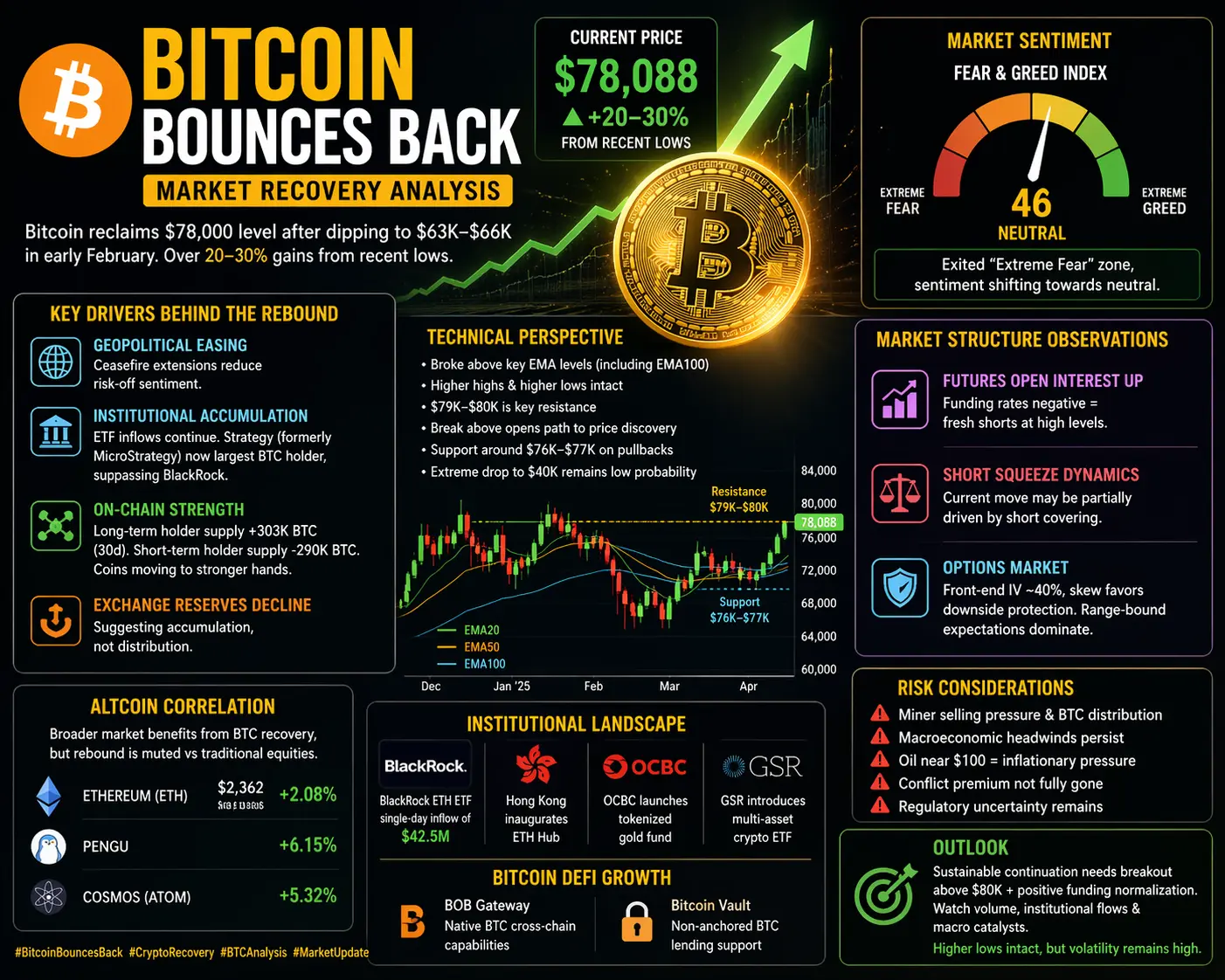
Bitcoin Bounces Back: A Comprehensive Analysis of the Recent Recovery
Bitcoin has staged an impressive comeback, climbing from lows around $75,000 to breach the $78,000 level with momentum that suggests the worst of the recent correction may be behind us. The cryptocurrency is currently trading around $78,408, marking a 2.72% gain in the last 24 hours with a daily high of $79,469.8 and a low of $76,125.6. This recovery represents a meaningful bounce of approximately 4-5% from the recent bottom, bringing renewed optimism to the market after weeks of consolidation and uncert
BTC-0,55%
HighAmbition
#BitcoinBouncesBack
Bitcoin Bounces Back: A Comprehensive Analysis of the Recent Recovery
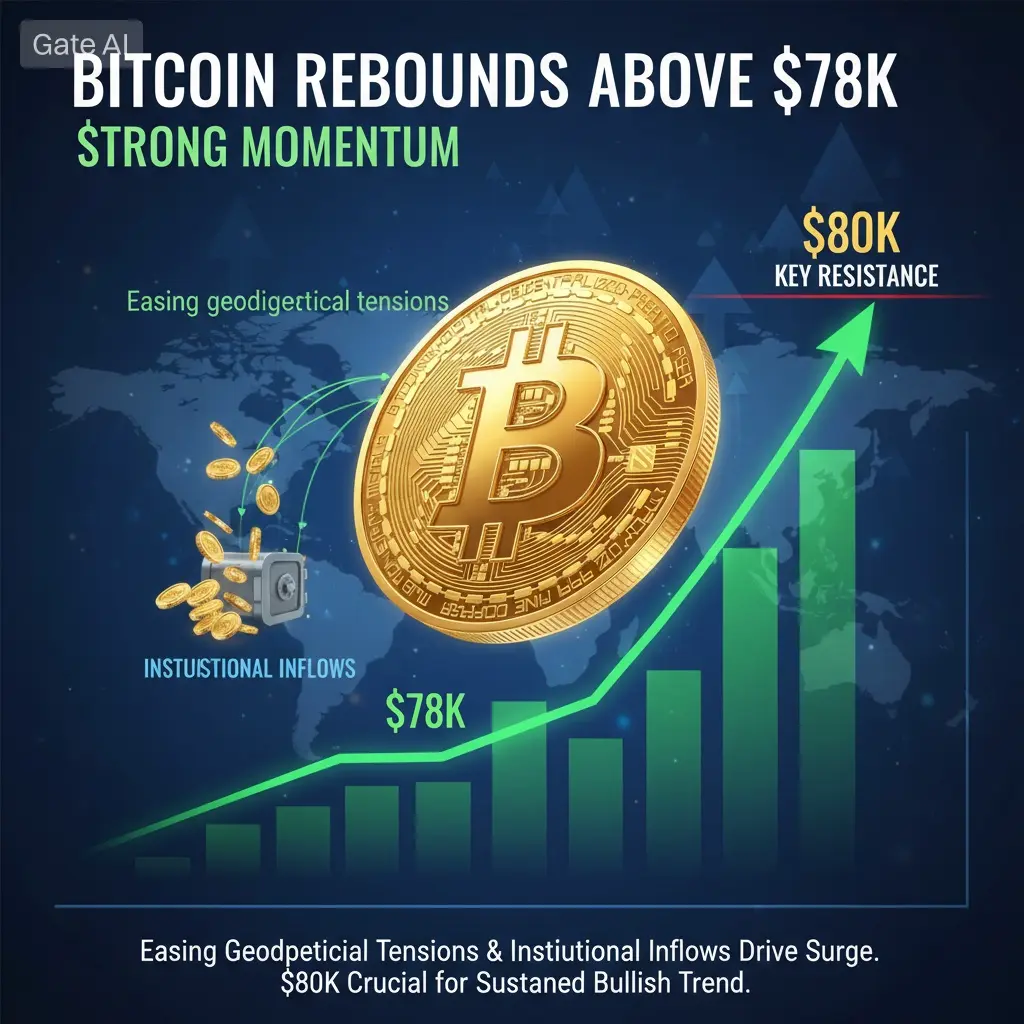
Bitcoin has staged an impressive comeback, climbing from lows around $75,000 to breach the $78,000 level with momentum that suggests the worst of the recent correction may be behind us. The cryptocurrency is currently trading around $78,408, marking a 2.72% gain in the last 24 hours with a daily high of $79,469.8 and a low of $76,125.6. This recovery represents a meaningful bounce of approximately 4-5% from the recent bottom, bringing renewed optimism to the market after weeks of consolidation and uncertainty.
Key Drivers Behind Bitcoin's Resurgence
The primary catalyst for Bitcoin's bounce back stems from the easing of geopolitical tensions, particularly the extension of the Iran ceasefire agreement. President Trump's unilateral decision to extend the ceasefire with Iran has temporarily reduced the risk of immediate military escalation, allowing risk assets including cryptocurrencies to breathe easier. The market had been pricing in significant tail risk from potential conflict in the Middle East, and the ceasefire extension has provided a window for relief.
Additionally, Federal Reserve Governor Kevin Warsh's testimony reinforced the central bank's data-dependent approach to monetary policy, which has helped stabilize market expectations around interest rates. While this did not signal a dovish pivot, it provided clarity that the Fed remains committed to its dual mandate without rushing into premature rate cuts.
Institutional inflows have also played a crucial role in supporting the recovery. Spot Bitcoin ETFs have seen approximately $1 billion in inflows, with Strategy (formerly MicroStrategy) continuing to accumulate Bitcoin aggressively. The company now holds 815,061 BTC with an average cost basis of $75,527, and has officially turned profitable on its holdings with unrealized gains exceeding $1.9 billion as Bitcoin crossed above $78,000. This institutional validation continues to provide structural support for the asset.
Technical Analysis and Price Targets
From a technical perspective, Bitcoin has broken out of its recent ascending channel, which is typically viewed as a bullish signal that could accelerate price movement toward the 365-day moving average at $87,050. The monthly Bollinger Bands have tightened to historically narrow levels, a pattern that previously preceded major bull runs in 2016 and 2020. The monthly Relative Strength Index has also fallen to levels not seen since the 2022 bear market lows and has touched long-term support trendlines, historically corresponding to cycle bottoms.
However, significant resistance remains ahead. The $78,000 to $80,000 zone contains substantial selling pressure according to order book data. A successful breakout above $80,000 could open the path toward $84,000 to $86,000, with some analysts eyeing $90,000 to $100,000 as a possibility if momentum continues. Conversely, failure to break through the $80,000 resistance could see Bitcoin retreat to test support levels around $74,000 to $75,000.
Iran Ceasefire Situation and Market Implications
Regarding the Iran ceasefire, the situation remains fluid despite the temporary extension. The ceasefire has been escalated and extended, but no permanent solution has emerged. The Strait of Hormuz remains a point of concern, with oil prices hovering around $100 per barrel, which continues to exert inflationary pressure and limits the Federal Reserve's room for monetary easing.
The market reaction to the ceasefire extension has been positive but cautious. QCP Capital notes that Bitcoin's rebound is driven more by a reduction in tail risk rather than fundamental improvement. Open interest has rebuilt while funding rates remain negative, indicating new short positions entering the market rather than long capitulation. This suggests that while the squeeze dynamics are in play, market conviction remains shallow.
Social Sentiment and Market Psychology
The Fear and Greed Index currently sits at 46, indicating a neutral sentiment that has recovered from previous extreme fear levels. Social media sentiment analysis shows 145 bullish authors versus 32 bearish authors, with 274 bullish tweets compared to 47 bearish ones, reflecting a clear shift toward optimism.
Whale activity has been particularly noteworthy, with addresses holding over 1,000 BTC adding 270,000 BTC in the last 30 days, representing the largest accumulation since 2013. Exchange reserves have fallen to seven-year lows, indicating strong holder conviction and reduced selling pressure.
Future Outlook
Bitcoin's bounce back above $78,000 is a positive sign, but the sustainability of this rally depends on several factors. First, the geopolitical situation must remain stable, with no escalation in the Iran conflict or other global hotspots. Second, institutional inflows need to continue supporting price action. Third, technical resistance at $80,000 must be overcome to confirm a broader uptrend.
The path forward remains anchored to oil prices and Federal Reserve policy direction. A pullback in oil prices or clearer signals from the Fed regarding rate cuts would support risk assets. Without these catalysts, the market may remain in a wait-and-see mode, pricing for uncertainty rather than seeking definitive resolutions.
For now, Bitcoin's ability to hold above $75,000 and challenge the $80,000 resistance represents a constructive development. Traders should watch for volume confirmation on any breakout above $80,000, as this would likely trigger a cascade of buying activity and potentially accelerate the move toward higher targets. The coming weeks will be critical in determining whether this bounce back evolves into a sustained uptrend or proves to be another temporary relief rally within a broader consolidation phase.
repost-content-media
  • Reward
  • Comment
  • Repost
  • Share
#ArbitrumFreezesKelpDAOHackerETH
Arbitrum Security Council Freezes $71M in ETH Linked to Kelp DAO Exploit
Arbitrum's Security Council executed an emergency freeze of 30,766 ETH worth approximately $71 million on April 20, 2026, moving funds linked to the Kelp DAO exploit into an intermediary wallet that can only be accessed through further Arbitrum governance action. The council acted on law enforcement's input regarding the exploiter's identity and executed the freeze within approximately 20 minutes via a system-level ArbOS transaction executed by nine of the 12 council members.
The Kelp DAO
ETH-1,48%
AAVE1,75%
BTC-0,55%
ZRO2,25%
BlackRiderCryptoLord
#ArbitrumFreezesKelpDAOHackerETH
Arbitrum Security Council Freezes $71M in ETH Linked to Kelp DAO Exploit
Arbitrum's Security Council executed an emergency freeze of 30,766 ETH worth approximately $71 million on April 20, 2026, moving funds linked to the Kelp DAO exploit into an intermediary wallet that can only be accessed through further Arbitrum governance action. The council acted on law enforcement's input regarding the exploiter's identity and executed the freeze within approximately 20 minutes via a system-level ArbOS transaction executed by nine of the 12 council members.
The Kelp DAO Exploit Context
The original exploit struck Kelp DAO's LayerZero-powered bridge on April 18, where attackers minted approximately $292 million worth of unbacked rsETH and drained over $200 million in real WETH from Aave before markets could freeze, leaving the lending protocol with hundreds of millions in bad debt. The freeze recovered roughly a quarter of the stolen funds before they could be fully bridged to Ethereum mainnet. However, the exploiter quickly moved the remaining approximately $175 million (75,701 ETH) in three transactions to fresh wallets on mainnet, with signs of laundering through THORChain and Umbra toward BTC.
Attribution and Investigation
Preliminary indicators point to North Korean hackers as the culprit, specifically the TraderTraitor hacking group known for targeting crypto assets. North Korean hackers working for Kim Jong Un's regime have become highly successful at stealing crypto, with over $2 billion stolen in 2025 alone and approximately $6 billion total since 2017.
Kelp DAO's Response
Kelp DAO acted quickly by pausing contracts and blacklisting wallets tied to the attacker, preventing an additional 40,000 rsETH worth about $95 million from being drained. LayerZero criticized Kelp DAO's use of a 1-of-1 decentralized verified network configuration, arguing that it created a single point of failure without independent verification. Kelp DAO, however, pointed out that the single-DVN setup is the configuration documented by LayerZero.
Aave's Position
The rsETH markets on Aave V3 and V4 have been frozen, with the asset stripped of borrowing power as a measure following the exploit. Aave is now dealing with $124M to $230M in bad debt from the incident. The Aave community is expected to discuss whether rsETH should be permanently delisted from all Aave markets once the situation stabilizes.
Decentralization vs Security Debate
The incident has sparked debates on decentralization versus security in Layer 2 networks. Arbitrum is a permissionless layer-2 network settled on Ethereum, and the Security Council's ability to freeze funds controlled by an outside address raises questions about how far emergency powers should extend, even when applied to state-sponsored thieves. The frozen funds can only be released through an Arbitrum governance vote, such as if the owner proves innocence, and the action had no impact on other users or applications on the network.
#Arbitrum #KelpDAO #DeFiSecurity
repost-content-media
  • Reward
  • Comment
  • Repost
  • Share
#ArbitrumFreezesKelpDAOHackerETH
Arbitrum Security Council Freezes $71M in ETH Linked to Kelp DAO Exploit
Arbitrum's Security Council executed an emergency freeze of 30,766 ETH worth approximately $71 million on April 20, 2026, moving funds linked to the Kelp DAO exploit into an intermediary wallet that can only be accessed through further Arbitrum governance action. The council acted on law enforcement's input regarding the exploiter's identity and executed the freeze within approximately 20 minutes via a system-level ArbOS transaction executed by nine of the 12 council members.
The Kelp DAO
ETH-1,48%
AAVE1,75%
BTC-0,55%
ZRO2,25%
BlackRiderCryptoLord
#ArbitrumFreezesKelpDAOHackerETH
Arbitrum Security Council Freezes $71M in ETH Linked to Kelp DAO Exploit
Arbitrum's Security Council executed an emergency freeze of 30,766 ETH worth approximately $71 million on April 20, 2026, moving funds linked to the Kelp DAO exploit into an intermediary wallet that can only be accessed through further Arbitrum governance action. The council acted on law enforcement's input regarding the exploiter's identity and executed the freeze within approximately 20 minutes via a system-level ArbOS transaction executed by nine of the 12 council members.
The Kelp DAO Exploit Context
The original exploit struck Kelp DAO's LayerZero-powered bridge on April 18, where attackers minted approximately $292 million worth of unbacked rsETH and drained over $200 million in real WETH from Aave before markets could freeze, leaving the lending protocol with hundreds of millions in bad debt. The freeze recovered roughly a quarter of the stolen funds before they could be fully bridged to Ethereum mainnet. However, the exploiter quickly moved the remaining approximately $175 million (75,701 ETH) in three transactions to fresh wallets on mainnet, with signs of laundering through THORChain and Umbra toward BTC.
Attribution and Investigation
Preliminary indicators point to North Korean hackers as the culprit, specifically the TraderTraitor hacking group known for targeting crypto assets. North Korean hackers working for Kim Jong Un's regime have become highly successful at stealing crypto, with over $2 billion stolen in 2025 alone and approximately $6 billion total since 2017.
Kelp DAO's Response
Kelp DAO acted quickly by pausing contracts and blacklisting wallets tied to the attacker, preventing an additional 40,000 rsETH worth about $95 million from being drained. LayerZero criticized Kelp DAO's use of a 1-of-1 decentralized verified network configuration, arguing that it created a single point of failure without independent verification. Kelp DAO, however, pointed out that the single-DVN setup is the configuration documented by LayerZero.
Aave's Position
The rsETH markets on Aave V3 and V4 have been frozen, with the asset stripped of borrowing power as a measure following the exploit. Aave is now dealing with $124M to $230M in bad debt from the incident. The Aave community is expected to discuss whether rsETH should be permanently delisted from all Aave markets once the situation stabilizes.
Decentralization vs Security Debate
The incident has sparked debates on decentralization versus security in Layer 2 networks. Arbitrum is a permissionless layer-2 network settled on Ethereum, and the Security Council's ability to freeze funds controlled by an outside address raises questions about how far emergency powers should extend, even when applied to state-sponsored thieves. The frozen funds can only be released through an Arbitrum governance vote, such as if the owner proves innocence, and the action had no impact on other users or applications on the network.
#Arbitrum #KelpDAO #DeFiSecurity
repost-content-media
  • Reward
  • Comment
  • Repost
  • Share
#ArbitrumFreezesKelpDAOHackerETH
Arbitrum Security Council Freezes $71M in ETH Linked to Kelp DAO Exploit
Arbitrum's Security Council executed an emergency freeze of 30,766 ETH worth approximately $71 million on April 20, 2026, moving funds linked to the Kelp DAO exploit into an intermediary wallet that can only be accessed through further Arbitrum governance action. The council acted on law enforcement's input regarding the exploiter's identity and executed the freeze within approximately 20 minutes via a system-level ArbOS transaction executed by nine of the 12 council members.
The Kelp DAO
ETH-1,48%
ARB0,7%
AAVE1,75%
ZRO2,25%
BlackRiderCryptoLord
#ArbitrumFreezesKelpDAOHackerETH
Arbitrum Security Council Freezes $71M in ETH Linked to Kelp DAO Exploit
Arbitrum's Security Council executed an emergency freeze of 30,766 ETH worth approximately $71 million on April 20, 2026, moving funds linked to the Kelp DAO exploit into an intermediary wallet that can only be accessed through further Arbitrum governance action. The council acted on law enforcement's input regarding the exploiter's identity and executed the freeze within approximately 20 minutes via a system-level ArbOS transaction executed by nine of the 12 council members.
The Kelp DAO Exploit Context
The original exploit struck Kelp DAO's LayerZero-powered bridge on April 18, where attackers minted approximately $292 million worth of unbacked rsETH and drained over $200 million in real WETH from Aave before markets could freeze, leaving the lending protocol with hundreds of millions in bad debt. The freeze recovered roughly a quarter of the stolen funds before they could be fully bridged to Ethereum mainnet. However, the exploiter quickly moved the remaining approximately $175 million (75,701 ETH) in three transactions to fresh wallets on mainnet, with signs of laundering through THORChain and Umbra toward BTC.
Attribution and Investigation
Preliminary indicators point to North Korean hackers as the culprit, specifically the TraderTraitor hacking group known for targeting crypto assets. North Korean hackers working for Kim Jong Un's regime have become highly successful at stealing crypto, with over $2 billion stolen in 2025 alone and approximately $6 billion total since 2017.
Kelp DAO's Response
Kelp DAO acted quickly by pausing contracts and blacklisting wallets tied to the attacker, preventing an additional 40,000 rsETH worth about $95 million from being drained. LayerZero criticized Kelp DAO's use of a 1-of-1 decentralized verified network configuration, arguing that it created a single point of failure without independent verification. Kelp DAO, however, pointed out that the single-DVN setup is the configuration documented by LayerZero.
Aave's Position
The rsETH markets on Aave V3 and V4 have been frozen, with the asset stripped of borrowing power as a measure following the exploit. Aave is now dealing with $124M to $230M in bad debt from the incident. The Aave community is expected to discuss whether rsETH should be permanently delisted from all Aave markets once the situation stabilizes.
Decentralization vs Security Debate
The incident has sparked debates on decentralization versus security in Layer 2 networks. Arbitrum is a permissionless layer-2 network settled on Ethereum, and the Security Council's ability to freeze funds controlled by an outside address raises questions about how far emergency powers should extend, even when applied to state-sponsored thieves. The frozen funds can only be released through an Arbitrum governance vote, such as if the owner proves innocence, and the action had no impact on other users or applications on the network.
#Arbitrum #KelpDAO #DeFiSecurity
repost-content-media
  • Reward
  • Comment
  • Repost
  • Share
#TopCopyTradingScout
Gate Copy Trading: The Smart Path to Profitable Trading
Copy trading has revolutionized how retail investors participate in financial markets. Instead of spending years mastering technical analysis and risk management, you can now replicate the strategies of proven traders automatically. Gate.io's copy trading platform stands at the forefront of this innovation, offering both crypto and traditional finance (TradFi) opportunities.
Understanding Copy Trading Mechanics
When you engage in copy trading, your account mirrors the positions of experienced traders in real-time. Ev
BlackRiderCryptoLord
#TopCopyTradingScout
Gate Copy Trading: The Smart Path to Profitable Trading
Copy trading has revolutionized how retail investors participate in financial markets. Instead of spending years mastering technical analysis and risk management, you can now replicate the strategies of proven traders automatically. Gate.io's copy trading platform stands at the forefront of this innovation, offering both crypto and traditional finance (TradFi) opportunities.
Understanding Copy Trading Mechanics
When you engage in copy trading, your account mirrors the positions of experienced traders in real-time. Every buy, sell, or adjustment they make is automatically executed in your portfolio proportionally. This means you benefit from their expertise without constant market monitoring. Gate's platform allows you to follow up to five different lead traders simultaneously, diversifying your exposure across multiple strategies and trading styles.
Gate TradFi: Expanding Beyond Crypto
Gate recently launched TradFi copy trading, bringing traditional assets into the copy trading ecosystem. This feature enables you to copy trades involving gold, silver, crude oil, forex pairs, and US stocks. The integration bridges the gap between cryptocurrency and traditional markets, providing a unified platform for diversified portfolio management. With over $4.5 billion in 24-hour trading volume across TradFi assets, liquidity and execution quality remain robust.
Selecting the Right Lead Trader
Success in copy trading depends heavily on choosing the right traders to follow. Gate provides comprehensive performance metrics for each lead trader, including:
Return on Investment (ROI): Historical performance over various timeframes
Sharpe Ratio: Risk-adjusted returns measuring consistency
Maximum Drawdown: Largest peak-to-trough decline, indicating risk tolerance
Win Rate: Percentage of profitable trades
Trading Frequency: How often positions are opened and closed
Asset Specialization: Whether they focus on specific markets or trade broadly
Analyze these metrics carefully. A trader with high returns but excessive drawdowns may not suit conservative investors. Conversely, steady performers with moderate gains might align better with long-term wealth building.
Risk Management Essentials
While copy trading simplifies execution, risk management remains your responsibility. Gate allows you to set stop-loss parameters for each copied position, protecting your capital if markets move against you. Additionally, you can allocate specific amounts to each trader, ensuring no single strategy dominates your portfolio.
The platform enforces minimum copy amounts of 100 USDT and maximums of 1,000,000 USD per trader, accommodating both small investors and high-net-worth individuals. These limits help maintain proportional position sizing and prevent overconcentration.
Becoming a Lead Trader
If you possess strong trading skills, Gate offers opportunities to monetize your expertise. Lead traders earn profit-sharing commissions from their followers, with rates adjustable between 0% and 20%. The application process requires a verified Gate account with at least 100 USDT in your contract account. Once approved, you can attract up to 300 copiers initially, with options to expand this limit.
Lead traders must maintain consistent performance to retain followers. The platform's transparent ranking system ensures only quality traders rise to prominence, creating a meritocratic environment where skill determines success.
Current Promotions and Opportunities
Gate frequently runs promotional campaigns to incentivize copy trading participation. Recent offerings include signup bonuses for new lead traders, loss subsidies for first-time copiers, and prize pools based on trading volume. These promotions reduce entry barriers and provide additional upside for early adopters.
Technical Requirements and Accessibility
To access Gate's copy trading features, ensure your mobile application is updated to version 8.14.0 or later. The interface provides intuitive navigation between crypto and TradFi sections, real-time performance tracking, and seamless fund transfers between your spot account and copy trading accounts.
Strategic Considerations for Copiers
Before committing capital, observe potential lead traders for several weeks. Review their historical trades, understand their strategy descriptions, and assess how they handle volatile market conditions. Diversify across traders with different approaches—some may excel in trending markets while others perform better during consolidation.
Monitor your copied positions regularly. While automation handles execution, staying informed about market developments helps you understand performance drivers and make informed decisions about continuing or terminating copy relationships.
The Future of Social Trading
Copy trading represents the democratization of financial expertise. As platforms like Gate continue innovating, the barriers between professional and retail trading diminish. The integration of AI-driven trader recommendations, enhanced risk analytics, and expanded asset classes promises to make copy trading even more sophisticated and accessible.
Whether you seek passive income streams, learning opportunities, or portfolio diversification, Gate's copy trading ecosystem provides the infrastructure to pursue your financial goals. Start small, learn continuously, and let proven expertise guide your investment journey.
#CopyTrading #GateTradFi #TopCopyTradingScout
repost-content-media
  • Reward
  • Comment
  • Repost
  • Share
#TopCopyTradingScout
Gate Copy Trading: The Smart Path to Profitable Trading
Copy trading has revolutionized how retail investors participate in financial markets. Instead of spending years mastering technical analysis and risk management, you can now replicate the strategies of proven traders automatically. Gate.io's copy trading platform stands at the forefront of this innovation, offering both crypto and traditional finance (TradFi) opportunities.
Understanding Copy Trading Mechanics
When you engage in copy trading, your account mirrors the positions of experienced traders in real-time. Ev
BlackRiderCryptoLord
#TopCopyTradingScout
Gate Copy Trading: The Smart Path to Profitable Trading
Copy trading has revolutionized how retail investors participate in financial markets. Instead of spending years mastering technical analysis and risk management, you can now replicate the strategies of proven traders automatically. Gate.io's copy trading platform stands at the forefront of this innovation, offering both crypto and traditional finance (TradFi) opportunities.
Understanding Copy Trading Mechanics
When you engage in copy trading, your account mirrors the positions of experienced traders in real-time. Every buy, sell, or adjustment they make is automatically executed in your portfolio proportionally. This means you benefit from their expertise without constant market monitoring. Gate's platform allows you to follow up to five different lead traders simultaneously, diversifying your exposure across multiple strategies and trading styles.
Gate TradFi: Expanding Beyond Crypto
Gate recently launched TradFi copy trading, bringing traditional assets into the copy trading ecosystem. This feature enables you to copy trades involving gold, silver, crude oil, forex pairs, and US stocks. The integration bridges the gap between cryptocurrency and traditional markets, providing a unified platform for diversified portfolio management. With over $4.5 billion in 24-hour trading volume across TradFi assets, liquidity and execution quality remain robust.
Selecting the Right Lead Trader
Success in copy trading depends heavily on choosing the right traders to follow. Gate provides comprehensive performance metrics for each lead trader, including:
Return on Investment (ROI): Historical performance over various timeframes
Sharpe Ratio: Risk-adjusted returns measuring consistency
Maximum Drawdown: Largest peak-to-trough decline, indicating risk tolerance
Win Rate: Percentage of profitable trades
Trading Frequency: How often positions are opened and closed
Asset Specialization: Whether they focus on specific markets or trade broadly
Analyze these metrics carefully. A trader with high returns but excessive drawdowns may not suit conservative investors. Conversely, steady performers with moderate gains might align better with long-term wealth building.
Risk Management Essentials
While copy trading simplifies execution, risk management remains your responsibility. Gate allows you to set stop-loss parameters for each copied position, protecting your capital if markets move against you. Additionally, you can allocate specific amounts to each trader, ensuring no single strategy dominates your portfolio.
The platform enforces minimum copy amounts of 100 USDT and maximums of 1,000,000 USD per trader, accommodating both small investors and high-net-worth individuals. These limits help maintain proportional position sizing and prevent overconcentration.
Becoming a Lead Trader
If you possess strong trading skills, Gate offers opportunities to monetize your expertise. Lead traders earn profit-sharing commissions from their followers, with rates adjustable between 0% and 20%. The application process requires a verified Gate account with at least 100 USDT in your contract account. Once approved, you can attract up to 300 copiers initially, with options to expand this limit.
Lead traders must maintain consistent performance to retain followers. The platform's transparent ranking system ensures only quality traders rise to prominence, creating a meritocratic environment where skill determines success.
Current Promotions and Opportunities
Gate frequently runs promotional campaigns to incentivize copy trading participation. Recent offerings include signup bonuses for new lead traders, loss subsidies for first-time copiers, and prize pools based on trading volume. These promotions reduce entry barriers and provide additional upside for early adopters.
Technical Requirements and Accessibility
To access Gate's copy trading features, ensure your mobile application is updated to version 8.14.0 or later. The interface provides intuitive navigation between crypto and TradFi sections, real-time performance tracking, and seamless fund transfers between your spot account and copy trading accounts.
Strategic Considerations for Copiers
Before committing capital, observe potential lead traders for several weeks. Review their historical trades, understand their strategy descriptions, and assess how they handle volatile market conditions. Diversify across traders with different approaches—some may excel in trending markets while others perform better during consolidation.
Monitor your copied positions regularly. While automation handles execution, staying informed about market developments helps you understand performance drivers and make informed decisions about continuing or terminating copy relationships.
The Future of Social Trading
Copy trading represents the democratization of financial expertise. As platforms like Gate continue innovating, the barriers between professional and retail trading diminish. The integration of AI-driven trader recommendations, enhanced risk analytics, and expanded asset classes promises to make copy trading even more sophisticated and accessible.
Whether you seek passive income streams, learning opportunities, or portfolio diversification, Gate's copy trading ecosystem provides the infrastructure to pursue your financial goals. Start small, learn continuously, and let proven expertise guide your investment journey.
#CopyTrading #GateTradFi #TopCopyTradingScout
repost-content-media
  • Reward
  • Comment
  • Repost
  • Share
WCTC S8 Trading Competition - Join My Team!
The WCTC S8 trading competition is here with a massive 8 million USDT prize pool! Only 1 day left - time is running out!
Prize Pool Breakdown:
Team Competition: 3,600,000 USDT
Solo Competition: 3,600,000 USDT
Champions Showdown: Extra rewards
Team Benefits:
Team leaders can earn up to 108,000 USDT
First 30 teams with 50+ members get instant 3,000 USDT bonus
New users get 20 USDT experience voucher
My Team Link: [Share your team link here]
How to Join:
1. Click the link above to join my team
2. Complete KYC verification
3. Start trading with minimum 2
BlackRiderCryptoLord
WCTC S8 Trading Competition - Join My Team!
The WCTC S8 trading competition is here with a massive 8 million USDT prize pool! Only 1 day left - time is running out!
Prize Pool Breakdown:
Team Competition: 3,600,000 USDT
Solo Competition: 3,600,000 USDT
Champions Showdown: Extra rewards
Team Benefits:
Team leaders can earn up to 108,000 USDT
First 30 teams with 50+ members get instant 3,000 USDT bonus
New users get 20 USDT experience voucher
My Team Link: [Share your team link here]
How to Join:
1. Click the link above to join my team
2. Complete KYC verification
3. Start trading with minimum 20,000 USDT volume to qualify
Extra Square Rewards:
Lucky Star: 100 random team sharers get 50 USDT each
Real Deal: 10 quality experience shares get 200 USDT each
Competition Entry: https://www.gate.com/competition/wctc-s8
Let's conquer the leaderboard together!
repost-content-media
  • Reward
  • Comment
  • Repost
  • Share
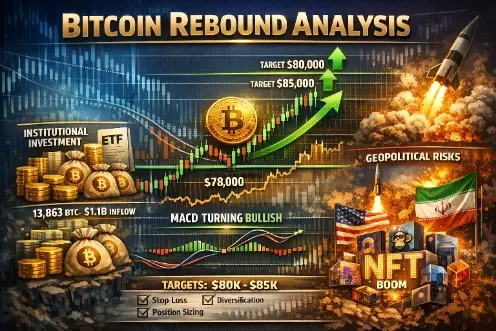
#BitcoinRebound #CryptoAnalysis
Bitcoin Rebound Analysis: Technical Setup and Strategic Positioning Amid Geopolitical Uncertainty
The cryptocurrency market has witnessed a significant technical breakout as Bitcoin successfully reclaimed the $76,000-$78,000 range, marking a decisive shift from the prolonged consolidation phase that has characterized recent price action. This movement carries substantial implications for traders positioning ahead of critical geopolitical developments.
Technical Analysis of the Current Rebound
Bitcoin's breach above $76,000 represents more than a simple price mi
BTC-0,55%
ETH-1,48%
SOL-0,54%
BlackRiderCryptoLord
#BitcoinRebound #CryptoAnalysis
Bitcoin Rebound Analysis: Technical Setup and Strategic Positioning Amid Geopolitical Uncertainty
The cryptocurrency market has witnessed a significant technical breakout as Bitcoin successfully reclaimed the $76,000-$78,000 range, marking a decisive shift from the prolonged consolidation phase that has characterized recent price action. This movement carries substantial implications for traders positioning ahead of critical geopolitical developments.
Technical Analysis of the Current Rebound
Bitcoin's breach above $76,000 represents more than a simple price milestone; it signals a potential trend reversal following months of bearish sentiment. The weekly MACD indicator, which had maintained bearish divergence for approximately eight months, has now returned to the zero line, suggesting the bear market phase may be concluding. This technical development is further validated by the 7-day net inflow data showing institutional accumulation of over 13,863 BTC (+$1.1B) across Bitcoin ETFs, indicating sustained institutional confidence despite retail hesitation.
The current price structure exhibits characteristics of a classic accumulation phase. Volume analysis reveals that the breakout was accompanied by genuine buying pressure rather than low-liquidity manipulation. The $78,000 level now serves as immediate support, with resistance targets extending toward $80,000 and potentially $85,000 if momentum sustains. However, traders should remain cognizant that previous attempts at similar breakouts this year have resulted in 10-15% corrections, creating a pattern of liquidity traps that sophisticated market participants have exploited.
NFT Sector Leading the Rally
A notable development accompanying Bitcoin's ascent is the outperformance of the NFT sector, which has historically served as a risk-sentiment barometer within the crypto ecosystem. This sector rotation suggests that speculative capital is returning to the market, a phenomenon typically observed during early-stage bull market phases. The correlation between NFT activity and broader altcoin performance warrants monitoring, as sustained NFT strength often precedes altseason dynamics.
Geopolitical Context: US-Iran Negotiations and Market Implications
The ceasefire agreement between conflicting parties remains in a precarious state, with statements indicating that extensions are "highly unlikely" while diplomatic channels simultaneously suggest a return to negotiations. This contradictory signaling creates a binary risk event for risk assets including cryptocurrencies.
Historical precedent suggests that geopolitical uncertainty tends to drive short-term volatility rather than sustained directional moves in Bitcoin. However, the current macro environment differs from previous conflict scenarios due to concurrent monetary policy considerations. The US Treasury's recent liquidity injections have provided favorable conditions for risk asset appreciation, potentially cushioning Bitcoin against adverse geopolitical developments.
Strategic Positioning Framework
For traders seeking to capitalize on the current setup while managing geopolitical risk, several approaches merit consideration:
Conservative Approach: Maintain core Bitcoin exposure with tight stop-losses below the $74,000 level, representing the previous resistance-turned-support zone. This strategy acknowledges the technical breakout while protecting against false breakout scenarios that have characterized 2026 price action.
Moderate Approach: Implement a barbell strategy combining spot Bitcoin holdings with selective exposure to outperforming altcoins, particularly within the NFT and infrastructure sectors that are demonstrating relative strength. Position sizing should reflect the elevated volatility environment.
Aggressive Approach: Utilize leverage cautiously, focusing on short-term momentum plays with strict risk management. The current funding rate environment suggests that aggressive shorting has been punished, but crowded long positions create vulnerability to sudden reversals.
Risk Management Considerations
Several factors warrant caution despite the bullish technical setup. Funding rates have increased significantly, indicating leveraged long positioning that could accelerate downside moves if sentiment shifts. The pattern of fake breakouts observed in February, March, and April 2026 suggests that market structure remains vulnerable to manipulation. Additionally, liquidity conditions, while improved, remain susceptible to rapid deterioration during stress events.
Institutional Flow Analysis
ETF flow data provides crucial context for assessing the sustainability of the current move. Ethereum ETFs have recorded substantial 7-day inflows of 124,197 ETH (+$298.07M), while Solana ETFs attracted 431,799 SOL (+$38M) over the same period. This broad-based institutional accumulation across major cryptocurrencies suggests genuine conviction rather than isolated Bitcoin speculation. The divergence between institutional accumulation and retail sentiment, which remains mixed according to social metrics, creates a favorable supply-demand dynamic.
Conclusion
Bitcoin's reclaiming of the $76,000-$78,000 range represents a technically significant development that warrants attention from market participants. The confluence of improving technical indicators, institutional inflows, and sector rotation suggests that the market structure has shifted from accumulation to early markup phase. However, the proximity to key geopolitical events and historical patterns of failed breakouts necessitate disciplined risk management.
Traders should view the current setup as a high-probability, high-risk environment where the potential for continued upside exists alongside elevated downside risks. Position sizing, stop-loss discipline, and scenario planning for both bullish and bearish outcomes remain essential components of any strategy. The coming days will likely determine whether this breakout marks the beginning of a sustained uptrend or another liquidity trap in a year characterized by range-bound price action.
For those seeking diversified exposure beyond cryptocurrencies, Gate TradFi offers access to traditional financial instruments including gold, forex pairs, and stock indices with USDT settlement, providing hedging opportunities against both crypto volatility and geopolitical risk.
#MarketStrategy #GateSquare
repost-content-media
  • Reward
  • Comment
  • Repost
  • Share
#BitcoinBouncesBack
Bitcoin Bounces Back: Market Recovery Analysis
Bitcoin has staged a remarkable recovery, reclaiming the $78,000 level after dipping to lows around $63,000-$66,000 in early February. This bounce represents over 20-30% gains from recent lows, with current price hovering around $78,088. The Fear and Greed Index has exited the "extreme fear" zone, now sitting at 46, indicating a gradual shift toward neutral sentiment.
Key Drivers Behind the Rebound
The recovery stems from multiple converging factors. Geopolitical tensions have shown signs of easing, with ceasefire extensions r
BTC-0,55%
ETH-1,48%
PENGU-0,75%
ATOM3,48%
BlackRiderCryptoLord
#BitcoinBouncesBack
Bitcoin Bounces Back: Market Recovery Analysis
Bitcoin has staged a remarkable recovery, reclaiming the $78,000 level after dipping to lows around $63,000-$66,000 in early February. This bounce represents over 20-30% gains from recent lows, with current price hovering around $78,088. The Fear and Greed Index has exited the "extreme fear" zone, now sitting at 46, indicating a gradual shift toward neutral sentiment.
Key Drivers Behind the Rebound
The recovery stems from multiple converging factors. Geopolitical tensions have shown signs of easing, with ceasefire extensions reducing immediate risk-off sentiment. Institutional activity remains robust, with ETF inflows continuing to support price action. Strategy (formerly MicroStrategy) has surpassed BlackRock as the largest Bitcoin holder, while Morgan Stanley and other institutional players maintain accumulation positions, viewing BTC as a geopolitical hedge.
On-chain metrics paint an encouraging picture. Long-term holder supply has increased by 303,000 BTC over the past 30 days, while short-term holder supply declined by 290,000 BTC. This indicates systematic migration of coins into stronger hands. Exchange reserves continue to decline, suggesting sustained accumulation rather than distribution.
Technical Perspective
From a technical standpoint, Bitcoin has broken above key EMA levels including the EMA100, with higher highs and higher lows intact. The $79,000-$80,000 range represents critical resistance. A confirmed breakout above this zone could open the path toward price discovery, while rejection may trigger retests of support around $76,000-$77,000. Mean reversion models suggest extreme drops to $40,000 remain low-probability events.
Market Structure Observations
Despite the positive price action, caution remains warranted. Futures open interest has risen significantly while funding rates stay negative, indicating fresh short positions building at elevated levels. This suggests the current move may partially reflect short squeeze dynamics rather than pure spot buying. Options market structure shows front-end implied volatility around 40%, with skew still favoring downside protection, pointing toward range-bound expectations rather than directional conviction.
Altcoin Correlation
The broader crypto market has benefited from Bitcoin's recovery, with Ethereum gaining 2.08% to trade near $2,362. Altcoins including PENGU and Cosmos have posted notable gains alongside Bitcoin's advance. However, market participants note that crypto's rebound appears relatively muted compared to traditional equity markets, where the S&P has reached new highs.
Institutional Landscape
Traditional finance integration continues accelerating. BlackRock's spot ETF saw single-day inflows of $42.5 million for Ethereum exposure. Hong Kong's ETH Hub inauguration, OCBC's tokenized gold fund launch, and GSR's multi-asset crypto ETF introduction signal deepening Web3 convergence with conventional finance. Bitcoin DeFi infrastructure expands through BOB Gateway's native BTC cross-chain capabilities and Bitcoin Vault's non-anchored BTC lending support.
Risk Considerations
Several factors warrant monitoring. Miner selling pressure has been cited as a concern, with reports of significant BTC distribution. Macroeconomic headwinds persist, with oil prices near $100 maintaining inflationary pressure and limiting central bank flexibility. The conflict premium from Middle East tensions has not fully dissipated despite temporary risk relief.
Outlook
The current recovery demonstrates Bitcoin's resilience and institutional staying power. However, sustainable continuation requires confirmation above $80,000 resistance and positive funding rate normalization. Traders should watch for volume confirmation on breakout attempts and monitor institutional flow trends. The path forward likely depends on macro catalysts, regulatory developments, and continued institutional adoption momentum.
Market structure remains constructive with higher lows intact, but the battle between accumulation conviction and macro uncertainty continues. Risk management remains essential as volatility expectations persist.
#BitcoinBouncesBack #CryptoRecovery #BTCAnalysis #MarketUpdate
repost-content-media
  • Reward
  • Comment
  • Repost
  • Share
#WCTC交易赛瓜分800万USDT
WCTC S8 Global Trading Competition: 8 Million USDT Prize Pool Awaits
Gate marks its 13th anniversary with the grand return of the World Crypto Trading Competition Season 8, featuring the largest prize pool in the event's history at up to 8,000,000 USDT. This season introduces a comprehensive format upgrade designed to maximize participation and reward opportunities across multiple competition categories.
Competition Structure & Prize Distribution
The 8 million USDT prize pool is strategically allocated across five distinct competition formats:
Team Competition commands the
BlackRiderCryptoLord
#WCTC交易赛瓜分800万USDT
WCTC S8 Global Trading Competition: 8 Million USDT Prize Pool Awaits
Gate marks its 13th anniversary with the grand return of the World Crypto Trading Competition Season 8, featuring the largest prize pool in the event's history at up to 8,000,000 USDT. This season introduces a comprehensive format upgrade designed to maximize participation and reward opportunities across multiple competition categories.
Competition Structure & Prize Distribution
The 8 million USDT prize pool is strategically allocated across five distinct competition formats:
Team Competition commands the largest share with up to 3,600,000 USDT, split into two phases. The first half runs from April 23 to May 6, followed by the second half from May 6 to May 20. Each phase operates independently with separate rankings, allowing teams to compete twice for double the reward potential. Top 20 teams per phase qualify based on combined trading volume and profit metrics.
Individual Competition offers up to 2,000,000 USDT for solo traders demonstrating exceptional performance across the full competition period from April 23 through May 20.
1v1 Champion PK allocates up to 1,600,000 USDT for head-to-head trading battles, creating intense competitive matchups between selected participants.
Bonus & Livestream Events provide a fixed 800,000 USDT pool distributed through engagement activities and streaming events, independent of trading performance metrics.
Mystery Box Chest and Cash Chest mechanics add gamified reward layers throughout the competition period.
Eligibility & Participation Requirements
Registration remains open to both new and existing Gate users. The pre-registration phase concluded on April 23, with the official competition now active through May 20, 2025. Participants must complete a minimum of 10,000 USDT in trading volume to qualify as valid traders and unlock prize eligibility.
Supported Trading Instruments
The competition accepts trades across Gate's full product spectrum: all USDT-margined spot trading pairs, leveraged ETFs, flash swap transactions, perpetual futures contracts, and TradFi trading pairs. This broad inclusion allows participants to deploy diverse strategies across multiple market segments.
Dynamic Prize Pool Unlocking
Prize pools scale based on participation levels. As valid trader counts increase from baseline thresholds toward 500,000+ participants, locked portions of the prize pools progressively unlock, ensuring proportional reward distribution aligned with competition scale.
Strategic Considerations
The two-phase team structure presents unique tactical opportunities. Teams performing strongly in the first half can reset and compete again in the second half with fresh rankings. Solo traders benefit from the extended individual competition window spanning the full 27-day period. The 1v1 format rewards specialized skills in direct competitive scenarios.
Timeline Summary
Pre-registration: April 14-23, 2025 (completed)
Official competition: April 23 - May 20, 2025 (active)
Team Phase 1: April 23 - May 6, 2025
Team Phase 2: May 6 - May 20, 2025
Whether participating as part of a coordinated team effort or pursuing individual trading excellence, the WCTC S8 format accommodates various competitive approaches. The substantial prize pool combined with multiple entry paths creates accessible opportunities for traders across experience levels.
Registration and full competition details available through the official WCTC S8 portal.
repost-content-media
  • Reward
  • Comment
  • Repost
  • Share
#WCTC交易赛瓜分800万USDT
WCTC S8 Global Trading Competition: 8 Million USDT Prize Pool Awaits
Gate marks its 13th anniversary with the grand return of the World Crypto Trading Competition Season 8, featuring the largest prize pool in the event's history at up to 8,000,000 USDT. This season introduces a comprehensive format upgrade designed to maximize participation and reward opportunities across multiple competition categories.
Competition Structure & Prize Distribution
The 8 million USDT prize pool is strategically allocated across five distinct competition formats:
Team Competition commands the
BlackRiderCryptoLord
#WCTC交易赛瓜分800万USDT
WCTC S8 Global Trading Competition: 8 Million USDT Prize Pool Awaits
Gate marks its 13th anniversary with the grand return of the World Crypto Trading Competition Season 8, featuring the largest prize pool in the event's history at up to 8,000,000 USDT. This season introduces a comprehensive format upgrade designed to maximize participation and reward opportunities across multiple competition categories.
Competition Structure & Prize Distribution
The 8 million USDT prize pool is strategically allocated across five distinct competition formats:
Team Competition commands the largest share with up to 3,600,000 USDT, split into two phases. The first half runs from April 23 to May 6, followed by the second half from May 6 to May 20. Each phase operates independently with separate rankings, allowing teams to compete twice for double the reward potential. Top 20 teams per phase qualify based on combined trading volume and profit metrics.
Individual Competition offers up to 2,000,000 USDT for solo traders demonstrating exceptional performance across the full competition period from April 23 through May 20.
1v1 Champion PK allocates up to 1,600,000 USDT for head-to-head trading battles, creating intense competitive matchups between selected participants.
Bonus & Livestream Events provide a fixed 800,000 USDT pool distributed through engagement activities and streaming events, independent of trading performance metrics.
Mystery Box Chest and Cash Chest mechanics add gamified reward layers throughout the competition period.
Eligibility & Participation Requirements
Registration remains open to both new and existing Gate users. The pre-registration phase concluded on April 23, with the official competition now active through May 20, 2025. Participants must complete a minimum of 10,000 USDT in trading volume to qualify as valid traders and unlock prize eligibility.
Supported Trading Instruments
The competition accepts trades across Gate's full product spectrum: all USDT-margined spot trading pairs, leveraged ETFs, flash swap transactions, perpetual futures contracts, and TradFi trading pairs. This broad inclusion allows participants to deploy diverse strategies across multiple market segments.
Dynamic Prize Pool Unlocking
Prize pools scale based on participation levels. As valid trader counts increase from baseline thresholds toward 500,000+ participants, locked portions of the prize pools progressively unlock, ensuring proportional reward distribution aligned with competition scale.
Strategic Considerations
The two-phase team structure presents unique tactical opportunities. Teams performing strongly in the first half can reset and compete again in the second half with fresh rankings. Solo traders benefit from the extended individual competition window spanning the full 27-day period. The 1v1 format rewards specialized skills in direct competitive scenarios.
Timeline Summary
Pre-registration: April 14-23, 2025 (completed)
Official competition: April 23 - May 20, 2025 (active)
Team Phase 1: April 23 - May 6, 2025
Team Phase 2: May 6 - May 20, 2025
Whether participating as part of a coordinated team effort or pursuing individual trading excellence, the WCTC S8 format accommodates various competitive approaches. The substantial prize pool combined with multiple entry paths creates accessible opportunities for traders across experience levels.
Registration and full competition details available through the official WCTC S8 portal.
repost-content-media
  • Reward
  • Comment
  • Repost
  • Share
#WCTC交易赛瓜分800万USDT
WCTC S8 Global Trading Competition: 8 Million USDT Prize Pool Awaits
Gate marks its 13th anniversary with the grand return of the World Crypto Trading Competition Season 8, featuring the largest prize pool in the event's history at up to 8,000,000 USDT. This season introduces a comprehensive format upgrade designed to maximize participation and reward opportunities across multiple competition categories.
Competition Structure & Prize Distribution
The 8 million USDT prize pool is strategically allocated across five distinct competition formats:
Team Competition commands the
BlackRiderCryptoLord
#WCTC交易赛瓜分800万USDT
WCTC S8 Global Trading Competition: 8 Million USDT Prize Pool Awaits
Gate marks its 13th anniversary with the grand return of the World Crypto Trading Competition Season 8, featuring the largest prize pool in the event's history at up to 8,000,000 USDT. This season introduces a comprehensive format upgrade designed to maximize participation and reward opportunities across multiple competition categories.
Competition Structure & Prize Distribution
The 8 million USDT prize pool is strategically allocated across five distinct competition formats:
Team Competition commands the largest share with up to 3,600,000 USDT, split into two phases. The first half runs from April 23 to May 6, followed by the second half from May 6 to May 20. Each phase operates independently with separate rankings, allowing teams to compete twice for double the reward potential. Top 20 teams per phase qualify based on combined trading volume and profit metrics.
Individual Competition offers up to 2,000,000 USDT for solo traders demonstrating exceptional performance across the full competition period from April 23 through May 20.
1v1 Champion PK allocates up to 1,600,000 USDT for head-to-head trading battles, creating intense competitive matchups between selected participants.
Bonus & Livestream Events provide a fixed 800,000 USDT pool distributed through engagement activities and streaming events, independent of trading performance metrics.
Mystery Box Chest and Cash Chest mechanics add gamified reward layers throughout the competition period.
Eligibility & Participation Requirements
Registration remains open to both new and existing Gate users. The pre-registration phase concluded on April 23, with the official competition now active through May 20, 2025. Participants must complete a minimum of 10,000 USDT in trading volume to qualify as valid traders and unlock prize eligibility.
Supported Trading Instruments
The competition accepts trades across Gate's full product spectrum: all USDT-margined spot trading pairs, leveraged ETFs, flash swap transactions, perpetual futures contracts, and TradFi trading pairs. This broad inclusion allows participants to deploy diverse strategies across multiple market segments.
Dynamic Prize Pool Unlocking
Prize pools scale based on participation levels. As valid trader counts increase from baseline thresholds toward 500,000+ participants, locked portions of the prize pools progressively unlock, ensuring proportional reward distribution aligned with competition scale.
Strategic Considerations
The two-phase team structure presents unique tactical opportunities. Teams performing strongly in the first half can reset and compete again in the second half with fresh rankings. Solo traders benefit from the extended individual competition window spanning the full 27-day period. The 1v1 format rewards specialized skills in direct competitive scenarios.
Timeline Summary
Pre-registration: April 14-23, 2025 (completed)
Official competition: April 23 - May 20, 2025 (active)
Team Phase 1: April 23 - May 6, 2025
Team Phase 2: May 6 - May 20, 2025
Whether participating as part of a coordinated team effort or pursuing individual trading excellence, the WCTC S8 format accommodates various competitive approaches. The substantial prize pool combined with multiple entry paths creates accessible opportunities for traders across experience levels.
Registration and full competition details available through the official WCTC S8 portal.
repost-content-media
  • Reward
  • Comment
  • Repost
  • Share
#ArbitrumFreezesKelpDAOHackerETH
Arbitrum Freezes Kelp DAO Hacker ETH:
What HappenedOn April18,2026, Kelp DAO suffered a massive exploit through its LayerZero-powered bridge. The attacker minted approximately $293 million worth of unbacked rsETH tokens and drained over $200 million in real WETH from Aave, creating a significant bad debt crisis.
The Arbitrum Security Council took emergency action on April21,2026, freezing30,766 ETH (worth approximately $71 million) that was held in an address on Arbitrum One connected to the exploit. The funds were moved to a secure intermediary wallet contro
ETH-1,48%
AAVE1,75%
BTC-0,55%
HighAmbition
#ArbitrumFreezesKelpDAOHackerETH
Arbitrum Freezes Kelp DAO Hacker ETH:
What HappenedOn April18,2026, Kelp DAO suffered a massive exploit through its LayerZero-powered bridge. The attacker minted approximately $293 million worth of unbacked rsETH tokens and drained over $200 million in real WETH from Aave, creating a significant bad debt crisis.
The Arbitrum Security Council took emergency action on April21,2026, freezing30,766 ETH (worth approximately $71 million) that was held in an address on Arbitrum One connected to the exploit. The funds were moved to a secure intermediary wallet controlled by governance, requiring further community votes for any future movement.
This action was coordinated with law enforcement, and preliminary indicators suggest the attack may be linked to North Korean hackers (Lazarus Group/TraderTraitor). Notably, the freeze did not impact any other Arbitrum users or applications.
Impact on the Crypto MarketImmediate Effects:
1. DeFi Sector Shock: The exploit triggered a $13.2 billion drop in total value locked (TVL) across DeFi protocols. Aave now faces over $200 million in bad debt from this incident.
2. Bridge Security Concerns: The attack exposed vulnerabilities in cross-chain bridge configurations. Kelp DAO was using a single-DVN (Decentralized Verifier Network) setup, which created a single point of failure.
3. Decentralization Debate: The freeze sparked controversy about whether Arbitrum is truly decentralized. As a Stage1 rollup, Arbitrum relies on a9-of-12 multisig Security Council that can execute state changes. While effective for emergency response, this raises questions about permissionlessness versus security.
4. Partial Recovery: Only about25% of the stolen funds were frozen. The remaining76% (approximately $175 million) was rapidly moved to Ethereum mainnet and laundered through THORChain and Umbra, eventually converted to Bitcoin.
ETH Current Price and Trading StrategyCurrent ETH Price: $2,362.33
Price Performance:
-24-hour change: +2.26%
-7-day change: +0.61%
-30-day change: +9.55%
-24-hour volume: $265 millionTechnical Analysis:
The short-term picture shows mixed signals. On the15-minute timeframe, ETH displays a bullish alignment with MA7 above MA30 and MA30 above MA120, indicating an upward trend. However, momentum indicators suggest caution:
RSI on the15-minute chart sits at69.10, approaching overbought territory
CCI indicators on both15-minute and4-hour timeframes show overbought conditions
Most concerning is the daily MACD showing a bearish divergence, where price made a higher high at $2,379 but the MACD histogram actually declinedTrading Strategy Considerations:
Given the current market conditions following the Kelp DAO exploit:
1. Short-term Caution: The overbought signals on lower timeframes combined with the daily MACD divergence suggest potential for a pullback. Traders might consider waiting for a retracement to stronger support levels around $2,280-$2,300 before entering long positions.
2. Volatility Expectation: The exploit aftermath and ongoing security concerns in the DeFi sector may create elevated volatility. Setting wider stop losses and reducing position sizes could be prudent.
3. Support Levels: Key support sits at the recent low of $2,284. A break below this level could see ETH test the $2,200-$2,250 range.
4. Resistance Levels: Immediate resistance is at the recent high of $2,379. A decisive break above this level with volume confirmation could target $2,450-$2,500.
5. Risk Management: Given the recent security incidents and potential for further contagion in DeFi, maintaining strict risk management with position sizing no more than2-3% of portfolio per trade is advisable.
Market Sentiment:
Social sentiment for ETH shows52% positive versus35% negative, with discussion volume up71% over the past three days. However, the lack of KOL participation in discussions suggests retail-driven sentiment rather than institutional conviction.
Key TakeawaysThe Arbitrum freeze demonstrates both the strengths and weaknesses of current Layer2 solutions. While the Security Council's quick action prevented further losses, it also highlights the trade-off between decentralization and security. For traders, ETH remains in a technically precarious position with mixed signals across timeframes, warranting cautious positioning until clearer direction emerges from the current consolidation.
repost-content-media
  • Reward
  • 1
  • Repost
  • Share
Falcon_Official:
2026 GOGOGO 👊
#USIranTalksProgress
US-Iran Nuclear Talks: Current Status and Crypto Market Impact Analysis
The US-Iran nuclear negotiations have reached a critical juncture with significant uncertainty hanging over the crypto markets. Here is a comprehensive analysis of the current situation:
Current Status of Talks (As of April 22, 2026)
The second phase of high-level US-Iran negotiations was scheduled to take place in Islamabad, Pakistan on April 21, 2026. However, Iran has shown reluctance to participate. According to Iranian state media and sources close to the negotiating team, Iran currently has no p
BTC-0,55%
HighAmbition
#USIranTalksProgress
US-Iran Nuclear Talks: Current Status and Crypto Market Impact Analysis
The US-Iran nuclear negotiations have reached a critical juncture with significant uncertainty hanging over the crypto markets. Here is a comprehensive analysis of the current situation:
Current Status of Talks (As of April 22, 2026)
The second phase of high-level US-Iran negotiations was scheduled to take place in Islamabad, Pakistan on April 21, 2026. However, Iran has shown reluctance to participate. According to Iranian state media and sources close to the negotiating team, Iran currently has no plans to attend these talks. The Islamic Revolutionary Guard Corps (IRGC) has reportedly consolidated control over Iran's negotiation policy, creating additional complications.
The 14-day ceasefire between the US, Israel, and Iran is set to expire on April 22, 2026, adding pressure to the diplomatic timeline. Mediators are pushing for a compromise on three main sticking points: Iran's nuclear program, the Strait of Hormuz, and compensation for wartime damages.
Three Possible Scenarios and Market Impacts
Scenario 1: Talks Fail to Happen
If negotiations collapse before they begin, the crypto market would likely face immediate negative pressure. Risk assets including Bitcoin typically sell off during geopolitical escalations. BTC could test support levels around 72,000-74,000 USDT as investors flee to safer assets. The market is already showing signs of stress, and this scenario would amplify volatility.
Scenario 2: Talks Occur But End Without Agreement
Even if talks proceed but fail to produce a deal, the market reaction would be moderately bearish. The uncertainty would persist, keeping institutional investors cautious. BTC might consolidate in the 74,000-78,000 range with elevated volatility. The key concern here is that failed negotiations often lead to renewed tensions, which could trigger gradual risk-off sentiment.
Scenario 3: Successful Agreement Reached
A breakthrough deal would be bullish for crypto markets. Reduced geopolitical risk typically benefits risk assets. BTC could break above the 78,000 resistance and target 80,000-82,000 in the short term. However, this scenario appears less likely given Iran's current stance and the IRGC's hardline position.
BTC Current Market Analysis
Bitcoin is currently trading at approximately 76,177 USDT, showing a modest 0.22% gain over 24 hours. The technical picture presents mixed signals:
Bullish Factors:
4-hour timeframe shows a bullish alignment with MA7 > MA30 > MA120
Price remains above the 20-day moving average at 75,849
Daily RSI at 61.5 indicates healthy momentum without extreme overbought conditions
Market sentiment shows 72% positive social sentiment versus 13% negative
Bearish/Cautionary Signals:
15-minute timeframe shows MACD bearish divergence (price making higher highs while MACD momentum weakens)
Both 15-minute and 4-hour CCI indicators are in overbought territory
WR (Williams %R) indicators showing overbought conditions on multiple timeframes
The 90-day performance remains negative at -15%, indicating the broader downtrend since the February highs
Volume Analysis:
24-hour trading volume stands at approximately 413 million USDT, which is below the 7-day average. This suggests that the current price level lacks strong conviction from buyers, making BTC vulnerable to sudden moves on geopolitical headlines.
Strategic Outlook
The crypto market is indeed under stress as you noted. The combination of geopolitical uncertainty, upcoming ceasefire expiration, and Iran's apparent reluctance to engage creates a fragile environment. Traders should monitor:
1. Any confirmation of Iran's participation in Pakistan talks
2. Statements from US officials regarding the blockade and Hormuz Strait
3. Technical support at 74,000-75,000 range
Given the high uncertainty, risk management remains paramount. The market could see sharp moves in either direction depending on how the diplomatic situation unfolds in the coming 24-48 hours.
repost-content-media
  • Reward
  • 1
  • Repost
  • Share
Falcon_Official:
To The Moon 🌕
  • Pin