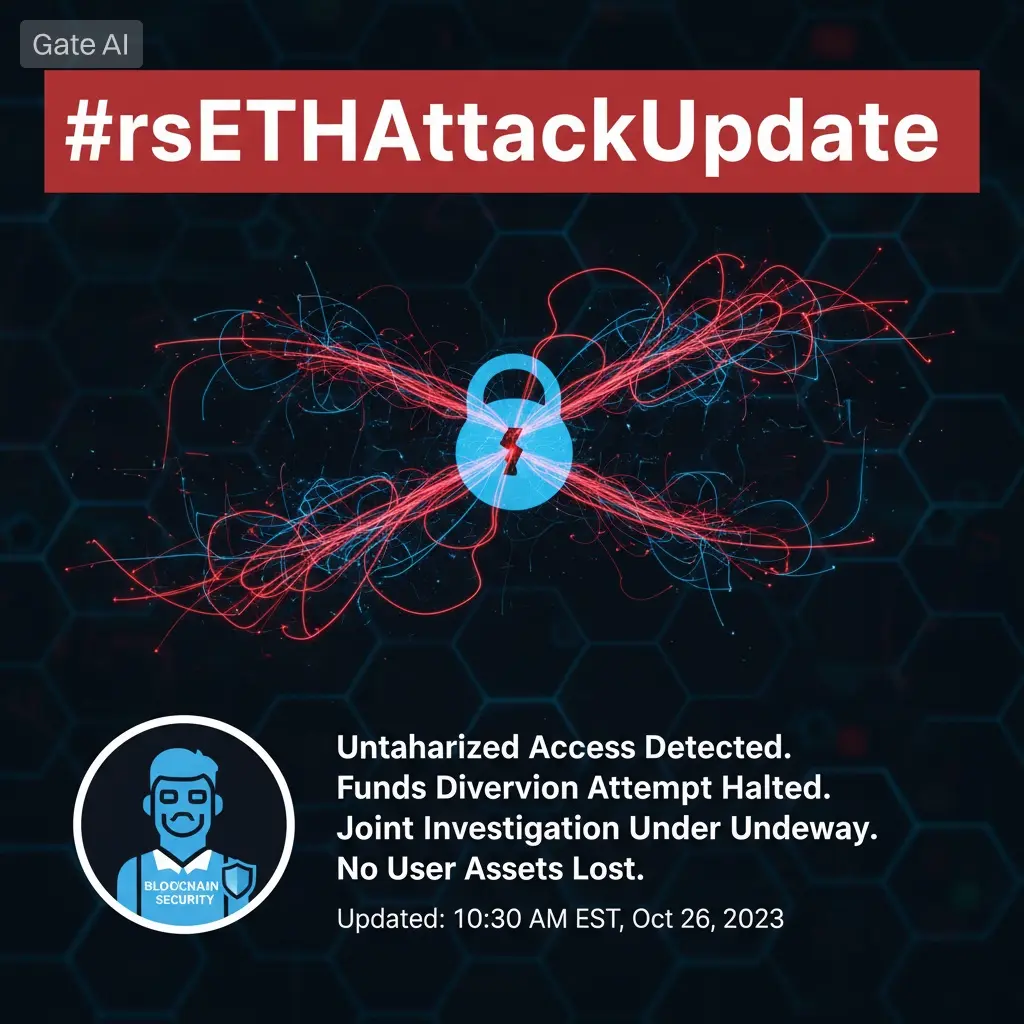
# rsETHAttackUpdate

77.54K
#rsETHAttackUpdate
The rsETH Attack: A $292M DeFi Shock That Exposed the Fragility of Cross-Chain Finance in 2026
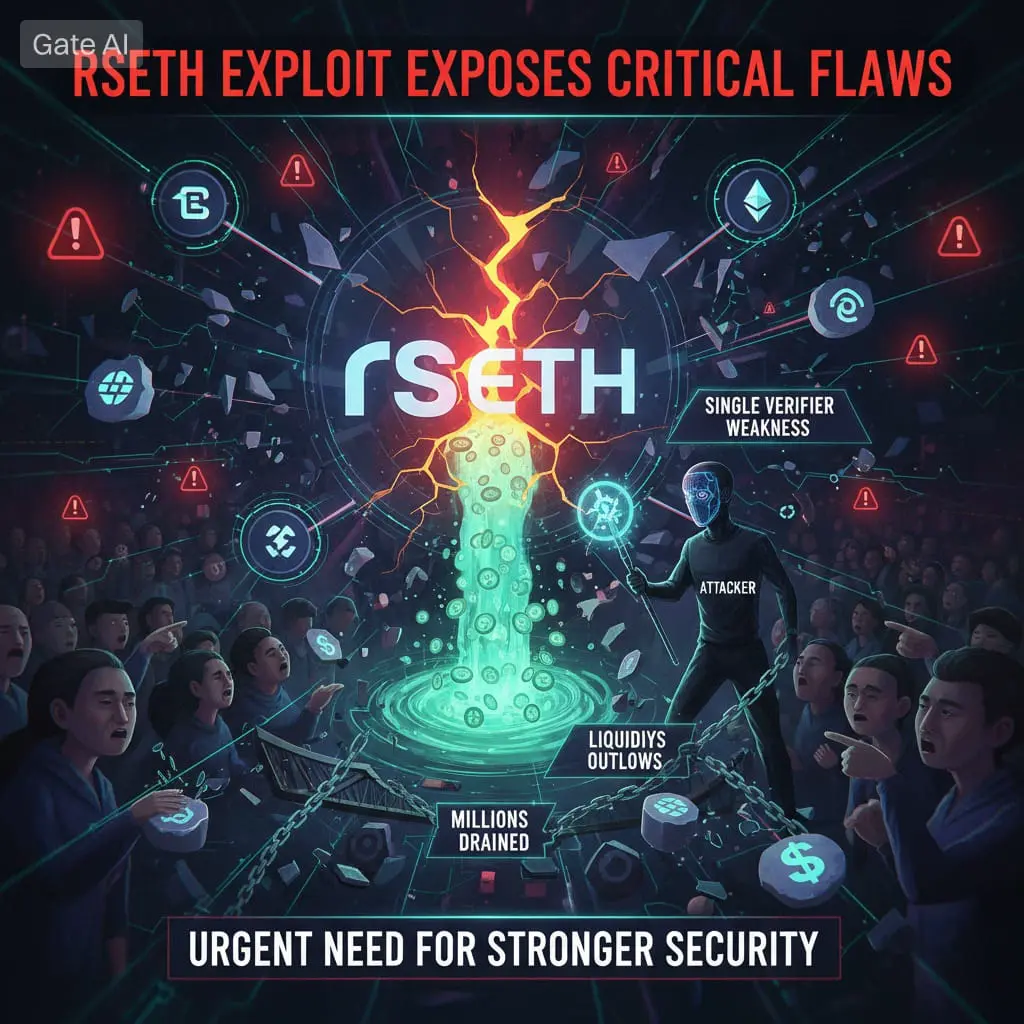
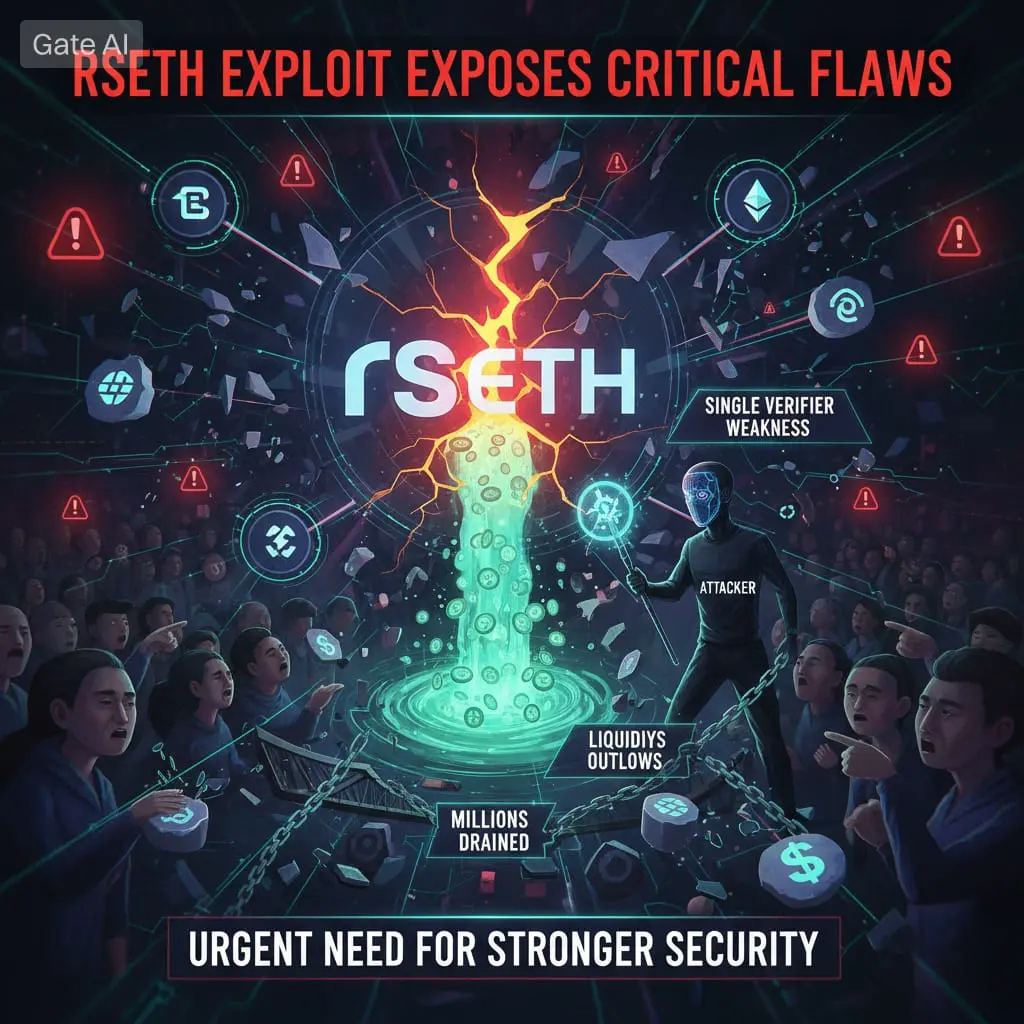
The DeFi ecosystem experienced one of its most disruptive moments on April 18, 2026, when KelpDAO’s rsETH protocol suffered a massive exploit valued at approximately $292 million. Unlike typical smart contract hacks that target isolated protocols, this incident triggered a systemic shock across multiple layers of decentralized finance. It was not just a loss of funds—it was a coordinated failure that exposed how deeply interconnected, and potentially fragile, modern DeFi infrastru
ETH-1,88%
ARB1,15%
AAVE1,43%
ZRO1,4%
post-image
  • Reward
  • 3
  • Repost
  • Share
LiuYang:
To The Moon 🌕
View More
#ArbitrumFreezesKelpDAOHackerETH
🔥 ARBITRUM FREEZES KELP DAO HACKER FUNDS — SECURITY, CONTROL, AND THE TRUE MEANING OF “DECENTRALIZATION” UNDER THE SPOTLIGHT 🔥
The decision by Arbitrum to freeze funds linked to the Kelp DAO exploit has immediately ignited one of the most important debates in the crypto space right now, because this is not just about stopping a hacker or protecting users, it is about exposing the underlying tension between security and decentralization, and forcing the entire industry to confront a difficult but unavoidable question: when something goes wrong, who actually h
ARB1,15%
EagleEye
#ArbitrumFreezesKelpDAOHackerETH
🔥 ARBITRUM FREEZES KELP DAO HACKER FUNDS — SECURITY, CONTROL, AND THE TRUE MEANING OF “DECENTRALIZATION” UNDER THE SPOTLIGHT 🔥
The decision by Arbitrum to freeze funds linked to the Kelp DAO exploit has immediately ignited one of the most important debates in the crypto space right now, because this is not just about stopping a hacker or protecting users, it is about exposing the underlying tension between security and decentralization, and forcing the entire industry to confront a difficult but unavoidable question: when something goes wrong, who actually has the power to intervene, and at what cost to the principles that define blockchain itself.
At a surface level, the action appears justified and even necessary, as freezing exploited funds can prevent further damage, protect liquidity, and potentially create a pathway for recovery, which is something the market often demands in the immediate aftermath of a hack, especially when large amounts of capital are at risk and user confidence is fragile. In fast-moving DeFi environments, delays in response can mean irreversible loss, so the ability to act quickly becomes a form of defense mechanism that many participants quietly rely on, even if it contradicts the ideal of a permissionless system.
But this is where the situation becomes far more complex, because the very act of freezing funds implies a level of control that challenges the narrative of decentralization. If a network can intervene, restrict access, or alter the flow of assets, then it raises questions about governance, authority, and the true nature of user ownership. This does not automatically mean the action is wrong, but it does mean the system is not as neutral or unstoppable as many assume, and that reality has long-term implications for how trust is built within the ecosystem.
From a strategic perspective, this event highlights the evolving role of layer 2 networks like Arbitrum, which are no longer just scaling solutions but are increasingly acting as active participants in maintaining network stability and security. This shift reflects a broader trend where infrastructure providers are taking on more responsibility, not just for performance but for ecosystem protection, and while this can strengthen resilience, it also introduces new layers of decision-making that must be carefully managed to avoid centralization risks.
The Kelp DAO exploit itself serves as a reminder that vulnerabilities still exist within DeFi systems, regardless of how advanced or widely adopted they become. Smart contracts, integrations, and liquidity mechanisms create complex environments where a single weakness can be exploited with significant impact, and this reinforces the importance of continuous auditing, monitoring, and risk assessment. At the same time, it also shows that post-incident response is becoming just as critical as prevention, as the ability to react effectively can influence not only financial outcomes but also long-term confidence in the platform.
From a market psychology standpoint, actions like this can have mixed effects. On one hand, they can restore confidence by demonstrating that there are mechanisms in place to respond to threats and protect users, which can encourage continued participation and reduce panic. On the other hand, they can introduce uncertainty about the limits of decentralization and the potential for intervention, which may lead some participants to question the level of control they truly have over their assets. This dual reaction reflects the broader challenge of balancing security with autonomy in a rapidly evolving financial system.
Another important layer to consider is precedent. Every time a network intervenes in this way, it sets an example that can influence future expectations and decisions. If interventions become more common, users may begin to expect them as a standard response, which could gradually shift the culture of the ecosystem toward a more managed environment. Conversely, if such actions are rare and carefully justified, they may be viewed as exceptional measures taken only under extreme circumstances. The direction this takes will play a significant role in shaping the identity of decentralized finance moving forward.
From my perspective, this situation clearly shows that the industry is moving into a phase where idealism is being tested by real-world challenges. Pure decentralization is powerful in theory, but in practice, systems that manage large amounts of capital must also address security risks, user protection, and operational resilience. The key is not choosing one side over the other, but finding a balance where intervention is possible without undermining trust or creating excessive centralization.
⚡ My Insight: The freeze demonstrates that control mechanisms exist beneath the surface of decentralized systems, and while they can be used for protection, they must be applied with transparency and restraint to maintain credibility.
⚡ My Advice: Do not assume any platform is fully immune to intervention or risk. Always evaluate where control lies, understand governance structures, and diversify exposure rather than relying on a single ecosystem for security.
⚡ Bottom Line: The Arbitrum action is not just about stopping a hacker — it is a defining moment that highlights the ongoing evolution of DeFi, where security, control, and decentralization must coexist, and how that balance is managed will shape the future of the entire space.

repost-content-media
  • Reward
  • Comment
  • Repost
  • Share
#rsETHAttackUpdate :
The rsETH Attack: A $292M DeFi Shock That Redefined Crypto Security in 2026
The crypto market was violently shaken on April 18, 2026, when KelpDAO’s rsETH ecosystem suffered a devastating exploit worth approximately $292 million. This was not just another DeFi hack—it became a systemic stress test for the entire decentralized finance ecosystem, exposing structural weaknesses in cross-chain infrastructure, collateral design, and protocol interdependence.
What followed was not only a token collapse—but a liquidity shock, confidence crisis, and a forced global reassessment o
ETH-1,88%
AAVE1,43%
ARB1,15%
HighAmbition
#rsETHAttackUpdate :
The rsETH Attack: A $292M DeFi Shock That Redefined Crypto Security in 2026
The crypto market was violently shaken on April 18, 2026, when KelpDAO’s rsETH ecosystem suffered a devastating exploit worth approximately $292 million. This was not just another DeFi hack—it became a systemic stress test for the entire decentralized finance ecosystem, exposing structural weaknesses in cross-chain infrastructure, collateral design, and protocol interdependence.
What followed was not only a token collapse—but a liquidity shock, confidence crisis, and a forced global reassessment of DeFi risk models.
🧠 Understanding rsETH and Its Role in DeFi
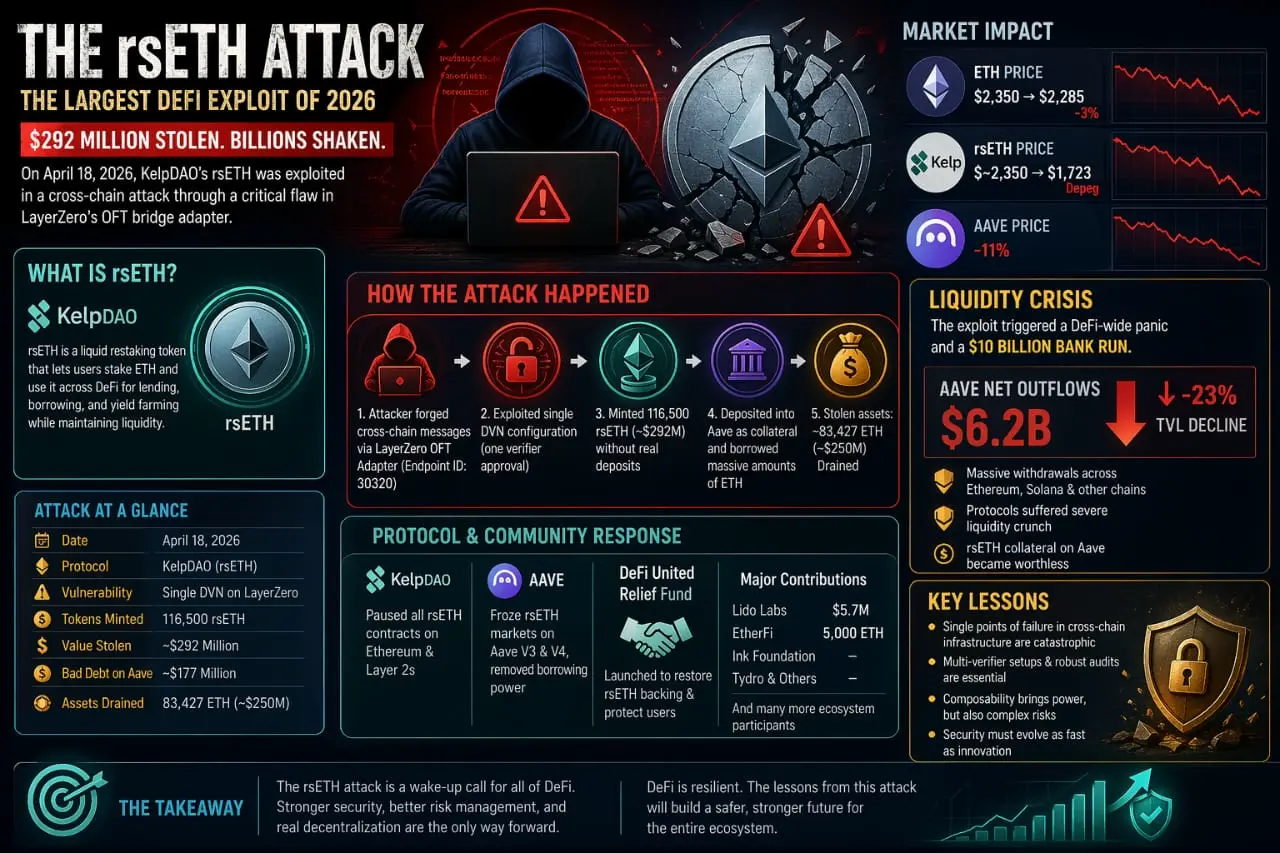
rsETH is a liquid restaking token issued by KelpDAO, allowing users to stake Ethereum while keeping liquidity active across DeFi platforms.
In simple terms:
Users stake ETH → receive rsETH
rsETH is used in lending, borrowing, and yield strategies
It acts as collateral across multiple DeFi ecosystems
This makes rsETH a systemically important asset in DeFi, meaning any instability affects not just one protocol—but many interconnected markets.
⚠️ How the $292M Exploit Happened
The attack exploited a critical flaw in KelpDAO’s cross-chain verification system, specifically within a LayerZero bridge adapter.
🔴 Core vulnerability:
KelpDAO used a single-verifier DVN (Decentralized Verifier Network) configuration.
Instead of requiring multiple independent confirmations, only one verifier approval was needed to validate cross-chain messages.
That single point of trust became the entry point for attackers.
🧨 Attack Execution Flow
The exploit unfolded in a highly structured sequence:
1. Fake Cross-Chain Messages
Attackers injected forged messages into the system, pretending legitimate deposits occurred across chains.
2. Minting Unbacked rsETH
The system incorrectly minted:
~116,500 rsETH tokens
Worth approximately $292 million
With no real ETH backing
3. DeFi Collateral Abuse
The attackers used rsETH as collateral on major lending protocols (including Aave) and borrowed real assets:
~52,834 WETH (Ethereum mainnet)
~29,782 WETH + 821 wstETH (Arbitrum)
4. Extraction of Real Liquidity
This created a massive imbalance between synthetic collateral and real assets, leading to systemic exposure.
📉 Immediate Market Reaction
The impact was instant:
rsETH sharply depegged from ETH
Ethereum experienced short-term pressure
DeFi tokens (especially lending protocols) dropped significantly
Trading volumes surged due to panic repositioning
Ethereum Price Context (Current Market)
At the time of market stabilization:
ETH Price: ~$2,320–$2,380 range
Market remained in a consolidation phase between $2,100–$2,400 zones
Despite the exploit, ETH remained structurally stable because the issue was not Ethereum itself—but a layered DeFi dependency failure.
💣 Systemic Impact: The DeFi Liquidity Shock
The most dangerous outcome was not the hack itself—but the liquidity chain reaction.
Key consequences:
Massive withdrawals from DeFi lending protocols
Sudden liquidity contraction across multiple chains
Collateral reassessment across lending platforms
Risk repricing across all synthetic assets
This resembled a “digital bank-run effect”, where fear spreads faster than technical fixes.
Aave and other lending platforms faced:
Rising bad debt exposure
Emergency asset freezes
Collateral re-evaluation processes
🛡️ Emergency Protocol Responses
🔹 KelpDAO Actions:
Paused rsETH minting and transfers
Suspended cross-chain operations
Began full reserve reconciliation
🔹 Aave Actions:
Froze rsETH collateral markets
Removed borrowing power from rsETH
Initiated risk containment procedures
🔹 Ecosystem Response:
Major DeFi players created emergency liquidity support pools to stabilize rsETH backing and reduce systemic damage.
📊 Ethereum Trading Strategy (Post-Exploit Market Structure)
Despite the chaos, ETH continues to trade within a structured macro range.
🟢 Current ETH Market Zone:
Range: $2,200 – $2,450
Bias: Neutral to slightly bearish consolidation
Volatility: Moderate, event-driven spikes
📈 ETH Trading Strategy (Simplified Institutional Approach)
1. Accumulation Zone Strategy
Range: $2,100 – $2,250
Considered long-term value accumulation zone
Suitable for gradual spot entry
Ideal for DCA (Dollar Cost Averaging)
2. Breakout Strategy
Trigger: Above $2,450
Confirms bullish expansion phase
Targets: $2,600 → $2,800
Momentum continuation likely if volume supports
3. Risk/Downside Strategy
If breakdown below $2,100:
Market enters deeper correction phase
Next support: $1,950–$2,000
Defensive positioning recommended
⚖️ Market Sentiment Shift After rsETH Attack
The event has permanently shifted market psychology:
Before:
High trust in cross-chain composability
Aggressive leverage usage
Strong confidence in synthetic collateral systems
After:
Increased skepticism toward bridged assets
Lower leverage appetite
Strong preference for native collateral (ETH, BTC)
Higher demand for protocol insurance models
🔍 Key Lessons for Crypto Investors
1. Composability is powerful—but fragile
One weak link can destabilize entire systems.
2. Cross-chain bridges remain high-risk infrastructure
Even advanced protocols can fail if verification is centralized.
3. Collateral ≠ safety
Synthetic assets require deeper risk analysis than native assets.
4. DeFi is now entering “risk maturity phase”
Security will matter more than speed or innovation.
📌 Final Outlook
The rsETH exploit is more than a hack—it is a defining moment for DeFi evolution.
While the immediate damage was severe, the long-term outcome may actually strengthen the ecosystem through:
Better bridge security standards
Improved collateral frameworks
Stronger risk management systems
More realistic leverage controls
Ethereum and DeFi markets have survived this shock—but the rules of the game are changing.
🚀 Closing Insight
In crypto, innovation always moves faster than regulation or security. The rsETH incident is a reminder that:
The future of DeFi will not be defined by how fast it grows—but by how well it survives its own complexity.
repost-content-media
  • Reward
  • 1
  • Repost
  • Share
HighAmbition:
thnxx for the update
#rsETHAttackUpdate :
The rsETH Attack: A $292M DeFi Shock That Redefined Crypto Security in 2026
The crypto market was violently shaken on April 18, 2026, when KelpDAO’s rsETH ecosystem suffered a devastating exploit worth approximately $292 million. This was not just another DeFi hack—it became a systemic stress test for the entire decentralized finance ecosystem, exposing structural weaknesses in cross-chain infrastructure, collateral design, and protocol interdependence.
What followed was not only a token collapse—but a liquidity shock, confidence crisis, and a forced global reassessment o
ETH-1,88%
AAVE1,43%
ARB1,15%
HighAmbition
#rsETHAttackUpdate :
The rsETH Attack: A $292M DeFi Shock That Redefined Crypto Security in 2026
The crypto market was violently shaken on April 18, 2026, when KelpDAO’s rsETH ecosystem suffered a devastating exploit worth approximately $292 million. This was not just another DeFi hack—it became a systemic stress test for the entire decentralized finance ecosystem, exposing structural weaknesses in cross-chain infrastructure, collateral design, and protocol interdependence.
What followed was not only a token collapse—but a liquidity shock, confidence crisis, and a forced global reassessment of DeFi risk models.
🧠 Understanding rsETH and Its Role in DeFi
rsETH is a liquid restaking token issued by KelpDAO, allowing users to stake Ethereum while keeping liquidity active across DeFi platforms.
In simple terms:
Users stake ETH → receive rsETH
rsETH is used in lending, borrowing, and yield strategies
It acts as collateral across multiple DeFi ecosystems
This makes rsETH a systemically important asset in DeFi, meaning any instability affects not just one protocol—but many interconnected markets.
⚠️ How the $292M Exploit Happened
The attack exploited a critical flaw in KelpDAO’s cross-chain verification system, specifically within a LayerZero bridge adapter.
🔴 Core vulnerability:
KelpDAO used a single-verifier DVN (Decentralized Verifier Network) configuration.
Instead of requiring multiple independent confirmations, only one verifier approval was needed to validate cross-chain messages.
That single point of trust became the entry point for attackers.
🧨 Attack Execution Flow
The exploit unfolded in a highly structured sequence:
1. Fake Cross-Chain Messages
Attackers injected forged messages into the system, pretending legitimate deposits occurred across chains.
2. Minting Unbacked rsETH
The system incorrectly minted:
~116,500 rsETH tokens
Worth approximately $292 million
With no real ETH backing
3. DeFi Collateral Abuse
The attackers used rsETH as collateral on major lending protocols (including Aave) and borrowed real assets:
~52,834 WETH (Ethereum mainnet)
~29,782 WETH + 821 wstETH (Arbitrum)
4. Extraction of Real Liquidity
This created a massive imbalance between synthetic collateral and real assets, leading to systemic exposure.
📉 Immediate Market Reaction
The impact was instant:
rsETH sharply depegged from ETH
Ethereum experienced short-term pressure
DeFi tokens (especially lending protocols) dropped significantly
Trading volumes surged due to panic repositioning
Ethereum Price Context (Current Market)
At the time of market stabilization:
ETH Price: ~$2,320–$2,380 range
Market remained in a consolidation phase between $2,100–$2,400 zones
Despite the exploit, ETH remained structurally stable because the issue was not Ethereum itself—but a layered DeFi dependency failure.
💣 Systemic Impact: The DeFi Liquidity Shock
The most dangerous outcome was not the hack itself—but the liquidity chain reaction.
Key consequences:
Massive withdrawals from DeFi lending protocols
Sudden liquidity contraction across multiple chains
Collateral reassessment across lending platforms
Risk repricing across all synthetic assets
This resembled a “digital bank-run effect”, where fear spreads faster than technical fixes.
Aave and other lending platforms faced:
Rising bad debt exposure
Emergency asset freezes
Collateral re-evaluation processes
🛡️ Emergency Protocol Responses
🔹 KelpDAO Actions:
Paused rsETH minting and transfers
Suspended cross-chain operations
Began full reserve reconciliation
🔹 Aave Actions:
Froze rsETH collateral markets
Removed borrowing power from rsETH
Initiated risk containment procedures
🔹 Ecosystem Response:
Major DeFi players created emergency liquidity support pools to stabilize rsETH backing and reduce systemic damage.
📊 Ethereum Trading Strategy (Post-Exploit Market Structure)
Despite the chaos, ETH continues to trade within a structured macro range.
🟢 Current ETH Market Zone:
Range: $2,200 – $2,450
Bias: Neutral to slightly bearish consolidation
Volatility: Moderate, event-driven spikes
📈 ETH Trading Strategy (Simplified Institutional Approach)
1. Accumulation Zone Strategy
Range: $2,100 – $2,250
Considered long-term value accumulation zone
Suitable for gradual spot entry
Ideal for DCA (Dollar Cost Averaging)
2. Breakout Strategy
Trigger: Above $2,450
Confirms bullish expansion phase
Targets: $2,600 → $2,800
Momentum continuation likely if volume supports
3. Risk/Downside Strategy
If breakdown below $2,100:
Market enters deeper correction phase
Next support: $1,950–$2,000
Defensive positioning recommended
⚖️ Market Sentiment Shift After rsETH Attack
The event has permanently shifted market psychology:
Before:
High trust in cross-chain composability
Aggressive leverage usage
Strong confidence in synthetic collateral systems
After:
Increased skepticism toward bridged assets
Lower leverage appetite
Strong preference for native collateral (ETH, BTC)
Higher demand for protocol insurance models
🔍 Key Lessons for Crypto Investors
1. Composability is powerful—but fragile
One weak link can destabilize entire systems.
2. Cross-chain bridges remain high-risk infrastructure
Even advanced protocols can fail if verification is centralized.
3. Collateral ≠ safety
Synthetic assets require deeper risk analysis than native assets.
4. DeFi is now entering “risk maturity phase”
Security will matter more than speed or innovation.
📌 Final Outlook
The rsETH exploit is more than a hack—it is a defining moment for DeFi evolution.
While the immediate damage was severe, the long-term outcome may actually strengthen the ecosystem through:
Better bridge security standards
Improved collateral frameworks
Stronger risk management systems
More realistic leverage controls
Ethereum and DeFi markets have survived this shock—but the rules of the game are changing.
🚀 Closing Insight
In crypto, innovation always moves faster than regulation or security. The rsETH incident is a reminder that:
The future of DeFi will not be defined by how fast it grows—but by how well it survives its own complexity.
repost-content-media
  • Reward
  • Comment
  • Repost
  • Share
#rsETHAttackUpdate :
The rsETH Attack: A $292M DeFi Shock That Redefined Crypto Security in 2026
The crypto market was violently shaken on April 18, 2026, when KelpDAO’s rsETH ecosystem suffered a devastating exploit worth approximately $292 million. This was not just another DeFi hack—it became a systemic stress test for the entire decentralized finance ecosystem, exposing structural weaknesses in cross-chain infrastructure, collateral design, and protocol interdependence.
What followed was not only a token collapse—but a liquidity shock, confidence crisis, and a forced global reassessment o
ETH-1,88%
AAVE1,43%
ARB1,15%
BTC-0,41%
HighAmbition
#rsETHAttackUpdate :
The rsETH Attack: A $292M DeFi Shock That Redefined Crypto Security in 2026
The crypto market was violently shaken on April 18, 2026, when KelpDAO’s rsETH ecosystem suffered a devastating exploit worth approximately $292 million. This was not just another DeFi hack—it became a systemic stress test for the entire decentralized finance ecosystem, exposing structural weaknesses in cross-chain infrastructure, collateral design, and protocol interdependence.
What followed was not only a token collapse—but a liquidity shock, confidence crisis, and a forced global reassessment of DeFi risk models.
🧠 Understanding rsETH and Its Role in DeFi
rsETH is a liquid restaking token issued by KelpDAO, allowing users to stake Ethereum while keeping liquidity active across DeFi platforms.
In simple terms:
Users stake ETH → receive rsETH
rsETH is used in lending, borrowing, and yield strategies
It acts as collateral across multiple DeFi ecosystems
This makes rsETH a systemically important asset in DeFi, meaning any instability affects not just one protocol—but many interconnected markets.
⚠️ How the $292M Exploit Happened
The attack exploited a critical flaw in KelpDAO’s cross-chain verification system, specifically within a LayerZero bridge adapter.
🔴 Core vulnerability:
KelpDAO used a single-verifier DVN (Decentralized Verifier Network) configuration.
Instead of requiring multiple independent confirmations, only one verifier approval was needed to validate cross-chain messages.
That single point of trust became the entry point for attackers.
🧨 Attack Execution Flow
The exploit unfolded in a highly structured sequence:
1. Fake Cross-Chain Messages
Attackers injected forged messages into the system, pretending legitimate deposits occurred across chains.
2. Minting Unbacked rsETH
The system incorrectly minted:
~116,500 rsETH tokens
Worth approximately $292 million
With no real ETH backing
3. DeFi Collateral Abuse
The attackers used rsETH as collateral on major lending protocols (including Aave) and borrowed real assets:
~52,834 WETH (Ethereum mainnet)
~29,782 WETH + 821 wstETH (Arbitrum)
4. Extraction of Real Liquidity
This created a massive imbalance between synthetic collateral and real assets, leading to systemic exposure.
📉 Immediate Market Reaction
The impact was instant:
rsETH sharply depegged from ETH
Ethereum experienced short-term pressure
DeFi tokens (especially lending protocols) dropped significantly
Trading volumes surged due to panic repositioning
Ethereum Price Context (Current Market)
At the time of market stabilization:
ETH Price: ~$2,320–$2,380 range
Market remained in a consolidation phase between $2,100–$2,400 zones
Despite the exploit, ETH remained structurally stable because the issue was not Ethereum itself—but a layered DeFi dependency failure.
💣 Systemic Impact: The DeFi Liquidity Shock
The most dangerous outcome was not the hack itself—but the liquidity chain reaction.
Key consequences:
Massive withdrawals from DeFi lending protocols
Sudden liquidity contraction across multiple chains
Collateral reassessment across lending platforms
Risk repricing across all synthetic assets
This resembled a “digital bank-run effect”, where fear spreads faster than technical fixes.
Aave and other lending platforms faced:
Rising bad debt exposure
Emergency asset freezes
Collateral re-evaluation processes
🛡️ Emergency Protocol Responses
🔹 KelpDAO Actions:
Paused rsETH minting and transfers
Suspended cross-chain operations
Began full reserve reconciliation
🔹 Aave Actions:
Froze rsETH collateral markets
Removed borrowing power from rsETH
Initiated risk containment procedures
🔹 Ecosystem Response:
Major DeFi players created emergency liquidity support pools to stabilize rsETH backing and reduce systemic damage.
📊 Ethereum Trading Strategy (Post-Exploit Market Structure)
Despite the chaos, ETH continues to trade within a structured macro range.
🟢 Current ETH Market Zone:
Range: $2,200 – $2,450
Bias: Neutral to slightly bearish consolidation
Volatility: Moderate, event-driven spikes
📈 ETH Trading Strategy (Simplified Institutional Approach)
1. Accumulation Zone Strategy
Range: $2,100 – $2,250
Considered long-term value accumulation zone
Suitable for gradual spot entry
Ideal for DCA (Dollar Cost Averaging)
2. Breakout Strategy
Trigger: Above $2,450
Confirms bullish expansion phase
Targets: $2,600 → $2,800
Momentum continuation likely if volume supports
3. Risk/Downside Strategy
If breakdown below $2,100:
Market enters deeper correction phase
Next support: $1,950–$2,000
Defensive positioning recommended
⚖️ Market Sentiment Shift After rsETH Attack
The event has permanently shifted market psychology:
Before:
High trust in cross-chain composability
Aggressive leverage usage
Strong confidence in synthetic collateral systems
After:
Increased skepticism toward bridged assets
Lower leverage appetite
Strong preference for native collateral (ETH, BTC)
Higher demand for protocol insurance models
🔍 Key Lessons for Crypto Investors
1. Composability is powerful—but fragile
One weak link can destabilize entire systems.
2. Cross-chain bridges remain high-risk infrastructure
Even advanced protocols can fail if verification is centralized.
3. Collateral ≠ safety
Synthetic assets require deeper risk analysis than native assets.
4. DeFi is now entering “risk maturity phase”
Security will matter more than speed or innovation.
📌 Final Outlook
The rsETH exploit is more than a hack—it is a defining moment for DeFi evolution.
While the immediate damage was severe, the long-term outcome may actually strengthen the ecosystem through:
Better bridge security standards
Improved collateral frameworks
Stronger risk management systems
More realistic leverage controls
Ethereum and DeFi markets have survived this shock—but the rules of the game are changing.
🚀 Closing Insight
In crypto, innovation always moves faster than regulation or security. The rsETH incident is a reminder that:
The future of DeFi will not be defined by how fast it grows—but by how well it survives its own complexity.
repost-content-media
  • Reward
  • Comment
  • Repost
  • Share
#rsETHAttackUpdate :
The rsETH Attack: A $292M DeFi Shock That Redefined Crypto Security in 2026
The crypto market was violently shaken on April 18, 2026, when KelpDAO’s rsETH ecosystem suffered a devastating exploit worth approximately $292 million. This was not just another DeFi hack—it became a systemic stress test for the entire decentralized finance ecosystem, exposing structural weaknesses in cross-chain infrastructure, collateral design, and protocol interdependence.
What followed was not only a token collapse—but a liquidity shock, confidence crisis, and a forced global reassessment o
ETH-1,88%
AAVE1,43%
ARB1,15%
HighAmbition
#rsETHAttackUpdate :
The rsETH Attack: A $292M DeFi Shock That Redefined Crypto Security in 2026
The crypto market was violently shaken on April 18, 2026, when KelpDAO’s rsETH ecosystem suffered a devastating exploit worth approximately $292 million. This was not just another DeFi hack—it became a systemic stress test for the entire decentralized finance ecosystem, exposing structural weaknesses in cross-chain infrastructure, collateral design, and protocol interdependence.
What followed was not only a token collapse—but a liquidity shock, confidence crisis, and a forced global reassessment of DeFi risk models.
🧠 Understanding rsETH and Its Role in DeFi
rsETH is a liquid restaking token issued by KelpDAO, allowing users to stake Ethereum while keeping liquidity active across DeFi platforms.
In simple terms:
Users stake ETH → receive rsETH
rsETH is used in lending, borrowing, and yield strategies
It acts as collateral across multiple DeFi ecosystems
This makes rsETH a systemically important asset in DeFi, meaning any instability affects not just one protocol—but many interconnected markets.
⚠️ How the $292M Exploit Happened
The attack exploited a critical flaw in KelpDAO’s cross-chain verification system, specifically within a LayerZero bridge adapter.
🔴 Core vulnerability:
KelpDAO used a single-verifier DVN (Decentralized Verifier Network) configuration.
Instead of requiring multiple independent confirmations, only one verifier approval was needed to validate cross-chain messages.
That single point of trust became the entry point for attackers.
🧨 Attack Execution Flow
The exploit unfolded in a highly structured sequence:
1. Fake Cross-Chain Messages
Attackers injected forged messages into the system, pretending legitimate deposits occurred across chains.
2. Minting Unbacked rsETH
The system incorrectly minted:
~116,500 rsETH tokens
Worth approximately $292 million
With no real ETH backing
3. DeFi Collateral Abuse
The attackers used rsETH as collateral on major lending protocols (including Aave) and borrowed real assets:
~52,834 WETH (Ethereum mainnet)
~29,782 WETH + 821 wstETH (Arbitrum)
4. Extraction of Real Liquidity
This created a massive imbalance between synthetic collateral and real assets, leading to systemic exposure.
📉 Immediate Market Reaction
The impact was instant:
rsETH sharply depegged from ETH
Ethereum experienced short-term pressure
DeFi tokens (especially lending protocols) dropped significantly
Trading volumes surged due to panic repositioning
Ethereum Price Context (Current Market)
At the time of market stabilization:
ETH Price: ~$2,320–$2,380 range
Market remained in a consolidation phase between $2,100–$2,400 zones
Despite the exploit, ETH remained structurally stable because the issue was not Ethereum itself—but a layered DeFi dependency failure.
💣 Systemic Impact: The DeFi Liquidity Shock
The most dangerous outcome was not the hack itself—but the liquidity chain reaction.
Key consequences:
Massive withdrawals from DeFi lending protocols
Sudden liquidity contraction across multiple chains
Collateral reassessment across lending platforms
Risk repricing across all synthetic assets
This resembled a “digital bank-run effect”, where fear spreads faster than technical fixes.
Aave and other lending platforms faced:
Rising bad debt exposure
Emergency asset freezes
Collateral re-evaluation processes
🛡️ Emergency Protocol Responses
🔹 KelpDAO Actions:
Paused rsETH minting and transfers
Suspended cross-chain operations
Began full reserve reconciliation
🔹 Aave Actions:
Froze rsETH collateral markets
Removed borrowing power from rsETH
Initiated risk containment procedures
🔹 Ecosystem Response:
Major DeFi players created emergency liquidity support pools to stabilize rsETH backing and reduce systemic damage.
📊 Ethereum Trading Strategy (Post-Exploit Market Structure)
Despite the chaos, ETH continues to trade within a structured macro range.
🟢 Current ETH Market Zone:
Range: $2,200 – $2,450
Bias: Neutral to slightly bearish consolidation
Volatility: Moderate, event-driven spikes
📈 ETH Trading Strategy (Simplified Institutional Approach)
1. Accumulation Zone Strategy
Range: $2,100 – $2,250
Considered long-term value accumulation zone
Suitable for gradual spot entry
Ideal for DCA (Dollar Cost Averaging)
2. Breakout Strategy
Trigger: Above $2,450
Confirms bullish expansion phase
Targets: $2,600 → $2,800
Momentum continuation likely if volume supports
3. Risk/Downside Strategy
If breakdown below $2,100:
Market enters deeper correction phase
Next support: $1,950–$2,000
Defensive positioning recommended
⚖️ Market Sentiment Shift After rsETH Attack
The event has permanently shifted market psychology:
Before:
High trust in cross-chain composability
Aggressive leverage usage
Strong confidence in synthetic collateral systems
After:
Increased skepticism toward bridged assets
Lower leverage appetite
Strong preference for native collateral (ETH, BTC)
Higher demand for protocol insurance models
🔍 Key Lessons for Crypto Investors
1. Composability is powerful—but fragile
One weak link can destabilize entire systems.
2. Cross-chain bridges remain high-risk infrastructure
Even advanced protocols can fail if verification is centralized.
3. Collateral ≠ safety
Synthetic assets require deeper risk analysis than native assets.
4. DeFi is now entering “risk maturity phase”
Security will matter more than speed or innovation.
📌 Final Outlook
The rsETH exploit is more than a hack—it is a defining moment for DeFi evolution.
While the immediate damage was severe, the long-term outcome may actually strengthen the ecosystem through:
Better bridge security standards
Improved collateral frameworks
Stronger risk management systems
More realistic leverage controls
Ethereum and DeFi markets have survived this shock—but the rules of the game are changing.
🚀 Closing Insight
In crypto, innovation always moves faster than regulation or security. The rsETH incident is a reminder that:
The future of DeFi will not be defined by how fast it grows—but by how well it survives its own complexity.
repost-content-media
  • Reward
  • Comment
  • Repost
  • Share
#rsETHAttackUpdate :
The rsETH Attack: A $292M DeFi Shock That Redefined Crypto Security in 2026
The crypto market was violently shaken on April 18, 2026, when KelpDAO’s rsETH ecosystem suffered a devastating exploit worth approximately $292 million. This was not just another DeFi hack—it became a systemic stress test for the entire decentralized finance ecosystem, exposing structural weaknesses in cross-chain infrastructure, collateral design, and protocol interdependence.
What followed was not only a token collapse—but a liquidity shock, confidence crisis, and a forced global reassessment o
ETH-1,88%
AAVE1,43%
ARB1,15%
BTC-0,41%
HighAmbition
#rsETHAttackUpdate :
The rsETH Attack: A $292M DeFi Shock That Redefined Crypto Security in 2026
The crypto market was violently shaken on April 18, 2026, when KelpDAO’s rsETH ecosystem suffered a devastating exploit worth approximately $292 million. This was not just another DeFi hack—it became a systemic stress test for the entire decentralized finance ecosystem, exposing structural weaknesses in cross-chain infrastructure, collateral design, and protocol interdependence.
What followed was not only a token collapse—but a liquidity shock, confidence crisis, and a forced global reassessment of DeFi risk models.
🧠 Understanding rsETH and Its Role in DeFi
rsETH is a liquid restaking token issued by KelpDAO, allowing users to stake Ethereum while keeping liquidity active across DeFi platforms.
In simple terms:
Users stake ETH → receive rsETH
rsETH is used in lending, borrowing, and yield strategies
It acts as collateral across multiple DeFi ecosystems
This makes rsETH a systemically important asset in DeFi, meaning any instability affects not just one protocol—but many interconnected markets.
⚠️ How the $292M Exploit Happened
The attack exploited a critical flaw in KelpDAO’s cross-chain verification system, specifically within a LayerZero bridge adapter.
🔴 Core vulnerability:
KelpDAO used a single-verifier DVN (Decentralized Verifier Network) configuration.
Instead of requiring multiple independent confirmations, only one verifier approval was needed to validate cross-chain messages.
That single point of trust became the entry point for attackers.
🧨 Attack Execution Flow
The exploit unfolded in a highly structured sequence:
1. Fake Cross-Chain Messages
Attackers injected forged messages into the system, pretending legitimate deposits occurred across chains.
2. Minting Unbacked rsETH
The system incorrectly minted:
~116,500 rsETH tokens
Worth approximately $292 million
With no real ETH backing
3. DeFi Collateral Abuse
The attackers used rsETH as collateral on major lending protocols (including Aave) and borrowed real assets:
~52,834 WETH (Ethereum mainnet)
~29,782 WETH + 821 wstETH (Arbitrum)
4. Extraction of Real Liquidity
This created a massive imbalance between synthetic collateral and real assets, leading to systemic exposure.
📉 Immediate Market Reaction
The impact was instant:
rsETH sharply depegged from ETH
Ethereum experienced short-term pressure
DeFi tokens (especially lending protocols) dropped significantly
Trading volumes surged due to panic repositioning
Ethereum Price Context (Current Market)
At the time of market stabilization:
ETH Price: ~$2,320–$2,380 range
Market remained in a consolidation phase between $2,100–$2,400 zones
Despite the exploit, ETH remained structurally stable because the issue was not Ethereum itself—but a layered DeFi dependency failure.
💣 Systemic Impact: The DeFi Liquidity Shock
The most dangerous outcome was not the hack itself—but the liquidity chain reaction.
Key consequences:
Massive withdrawals from DeFi lending protocols
Sudden liquidity contraction across multiple chains
Collateral reassessment across lending platforms
Risk repricing across all synthetic assets
This resembled a “digital bank-run effect”, where fear spreads faster than technical fixes.
Aave and other lending platforms faced:
Rising bad debt exposure
Emergency asset freezes
Collateral re-evaluation processes
🛡️ Emergency Protocol Responses
🔹 KelpDAO Actions:
Paused rsETH minting and transfers
Suspended cross-chain operations
Began full reserve reconciliation
🔹 Aave Actions:
Froze rsETH collateral markets
Removed borrowing power from rsETH
Initiated risk containment procedures
🔹 Ecosystem Response:
Major DeFi players created emergency liquidity support pools to stabilize rsETH backing and reduce systemic damage.
📊 Ethereum Trading Strategy (Post-Exploit Market Structure)
Despite the chaos, ETH continues to trade within a structured macro range.
🟢 Current ETH Market Zone:
Range: $2,200 – $2,450
Bias: Neutral to slightly bearish consolidation
Volatility: Moderate, event-driven spikes
📈 ETH Trading Strategy (Simplified Institutional Approach)
1. Accumulation Zone Strategy
Range: $2,100 – $2,250
Considered long-term value accumulation zone
Suitable for gradual spot entry
Ideal for DCA (Dollar Cost Averaging)
2. Breakout Strategy
Trigger: Above $2,450
Confirms bullish expansion phase
Targets: $2,600 → $2,800
Momentum continuation likely if volume supports
3. Risk/Downside Strategy
If breakdown below $2,100:
Market enters deeper correction phase
Next support: $1,950–$2,000
Defensive positioning recommended
⚖️ Market Sentiment Shift After rsETH Attack
The event has permanently shifted market psychology:
Before:
High trust in cross-chain composability
Aggressive leverage usage
Strong confidence in synthetic collateral systems
After:
Increased skepticism toward bridged assets
Lower leverage appetite
Strong preference for native collateral (ETH, BTC)
Higher demand for protocol insurance models
🔍 Key Lessons for Crypto Investors
1. Composability is powerful—but fragile
One weak link can destabilize entire systems.
2. Cross-chain bridges remain high-risk infrastructure
Even advanced protocols can fail if verification is centralized.
3. Collateral ≠ safety
Synthetic assets require deeper risk analysis than native assets.
4. DeFi is now entering “risk maturity phase”
Security will matter more than speed or innovation.
📌 Final Outlook
The rsETH exploit is more than a hack—it is a defining moment for DeFi evolution.
While the immediate damage was severe, the long-term outcome may actually strengthen the ecosystem through:
Better bridge security standards
Improved collateral frameworks
Stronger risk management systems
More realistic leverage controls
Ethereum and DeFi markets have survived this shock—but the rules of the game are changing.
🚀 Closing Insight
In crypto, innovation always moves faster than regulation or security. The rsETH incident is a reminder that:
The future of DeFi will not be defined by how fast it grows—but by how well it survives its own complexity.
repost-content-media
  • Reward
  • Comment
  • Repost
  • Share
#rsETHAttackUpdate :
The rsETH Attack: A $292M DeFi Shock That Redefined Crypto Security in 2026
The crypto market was violently shaken on April 18, 2026, when KelpDAO’s rsETH ecosystem suffered a devastating exploit worth approximately $292 million. This was not just another DeFi hack—it became a systemic stress test for the entire decentralized finance ecosystem, exposing structural weaknesses in cross-chain infrastructure, collateral design, and protocol interdependence.
What followed was not only a token collapse—but a liquidity shock, confidence crisis, and a forced global reassessment o
ETH-1,88%
AAVE1,43%
ARB1,15%
post-image
post-image
post-image
  • Reward
  • 20
  • Repost
  • Share
Pheonixprincess:
Buy To Earn 💰️
View More
#rsETHAttackUpdate
rsETH Attack Update: Inside One of the Most Critical DeFi Security Events of 2026
The recent security incident involving rsETH has quickly become one of the most discussed events in decentralized finance this year. What initially appeared as a technical exploit has now evolved into a broader conversation about cross-chain security, restaking risks, and the structural weaknesses hidden inside modern DeFi infrastructure.
At the center of the event is rsETH, a liquid restaking token associated with the KelpDAO ecosystem, which plays a role in representing staked Ethereum expos
ETH-1,88%
post-image
  • Reward
  • 5
  • Repost
  • Share
MrFlower_XingChen:
2026 GOGOGO 👊
View More
#ArbitrumFreezesKelpDAOHackerETH 🚨
Something just happened in DeFi… and most people are focusing on the wrong part.
It’s not the hack.
It’s not even the money.
It’s the moment the system paused.
⚡ The Part Everyone Expected
A vulnerability was found.
An attacker moved fast.
Funds started flowing out.
We’ve seen this before.
Smart contract exploited → assets drained → funds disappear → case closed.
That’s the usual script.
No interference. No reversal. No control.
Just code doing exactly what it was written to do.
🧊 The Part No One Expected
This time… the funds didn’t fully escape.
Some of th
post-image
  • Reward
  • 2
  • Repost
  • Share
NexaCrypto:
LFG 🔥
View More
Load More