A new report by Discovery Bank and Visa highlights a major shift in South Africa’s financial landscape, as cryptocurrency matures from a speculative trend into a mainstream investment class.
Key Takeaways:
- Discovery Bank and Visa report that 7.8 million South Africans now treat crypto as a mainstream asset class.
- Middle-income trading grew 26% in 2024, shifting the industry from speculation to disciplined investing.
- National Treasury’s 2026 regulations may soon require residents to declare or sell digital asset holdings.
A Mainstream Milestone
The landscape of digital finance in South Africa has reached a significant turning point, moving away from the volatile speculation of the past toward a more measured, institutionalized approach. According to the latest Spendtrend26 report by Discovery Bank and Visa, cryptocurrency has officially transitioned from a niche tech interest into a mainstream investment class, with one in every eight South Africans now participating in the ecosystem.
By mid-2025, approximately 7.8 million South Africans—roughly 13% of the population—were actively using major cryptocurrency platforms. This surge in adoption is underpinned by a high level of public awareness; 70% of the population expressed familiarity with digital assets, and over half of all consumers reported that they currently own or have previously held crypto.
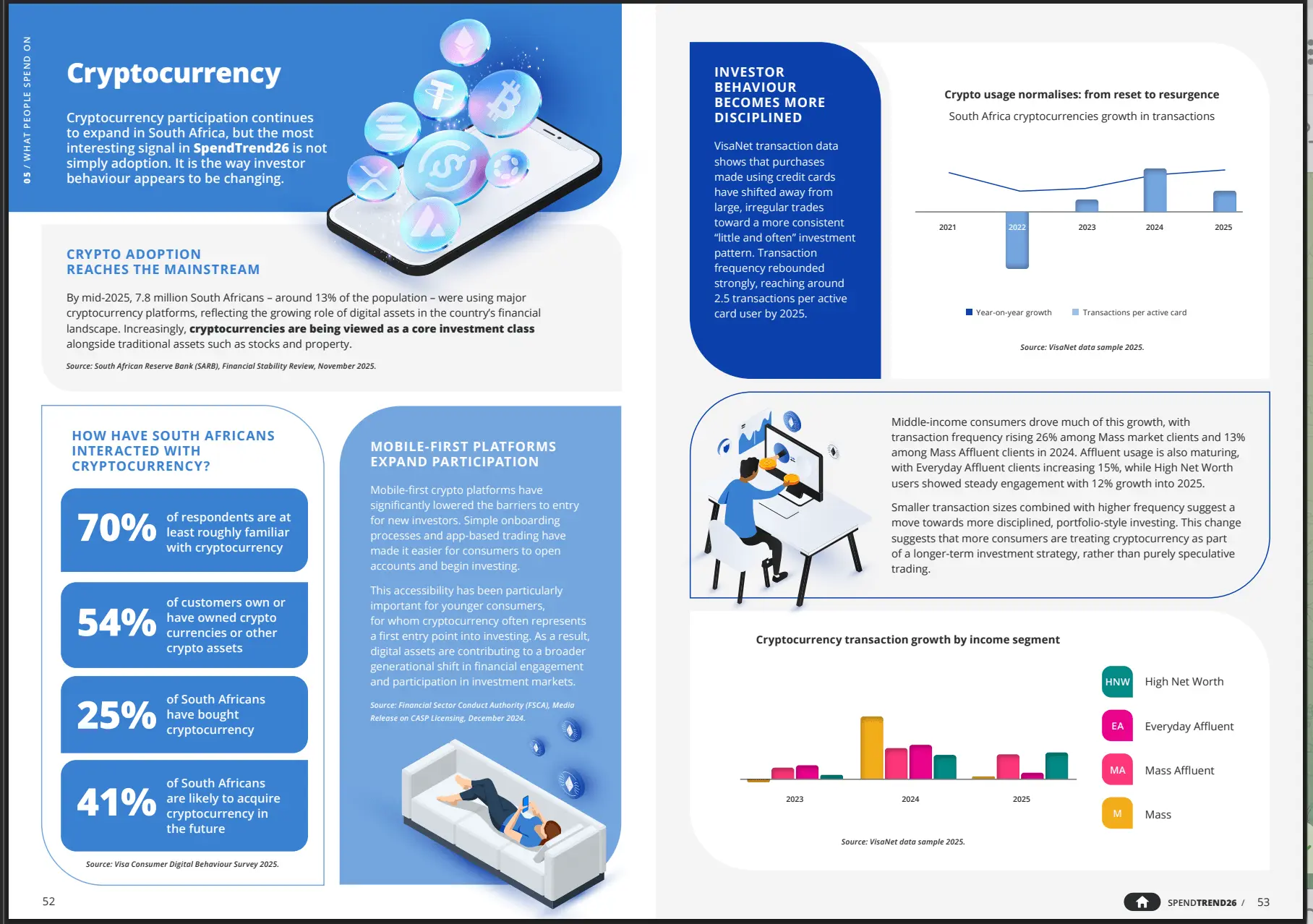
This mainstreaming effect is largely driven by the rise of mobile-first platforms, which have lowered barriers to entry through simplified onboarding and user-friendly, app-based trading. For many younger consumers, these digital assets now serve as their primary entry point into the broader world of financial investment.
“Increasingly, cryptocurrencies are being viewed as a core investment class alongside traditional assets such as stocks and property,” the report states.
Demographics of Growth
Perhaps the most striking finding in the report is the evolution of investor behavior. Visanet transaction data shows that South Africans are increasingly abandoning large, irregular trades in favor of a “little and often” strategy. This shift suggests a move toward disciplined, portfolio-style investing where crypto is treated similarly to traditional assets such as stocks or property.
Transaction frequency has rebounded strongly, reaching an average of 2.5 transactions per active card user by 2025. This pattern of smaller, more frequent purchases indicates that consumers are integrating digital assets into their long-term financial planning rather than chasing short-term market spikes.
The growth is particularly pronounced among middle-income and mass-market consumers. In 2024, transaction frequency among mass-market clients jumped by 26%, while the mass-affluent and everyday-affluent segments also showed double-digit increases. Even the high-net-worth segment maintained steady engagement, with 12% growth heading into 2025.
This broad-based participation suggests that the “ crypto reset” of previous years has paved the way for a more stable resurgence. With 41% of South Africans stating they are likely to acquire cryptocurrency in the future, the data points to a financial future where digital assets are no longer an outlier but a fundamental component of the national economy.
Disclaimer: The information on this page may come from third parties and does not represent the views or opinions of Gate. The content displayed on this page is for reference only and does not constitute any financial, investment, or legal advice. Gate does not guarantee the accuracy or completeness of the information and shall not be liable for any losses arising from the use of this information. Virtual asset investments carry high risks and are subject to significant price volatility. You may lose all of your invested principal. Please fully understand the relevant risks and make prudent decisions based on your own financial situation and risk tolerance. For details, please refer to
Disclaimer.
Related Articles
ARK 2026 Bitcoin Outlook: ETFs + DAT account for 12% of supply, and an estimated crypto market cap of 28 trillion by 2030
ARK Big Ideas 2026 points out that institutions adopting acceleration and the ETF+DAT merger have already secured BTC 12% of the circulating supply, and governments and state governments are gradually buying in to form long-term support. In 2025, it retraced to the lowest level in history, and volatility declined. By 2030, the market value is expected to be about $28 trillion, BTC about $4.2 trillion, with annual growth of 60–61%. In emerging markets, stablecoins replace some BTC reserve-demand, and long-term investors should focus on structural buy orders and risk management.
ChainNewsAbmedia3m ago
Fidelity Digital Assets Q2 Report: Bitcoin Dominance Rising, On-Chain Data Shows Stabilization Signals
Gate News message, April 27 — Fidelity Digital Assets released its Q2 2026 Signal Report, highlighting stabilization signals across multiple on-chain metrics despite early second-quarter consolidation in the crypto market.
Bitcoin's market dominance continued to rise, with capital concentrating
GateNews25m ago
New Altcoins Outperform Older Tokens in 2025, Data Shows Divergence in Exchange Performance
Gate News message, April 27 — In 2025, newly launched altcoins significantly outperformed older tokens, marking a shift in how liquidity is allocated across the crypto market. While older altcoins posted net losses between 18% and 23%, newly listed altcoins in 2025 retained 5% in net gains,
GateNews2h ago
Europe's MiCA Framework Makes Euro Stablecoin 'Safe but Uncompetitive,' Blockchain Association Reports
Gate News message, April 27 — The Blockchain for Europe association released a report on Monday that concludes the European Union's Markets in Crypto-Assets Regulation (MiCA) framework has significantly enhanced the safety of euro stablecoins but simultaneously undermined their commercial
GateNews3h ago
Global Crypto Funds Record $1.2B Weekly Inflows as Bitcoin Leads Institutional Capital Surge
Gate News message, April 27 — Global crypto investment products issued by asset managers including BlackRock, ARK 21Shares, and Fidelity recorded $1.2 billion in net inflows last week, according to CoinShares data. Bitcoin-based products led the charge with $932.5 million, pushing year-to-date bitco
GateNews6h ago
Bernstein: Crypto Market Shows Structural Strength, Bitcoin Poised for Extended Bull Market
Gate News message, April 27 — Investment research firm Bernstein has released a report indicating that cryptocurrency market fundamentals are steadily improving, with Bitcoin's recent $60,000 low establishing a clear bottom. The asset is now approaching $80,000 and is positioned to enter a longer-te
GateNews6h ago


