The Bitcoin mining industry is facing severe challenges. As the coin price falls, energy prices skyrocket, and geopolitical risks heat up, many miners find themselves trapped in a vicious cycle of “the more they mine, the more they lose.”
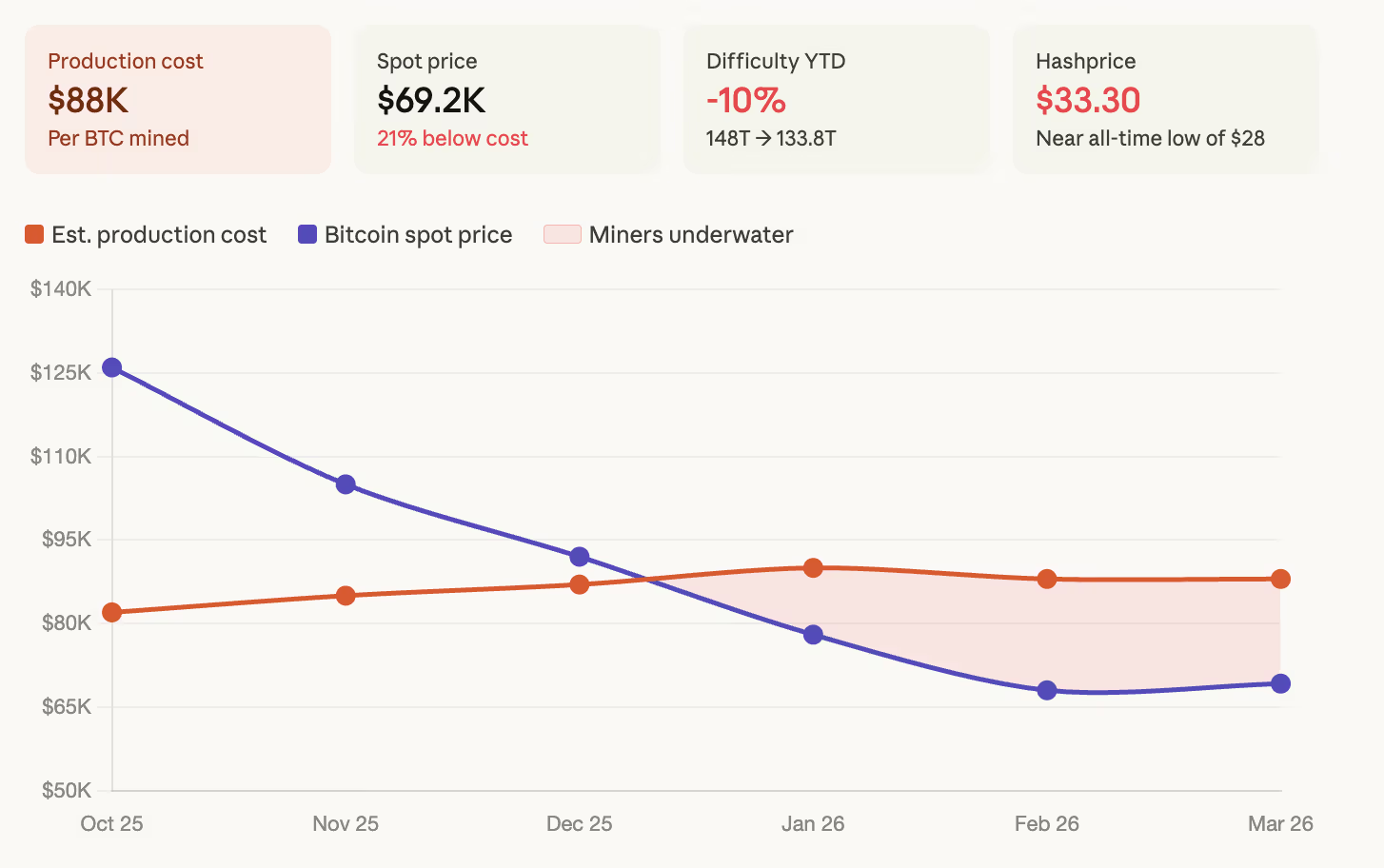
The on-chain data platform Checkonchain’s “Difficulty Regression Model (Difficulty Regression Model, which estimates average production costs based on network difficulty and energy投入)” shows that as of March 13, the cost to mine 1 Bitcoin has surged to $88,000.

However, as of the time of writing, the spot price of Bitcoin has been fluctuating around $68,000. This means that for every 1 Bitcoin produced, miners have to absorb losses of nearly $20,000; translated into block terms, mining 1 block results in a 21% loss.
A Cost Storm and Geopolitical Pressure: Oil Prices Break $100, a Deadline That Could Prove Fatal
Since last October, when Bitcoin slid from a $126,000 peak and kept plunging until it fell below the $70,000 mark, mining firms’ profit margins have been continuously squeezed. And the Iranian conflict that has recently erupted has become the final straw that breaks profitability.
International oil prices have surged past the $100 per-barrel threshold, directly driving up the massive electricity bills required for mining. As a result, roughly 8% to 10% of the world’s hash rate—because they are located in regions extremely sensitive to Middle East energy supplies—are taking the hardest hit.
Adding insult to injury, commercial shipping through the Strait of Hormuz, which controls about 20% of global oil and gas transportation, is nearly at a standstill. On top of that, U.S. President Donald Trump issued a “48-hour ultimatum,” threatening to attack Iranian power plants. These cascading geopolitical reactions have left miners even more stuck in uncomfortable circumstances.
Network Data Rings Alarm Bells: Hash Rate Exodus and Block Production Delays
Signs that miners are exiting the market are gradually reflected in network indicators.
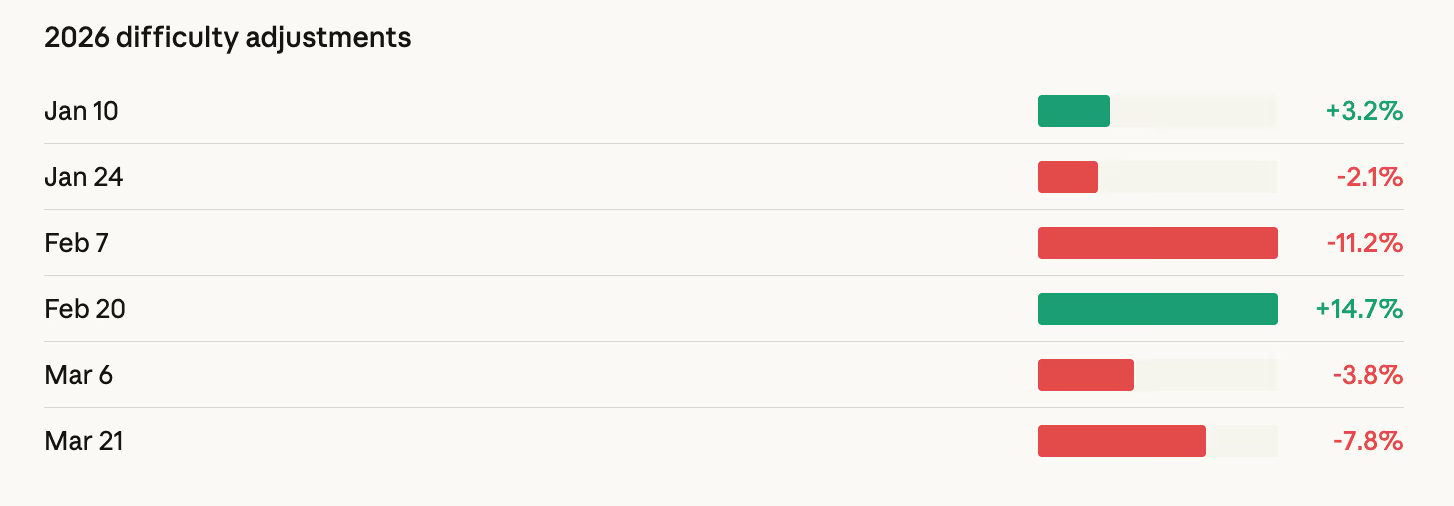
Bitcoin’s mining difficulty has recently been reduced by 7.76% to 133.79 T. This is the second-largest drop in 2026 so far, after the 11.16% difficulty plunge triggered by the “Fern severe winter storm” in February. At present, Bitcoin’s mining difficulty is not only down nearly 10% from the start of the year, but also far below the historical high of nearly 155 T reached in November 2025.
In addition, the network’s total hash rate has retreated sharply to about 920 EH/s, far from the astonishing record set in 2025 of 1 Zetahash (i.e., 1,000 EH/s).
The loss of hash rate has stretched the average block production time to 12 minutes and 36 seconds during the previous difficulty adjustment cycle, far exceeding Bitcoin’s original design of 10 minutes.
A Selling Rush Is Emerging: Not Just an Industry Crisis, but a Structural Market Risk
According to the hash rate index published by Luxor mining pool, “Hashprice,” which measures miners’ expected revenue per unit of hash rate, is currently hovering around $33.30 per day per PH/s. This figure is nearly at the break-even threshold for most mining rigs, leaving only a step between it and the historical low of $28 set on February 23.
When revenues don’t cover costs, miners’ only way to keep going is to “sell Bitcoin for cash.”
This kind of forced dump unquestionably adds heavy selling pressure to a market that was already weak. After all, currently as much as 43% of Bitcoin holdings in the market are in a losing position, and large whale investors are also offloading at higher prices during rebounds. In addition, positions with high leverage are dominating price movements. In other words, the pressure facing miners is not only an industry problem—it is gradually evolving into an important variable affecting the market’s structure.
A Do-or-Die Survival Play for Mining Companies: Marching Toward AI and Hash Rate Transformation
Faced with the predicament of “losing money every day you mine,” listed mining companies have begun pursuing transformation. They are extending their massive computing resources into artificial intelligence (AI) and high-performance computing (HPC) in hopes of securing more stable cash flow than mining can provide. Mining giants, including Marathon Digital and Cipher Mining, have all started expanding data centers on the basis of their existing mining sites.
According to CoinWarz’s data projections, the next mining difficulty adjustment is expected to fall in early April, and it will very likely be lowered further. If Bitcoin’s price still fails to return to the $88,000 mining cost line for a long time, this “miner exodus wave” is bound to keep spreading.
Disclaimer: The information on this page may come from third parties and does not represent the views or opinions of Gate. The content displayed on this page is for reference only and does not constitute any financial, investment, or legal advice. Gate does not guarantee the accuracy or completeness of the information and shall not be liable for any losses arising from the use of this information. Virtual asset investments carry high risks and are subject to significant price volatility. You may lose all of your invested principal. Please fully understand the relevant risks and make prudent decisions based on your own financial situation and risk tolerance. For details, please refer to
Disclaimer.
Related Articles
Next Crypto Breakout: 3 Altcoins Poised for Massive Upside
CHZ breaks resistance with strong volume, driven by sports and fan engagement demand.
XMR hits all-time high, fueled by privacy demand and strong trading volume.
ATOM rebounds from lows, holding support while building momentum toward higher resistance levels.
The crypto market
CryptoNewsLand58m ago
Kalshi Traders Forecast XRP to Hit $1.60 in April
Kalshi traders predict XRP will reach $1.60 in April amid rising demand and significant ETF inflows. With a bullish technical outlook and upcoming regulatory votes, XRP's market dynamics show potential for further gains, despite risks of declining support levels if outcomes are unfavorable.
CryptoFrontier2h ago
Solana Adoption Surges to 167M While Usage and Price Diverge
Key Insights
Solana reached 167 million holders, signaling strong adoption growth even as active addresses declined, showing a widening gap between ownership and usage trends.
Institutional interest increased as DeFi Development Corp accumulated over 2.22 million SOL, reinforcing long-term c
CryptoNewsLand4h ago
Shiba Inu Forecast: Range-bound Moves Shift After Bullish Golden Cross
SHIB consolidates near $0.0000058 amid declining volume and reduced market participation.
Bullish golden cross signals short-term momentum shift despite ongoing range-bound price action.
Key support at $0.00000562 holds focus, with breakout targets near $0.00000625 and higher.
Shiba
CryptoNewsLand7h ago
Pudgy Penguins Price Analysis: $0.008 Could Trigger the Next Big Move
PENGU shows steady growth, signaling accumulation rather than short-term speculation.
Buyers dominate spot and futures markets, strengthening current bullish momentum.
$0.008 resistance remains key, with breakout or consolidation likely next.
Pudgy Penguins — PENGU, has started showing a
CryptoNewsLand8h ago
The Strait of Hormuz is fully reopened, and Bitcoin surged to 78K. MicroStrategy (MSTR) jumped 12%.
Iran announces that the Strait of Hormuz is fully open; oil prices fall sharply as supply concerns ease, and U.S. stock indexes hit record highs. Bitcoin once surged to $78,333 and lifted MicroStrategy’s stock price by 12% in a big jump. Market-wide sentiment improves, and cryptocurrencies also show signs of capital inflows.
ChainNewsAbmedia13h ago


