I. What Is a Prediction Market—and Why Is It Called a “Price Oracle for the Real World”?
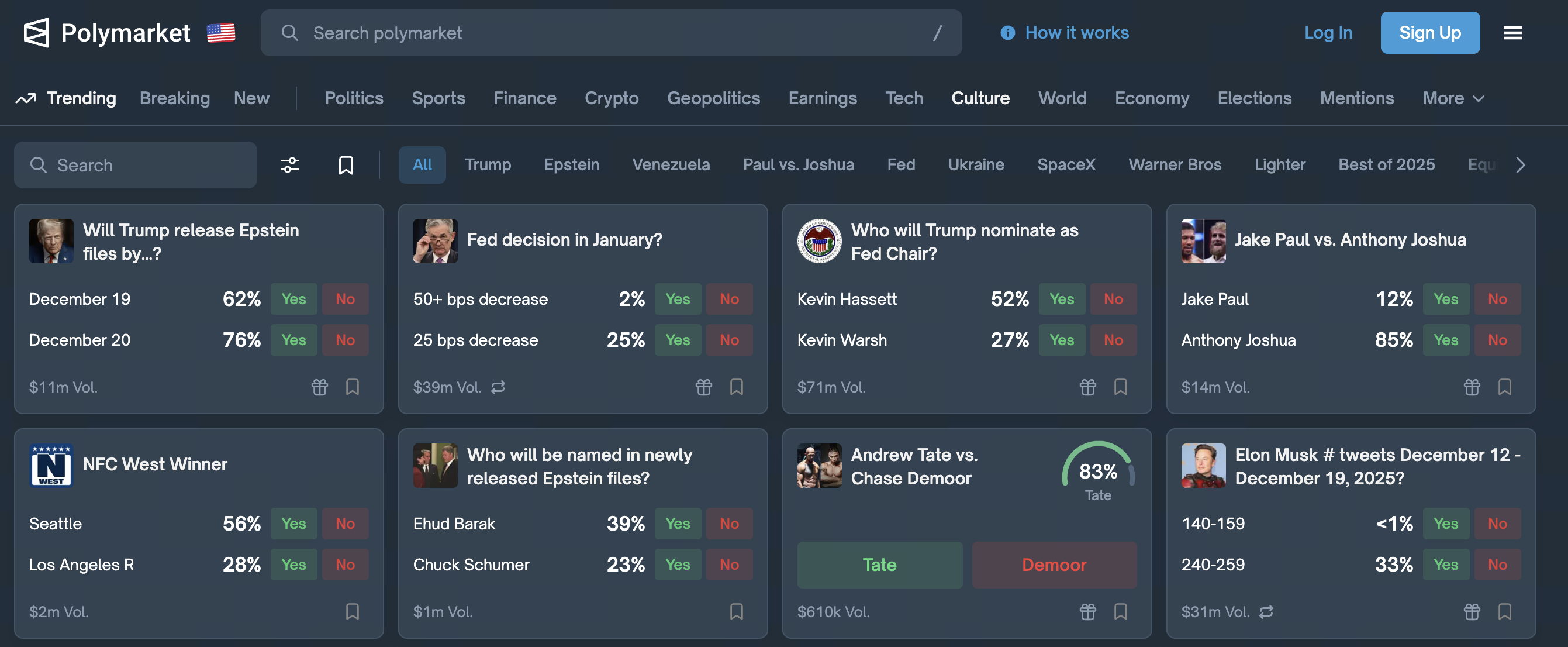
Image:https://polymarket.com/
A prediction market is a probability-aggregation system built on market mechanisms. Participants trade contracts tied to future events, and the market price reflects the collective assessment of how likely those events are to occur.
In simple terms: Prediction markets use trading to produce real-time probabilities for future events.
Example:
- A contract for a candidate winning a U.S. election rises from 0.45 to 0.62 → the market now estimates a 62% chance of victory (up from 45%).
- A contract predicting whether an ETF will be approved by a certain date trades at 0.30 → the market assigns a 30% probability.
Why Are Prediction Markets More Effective Than Polls or Surveys?
- Skin in the game: Participants put real money at risk, so information has a cost.
- Continuous price discovery: Markets constantly update prices as new information emerges.
- Ongoing trading: Probabilities adjust dynamically in real time.
Because of these properties, prediction markets are often described as:
- A sentiment barometer
- A market-based pricing engine for future probabilities
- The best aggregator of information (the “wisdom of crowds”)
II. The Value of Prediction Markets: More Than Betting—A Systemic Information and Asset Layer
Prediction markets offer far more than simple “long or short” speculation. Their real value lies in:
1. Forming society-level probability consensus
Major events—such as economic policy changes, political outcomes, or industry-shaping decisions—can be priced by the market in real time, reflecting a collective view of likelihood.
2. Turning expectations into tradable assets
Future events can be tokenized and traded, which is an area where blockchain technology is particularly powerful.
3. A practical tool for hedging real-world risk
Examples include:
- Companies hedging against policy or regulatory uncertainty
- Investors managing macroeconomic event risk
- Industry participants trading outcomes tied to regulation or approvals
4. Delivering the most authentic market signals
Compared with polls, news coverage, or social media sentiment, prediction markets are harder to manipulate because participation requires real economic commitment.
A widely cited view: Prediction markets are one of the cheapest and most accurate engines for aggregating information and measuring collective sentiment.
III. Why On-Chain Prediction Markets Entered an Acceleration Phase in 2025
The years 2024–2025 mark an ideal window for the rapid growth of prediction markets, driven by several structural factors coming together at the same time:
1. A High Concentration of Global Macro Events (elections, interest rates, tech cycles)
More events lead to more trading opportunities, which naturally drives liquidity growth.
2. Growth in Crypto Users and Capital Flowing into Derivatives
As user sophistication increases, participants are more willing to trade future outcomes rather than focus solely on token price movements.
3. L2 Performance Advances Bring On-Chain Trading Closer to CEX Experience
Low fees and high-throughput blockchains enable prediction markets to function as truly real-time markets.
4. Mature Data and Oracle Infrastructure
Reliable oracles make settlement more transparent, accurate, and faster.
5. Prediction Markets Become a Core Application of On-Chain Information Financialization
Any future event can be structured as a tradable asset, unlocking a vast new market.
VII. Prediction Markets Are Information Finance—Not Gambling
The key to understanding prediction markets is not to view them as simple bets on outcomes, but to recognize them as:
- A mechanism for aggregating information
- A pricing system that reflects future probabilities
- An on-chain derivatives market
- A real-time indicator of collective sentiment
- A new financial product category
Prediction markets are not a new idea. What is new is that Web3 has, for the first time, given them:
- Global accessibility
- Full on-chain transparency
- Fast and reliable settlement
- Robust oracle infrastructure
This is why, in 2025, prediction markets have emerged as one of the most actively discussed and fastest-growing verticals in the crypto space.