PopulusEuphratica

vip
Age 1.6 Yıl
Peak Tier 1
No content yet
Still chasing airdrops? The real game has changed, and the scoreboard is the stablecoin balance.
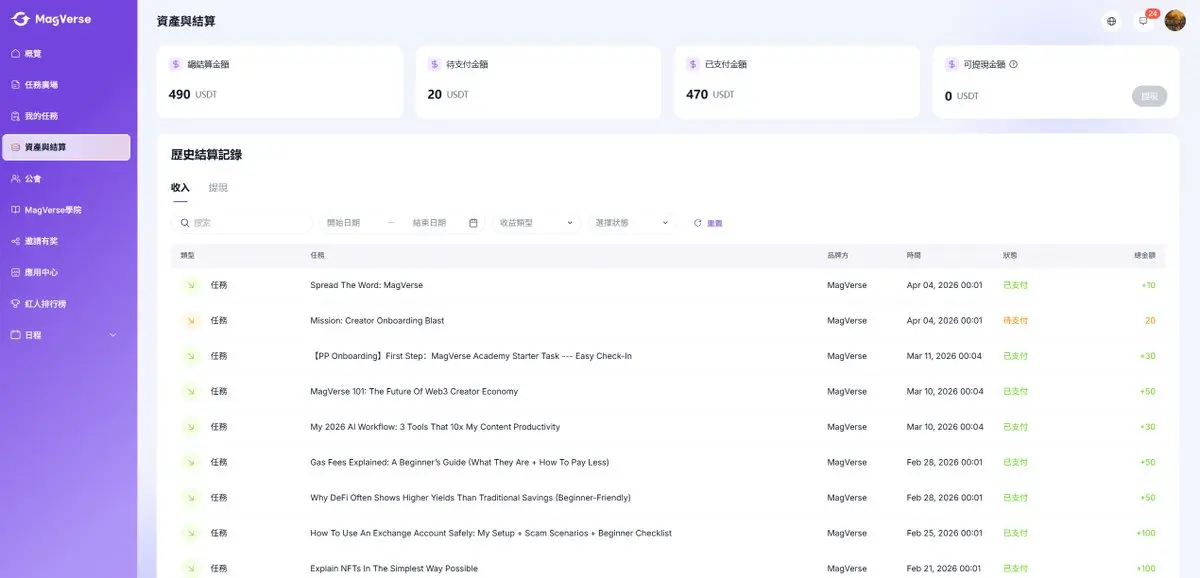
Just now, I received another deposit in my wallet, the reason being a reward from a tweet I posted last week about modular blockchain.
If you're still anxious about vague leaderboard rankings;
If you're still playing the active user in countless Discords;
If you're still praying that some project will remember your contribution in the future;
Then let me tell you: you are participating with your time and creativity in a well-designed financial game with an almost zero expected return.
A
ZK0,26%
View Original
post-image
  • Reward
  • Comment
  • Repost
  • Share
I increasingly believe that the next phase of competition in DeFi is not about product features but about participation structure.
A key breakthrough lies in how it simplifies the user onboarding process to the extreme.
Create a wallet with one click, mobile-first, directly enter trading.
This seems like UX optimization but essentially reduces the cognitive threshold.
Allowing users to access the system without needing to understand complex mechanisms.
Adding social features and leaderboards.
New users don't need to explore on their own but can follow directly.
@easydotfunX this
View Original
  • Reward
  • Comment
  • Repost
  • Share
I've been pondering a question: why does the on-chain capital scale keep growing, yet genuine long-term capital remains absent?
The answer is actually quite clear—without certainty, there is no long-term allocation.
@TermMaxFi's emergence has provided the first structural solution to this problem, transforming short-term speculation into a manageable capital activity through fixed-term assets.
Depositing is not just about providing liquidity; it's about entering a return structure with a clear time boundary.
Lending is no longer about entering and exiting at will but about matching aro
View Original
post-image
  • Reward
  • Comment
  • Repost
  • Share
Recently, I’ve noticed a clear trend: creators are shifting from traffic-driven to skill-driven approaches.
In the past, the more followers you had, the more opportunities you had; now, it’s gradually becoming about whether you can consistently produce high-quality content.
During this process, I also noticed @MagVerse_AI. What they do is actually very simple but crucial: using AI to match content tasks and on-chain settlement to ensure earnings.
Their system connects content creation needs with your output, and directly settles payments after completion. This structure is actually close
View Original
post-image
  • Reward
  • Comment
  • Repost
  • Share
My initial reaction to @RiverdotInc was actually skepticism; the cross-chain stablecoin track has already been over-discussed.
But what truly made me reevaluate it was the layer of non-financial design they deliberately implemented.
River didn't stop at liquidity abstraction; it took a step further by integrating contribution into the system structure.
The problem with traditional DeFi is clear: profit distribution only considers capital, resulting in the system becoming hollow once liquidity is withdrawn.
River aims to solve this fundamental issue by allowing three types of behavior t
PTS-25,14%
View Original
post-image
  • Reward
  • Comment
  • Repost
  • Share
Most people underestimate a fact: the strongest driving force behind Web3 has never been technology but engagement.
One good thing is that it doesn't try to educate users but directly lowers the understanding barrier.
The rule is simple: participation earns a ticket to enter the draw, whether through payment or completing social tasks.
This design is essentially reconstructing the entry threshold for users, not to make you understand DeFi, but to let you participate first; when participation is simple enough, network effects will truly occur.
Looking at another layer of @watchdotfun's
View Original
post-image
  • Reward
  • Comment
  • Repost
  • Share
I've been pondering a question repeatedly lately: why do most cross-chain infrastructures ultimately stay at the tool level?
The answer is actually quite simple—it's because they solve the path problem, not the structural problem.
@konnex_world's difference lies in its attempt to skip this step altogether.
It doesn't confine itself to bridges or routing but focuses on what happens after the connection.
Moving assets across is just the beginning; what's truly important is how they are used and how they continue to generate value.
That's also why I reevaluate Konnex—it’s designed more
View Original
post-image
  • Reward
  • Comment
  • Repost
  • Share
  • Pin