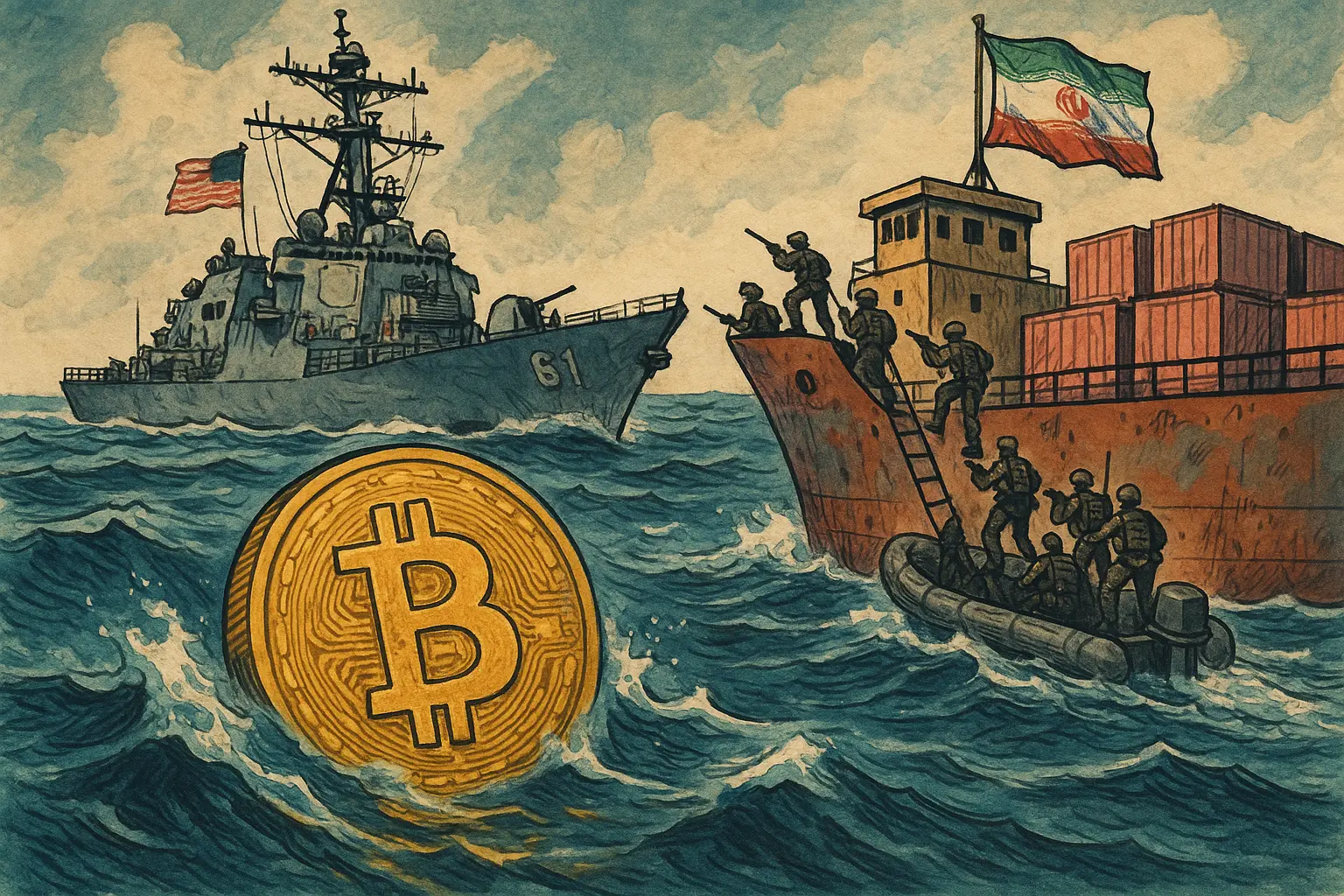
A U.S. Navy destroyer, the “USS Spruance,” on Sunday blew up the engine room of the Iranian cargo ship “Tosca” in the Gulf of Oman and seized it, triggering a flight-to-safety mood in the market. During Monday’s Asian trading session, Bitcoin fell 2.5%, trading near $73,996. Iran’s military immediately vowed direct retaliation against U.S. Navy vessels, and Brent crude briefly surged to $97.50. Market attention shifted to the ceasefire deadline on Wednesday; whether diplomatic talks can take place as scheduled remains uncertain.
Details of the Seizure Incident: Gunfire after a Six-Hour Refusal to Stop
A statement from U.S. Central Command said that the “Tosca” repeatedly refused to comply with stop warnings for as long as six hours. The U.S. later ordered the crew to evacuate the engine room, and fired several rounds from a 5-inch MK45 naval gun at the engine room to disable the ship’s power. The U.S. Marine Corps then boarded the vessel and took control. Trump confirmed on social media that the ship “tried to break through our naval blockade, but it didn’t go smoothly for them,” and said the ship had already been sanctioned by the U.S. Treasury Department beforehand.
Iran’s Joint Command Center said the boarding action was illegal, vowed to respond directly, and Iran’s Supreme National Security Council also stated that traffic-control measures would continue until the end of hostilities.
Market Impact: Bitcoin Ranges Between 73.9K and 76.2K, Oil Touches $97
In Monday’s Asian session, Bitcoin moved within the $73,886 to $76,165 range, with intraday pressure concentrated in the early part of the day. The total market value of cryptocurrencies was about $1.48 trillion, and trading volume was close to $62 billion. Despite the drop, Bitcoin has still risen 4.3% over the past seven days, and the weekly uptrend remains intact.
Brent crude briefly jumped 7.9% to $97.50 per barrel. Traders expect the situation of disruption or blockade in the Strait of Hormuz to persist. Normally, the Strait of Hormuz carries about one-fifth of global oil and LNG shipments, and it is currently basically idle.
Diplomatic Outlook: Wednesday’s Ceasefire Deadline as the Final Turning Point
Vice President Vance (JD Vance), envoy Steve Witkoff, and Jared Kushner plan to depart for Islamabad on Monday night to attend talks in Tuesday. However, Iran’s state television, citing negotiation representatives, said, “We don’t see any clear prospect for effective negotiations to make progress,” and the negotiation landscape is highly uncertain.
On the same day, Trump warned: “If Iran refuses to accept the conditions, the United States will destroy every power plant and every bridge in Iran.” The direction of Wednesday’s ceasefire deadline will be a key point in determining where geopolitical tensions go and how much the global energy market may fluctuate next.
Common Questions
How does the continued blockade of the Strait of Hormuz affect the global energy market?
In normal circumstances, the Strait of Hormuz carries about one-fifth of the world’s oil and LNG shipments. At present, the strait is basically idle, and Iran has announced that control measures will continue until the end of hostilities, meaning the risk of an energy supply disruption will remain. This standoff has already pushed Brent crude’s single-day gain to 7.9%, approaching the $100 per barrel threshold.
Why did Bitcoin fall during this geopolitical escalation?
In some market conditions, Bitcoin has a safe-haven characteristic, but when geopolitical uncertainty surges, the overall market’s risk sentiment tightening also suppresses Bitcoin. The uncertainty surrounding Wednesday’s ceasefire deadline, combined with the threat of Iran’s retaliation, led investors to reduce their exposure to risk assets in the short term, putting pressure on both Bitcoin and traditional stock markets.
What are the two main scenarios after Wednesday’s ceasefire deadline expires?
If negotiations succeed and result in a postponement or a formal agreement, market safe-haven sentiment is expected to ease, and Bitcoin and energy markets could see a clear rebound. If the ceasefire breaks down and the conflict escalates further—including additional U.S. military actions against Iranian infrastructure—oil and the energy market could keep surging, while risk assets including Bitcoin would face greater downside pressure.
Disclaimer: The information on this page may come from third parties and does not represent the views or opinions of Gate. The content displayed on this page is for reference only and does not constitute any financial, investment, or legal advice. Gate does not guarantee the accuracy or completeness of the information and shall not be liable for any losses arising from the use of this information. Virtual asset investments carry high risks and are subject to significant price volatility. You may lose all of your invested principal. Please fully understand the relevant risks and make prudent decisions based on your own financial situation and risk tolerance. For details, please refer to
Disclaimer.
Related Articles
BDX (Blindex) down 1.76% in 24 hours
Gate News update, April 22, according to Gate market data, as of the time of writing, BDX (Blindex) is trading at $0.22. It is down 1.76% over the past 24 hours, with a high of $0.27 and a low of $0.20. The 24-hour trading volume is $3,360.57. The current market cap is approximately $1.71B.
Beldex is a leading privacy dApp ecosystem, made up of decentralized privacy applications, including BChat, BelNet, the Beldex browser, the Beldex protocol, and the Beldex Bridge. The Beldex project is dedicated to enhancing your online privacy.
This message is not investment advice. Investing involves market volatility risk.
GateNews1h ago
Bitcoin Breaks Through $78,000, Ethereum Hits $2,390: Market Panic Eases
Bitcoin breaks through $78,000, while Ethereum climbs above $2,390. This article reviews the V-shaped reversal trend from April 13 to 22, analyzing the evolution of liquidation data and the Fear and Greed Index.
GateInstantTrends1h ago
Meme Coin Market Cap Surges 15.58% in 30 Days, Trading Volume Jumps 56.14%
Meme coins outpaced BTC over the last 30 days: market cap up 15.58% to about $35.6B and trading volume up 56.14% to roughly $3.79B, per Ai Yii; BTC rose 14.06%.
Abstract: The meme-coin segment showed stronger recent gains than Bitcoin. Meme coins' market capitalization increased by 15.58% to about $35.6 billion, with trading volume up 56.14% to roughly $3.79 billion, according to on-chain analyst Ai Yii, while Bitcoin's market cap rose 14.06%.
GateNews2h ago
SHIB Struggles to Recover as Fresh Developments Fail to Lift Price Action
SHIB trading activity rises, but price stays trapped in a tight consolidation range.
Whale accumulation increases while some long-term holders, including Aoki, exit positions.
Strong derivatives volume and inflows fail
CryptoNewsLand3h ago
TradFi Rise Alert: XUNCE (XUNCE 03317.HK) Rises Over 8%
Gate News: According to the latest Gate TradFi data, XUNCE (XUNCE 03317.HK) has surged by 8% in a short period. Current volatility is significantly higher than recent averages, indicating increased market
GateNews4h ago
Ethereum Breaks $2,400, Up 3.58% in 24 Hours
Gate News message, April 22 — Ethereum surged past the $2,400 mark today, trading at $2,400.85 with a 24-hour gain of 3.58% according to major CEX data.
GateNews4h ago


