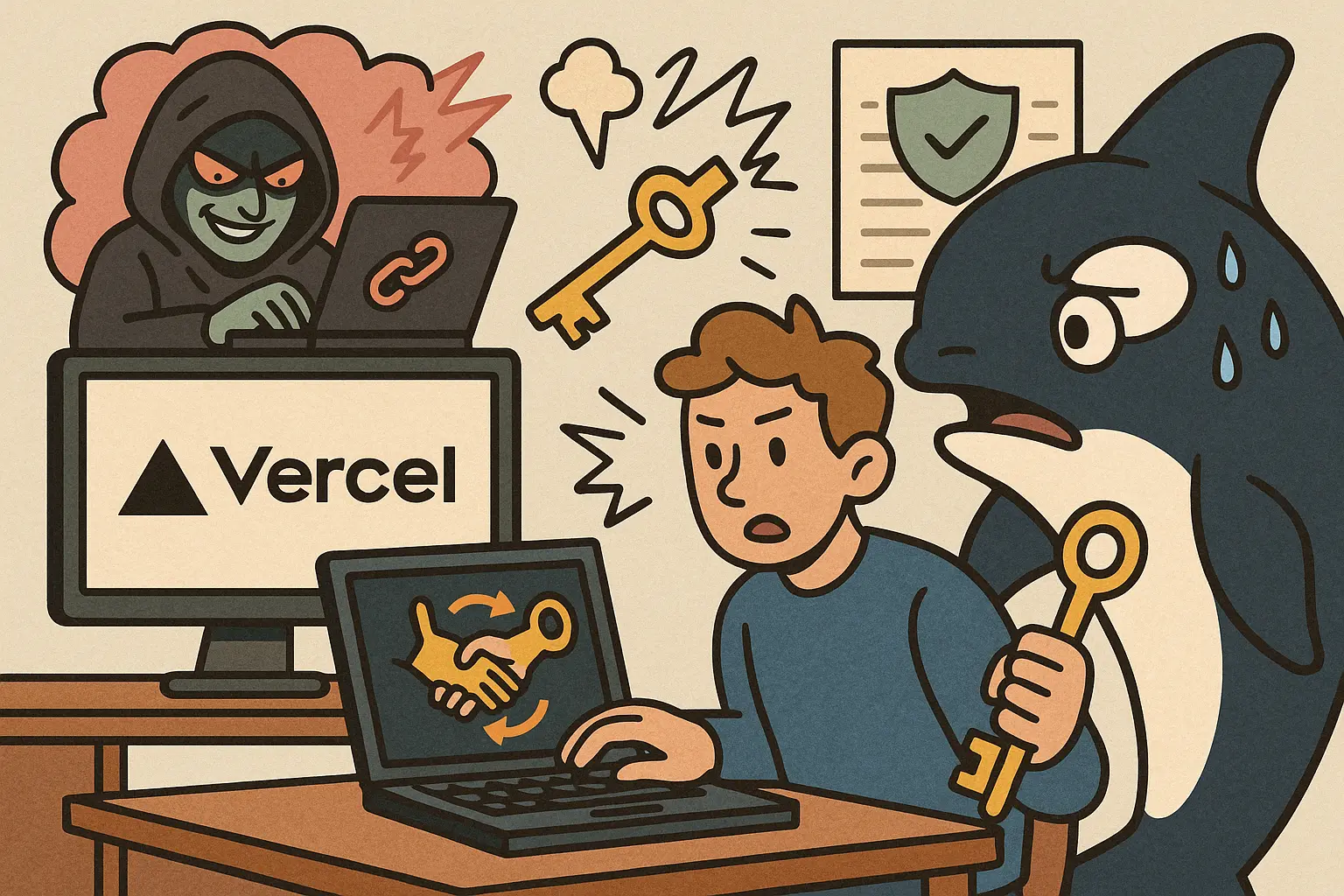
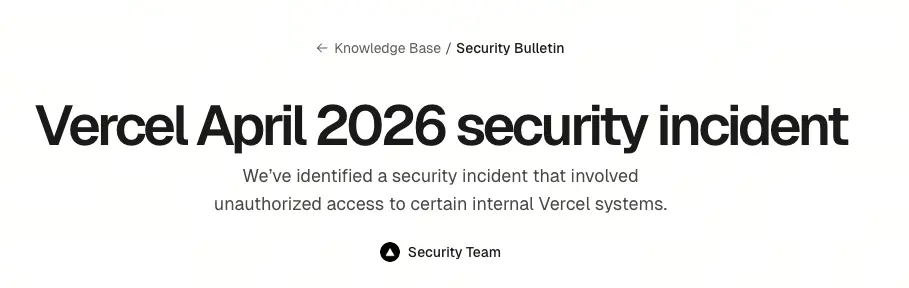
Decentralized exchange Orca announced on April 20 that it has completed a comprehensive rotation of encryption keys and credentials in response to a security incident involving the cloud development platform Vercel, confirming that its on-chain contracts and users’ funds were not affected. Vercel disclosed on Sunday that the attackers accessed parts of the platform’s internal systems through a third-party AI tool that integrates with Google Workspace OAuth.
Attack Path: An AI OAuth Supply Chain Flaw, Not a Direct Attack on Vercel Itself
 (Source: Vercel)
The attack path in this incident was not a direct targeting of Vercel, but instead involved a third-party AI tool that had previously been compromised in an earlier, larger-scale security incident. It used its Google Workspace OAuth integration permissions to access Vercel’s internal systems. Vercel said that the tool previously affected hundreds of users across multiple organizations.
This kind of supply chain vulnerability is difficult for traditional security monitoring to detect because it leverages trusted integration services rather than a direct code vulnerability. Developer Theo Browne noted that the most severely affected was the internal Vercel integration with Linear and GitHub. Information the attacker could potentially access includes: access keys, source code, database records, and deployment credentials (including NPM and GitHub tokens). The incident attribution is currently unclear; there have been reports that the seller demanded a ransom from Vercel, but the details of the negotiations were not disclosed.
Unique Risks for Crypto Frontends: Attacks on the Hosting Layer vs. Traditional DNS Hijacking
This incident highlights a long-overlooked attack surface in crypto frontend security:
Key Differences Between the Two Attack Modes
DNS-Layer Hijacking: Attackers redirect users to a spoofed website, which can typically be detected relatively quickly through monitoring tools
Hosting Layer (Build Pipeline) Compromise: Attackers directly modify the frontend code delivered to users. Users visit the correct domain but may unknowingly run malicious code
In the Vercel environment, if environment variables are not marked as “sensitive,” they may be leaked. For crypto protocols, these variables typically contain critical information such as API keys, private RPC endpoints, and deployment credentials. Once leaked, attackers may tamper with deployed versions, inject malicious code, or access backend services to carry out broader attacks. Vercel has urged customers to immediately review environment variables and enable the platform’s sensitive variable protection features.
Implications for Web3 Security: Supply Chain Dependence Is Becoming a Systemic Risk
This incident affects not only Orca but also reveals a deeper structural problem to the entire Web3 community: the growing dependence of crypto projects on centralized cloud infrastructure and AI integration services is creating a new attack surface that is difficult to defend against. When any trusted third-party service is compromised, attackers can bypass traditional security defenses and directly affect users. Crypto frontend security has moved beyond the scope of DNS protection and smart contract audits; comprehensive security governance for cloud platforms, CI/CD pipelines, and AI integrations is becoming an essential defensive layer that Web3 projects cannot ignore.
Frequently Asked Questions
How did this Vercel security incident affect crypto projects that use Vercel?
Vercel said the number of affected customers was limited and that the platform service was not interrupted. However, because many DeFi frontends, DEX interfaces, and wallet connection pages are hosted on Vercel, project teams are advised to immediately review environment variables, rotate any keys that may have been exposed, and confirm the security status of deployment credentials (including NPM and GitHub tokens).
What specific risks does “environment variable leakage” entail in crypto frontends?
Environment variables typically store sensitive information such as API keys, private RPC endpoints, and deployment credentials. If these values leak, attackers could tamper with frontend deployments, inject malicious code (for example, forged wallet authorization requests), or access backend connection services to carry out broader attacks—while the domain the user visits still appears normal on the surface.
Were Orca users’ funds affected by this Vercel incident?
Orca has explicitly confirmed that its on-chain contracts and users’ funds were not affected. This key rotation was carried out as a precautionary measure out of caution, not based on any confirmed loss of funds. Because Orca uses a non-custodial architecture, even if the frontend is affected, ownership and control of on-chain assets remain with the users themselves.
Disclaimer: The information on this page may come from third parties and does not represent the views or opinions of Gate. The content displayed on this page is for reference only and does not constitute any financial, investment, or legal advice. Gate does not guarantee the accuracy or completeness of the information and shall not be liable for any losses arising from the use of this information. Virtual asset investments carry high risks and are subject to significant price volatility. You may lose all of your invested principal. Please fully understand the relevant risks and make prudent decisions based on your own financial situation and risk tolerance. For details, please refer to
Disclaimer.
Related Articles
North Korean Lazarus Group Deploys Mach-O Man Malware to Steal Crypto Wallet Credentials from macOS Users
Lazarus releases Mach-O Man for macOS to steal keychain data and wallet credentials, targeting crypto executives via ClickFix pop-ups and compromised Telegram meetings.
Abstract: The article reports that the Lazarus-linked Mach-O Man malware targets macOS to exfiltrate keychain data, browser credentials, and login sessions to access cryptocurrency wallets and exchange accounts. Distribution relies on ClickFix social engineering and compromised Telegram accounts directing victims to fake meeting links. The piece ties the operation to the April 20 Kelp DAO hack and identifies TraderTraitor as Lazarus-affiliated, noting rsETH movement across blockchains via LayerZero’s OFT standard.
GateNews11m ago
ZachXBT Warns Against Bitcoin Depot ATM Over 44% Bitcoin Markup
ZachXBT warns Bitcoin Depot ATMs impose steep premiums—$25k fiat at $108k/BTC vs ~$75k market (about 44%), leading to ~ $7.5k loss on 0.232 BTC; also notes a $3.26M security breach.
This article summarizes ZachXBT's warnings about Bitcoin Depot's pricing practices and a recent security breach, highlighting risks from inflated rates and security lapses for users.
GateNews2h ago
Privacy Protocol Umbra Shuts Down Frontend to Block Attackers from Laundering Stolen Kelp Funds
Gate News message, April 22 — Privacy protocol Umbra has shut down its frontend website to prevent attackers from using the protocol to transfer stolen funds following recent attacks, including the Kelp protocol breach that resulted in losses exceeding $280 million. Approximately $800,000 in stolen
GateNews3h ago
Misty 23pds Alert: Lazarus Group releases a new macOS toolkit targeting cryptocurrencies
Misty’s Chief Information Security Officer 23pds issued an alert on April 22, stating that the North Korean hacking group Lazarus Group has released a new native macOS malware toolkit called “Mach-O Man,”专a专专专專專專 specialized in the cryptocurrency industry and high-value enterprise executives.
MarketWhisper5h ago
Venus Protocol 攻擊者轉移 2301 枚 ETH,流入 Tornado Cash 清洗
According to the on-chain analyst Ai Auntie’s monitoring on April 22, the Venus Protocol attacker transferred 2,301 ETH (about $5.32 million) to address 0xa21…23A7f 11 hours ago, then moved the funds in batches into the crypto mixer Tornado Cash for laundering; as of the time of monitoring, the attacker still held about $17.45 million worth of ETH on-chain.
MarketWhisper7h ago


