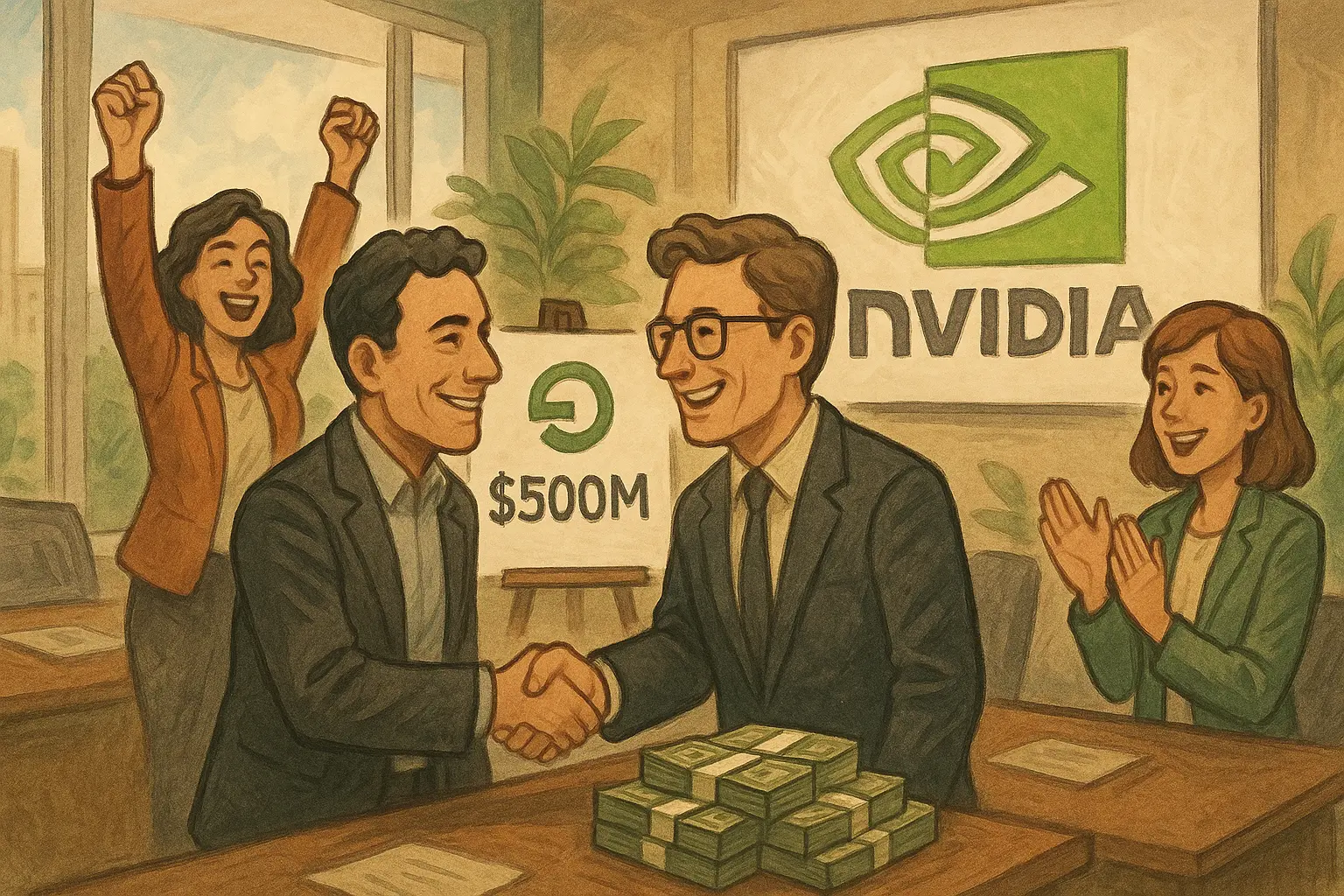
According to a report by the UK’s Financial Times, Recursive Superintelligence, a new UK AI startup that was founded only about four months ago, has completed at least $500 million in funding, with a pre-money valuation of $4 billion. This round was led by GV (formerly Google Ventures), with participation from Nvidia.
Funding round details
According to the Financial Times, the main terms of this funding round are as follows: pre-money valuation of $4 billion; target funding of at least $500 million; led by GV, with Nvidia participating; due to oversubscription, the final amount of funding could reach $1 billion. Recursive Superintelligence completed its company registration in London, UK, around the end of 2025, and has not yet made an official public debut to date.
Founder team background
According to the Financial Times and public information, the main members of the founding team of Recursive Superintelligence are as follows:
Richard Socher: Former Chief Scientist at Salesforce
Tim Rocktäschel: AI professor at University College London (UCL) and former Chief Scientist at Google DeepMind; previously involved in research on the Genie interactive world model
Josh Tobin, Jeff Clune, Tim Shi: All from OpenAI
Other members: From Google and Meta
R&D goals and industry background
According to the Financial Times, Recursive Superintelligence’s goal is to build AI systems that can continuously improve themselves without human intervention—meaning the model can autonomously generate training data and update its own parameters, removing human engineers from the training cycle. The Financial Times also notes that these concepts are still in the research stage and have not yet been validated through long-term testing.
According to Crunchbase data, in the first quarter of 2026 the global startup funding total reached an all-time high of $300 billion, with OpenAI, Anthropic, xAI, and Waymo accounting for the bulk of it. Recursive Superintelligence is one of the AI new labs spun out from—or created by—major technology companies in the recent period. Similar organizations include Thinking Machines Lab, Safe Superintelligence, Ineffable Intelligence, and Advanced Machine Intelligence Labs.
Frequently asked questions
What is the funding size of Recursive Superintelligence, and who are its key investors?
According to the Financial Times, Recursive Superintelligence has completed at least $500 million in funding, with a pre-money valuation of $4 billion. The round is led by GV (formerly Google Ventures), with Nvidia participating; due to oversubscription, the final funding size could reach $1 billion.
What are the main backgrounds of Recursive Superintelligence’s founding team?
According to public information, members of the founding team include Richard Socher, former Chief Scientist at Salesforce; Tim Rocktäschel, an AI professor at UCL and former Chief Scientist at DeepMind; and Josh Tobin, Jeff Clune, and Tim Shi from OpenAI. The other members are from Google and Meta.
What was the global startup funding total in the first quarter of 2026?
According to Crunchbase data, in the first quarter of 2026 the global startup funding total reached $300 billion, an all-time high, with OpenAI, Anthropic, xAI, and Waymo accounting for the bulk of it.
Disclaimer: The information on this page may come from third parties and does not represent the views or opinions of Gate. The content displayed on this page is for reference only and does not constitute any financial, investment, or legal advice. Gate does not guarantee the accuracy or completeness of the information and shall not be liable for any losses arising from the use of this information. Virtual asset investments carry high risks and are subject to significant price volatility. You may lose all of your invested principal. Please fully understand the relevant risks and make prudent decisions based on your own financial situation and risk tolerance. For details, please refer to
Disclaimer.
Related Articles
Google Research Releases ReasoningBank: AI Agents Learn Reasoning Strategies from Success and Failure
Gate News message, April 22 — Google Research released ReasoningBank, an agent memory framework that enables large language model-driven agents to continuously learn after deployment. The framework extracts universal reasoning strategies from both successful and failed task experiences, storing
GateNews29m ago
SK Telecom and Nvidia Partner on A.X K2 AI Model Under South Korea's Government Initiative
SK Telecom and Nvidia push A.X K2 under Korea’s Proprietary AI Foundation Model initiative, expanding from A.X K1 to a full-stack, open-source AI platform via the Krafton-Rebellions consortium for academic and commercial use.
Abstract: The article reports SK Telecom’s partnership with Nvidia to develop A.X K2 as a successor to A.X K1 under Korea’s government-backed program. The effort aims to create a full-stack, open-source AI platform through a Krafton-Rebellions-led consortium, with research focused on multimodal and vision-language models and open access to A.X models for academia and industry.
GateNews33m ago
Tsinghua Professor Dai Jifeng Launches Naive.ai, Raises ~$300M at $800M Valuation
Gate News message, April 22 — Dai Jifeng, an associate professor at Tsinghua University's Department of Electronic Engineering, has founded Naive.ai, a company focused on open-source model post-training and AI agents. The startup has raised approximately $300 million at an estimated valuation of $80
GateNews53m ago
AWS Expands Multi-Agent AI Workflows, Supports Claude Opus 4.7 on Bedrock
Gate News message, April 22 — Amazon Web Services announced expansion of its agentic AI initiatives through multi-agent workflows, supporting Anthropic's Claude Opus 4.7 on Amazon Bedrock to help customers move beyond generative AI pilots. The company is expanding partner relationships as customers
GateNews1h ago
Zhipu AI Discontinues GLM Coding Plan Unlimited Weekly Quota Subscription on April 30
Gate News message, April 22 — Zhipu AI announced that it will discontinue automatic renewal of the GLM Coding Plan unlimited weekly quota subscription starting at 10:00 AM Beijing time on April 30, 2026.
The discontinuation affects users currently subscribed to the legacy plan with auto-renewal
GateNews1h ago
Anthropic's Claude Code Removal Sparks Developer Backlash; OpenAI Gains Community Support
Anthropic drops Claude Code from Pro plan, drawing criticism as developers migrate to OpenAI; Codex remains free/basic, GPT-5.4 and Image 2.0 boost performance, driving large user migration.
Abstract: The article examines Anthropic's removal of Claude Code from the $20 Pro plan, which triggers backlash from developers who call it a hidden price increase and a reliability risk. It contrasts this move with OpenAI's policy of keeping Codex in free and basic tiers, while highlighting strong model performance from GPT-5.4 and ChatGPT Images 2.0, and notes a rapid migration of users to OpenAI, with Codex reportedly exceeding 4 million weekly active users.
GateNews1h ago


