While decentralized perpetual exchanges, or perp DEXes, clocked an eye-popping $1.2 trillion in volume in October, the data reveals their November tally eased slightly, trading a bit softer than the prior month’s fireworks. While the dip clocked in at just $70 billion, November’s perp DEX haul still loomed 71.7% above September, making it clear the momentum didn’t exactly curl up for a long winter nap.
Perp DEX Momentum Holds Strong With Another Heavyweight Month in November
At its core, a perp decentralized exchange (DEX) in DeFi operates as a DEX where traders lean on smart contracts to trade perpetual futures contracts — derivatives with no expiration date — straight from their own wallets, often with a pinch of leverage.
Everything remains onchain and non-custodial, letting collateral, funding payments, and liquidations play out in full view without a centralized hall monitor meddling in the process. Last month, data from defillama.com shows perp protocols pulled in $1.2 trillion in volume, marking their highest tally to date.
November’s perp DEX volume cooled a bit, slipping just 5.83% after stacking up $1.13 trillion over the 30-day stretch. Defillama.com figures show more than $240 billion flowed through Hyperliquid, while Aster chimed in with $258 billion during the same period. Together, Hyperliquid and Aster logged 44.07% of the total volume. Lighter grabbed the bigger slice, racking up $284 billion — a full 25.13% of the total.
Read more: Blackrock Credits Bitcoin ETFs With Leading Its Global Revenue
The remaining share flowed to perp protocols such as Vertex Edge, Synthetix, ApeX, Dydx, Satori Finance, Orderly Network, Pacifica, Synfutures, Drift, EdgX, Aevo, Jupiter, Reya, and GMX — with EdgX and ApeX both putting up notably competitive volume tallies for November.
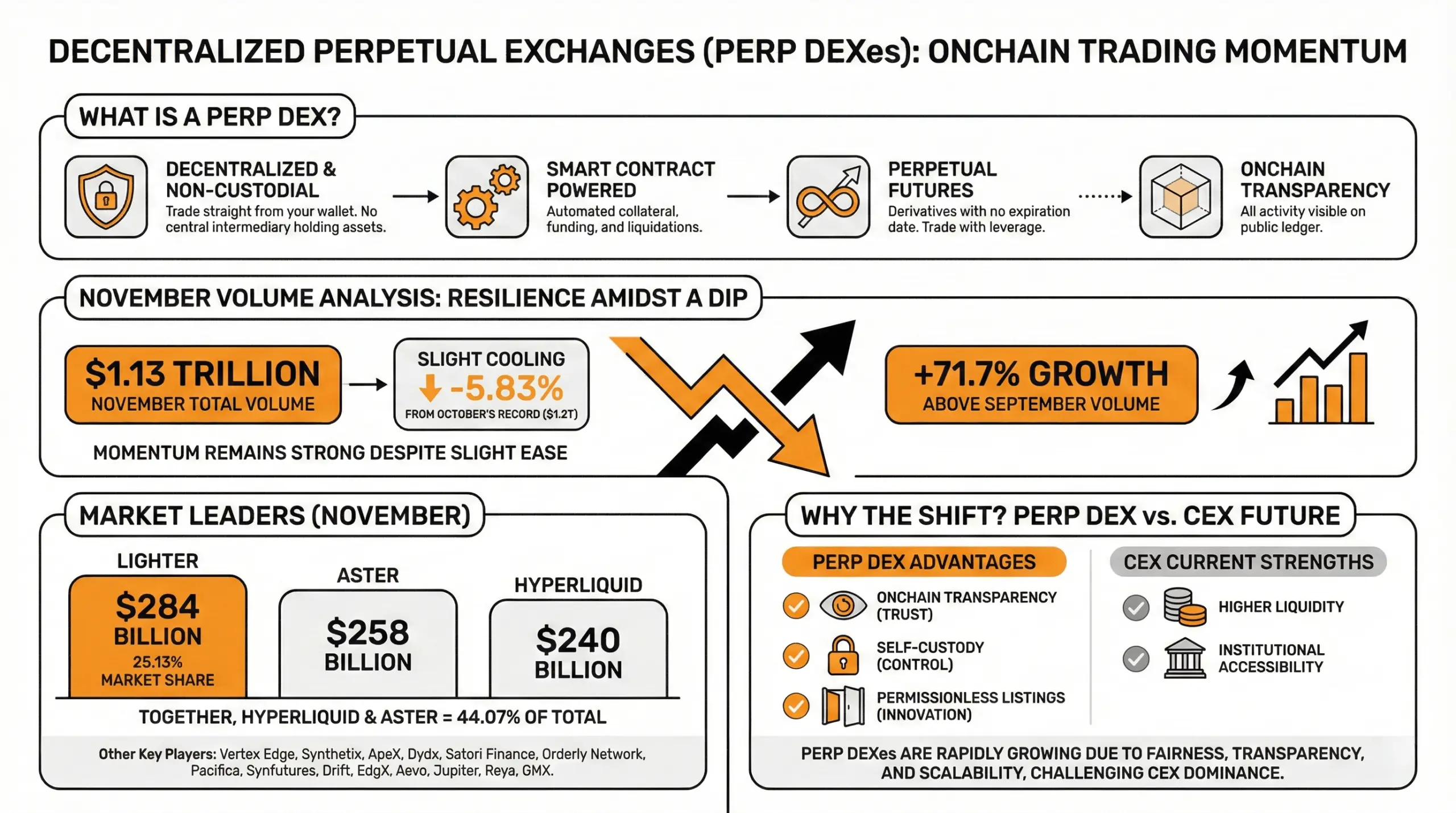
Over the long run, people believe perp DEXes will outpace centralized exchanges (CEXes) mainly because perp DEXes offer onchain transparency, self-custody of assets, and permissionless listings, which build trust and foster innovation in derivatives trading.
Although CEXs currently lead in liquidity and institutional accessibility, perp DEXs are rapidly growing in volume due to their fairness, transparency, and evolving scalability. As November wrapped, the takeaway was clear — even with a slight cooldown, perp DEXes kept the tempo high enough to remind everyone they’re not fading from the main stage anytime soon.
FAQ ❓
- **What is a perp DEX?**A perp DEX is a decentralized exchange that lets traders swap perpetual futures contracts onchain without relying on a centralized intermediary.
- **How much volume did perp DEXes handle in November?**Perp DEXes recorded $1.13 trillion in November, slipping just 5.83% from October’s all-time high.
- **Which platforms led November’s perp DEX activity?**Hyperliquid, Aster, and Lighter dominated the month, collectively handling a large share of total onchain derivatives volume.
- **Why are traders shifting toward perp DEXes?**Traders favor perp DEXes for transparency, self-custody, and permissionless access, which continue to draw volume from centralized exchanges.
Disclaimer: The information on this page may come from third parties and does not represent the views or opinions of Gate. The content displayed on this page is for reference only and does not constitute any financial, investment, or legal advice. Gate does not guarantee the accuracy or completeness of the information and shall not be liable for any losses arising from the use of this information. Virtual asset investments carry high risks and are subject to significant price volatility. You may lose all of your invested principal. Please fully understand the relevant risks and make prudent decisions based on your own financial situation and risk tolerance. For details, please refer to
Disclaimer.
Related Articles
BTC falls 0.49% in 15 minutes: fragile long leverage and active sell-off pressure resonate to weigh on the short term
From 18:00 to 18:15 (UTC) on 2026-04-17, the BTC price fluctuated and trended downward within the 77097.4 to 77573.2 USDT range. Over these 15 minutes, the return rate recorded -0.49%, and the amplitude reached 0.61%. During this period, market trading was active; short-term volatility was amplified, and trading attention increased significantly. The main driver behind this abnormal move is that the overall leverage structure is bearish and long positions are fragile. At present, the BTC perpetual contract funding rate has remained negative for 11 consecutive days, indicating that the bears have the upper hand in the market. In addition, futures open interest (OI) is about 628.3 billion USDT, which is at a historical high. During the anomaly window, trading volume increased noticeably. On-chain data shows large amounts of BTC flowing from long-term holder addresses to exchanges, suggesting that active sell orders may have triggered longs to passively reduce positions, amplifying downward price pressure. Moreover, institutional positioning enthusiasm in the mainstream contract market has cooled off; liquidity boundaries have tightened, causing large-trade activity to have an amplified effect on market volatility. In the options market, implied volatility rose to 39.81%, increasing demand for downside protection and reflecting a defensive posture among market participants. Macro-environment volatility and some capital flowing into safe-haven assets, together with the recent regulatory uncertainty-related historical events, reinforced the move, pushing overall market risk appetite lower. Current BTC leverage risks still remain. If, in the future, there are concentrated sell-offs, volatility may be further amplified. It is recommended to continue monitoring sustained high OI levels, the persistence of negative funding rates, and on-chain transfers of large amounts of funds, and to stay alert for whale behavior and any disruptions to market sentiment caused by macro-policy developments. For subsequent price action, please watch key support levels, institutional and whale on-chain moves, and relevant global market news, and guard against short-term risks.
GateNews1h ago
Bitcoin Liquidations Hit $815M as BTC Surges Above $78K Amid Iran Strait Opening
Over $815 million in leveraged cryptocurrency positions were liquidated recently, mainly due to short positions against Bitcoin. Markets improved as Iran reopened the Strait of Hormuz and Trump hinted at a deal with Iran, boosting Bitcoin prices significantly.
GateNews1h ago
XRP Consolidation Signals Reset as Bullish Setup Emerges
XRP has recently rebounded to $1.39 after trading between $1.20 and $1.40 due to improved market sentiment. A significant drop in futures open interest reflects reduced speculation, while technical indicators suggest a potential bullish breakout, targeting $1.50 and possibly $1.80.
CryptoNewsLand2h ago
BTC drops 0.45% in 15 minutes: Whale concentrated transfers into exchanges stack up sell pressure while leverage withdrawals amplify the pullback
From 17:00 to 17:15 (UTC) on 2026-04-17, BTC saw a brief drop. The return rate recorded was -0.45%, with the price ranging from 77354.3 to 77916.9 USDT and a swing of 0.72%. During the event, market attention warmed up, volatility intensified, and spot market liquidity changed significantly.
The main driver of this price anomaly was that whale wallets concentrated transfers to exchanges. In a single 15-minute period, the exchange inflow surged to 11,000 BTC, reaching a new high since December 2025. The average amount deposited per transaction was as high as 2.25 BTC, indicating that large holders chose key price levels to concentrate and release their positions, clearly lifting sell pressure. At the same time, BTC futures open interest fell to a 14-month low of $841 million, as leverage funds exited sharply. The spot market’s pull on price fluctuations became the main factor, further magnifying the impact of whale trading.
In addition, although ETF funds had a net inflow with a hedging effect—bringing the April cumulative inflow to $5.651 billion—within this anomaly window they were not able to fully absorb large sell orders. The spot market mainly relied on institutional buying to digest the selling pressure, and overall risk appetite contracted. On-chain data shows that 41% of the BTC supply is in a loss-making range, and some holders who bought at lower prices face take-profit and stop-loss pressure. With multiple factors converging, short-term tension formed among exchange inflows, leverage withdrawal, profit realization, and institutions’ ability to absorb, increasing the magnitude of spot volatility.
Short-term risks are worth watching closely. Users should closely monitor core indicators such as the subsequent exchange inflow volume, the pace of ETF net inflows, and futures open interest. If whale sell orders still have not eased and ETF inflows cannot accelerate in step, the BTC price may remain under sustained pressure. Users should focus on on-chain transfers and changes in major holders’ positions, watch the spot market’s key support ranges and trading structure, obtain more market information in a timely manner, and stay alert to risks brought by sharp volatility.
GateNews2h ago


