A new report on the state of bitcoin mining in Latam found that the region is lagging in bitcoin mining adoption, even as it holds vast energy resources. While Paraguay holds the fourth place in global hashrate, Hashrate Index picked Brazil and Venezuela as the nations to follow.
Key Takeaways:
- A 2026 Hashrate Index report highlights Latam’s mining growth, noting Paraguay holds 4.3% of global hashrate.
- Brazil grew its Bitcoin hashrate by 133% YoY as miners secure lower tariffs directly from energy generators.
- Future Venezuela operations can leverage its potential by capturing stranded energy via OFAC licenses.
Hashrate Index’s Latam Bitcoin Mining Report Highlights Brazil’s and Venezuela’s Potential
While the global share of bitcoin mining hashrate is dominated by nations like the U.S., China, and Russia, Latam might be on the verge of becoming a larger player in this market.
According to Hashrate Index’s “The State of Bitcoin Mining in Latin America (2026)” report, while Paraguay has the fourth place of countries hosting the most bitcoin hashrate with 43 EH/s and 4.3% of the global hashrate, Brazil and Venezuela have the potential to grow and turn Latam into a Bitcoin mining superpower.
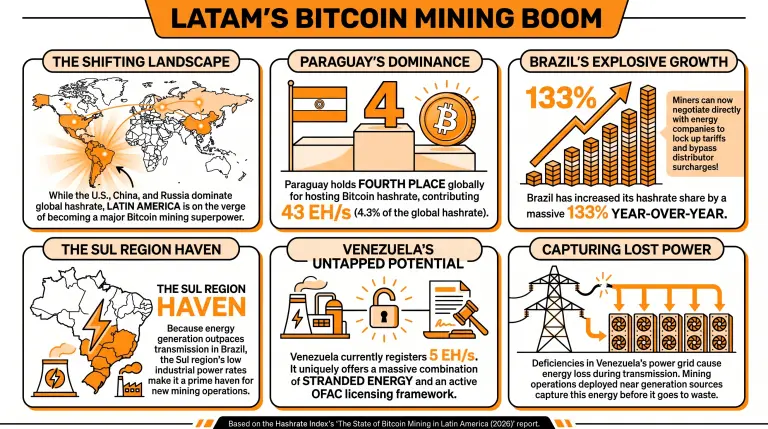
Brazil, which has increased its hashrate share by 133% year-over-year, has opened new opportunities for miners, as they can now negotiate directly with companies in the energy generation market to lock up tariffs, bypassing distributor tariffs and other surcharges.
While the report stresses that energy generation outpaces transmission, the Sul region, with its low industrial power rates, can become a bitcoin mining haven for companies seeking to enter the bitcoin mining industry.
Venezuela, on the other hand, shows an untapped potential, as it registers 5 EH/s even under the current conditions. The report states:
“What Venezuela has, and what no other country in Latin America has at the same scale, is a combination of stranded energy and an OFAC licensing framework that is already opening up the country’s energy,”
Due to deficiencies in the power grid, a large portion of the power generated cannot be transmitted to the final consumer. Bitcoin mining operations deployed near generation sources could capture it before it gets lost in transmission.
“The template for private capital entering Venezuela’s energy sector with OFAC authorization already exists. Bitcoin miners can leverage the same legal structure,” the report concluded.
Disclaimer: The information on this page may come from third parties and does not represent the views or opinions of Gate. The content displayed on this page is for reference only and does not constitute any financial, investment, or legal advice. Gate does not guarantee the accuracy or completeness of the information and shall not be liable for any losses arising from the use of this information. Virtual asset investments carry high risks and are subject to significant price volatility. You may lose all of your invested principal. Please fully understand the relevant risks and make prudent decisions based on your own financial situation and risk tolerance. For details, please refer to
Disclaimer.
Related Articles
GSR Debuts BESO ETF With Bitcoin, Ethereum, Solana
GSR debuts BESO ETF with active strategy, adjusting Bitcoin, Ether, and Solana allocations weekly to outperform benchmarks.
ETF records nearly $5M in first-day volume, signaling early investor interest in diversified crypto investment products.
Launch aligns with growing ETF momentum as
CryptoFrontNews26m ago
Iranian situation latest update: Control over the Strait of Hormuz is upgraded, and Bitcoin is consolidating around $77,000
On April 25, Iran once again escalated its Strait of Hormuz control measures. Bitcoin hovered around $77,500, gold was $4,709, and Brent crude was above $106. With fresh geopolitical turmoil, how will the three major assets move in tandem?
GateInstantTrends39m ago
Drivechain Architect Paul Sztorc Unveils August Bitcoin Hard Fork With 1:1 BTC Coin Split
Bitcoin developer and Drivechain architect Paul Sztorc announced a new Bitcoin hard fork called eCash, set to launch this August, giving every BTC holder an equal number of eCash coins at the time of the split.
Key Takeaways:
Paul Sztorc announced eCash, a new Bitcoin hard fork dropping in Augus
Coinpedia1h ago
Michael Saylor: Bitcoin’s winter is over; institutional and sovereign adoption could fuel the next uptrend
Gate News message, April 25 — Michael Saylor, co-founder of MicroStrategy, said "winter's over" as Bitcoin climbed to approximately $78,000, signaling a shift in market sentiment.
According to analyst Mati Greenspan, recent market moves since the flash crash have been corrections within a broader bull market, with Bitcoin's bottom now in place. Greenspan believes the next leg of gains will be driven by "sovereign adoption," including central banks adding BTC alongside gold to their reserves.
Governments and institutions are increasingly incorporating Bitcoin into their holdings. The U.S. government currently holds approximately 300,000 BTC and has discussed establishing a strategic Bitcoin reserve. El Salvador continues making daily purchases, while the U.K. government and several U.S. state pension funds have added Bitcoin to their asset allocations.
GateNews3h ago
Bitcoin Faces $1.315B in Short Liquidations Above $81,596; $1.168B in Long Liquidations Below $74,236
Gate News message, April 25 — According to Coinglass data, if Bitcoin breaks above $81,596, short positions across major CEXs would face cumulative liquidations of $1.315 billion. Conversely, if BTC falls below $74,236, long positions would encounter cumulative liquidations of $1.168
GateNews3h ago


