KAITO is the native utility token of the Kaito ecosystem, designed to unify exchange, incentives, and governance within the crypto information network under a single set of executable rules. The token represents more than just an asset for trading—it also reflects the weight of each participant’s role in the platform: those who contribute valuable content, engage long-term, or take on governance responsibilities all see their efforts recognized within the token system.
As AI and Web3 integration accelerates, the competition for information is shifting from “who posts first” to “who can consistently generate verifiable signals.” Without a well-designed token mechanism, platforms can easily become driven by short-term traffic, resulting in an overload of low-quality content, distorted incentives, and weakened governance. KAITO’s tokenomics are crucial because they aim to connect attention, reputation, and resource allocation through layered incentives and stake-based voting—ultimately enhancing the network’s long-term collaborative efficiency.
This article is structured as follows: it first examines the specific uses of KAITO on the platform, then explains how issuance and allocation support growth objectives, outlines the governance participation process, and finally assesses the token’s long-term sustainability from both market value and risk-return perspectives to provide a comprehensive evaluation framework.
Core Functions and Use Cases of the KAITO Token
KAITO serves three primary functions: network currency, incentive medium, and governance weight.
-
Network currency: The platform requires a unified unit of value for settlement and collaboration across its various modules. Whether it’s ecosystem activities, user interactions, or future product expansions, a tradable, measurable base asset is essential. KAITO acts as the “connector” at this foundational level.
-
Incentive medium: For the InfoFi network to continually generate high-quality information, incentives for real users are essential—algorithms alone are not enough. KAITO supports community participation, creator rewards, ecosystem expansion, and liquidity building, effectively translating “contribution” into quantifiable returns. This shifts the platform’s growth model from one-time user acquisition to sustained engagement.
-
Governance weight: Governance is the engine for platform evolution, not just a formality. When tokens are staked, participants gain direct influence over parameter adjustments, resource allocation, and mechanism optimization. This design not only increases transparency but also ensures that long-term participants play a greater role in shaping the rules.
From a growth perspective, these three layers are mutually dependent: without the currency layer, incentives can’t be settled; without incentives, it’s hard to retain quality content and users; without governance, incentive parameters can’t be dynamically adjusted. KAITO’s value lies in enabling all three to work together within a single system.
Token Issuance and Allocation Mechanism
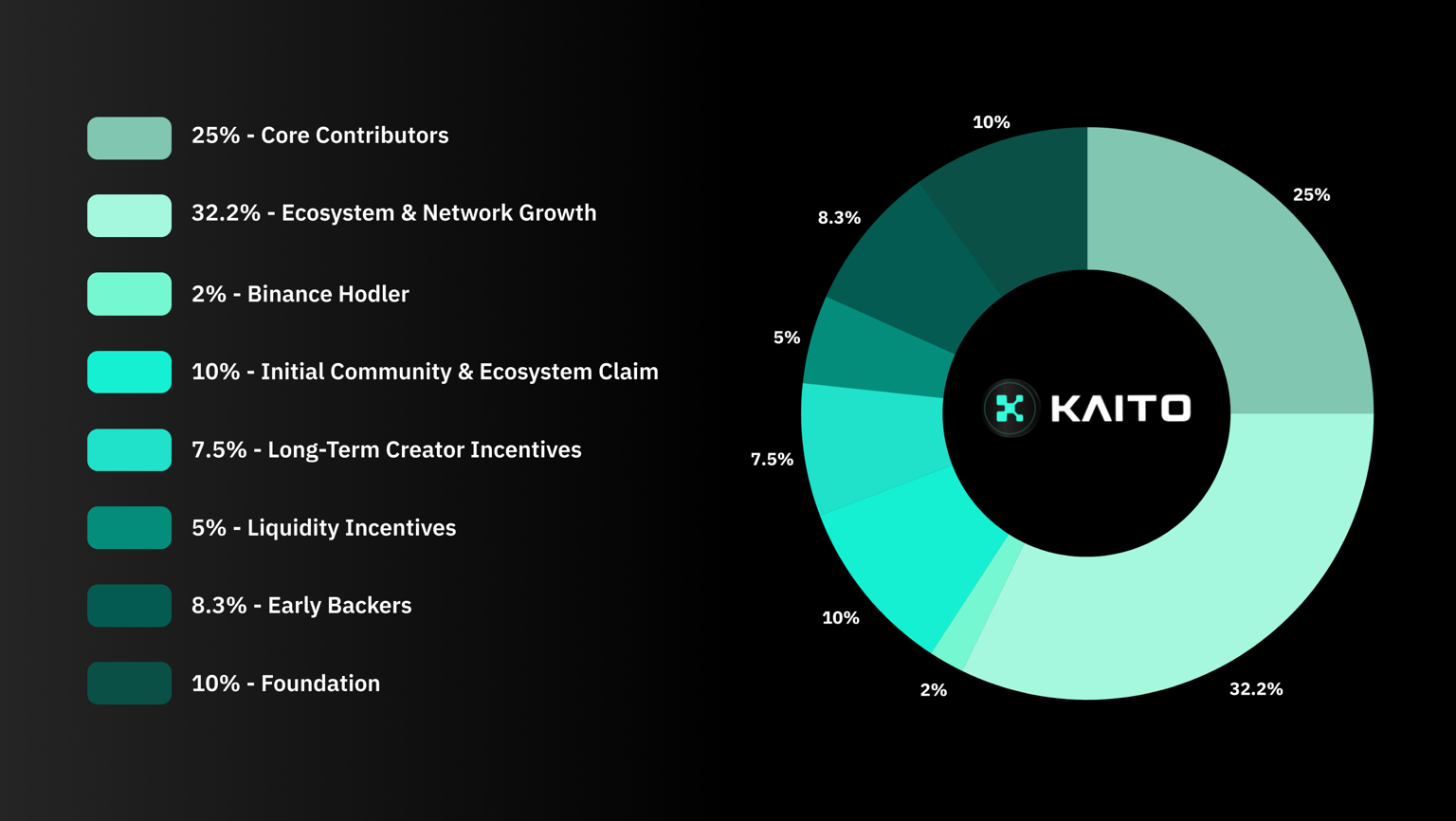
Source: Kaito Official Documentation
Evaluating a token model’s health means looking beyond “who gets what”—it’s also about “why it’s allocated this way, when it enters circulation, and what constraints are in place.”
KAITO’s allocation structure, based on public information, reserves a significant share for community and ecosystem pools—including ecosystem and network growth, initial community incentives, long-term creator rewards, and liquidity incentives. Additional allocations go to the foundation, core contributors, early supporters, and partners. This structure is clearly geared toward long-term development: more resources are reserved for network expansion and ongoing engagement, rather than concentrating most tokens among short-term speculators.
Three core principles shape this allocation mechanism:
-
Growth budget: The ecosystem pool ensures ongoing investment in product iteration, community expansion, partnership development, and market education, so the platform can continue growing even during market volatility.
-
Behavioral guidance: Creator and community incentives operate in parallel, making “high-quality contributions” more rewarding than “short-term volume manipulation,” thereby improving content quality.
-
Long-term alignment: Allocations to the team and early supporters are typically subject to vesting and phased release, aligning their interests with the platform’s long-term success.
Market participants should closely monitor dynamic indicators such as actual circulating supply, phased unlocks, staking ratios, and trading depth. Many tokens look balanced in static allocation charts, but concentrated unlocks can still trigger short-term sell pressure. For KAITO, allocation ratios indicate whether the structure is reasonable, but the pace of circulation ultimately determines how the price holds up.
Effective governance participation isn’t just about voting—it’s about being willing to commit long-term resources for decision-making power. In KAITO’s system, staking and voting weight are linked, so participants must lock tokens to express long-term commitment rather than making impulsive, short-term decisions.
In practice, governance focuses on three main areas:
- Adjusting incentive parameters
- Prioritizing ecosystem resource allocation
- Optimizing rules or algorithms for quality and fairness
For regular holders to truly participate in governance, three steps are essential: first, understanding the proposal’s goals and execution costs; second, assessing its impact on different stakeholders; third, tracking outcomes after voting, rather than treating the process as complete once the vote is cast. Only by maintaining a “proposal—vote—execution—review” cycle can governance build lasting credibility.
From the platform’s perspective, governance quality directly impacts token value stability. If the system can continually self-correct, the market’s long-term outlook improves; if governance is weak or participation is low, the token becomes more vulnerable to external sentiment swings.
KAITO’s Market Value and Long-Term Potential
KAITO’s market value is shaped by four core factors: usage demand, liquidity, narrative strength, and macro cycles.
- Usage demand forms the foundation. If the platform’s settlement, incentive, and governance activities keep growing, demand for the token becomes organic. If use cases weaken, prices are more easily swayed by short-term speculation.
- Liquidity affects price stability. With deep trading, prices are less sensitive to large trades; with thin liquidity, even small trades can drive volatility. Early liquidity incentives help, but long-term effectiveness depends on organic trading demand.
- Narrative strength sets the ceiling. AI and Web3 remain hot sectors, and the InfoFi story attracts attention. However, sustained valuation depends on tangible outcomes—like user retention, ecosystem activity, governance efficiency, and product innovation.
- Macro cycles drive risk appetite. Crypto markets are highly volatile, and factors like external liquidity, regulatory expectations, and risk sentiment all influence KAITO’s valuation. Long-term potential comes from the accumulation of stability and execution over time, not one-off events.
Risk and Return Analysis for KAITO Investors
Before considering returns, it’s important to recognize that KAITO remains a high-risk crypto asset—its price and liquidity can change dramatically in a short period.
Potential returns come from three main sources:
- Ecosystem-driven demand growth: As the platform expands and use cases stabilize, the token may gain stronger value support.
- Participatory rewards: Staking, liquidity provision, and governance incentives can provide additional returns.
- Revaluation: Improved long-term market expectations can lead to periodic price premiums.
Key risks include:
- Volatility: Crypto markets are highly volatile, and short-term prices may diverge from fundamentals.
- Unlock risk: Scheduled token releases can increase supply and create selling pressure.
- Mechanism risk: If incentives are gamed, content quality and governance efficiency can suffer.
- Regulatory risk: Changes in platform policies, regulatory approaches, or trading environments can directly impact token use cases.
- Competitive risk: The information and data space evolves quickly, with new alternatives emerging constantly—first-mover advantage is not guaranteed to last.
A prudent evaluation strategy is to base investment decisions on mechanism validation: first, assess whether use cases are genuine; second, whether governance is effective; and finally, whether valuation is justified by risk.
Conclusion
The true value of KAITO’s tokenomics lies not in the number of features, but in whether growth, participation, and governance are integrated into a sustainable, executable framework.
When the token meets real demand and governance mechanisms continually optimize incentives, the platform can foster a virtuous cycle of “high-quality content—user retention—ecosystem growth—governance improvement.” If any link fails, token performance is likely to revert to sentiment-driven swings.
Therefore, the most effective way to evaluate KAITO is not by chasing a single metric, but by continuously monitoring systemic synergy: does allocation support long-term development, does circulation match demand, and does governance address real issues? Only when all three are in place can the token model sustainably drive platform growth.







