From the evening of April 7, 2026 to the early morning of April 8, U.S. President Trump announced a temporary ceasefire agreement with Iran, brokered by Pakistan. The ceasefire period will last for two weeks, on the condition that Iran immediately and safely reopens the Strait of Hormuz. Iran has already responded by agreeing to the ceasefire arrangement. After the news was released, the price of Bitcoin quickly broke above the $72,000 mark. In the derivatives market for crypto assets, large-scale forced liquidations appeared within a short time. At the same time, the liquidation amount share of net short positions was significantly higher than usual. CoinGlass data shows that, as of the time of writing, the total crypto market liquidation amount over the past 24 hours reached $596 million, of which liquidations of short positions were about $428 million.

Core Factual Elements of the Ceasefire Agreement
Based on publicly available information, the key terms of this temporary ceasefire agreement are as follows:
- Announcement time:from the evening of April 7, 2026 to the early morning of April 8, 2026
- Ceasefire duration:two weeks
- Core condition:Iran immediately and safely reopens the Strait of Hormuz
- Mediator:Pakistan
- Iran’s response:has agreed to the ceasefire arrangement
The reaching of this ceasefire agreement marks a partial easing of the previously persistent tense geopolitical situation in the Middle East. As the Strait of Hormuz is a necessary passage for about one-fifth of the world’s seaborne oil trade, the safety of its passage is one of the key focal points of the game in this round of conflict. The setting of the ceasefire conditions directly relates to a reassessment of the risk premium for energy supply chains.
Timeline Characteristics and Scale Distribution of the Liquidation Event
This liquidation event shows a highly concentrated pattern over a short period of time. According to CoinGlass data retrospective analysis, within about sixty minutes after the ceasefire news spread across social media, the crypto derivatives market went through an intensive round of position cleanups. The specific data are as follows:
- Total liquidations in 1h:about $206 million
- Liquidated short positions in 1h:about $136 million
- Total liquidations in 24h:about $596 million
- Liquidated short positions in 24h:about $428 million
- Share of short liquidations:about 72%
- Number of affected accounts (24h cumulative):more than 120,000 accounts
Liquidations mainly occurred in the $69,000 to $72,500 price range. In the volatile trading environment of the preceding days, this zone accumulated a large volume of open interest orders, making it the main liquidity absorption layer during the price rally.
Immediate Shift in Funding Rates and Market Sentiment Indicators
Before and after the liquidation event, funding rates in the perpetual futures market showed significant fluctuations. Before the ceasefire news was announced, funding rates for mainstream trading pairs remained in negative territory or close to neutral, reflecting that the market’s overall positioning leaned toward shorts or a cautious wait-and-see stance. After the news was announced, as short positions were forcibly closed and longs added positions voluntarily, funding rates switched from negative to positive within a short time and climbed rapidly. This indicates that market sentiment completed a shift from risk avoidance to chasing gains within an extremely short time.
This phenomenon reveals the crypto derivatives market’s extremely high sensitivity to macro news. While large swings in sentiment indicators amplify the magnitude of price volatility, they also increase the difficulty for ordinary participants to manage position risk.
Re-examining the Divergence in Bitcoin and Gold Price Reactions
During the geopolitical conflict, the spot gold price kept strengthening and at one point approached historical highs; after the ceasefire agreement was announced, however, the gold price saw a modest pullback. Bitcoin, by contrast, followed the completely opposite path: it faced pressure during the conflict and then surged sharply after the ceasefire.
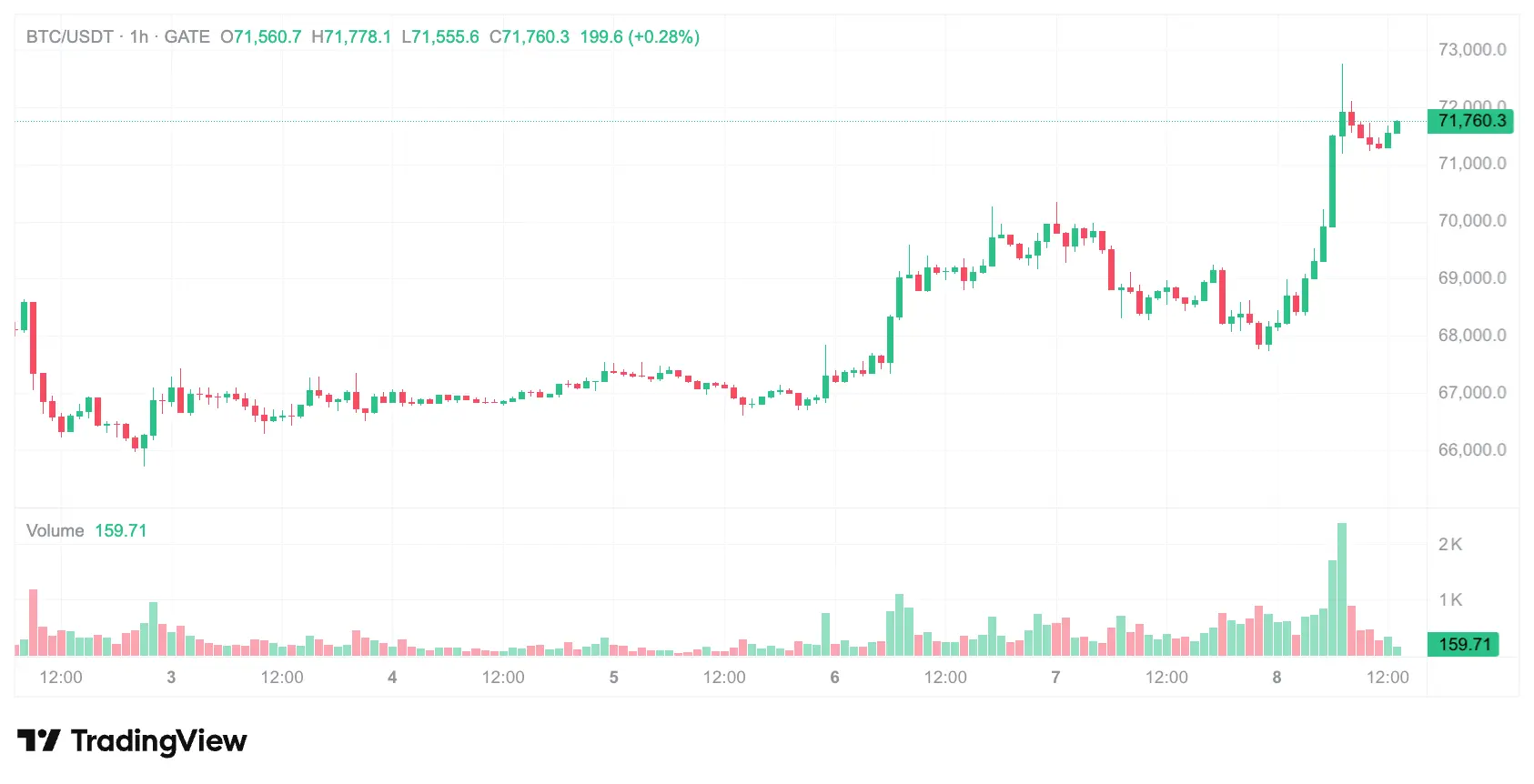 Bitcoin 1h price chart
This kind of difference in price behavior has again sparked market discussion about Bitcoin’s asset characteristics. Some market analysts pointed out that in this geopolitical event, Bitcoin’s performance is closer to high-beta risk assets such as technology stocks, and its risk-hedging function as “digital gold” has not yet been consistently confirmed in the context of geopolitical military conflicts. Discussion momentum around this topic rose significantly after the ceasefire, making it one of the core subjects on social media and in professional forums.
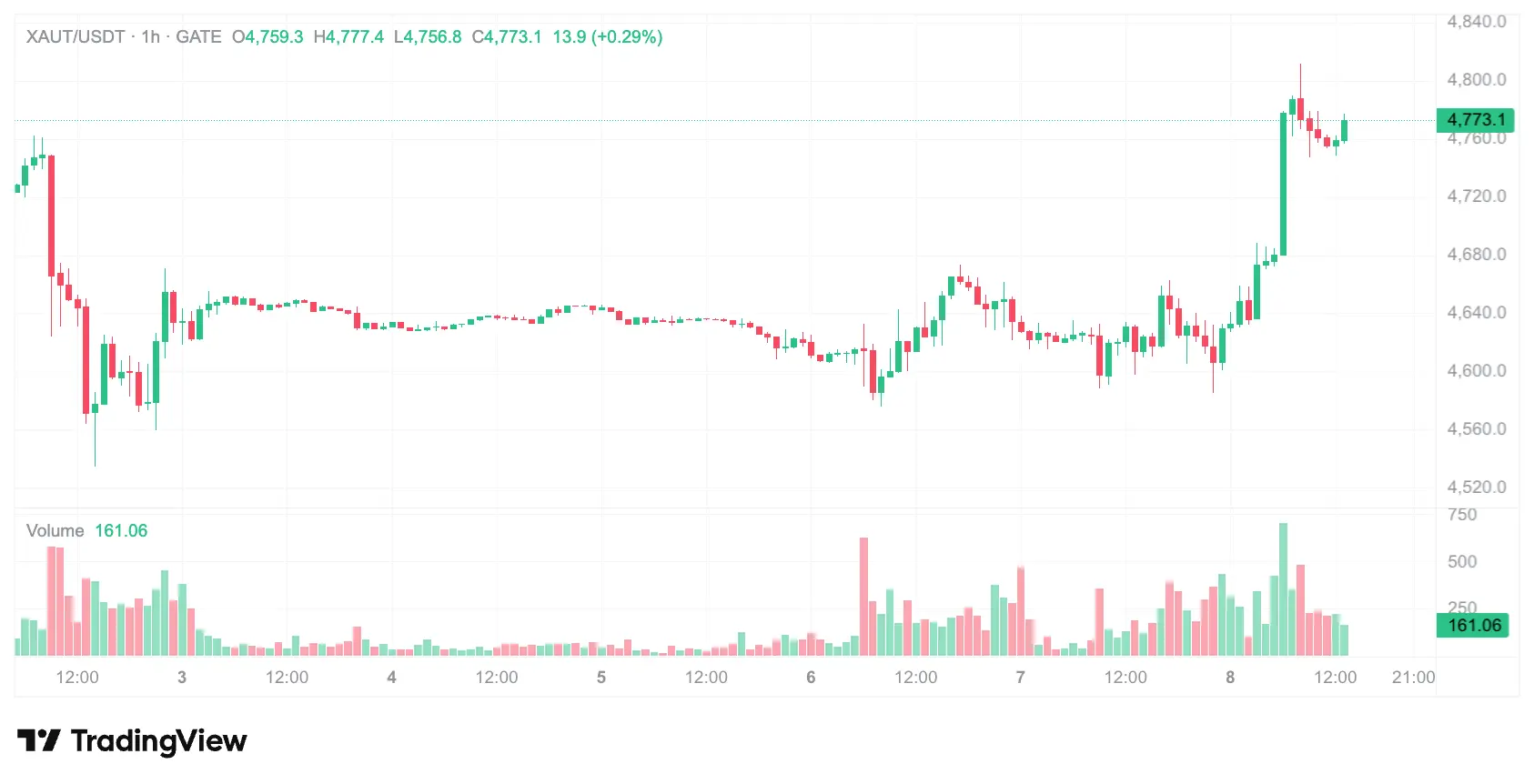
Gold token 1h price chart
Market Structure Changes After Position Reset
Large-scale liquidation events are usually accompanied by a reset of market position structure. After short positions were cleaned up in a concentrated manner, the market leverage level dropped somewhat in the short term. However, the rapid turn positive in funding rates also indicates that longs are rebuilding positions. At the current stage, the market’s focus lies on:
- Above $72,000, is there enough buy-side follow-through to absorb the pressure from taking profits?
- If, in the future, the macro data or the two-week negotiation process sees reversals, will the newly established long positions face the risk of reverse liquidation?
- The phenomenon that the price gains of Ethereum and major altcoins have surpassed Bitcoin—does this imply that risk appetite has shifted from “defensive-style allocation” to “offensive-style allocation”?
Summary
The crypto market volatility in this round, triggered by the temporary U.S.-Iran ceasefire agreement, shows a strong linkage between macro geopolitical events and derivatives position structure. After the news was released, Bitcoin’s price quickly broke above $72,000, along with large-scale liquidations dominated by shorts in the derivatives market, and the market’s leverage structure completed a reset within a short time. Meanwhile, the divergence in the price performance of Bitcoin and gold before and after the event has continued to drive industry discussion about the risk-hedging attributes of crypto assets. In the next stage, the main variables will be the implementation progress of the ceasefire over the following two weeks, the rollout status of the Strait of Hormuz passage arrangements, and how sensitive newly established positions in the crypto market are to macro data.
Frequently Asked Questions
Q: What are the specific details of this temporary ceasefire agreement?
A: According to publicly available information, U.S. President Trump announced in the evening of April 7, 2026 through the early morning of April 8, 2026 that he had reached a temporary ceasefire agreement with Iran, mediated by Pakistan. The ceasefire period will last for two weeks, with the condition that Iran immediately and safely reopens the Strait of Hormuz. Iran has already responded with its agreement.
Q: Why does the ceasefire news lead to massive short liquidations?
A: Before the ceasefire news was announced, some traders established short positions based on expectations that the geopolitical conflict would continue to escalate. After the news was released, the price quickly surged upward, triggering insufficient margin conditions and causing the system to forcibly close the short positions. During the liquidation of short positions, buying is required to close them, further pushing up the price and creating a chain reaction.
Q: How do Bitcoin and gold differ in their performance during the geopolitical event?
A: During this round of geopolitical conflict, the gold price rose and then saw a modest pullback after the ceasefire; Bitcoin, meanwhile, faced pressure during the conflict and then surged sharply after the ceasefire. Their price reaction directions were opposite, indicating that, in current market perceptions, Bitcoin’s risk-hedging attributes differ from those of gold.
Disclaimer: The information on this page may come from third parties and does not represent the views or opinions of Gate. The content displayed on this page is for reference only and does not constitute any financial, investment, or legal advice. Gate does not guarantee the accuracy or completeness of the information and shall not be liable for any losses arising from the use of this information. Virtual asset investments carry high risks and are subject to significant price volatility. You may lose all of your invested principal. Please fully understand the relevant risks and make prudent decisions based on your own financial situation and risk tolerance. For details, please refer to
Disclaimer.


