XRP Price Prediction: Can XRP Surge Nearly 170% to Reach 5 Dollars by 2026

Last Updated 2026-03-26 12:33:48
Reading Time: 1m
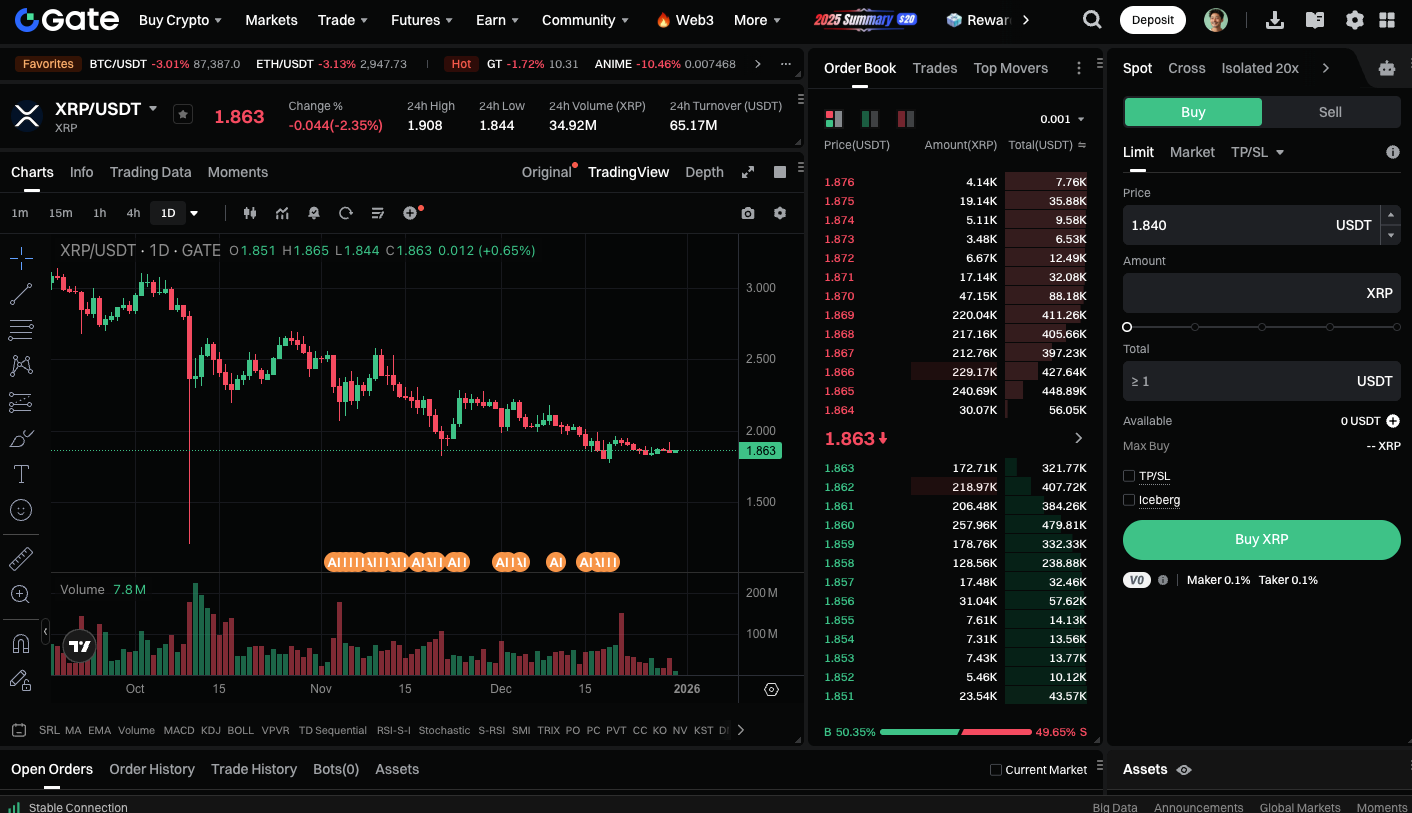
With XRP trading below $2 and market sentiment growing more conservative, analysts are highlighting several emerging structural tailwinds. This article examines five critical factors—from ETF inflows and Japan’s stablecoin strategy to asset tokenization and shifts in on-chain supply—to evaluate whether XRP has a realistic chance to reach $5 before 2026.

XRP Amid Market Correction

Since the overall crypto market entered a correction phase in October, XRP fell below the $2 threshold, cooling market sentiment. Despite this, XRP remains among the top five cryptocurrencies by market cap. Its short-term performance, however, is under significant pressure, with the price nearly 50% off its all-time high from July.

Market analyst Sam Daodu contends that recent price weakness does not indicate the end of XRP’s trend. Instead, several structural shifts are underway that could create a new path for XRP to reach $5 before 2026.

Key Drivers of XRP Price Movement

1. BlackRock XRP ETF Potential

Daodu first identifies the potential launch of an XRP ETF led by traditional financial giant BlackRock as a core variable. Since mid-November 2025, spot XRP ETFs have seen over $1 billion in cumulative inflows.

If BlackRock formally enters the market, new capital inflows could exceed $2 billion. This would not only reshape XRP’s capital structure but could also make it one of the few crypto assets in the US market deeply integrated with highly regulated financial products, further strengthening its valuation narrative.

2. Japanese Market and RLUSD Stablecoin Strategy

The second key driver is the strategic role of the Japanese market. Ripple is partnering with SBI Holdings to launch the RLUSD USD stablecoin in Japan in Q1 2026, pending regulatory approval.

Once RLUSD goes live on the XRP Ledger (XRPL), XRP’s utility as a bridge asset for cross-asset and cross-stablecoin transactions will increase. While the impact may not be immediate, over the long term, this development will support XRP’s push toward the $5 mark.

3. On-Chain Demand from Asset Tokenization

On the application side, Daodu highlights the significance of asset tokenization. Ripple is expanding its partnership with Archax, aiming to tokenize hundreds of millions of dollars in equities, bonds, and funds and onboard them to the XRP Ledger by mid-2026.

If XRPL captures 5% to 10% of the tokenized settlement market, the resulting on-chain transaction volume and liquidity demand will materially alter XRP’s supply-demand dynamics, providing a stronger fundamental base for price support.

4. Rotation to Risk Assets in a Rate-Cut Environment

Macroeconomic policy remains a critical factor. Markets widely anticipate that the US Federal Reserve may begin a rate-cut cycle, which would compress returns on cash and short-term bonds, driving capital back toward risk assets with growth and liquidity potential.

In this environment, XRP—with its institutional narrative, real-world applications, and regulatory progress—could become a prime beneficiary as capital is reallocated.

5. Declining Exchange Supply and Shifting Token Distribution

The final key indicator comes from on-chain data. Over the past two months, more than 1.35 billion XRP have been withdrawn from exchanges, with balances dropping from around 3.95 billion to roughly 2.6 billion XRP—over 1 billion of which moved in just three weeks. These large-scale withdrawals typically signal a shift toward long-term holding rather than short-term trading. If this trend persists, falling circulating supply will amplify price elasticity as demand returns.

Start trading XRP spot now: https://www.gate.com/trade/XRP_USDT
Summary

Daodu stresses that for XRP to reach $5 in 2026, it will take more than a single positive catalyst or a short-lived sentiment surge. Instead, it requires a confluence of ETF inflows, institutional adoption, macroeconomic conditions, and on-chain supply-demand shifts. As these factors gradually align, the medium- and long-term outlook for XRP remains compelling. However, whether this narrative translates into price momentum will ultimately depend on market execution and the test of time.

Author: Allen
Disclaimer
* The information is not intended to be and does not constitute financial advice or any other recommendation of any sort offered or endorsed by Gate.
* This article may not be reproduced, transmitted or copied without referencing Gate. Contravention is an infringement of Copyright Act and may be subject to legal action.

Related Articles

What is Fartcoin? All You Need to Know About FARTCOIN
Intermediate

What is Fartcoin? All You Need to Know About FARTCOIN

Fartcoin (FARTCOIN) is a representative meme coin within the Solana ecosystem based on an AI-driven narrative. Its core concept originated from an experiment aimed at exploring the "boundaries between AI Agents and humor." More than just a digital asset with social attributes, the project deeply couples absurd humor culture with on-chain financial logic by integrating autonomous AI interaction models.
2026-04-04 22:01:19
Gold Price Forecast for the Next Five Years: 2026–2030 Trend Outlook and Investment Implications, Could It Reach $6,000?
Beginner

Gold Price Forecast for the Next Five Years: 2026–2030 Trend Outlook and Investment Implications, Could It Reach $6,000?

Analyze current gold price trends alongside authoritative five-year forecasts, integrating an evaluation of market risks and opportunities. This gives investors insight into the potential trajectory of gold prices and the main drivers expected to shape the market over the next five years.
2026-03-25 18:13:30
Aster vs Hyperliquid: Which Perp DEX Will Prevail?
Beginner

Aster vs Hyperliquid: Which Perp DEX Will Prevail?

Aster and Hyperliquid are the two representative protocols of the "purpose-built L1 path" within the current decentralized perpetual exchange (Perp DEX) sector. As a pioneer in the field, Hyperliquid has built a deep liquidity moat through its highly mature order book architecture and strong community consensus. Conversely, Aster, as a rising challenger, seeks to leapfrog the competition in high-performance trading through more aggressive multi-chain aggregation logic, private transaction modules, and an underlying execution environment optimized for 2026 market demands.
2026-03-24 11:58:33
AI-Native Settlement Layers: How United Stables Is Building the Next Financial Rail
Beginner

AI-Native Settlement Layers: How United Stables Is Building the Next Financial Rail

Stablecoins were originally designed as dollar substitutes within exchanges, primarily used for asset pricing and trade settlement. As on-chain financial ecosystems have matured, their role has expanded beyond simple payments to include collateral assets, cross-chain liquidity mediums, and unified settlement units. In particular, as AI systems and automated agents begin to participate directly in economic activity, demand has risen sharply for programmable value units capable of instant settlement. This shift is pushing stablecoins toward the role of foundational financial infrastructure.
2026-03-25 03:16:17
Aerodrome Tokenomics: How ve(3,3) Powers Base's Most Profitable DEX
Beginner

Aerodrome Tokenomics: How ve(3,3) Powers Base's Most Profitable DEX

AERO is the native token of Aerodrome Finance, a core decentralized exchange and liquidity protocol in the Base ecosystem. It is primarily used for liquidity incentives and ecosystem operations. veAERO is a governance NFT that users receive by locking AERO, representing both voting power and the right to share protocol revenue. Through a dual track structure of AERO as a utility token and veAERO as a governance credential, Aerodrome separates liquidity usage value from long term governance power, allowing participants to act as liquidity providers, governance decision makers, and revenue sharers within the same system.
2026-03-25 06:40:31
Hybrid Collateral Stablecoins: Inside United Stables' Stability and Yield Architecture
Beginner

Hybrid Collateral Stablecoins: Inside United Stables' Stability and Yield Architecture

In the early stages of the crypto market, traditional stablecoins mainly relied on single-reserve or single-collateral models. Their primary focus was price stability and payment convenience, which allowed them to become foundational tools for on-chain trading and capital flows. As the market has entered a more mature financial phase, however, this structure has begun to reveal limitations, including high concentration risk and the difficulty of balancing liquidity with yield. These constraints have driven the evolution toward multi-layer collateral and portfolio-based designs, such as the dual-layer hybrid collateral architecture proposed by United Stables, which seeks to redefine the underlying logic of stable assets.
2026-03-25 03:17:39





