Analysts suggest XRP could hit $100 ahead of Bitcoin — Market analysis and future prospects

Last Updated 2026-03-27 07:48:10
Reading Time: 1m
Analysts forecast that XRP may surpass the $100 mark before Bitcoin reaches its $1 million milestone. This article provides a comprehensive look at the rationale behind this outlook, reviews XRP's current price action, and explores the key factors that could drive XRP's future growth.

Amid recent debates over price predictions in the crypto market, some analysts assert that XRP is likely to reach $100 before Bitcoin hits the million-dollar mark—outperforming Bitcoin by a significant margin.

Why Some Analysts Believe XRP Will Hit $100 First
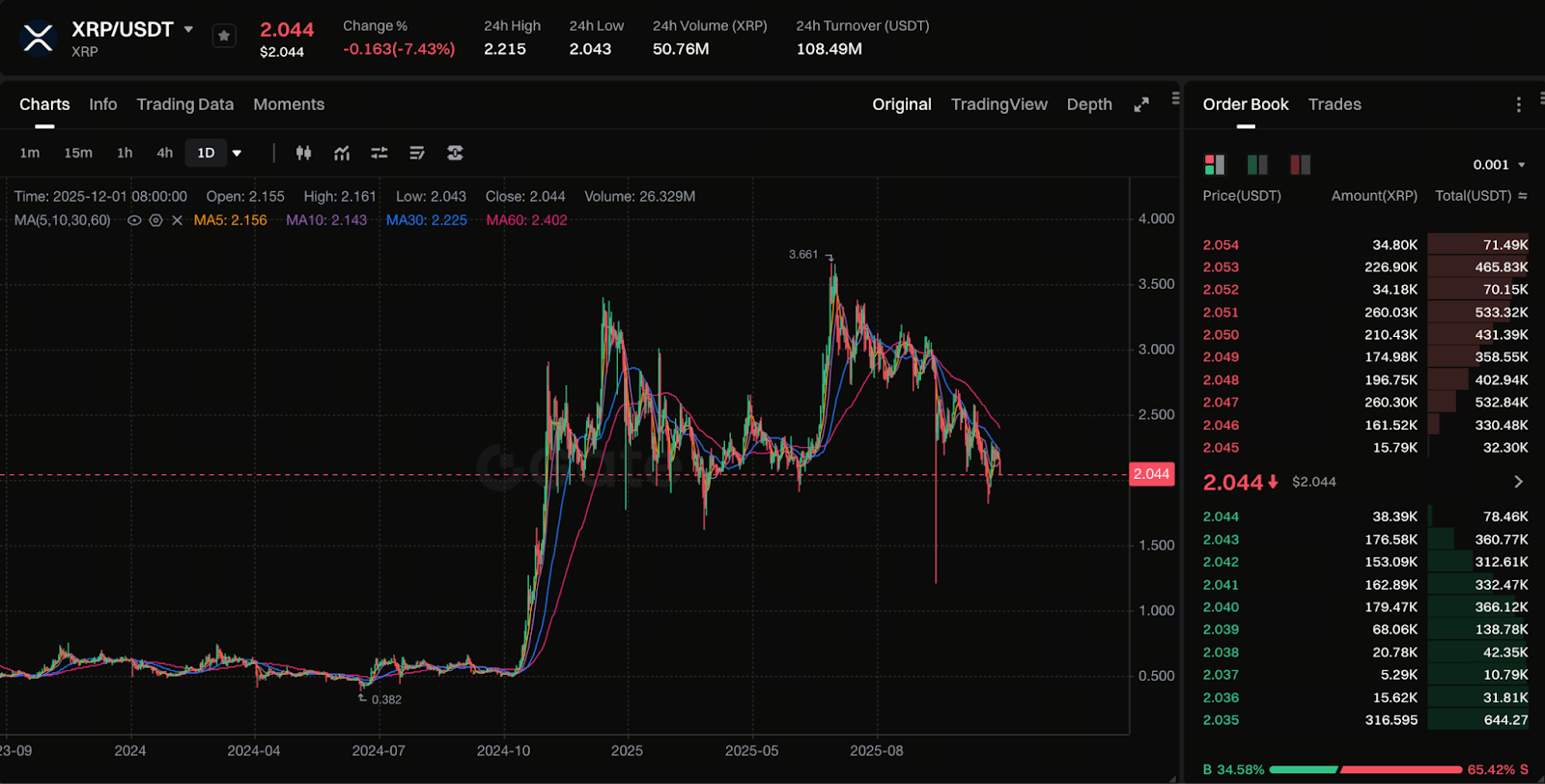

Source: https://www.gate.com/trade/XRP_USDT

Unlike Bitcoin, which would need to surge roughly 990% to reach $1,000,000, XRP—currently trading around $2.20 to $2.30—would require an approximate 4,445% increase to hit $100. While this is still a substantial rise, it is easier to quantify and seems more attainable. Additionally, analysts argue that a million- or ten-million-dollar valuation for Bitcoin is nearly impossible from a global market cap and liquidity standpoint. In contrast, a $100 target for XRP aligns better with the current structure and liquidity dynamics of crypto assets.

Current Price Comparison: XRP vs. Bitcoin

As of December 1, 2025, most sources indicate that XRP is trading in the $2.20–$2.30 range. In contrast, while Bitcoin remains the leading cryptocurrency by market capitalization and adoption, some aggressive forecasts suggest it could reach $1 million or even $10 million, requiring a much larger percentage gain than XRP needs to reach $100. For this reason, some analysts contend that, from a feasibility perspective, XRP is more likely to break through the $100 threshold first.

Three Key Drivers Behind Potential XRP Price Growth

  • Rising Institutional Interest and Adoption: Recently, analysts have noted growing institutional interest in XRP. If more financial institutions integrate XRP into payment and settlement systems, or use it for cross-border transfers and liquidity management, the resulting structural changes in supply and demand could drive prices higher.
  • Relative Valuation Advantage and Market Sentiment: XRP’s current low price, combined with a market consensus that “XRP will rise first,” could create a positive feedback loop—investors may take early positions and drive the rally. Analysts highlight this psychological effect as a reason why XRP’s upside may be more achievable than Bitcoin’s, which, despite a higher ceiling, faces greater barriers.
  • Crypto Market Rotation and Capital Inflows: When Bitcoin’s momentum slows or corrects, capital may shift toward higher-performing or undervalued altcoins. If XRP’s fundamentals—such as liquidity, use cases, and institutional adoption—gain market recognition, XRP could emerge as a primary beneficiary. Analysts project XRP could gain over 400% during such rotations.

Challenges and Market Risks

However, this outlook carries significant risks. XRP has long faced regulatory uncertainties and volatile market sentiment, resulting in sharp price swings. Even if institutions show interest, it does not guarantee large-scale usage or holdings; factors such as liquidity, supply, and competition from stablecoins or central bank digital currencies could limit its potential gains. Broader crypto market trends, macroeconomic policies, interest rates, and regulatory shifts may also impact both XRP and Bitcoin’s performance.

Furthermore, even if XRP ultimately approaches $100, the process could be lengthy and marked by significant volatility—potentially stretching investment cycles far beyond most expectations.

How Investors Can Maintain a Rational Perspective

For most investors and observers, the idea that “XRP will reach $100 before Bitcoin” should be viewed as an extremely optimistic yet possible scenario. This outlook may suit:

  • Investors with a long-term perspective who can withstand high volatility.
  • Those with strong conviction in crypto assets and a willingness to track market, institutional, and regulatory developments.

It is advisable to maintain a balanced asset allocation, avoid relying entirely on a single token, and remain attentive to broader market trends and risks.

Author: Max
Disclaimer
* The information is not intended to be and does not constitute financial advice or any other recommendation of any sort offered or endorsed by Gate.
* This article may not be reproduced, transmitted or copied without referencing Gate. Contravention is an infringement of Copyright Act and may be subject to legal action.

Related Articles

What is Fartcoin? All You Need to Know About FARTCOIN
Intermediate

What is Fartcoin? All You Need to Know About FARTCOIN

Fartcoin (FARTCOIN) is a representative meme coin within the Solana ecosystem based on an AI-driven narrative. Its core concept originated from an experiment aimed at exploring the "boundaries between AI Agents and humor." More than just a digital asset with social attributes, the project deeply couples absurd humor culture with on-chain financial logic by integrating autonomous AI interaction models.
2026-04-04 22:01:19
Gold Price Forecast for the Next Five Years: 2026–2030 Trend Outlook and Investment Implications, Could It Reach $6,000?
Beginner

Gold Price Forecast for the Next Five Years: 2026–2030 Trend Outlook and Investment Implications, Could It Reach $6,000?

Analyze current gold price trends alongside authoritative five-year forecasts, integrating an evaluation of market risks and opportunities. This gives investors insight into the potential trajectory of gold prices and the main drivers expected to shape the market over the next five years.
2026-03-25 18:13:30
Aster vs Hyperliquid: Which Perp DEX Will Prevail?
Beginner

Aster vs Hyperliquid: Which Perp DEX Will Prevail?

Aster and Hyperliquid are the two representative protocols of the "purpose-built L1 path" within the current decentralized perpetual exchange (Perp DEX) sector. As a pioneer in the field, Hyperliquid has built a deep liquidity moat through its highly mature order book architecture and strong community consensus. Conversely, Aster, as a rising challenger, seeks to leapfrog the competition in high-performance trading through more aggressive multi-chain aggregation logic, private transaction modules, and an underlying execution environment optimized for 2026 market demands.
2026-03-24 11:58:33
AI-Native Settlement Layers: How United Stables Is Building the Next Financial Rail
Beginner

AI-Native Settlement Layers: How United Stables Is Building the Next Financial Rail

Stablecoins were originally designed as dollar substitutes within exchanges, primarily used for asset pricing and trade settlement. As on-chain financial ecosystems have matured, their role has expanded beyond simple payments to include collateral assets, cross-chain liquidity mediums, and unified settlement units. In particular, as AI systems and automated agents begin to participate directly in economic activity, demand has risen sharply for programmable value units capable of instant settlement. This shift is pushing stablecoins toward the role of foundational financial infrastructure.
2026-03-25 03:16:17
ASTER Tokenomics: Buybacks, Burns, and Staking as the Value Foundation of ASTER in 2026
Beginner

ASTER Tokenomics: Buybacks, Burns, and Staking as the Value Foundation of ASTER in 2026

ASTER is the native equity and governance token of the Aster ecosystem, with its core value built upon a radical "Deflationary Engine." Beyond serving as a governance tool, ASTER integrates multiple utilities including staking rewards, trading fee discounts, and liquidity incentives. Through its deep integration with the upcoming dedicated Layer 1 mainnet, it enables direct value capture from protocol cash flow to token holders.
2026-03-25 07:38:07
Hybrid Collateral Stablecoins: Inside United Stables' Stability and Yield Architecture
Beginner

Hybrid Collateral Stablecoins: Inside United Stables' Stability and Yield Architecture

In the early stages of the crypto market, traditional stablecoins mainly relied on single-reserve or single-collateral models. Their primary focus was price stability and payment convenience, which allowed them to become foundational tools for on-chain trading and capital flows. As the market has entered a more mature financial phase, however, this structure has begun to reveal limitations, including high concentration risk and the difficulty of balancing liquidity with yield. These constraints have driven the evolution toward multi-layer collateral and portfolio-based designs, such as the dual-layer hybrid collateral architecture proposed by United Stables, which seeks to redefine the underlying logic of stable assets.
2026-03-25 03:17:39