Wintermute: Can Crypto Recover in 2026? The Answer Hinges on Three Key Outcomes

Beginner
Quick Reads
Last Updated 2026-03-26 01:55:02
Reading Time: 1m
Wintermute asserts that the revival of cryptocurrencies in 2026 hinges on three main outcomes: expansion of ETFs, robust performance of leading assets like Bitcoin, and renewed participation from retail investors. Drawing on current price movements and capital flow data, this article offers an objective assessment of the essential conditions for a genuine crypto market recovery in 2026.

The 2025 cryptocurrency market did not mirror the robust bull runs of 2021 or 2017. Although Bitcoin broke above $90,000 several times in the first half of the year, this failed to spark a broad rally among altcoins. Instead, the market displayed structural divergence, fleeting hot spots, and increasingly compressed cycles. Liquidity concentrated heavily in Bitcoin and Ethereum ETFs, while small and mid-cap tokens lagged far behind historical cycles in terms of gains. Wintermute’s latest market summary highlights that a true crypto revival in 2026 hinges on three critical outcomes.

1. Why did the 2025 market fall short of expectations?

The conventional view is: halving → BTC rally → ETH follows → altcoin rotation.

But 2025 clearly broke this pattern.

Key reasons include:

  • Capital focused heavily on institutional products like ETFs
  • Retail investors shifted attention to AI stocks, gold, and leading US tech companies
  • Altcoin speculation cycles shortened from 60–90 days to just 10–20 days
  • Risk appetite was constrained by the prevailing interest rate environment

The crypto market has entered a new era dominated by institutions, with fewer retail participants and structurally driven, selective rallies.

2. Wintermute’s Three Keys to Recovery

According to Wintermute, the trajectory of 2026 depends on at least one of three outcomes:

ETF and Institutional Product Expansion

Most capital inflows in 2025 came from Bitcoin ETFs. If institutions can:

  • Launch broader crypto index products
  • Increase allocations to Ether ETFs
  • Enable more companies to include crypto assets in their financial strategies

Then the scale of capital in 2026 will far surpass incremental gains from retail investors returning.

In short, institutions are the engine of the new cycle.

Mainstream Assets Must Create a Wealth Effect

If Bitcoin holds at elevated levels or reaches new all-time highs, it will drive:

  • Renewed market confidence
  • Rotation into altcoins
  • Improved fundraising for new projects
  • Stronger media coverage

If BTC establishes a clear upward trend—such as breaking through the $110,000–$120,000 range—it will serve as a “main trend signal” that fuels broader market expansion.

Retail Attention Returning to Crypto

Over the past year, retail capital flowed primarily into:

  • AI-themed stocks
  • Semiconductor indices
  • Safe-haven assets such as gold
  • High-frequency, short-term trades (like Telegram game tokens)

For retail investors to return, the market needs:

  • A clear, easily understood primary rally
  • Low-barrier, high-profile projects
  • Significantly increased media coverage
  • A visible “profit effect”

Once retail investors re-enter, trading volume, volatility, and narrative momentum will recover.

3. Current Price Trends and Market Structure Analysis
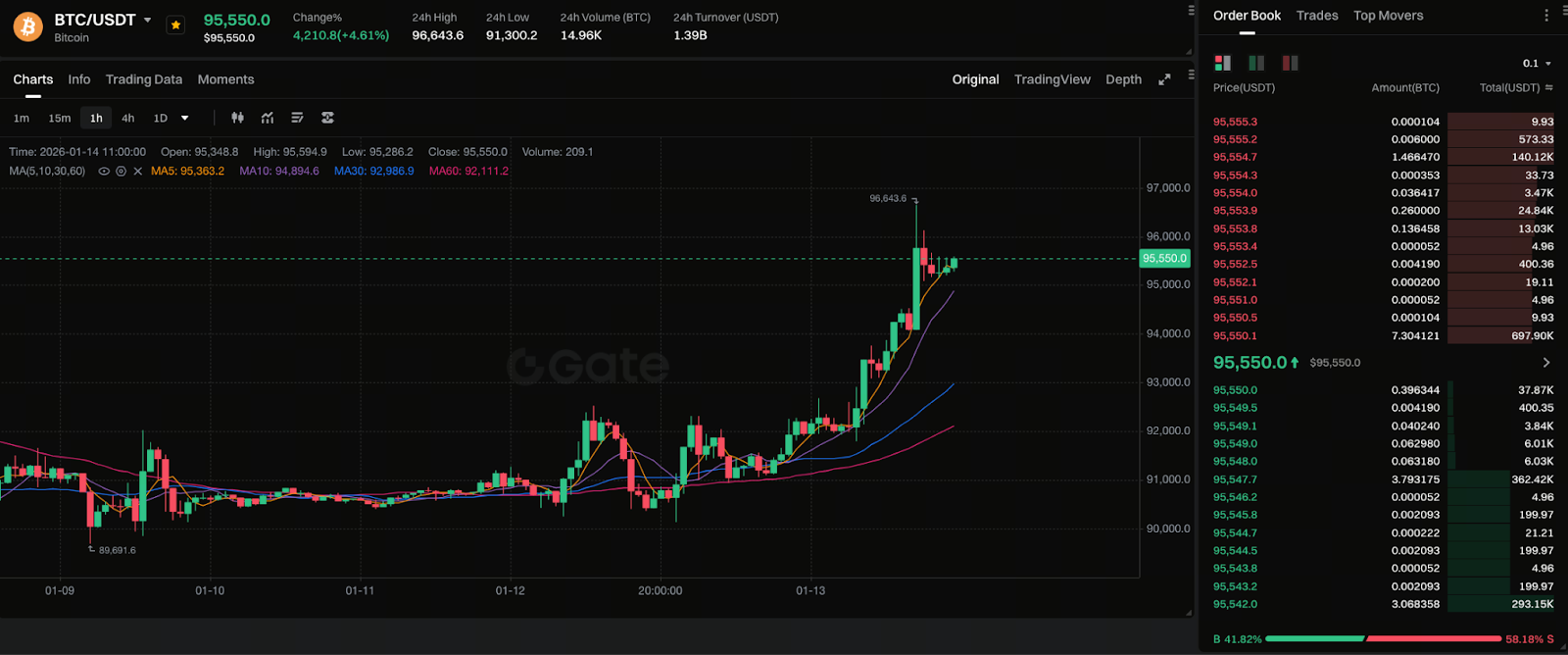

Chart: https://www.gate.com/trade/BTC_USDT

As of mid-January 2026:

  • Bitcoin remains stable, fluctuating near $90,000
  • Mainstream coins like ETH and SOL are trading within established ranges
  • Most altcoins and sector tokens have entered a period of low volatility

The capital structure reflects:

  • ETFs continue to attract inflows, though at a slower pace
  • On-chain activity has not meaningfully rebounded
  • Institutions are buying, but retail investors are not increasing their exposure in parallel

Structurally, the market is in a holding pattern, awaiting a new catalyst for capital inflow.

4. The Importance of Retail Return and Sentiment Recovery

Retail participation brings not only greater buying activity and liquidity, but also:

  • Faster narrative spread
  • Rising social media engagement
  • Renewed momentum in new token issuance
  • Higher trading volumes on exchanges

The absence of retail is a primary reason why altcoins cannot sustain rallies.

Early signs of retail returning include:

  • Growth in new user metrics on platforms like Gate
  • Increased engagement on social media (X, Reddit, WeChat, Douyin)
  • Top KOLs resuming crypto coverage
  • Small-cap coins showing sustained trend moves for one to two weeks

5. Macroeconomic Policy’s Potential Impact on 2026

The 2026 outlook is heavily dependent on:

  • The pace of Federal Reserve rate cuts
  • Changes in CPI
  • Risk appetite in US equities
  • Whether geopolitical risks subside

If the world enters a rate-cutting cycle in 2026, it will sharply increase the attractiveness of crypto assets.

6. Does the Crypto Market Have a Reversal Opportunity in 2026?

Wintermute’s observations indicate:

  • Institutional expansion is a confirmed growth driver
  • Mainstream asset rallies depend on macro conditions and ETF demand
  • Retail return requires a new trend to ignite the market

If any of these conditions are met, they could trigger a major rally in 2026.

The current market structure resembles: Preparation Phase → Awaiting breakout → Igniting a new cycle

Author: Max
Disclaimer
* The information is not intended to be and does not constitute financial advice or any other recommendation of any sort offered or endorsed by Gate.
* This article may not be reproduced, transmitted or copied without referencing Gate. Contravention is an infringement of Copyright Act and may be subject to legal action.

Related Articles

What is Fartcoin? All You Need to Know About FARTCOIN
Intermediate

What is Fartcoin? All You Need to Know About FARTCOIN

Fartcoin (FARTCOIN) is a representative meme coin within the Solana ecosystem based on an AI-driven narrative. Its core concept originated from an experiment aimed at exploring the "boundaries between AI Agents and humor." More than just a digital asset with social attributes, the project deeply couples absurd humor culture with on-chain financial logic by integrating autonomous AI interaction models.
2026-04-04 22:01:19
Gold Price Forecast for the Next Five Years: 2026–2030 Trend Outlook and Investment Implications, Could It Reach $6,000?
Beginner

Gold Price Forecast for the Next Five Years: 2026–2030 Trend Outlook and Investment Implications, Could It Reach $6,000?

Analyze current gold price trends alongside authoritative five-year forecasts, integrating an evaluation of market risks and opportunities. This gives investors insight into the potential trajectory of gold prices and the main drivers expected to shape the market over the next five years.
2026-03-25 18:13:30
Aster vs Hyperliquid: Which Perp DEX Will Prevail?
Beginner

Aster vs Hyperliquid: Which Perp DEX Will Prevail?

Aster and Hyperliquid are the two representative protocols of the "purpose-built L1 path" within the current decentralized perpetual exchange (Perp DEX) sector. As a pioneer in the field, Hyperliquid has built a deep liquidity moat through its highly mature order book architecture and strong community consensus. Conversely, Aster, as a rising challenger, seeks to leapfrog the competition in high-performance trading through more aggressive multi-chain aggregation logic, private transaction modules, and an underlying execution environment optimized for 2026 market demands.
2026-03-24 11:58:33
AI-Native Settlement Layers: How United Stables Is Building the Next Financial Rail
Beginner

AI-Native Settlement Layers: How United Stables Is Building the Next Financial Rail

Stablecoins were originally designed as dollar substitutes within exchanges, primarily used for asset pricing and trade settlement. As on-chain financial ecosystems have matured, their role has expanded beyond simple payments to include collateral assets, cross-chain liquidity mediums, and unified settlement units. In particular, as AI systems and automated agents begin to participate directly in economic activity, demand has risen sharply for programmable value units capable of instant settlement. This shift is pushing stablecoins toward the role of foundational financial infrastructure.
2026-03-25 03:16:17
ASTER Tokenomics: Buybacks, Burns, and Staking as the Value Foundation of ASTER in 2026
Beginner

ASTER Tokenomics: Buybacks, Burns, and Staking as the Value Foundation of ASTER in 2026

ASTER is the native equity and governance token of the Aster ecosystem, with its core value built upon a radical "Deflationary Engine." Beyond serving as a governance tool, ASTER integrates multiple utilities including staking rewards, trading fee discounts, and liquidity incentives. Through its deep integration with the upcoming dedicated Layer 1 mainnet, it enables direct value capture from protocol cash flow to token holders.
2026-03-25 07:38:07
Hybrid Collateral Stablecoins: Inside United Stables' Stability and Yield Architecture
Beginner

Hybrid Collateral Stablecoins: Inside United Stables' Stability and Yield Architecture

In the early stages of the crypto market, traditional stablecoins mainly relied on single-reserve or single-collateral models. Their primary focus was price stability and payment convenience, which allowed them to become foundational tools for on-chain trading and capital flows. As the market has entered a more mature financial phase, however, this structure has begun to reveal limitations, including high concentration risk and the difficulty of balancing liquidity with yield. These constraints have driven the evolution toward multi-layer collateral and portfolio-based designs, such as the dual-layer hybrid collateral architecture proposed by United Stables, which seeks to redefine the underlying logic of stable assets.
2026-03-25 03:17:39