What Is the Native Cryptocurrency of Polkadot?

Beginner
Quick Reads
Last Updated 2026-03-29 06:49:43
Reading Time: 1m
Dr. Gavin Wood, co-founder of Ethereum, introduced Polkadot as a cross-chain protocol. It was developed to address the isolation of traditional public blockchains and achieve interoperability across multiple blockchain networks.

Polkadot Overview

Dr. Gavin Wood, co-founder of Ethereum, developed Polkadot as a cross-chain protocol. Its core vision is to enable seamless communication and data sharing across different blockchains. This architecture resolves the isolation issue inherent in traditional public blockchains, making true interoperability possible in the Web3 world. Polkadot’s structure is comprised of three main components:

  • Relay Chain: The central backbone of the network, responsible for consensus, security, and coordinating cross-chain operations.
  • Parachains: Customizable blockchains designed for specific applications or functionalities.
  • Bridges: Connect Polkadot with external public blockchains like Ethereum and Bitcoin to enable cross-chain transactions.

Within this framework, DOT drives network operation and incentivizes participants.

Polkadot’s Native Digital Asset: DOT

DOT serves as Polkadot’s native cryptocurrency. It is more than just an investment vehicle; it acts as the engine and governance instrument of the entire ecosystem. Its primary functions include:

  • Governance: DOT holders propose and vote on network upgrades, protocol changes, and policy adjustments.
  • Staking: By staking DOT, participants secure the network via the Nominated Proof of Stake (NPoS) consensus model and receive rewards.
  • Bonding: New parachains joining the Polkadot ecosystem must bond DOT to obtain a slot, ensuring equitable resource allocation.

These core functions establish DOT as the foundational economic pillar of Polkadot.

DOT’s Three Core Functions

1. Governance

Polkadot prioritizes decentralized governance, much like other leading public blockchains. DOT holders initiate proposals and vote on key network decisions, including upgrades, protocol parameters, and treasury management. DOT is not only an investment asset but also a governance token.

2. Network Security

Polkadot uses the NPoS consensus mechanism. DOT staking underpins network security. Validators stake DOT to earn block production rights, while nominators select and support validators to share in the rewards. This system makes DOT the core of Polkadot’s security model.

3. Parachain Slot Auctions

One of Polkadot’s signature innovations is the Parachain Slot Auction. Projects that want to deploy parachains on Polkadot must bond DOT to bid for a slot. This mechanism drives demand for DOT and ensures fair, efficient allocation of network resources.

DOT’s Economic Model

DOT does not have a capped supply like Bitcoin. It follows an inflationary model that continuously incentivizes validators and network participants. Currently, DOT’s annual inflation rate stands at approximately 10%. Some newly minted DOT is distributed as staking rewards, with the remainder allocated to the treasury for ecosystem development.

This model encourages holders to participate actively in network governance and security.

DOT: Challenges and Future Outlook

DOT is central to the Polkadot ecosystem, but several challenges remain:

  • Ecosystem Growth: Parachain development needs more robust, real-world applications.
  • Market Competition: Competing blockchain architectures such as Cosmos and Ethereum are advancing cross-chain and multi-chain solutions.
  • Regulatory Risks: Government policy changes worldwide could impact DOT’s trajectory.

With additional parachain projects launching and the Web3 ecosystem expanding, DOT is expected to become a vital asset in blockchain infrastructure.

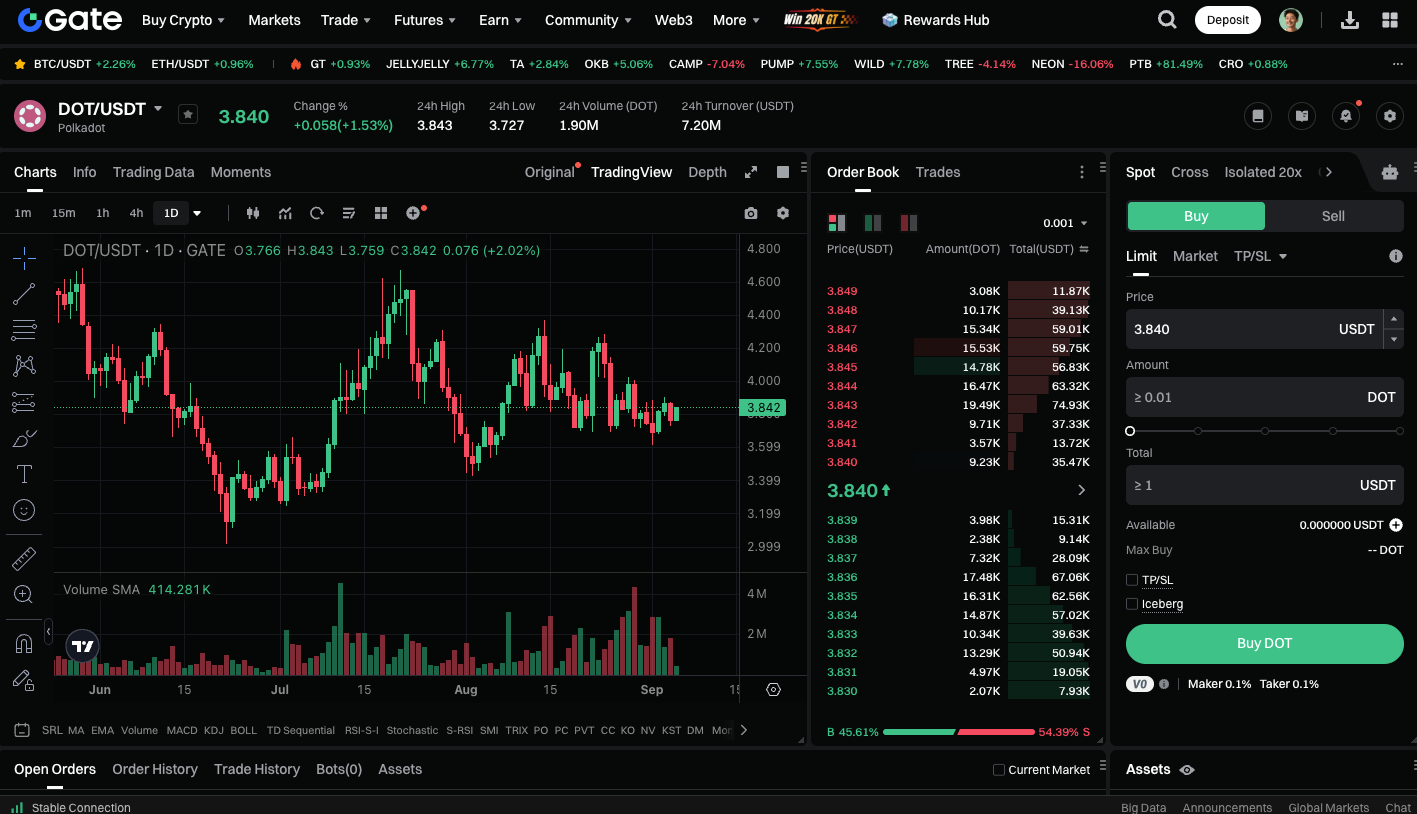
Begin trading DOT spot: https://www.gate.com/trade/DOT_USDT
Conclusion

DOT is far more than Polkadot’s native cryptocurrency. It is the beating heart of the cross-chain ecosystem, supporting governance, network security, and parachain slot auctions. As Web3 adoption accelerates, DOT’s significance will continue to grow. For investors seeking deeper insight into Polkadot or engagement with its ecosystem, understanding DOT’s functionality and value is essential for unlocking the full potential of Polkadot.

Author: Allen
Disclaimer
* The information is not intended to be and does not constitute financial advice or any other recommendation of any sort offered or endorsed by Gate.
* This article may not be reproduced, transmitted or copied without referencing Gate. Contravention is an infringement of Copyright Act and may be subject to legal action.

Related Articles

What is Fartcoin? All You Need to Know About FARTCOIN
Intermediate

What is Fartcoin? All You Need to Know About FARTCOIN

Fartcoin (FARTCOIN) is a representative meme coin within the Solana ecosystem based on an AI-driven narrative. Its core concept originated from an experiment aimed at exploring the "boundaries between AI Agents and humor." More than just a digital asset with social attributes, the project deeply couples absurd humor culture with on-chain financial logic by integrating autonomous AI interaction models.
2026-04-04 22:01:19
Gold Price Forecast for the Next Five Years: 2026–2030 Trend Outlook and Investment Implications, Could It Reach $6,000?
Beginner

Gold Price Forecast for the Next Five Years: 2026–2030 Trend Outlook and Investment Implications, Could It Reach $6,000?

Analyze current gold price trends alongside authoritative five-year forecasts, integrating an evaluation of market risks and opportunities. This gives investors insight into the potential trajectory of gold prices and the main drivers expected to shape the market over the next five years.
2026-03-25 18:13:30
Aster vs Hyperliquid: Which Perp DEX Will Prevail?
Beginner

Aster vs Hyperliquid: Which Perp DEX Will Prevail?

Aster and Hyperliquid are the two representative protocols of the "purpose-built L1 path" within the current decentralized perpetual exchange (Perp DEX) sector. As a pioneer in the field, Hyperliquid has built a deep liquidity moat through its highly mature order book architecture and strong community consensus. Conversely, Aster, as a rising challenger, seeks to leapfrog the competition in high-performance trading through more aggressive multi-chain aggregation logic, private transaction modules, and an underlying execution environment optimized for 2026 market demands.
2026-03-24 11:58:33
2026 Silver Price Forecast: Bull Market Continuation or High-Level Pullback? In-Depth Analysis of Silver Candlestick Chart
Beginner

2026 Silver Price Forecast: Bull Market Continuation or High-Level Pullback? In-Depth Analysis of Silver Candlestick Chart

2026 Silver Price Forecast: Latest Outlook This article integrates current market trends, silver candlestick chart analysis, and momentum factors to assess the potential key support and resistance levels, upside targets, and pullback risks for silver prices. The goal is to help investors make informed, rational decisions.
2026-03-25 16:08:59
ASTER Tokenomics: Buybacks, Burns, and Staking as the Value Foundation of ASTER in 2026
Beginner

ASTER Tokenomics: Buybacks, Burns, and Staking as the Value Foundation of ASTER in 2026

ASTER is the native equity and governance token of the Aster ecosystem, with its core value built upon a radical "Deflationary Engine." Beyond serving as a governance tool, ASTER integrates multiple utilities including staking rewards, trading fee discounts, and liquidity incentives. Through its deep integration with the upcoming dedicated Layer 1 mainnet, it enables direct value capture from protocol cash flow to token holders.
2026-03-25 07:38:07
Crypto Future Profit Calculator: How to Calculate Your Potential Gains
Beginner

Crypto Future Profit Calculator: How to Calculate Your Potential Gains

Crypto Future Profit Calculator helps traders estimate potential earnings from futures contracts by considering entry price, leverage, fees, and market movement.
2026-04-03 23:27:09