In Web3 projects, the tokenomics model plays a major role in determining whether project value can be sustained over the long term. Many projects issue tokens, but without support from real revenue, token value often depends mainly on market sentiment. Once market attention fades, both price and ecosystem activity can decline quickly.
The Shield Protocol launched by Staynex is a mechanism designed to link platform revenue with token value. By using part of the platform’s net revenue to buy back STAY, burn tokens, and lock liquidity, Shield Protocol connects platform business growth with the token’s supply and demand structure.
What Is the Core Mechanism of Shield Protocol?
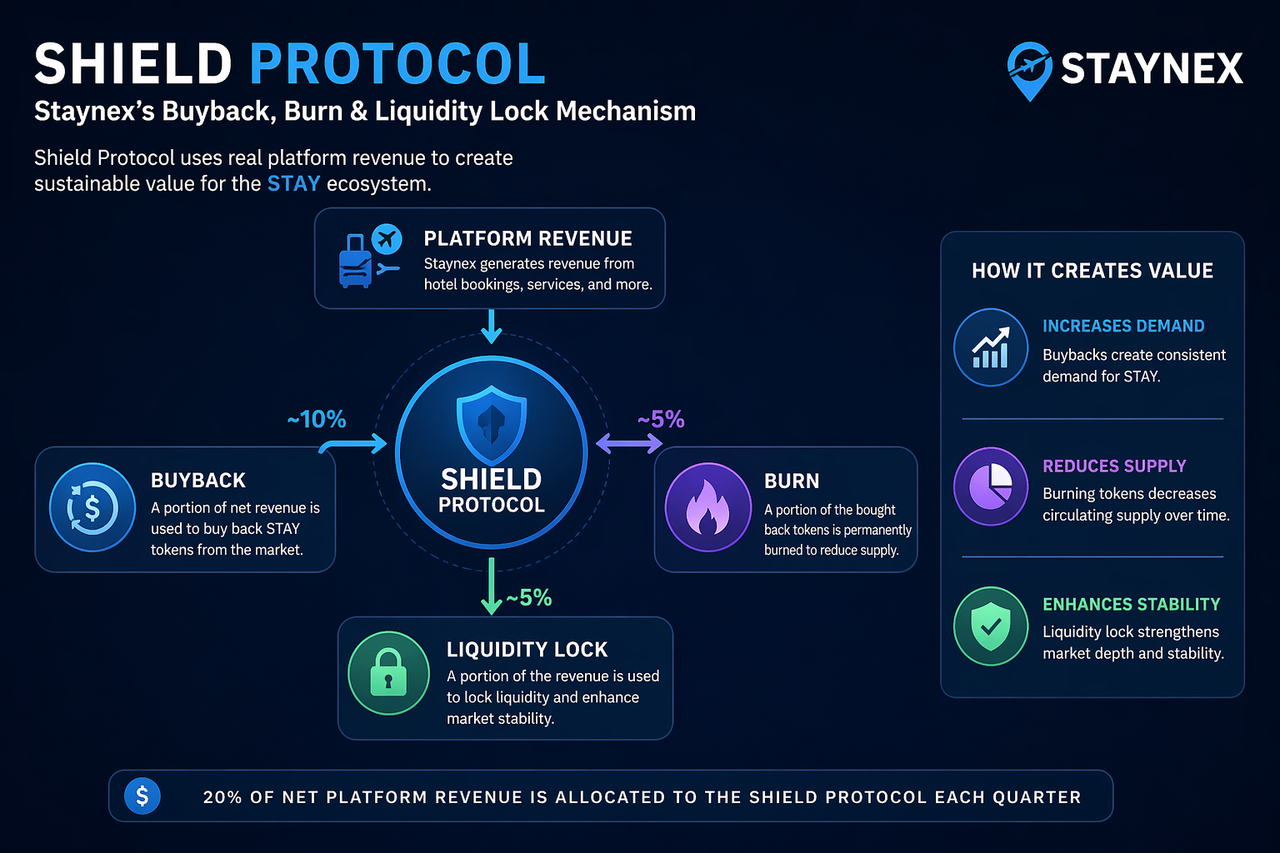
As a value support model designed by Staynex for the STAY token, Shield Protocol’s core goal is to continuously feed part of the platform’s revenue back into the token market, strengthening STAY’s long-term value support. According to the official mechanism, Staynex allocates 20% of the platform’s net revenue to buybacks, burns, and liquidity locking.
In essence, this design turns platform business growth into increased token demand. When platform revenue rises, the funds available for buying back STAY also increase, creating sustained buying demand for the token. At the same time, part of the repurchased tokens are burned, reducing circulating supply and further reinforcing token scarcity.
Through this approach, Shield Protocol connects STAY’s value with the platform’s actual business performance, rather than leaving it dependent only on secondary market sentiment.
How Does Staynex Support STAY’s Value Through Buybacks?
The buyback mechanism is the most direct form of value support within Shield Protocol. Staynex uses part of its platform net revenue to buy back STAY from the market, meaning every time the platform generates revenue, it creates real buying demand for STAY.
This buyback activity has two important effects. First, it increases market demand and brings additional buying pressure to STAY. Second, it converts platform revenue into token demand, linking token value with platform business growth. When platform bookings and revenue grow, the buyback force could theoretically become stronger, creating a positive value cycle.
For users, this means STAY’s long-term value does not rely only on market speculation. It may also benefit from real demand support generated by platform business growth.
How Does the Token Burn Mechanism Reduce Supply?
After buying back STAY, Staynex burns part of the tokens. Burning means these tokens are permanently removed from circulation and can no longer be used or traded. The main purpose of this mechanism is to reduce the circulating supply of STAY in the market and strengthen value support from the supply side.
When market demand remains unchanged or even increases while circulating supply decreases, token scarcity rises, which may affect the token’s long-term supply and demand structure. Compared with buybacks without burns, the burn mechanism can create a more visible supply contraction effect.
For STAY, combining the burn mechanism with platform revenue growth gives its total supply the potential to decrease dynamically, providing stronger support for its long-term value logic.
What Role Does Liquidity Locking Play in Shield Protocol?
In addition to buybacks and burns, Shield Protocol also allocates part of the funds to liquidity pool locking. The purpose of liquidity locking is to strengthen STAY’s stability in the trading market and reduce sharp price swings caused by insufficient liquidity.
In many projects, even when a token has a buyback mechanism, market prices may still fluctuate sharply if liquidity is insufficient. By locking liquidity, Staynex can improve market depth and provide a more stable trading environment for STAY.
This not only helps improve market performance, but also strengthens user and investor confidence in the tokenomics model, making Shield Protocol’s mechanism design more complete.
How Does Shield Protocol Create a Value Loop?
The core value of Shield Protocol lies in creating a complete value loop: platform revenue growth brings more buyback funds, buybacks increase market demand, burns reduce market supply, and liquidity locking improves market stability. Together, these three elements allow platform business growth to gradually translate into long-term value support for STAY.
The advantage of this closed-loop mechanism is that it links token value directly with platform business development. Changes in platform business performance may affect how the mechanism operates. The more stable token value becomes, the more willing users may be to participate in the platform ecosystem. This positive cycle can help strengthen ecosystem sustainability.
In Web3 projects, token models that can create this kind of revenue feedback loop are still relatively rare. That makes Shield Protocol an important part of Staynex’s token mechanism design.
Why Is Shield Protocol Important to Staynex?
For Staynex, Shield Protocol is not just a buyback and burn tool. It is an important part of the platform’s long-term value model. It connects travel business revenue with token value, making STAY an ecosystem asset that is genuinely related to platform growth, rather than simply a utility reward token.
This mechanism can help Staynex achieve three goals: first, establish long-term value support for STAY; second, strengthen users’ willingness to hold and stake the token; third, improve the stability of the overall platform ecosystem. In the highly competitive Web3 market, this revenue-driven mechanism helps strengthen the relationship between the token model and the platform’s business.
What Are the Risks and Limitations of Shield Protocol?
Although Shield Protocol establishes a relatively complete token adjustment mechanism through buybacks, burns, and liquidity locking, its effectiveness still depends on Staynex’s actual revenue performance. If platform revenue growth is limited, the amount of funding available for buybacks and burns will also be limited, which may weaken the mechanism’s impact. In addition, while buyback and liquidity locking mechanisms can affect the supply and demand structure, they cannot guarantee token price stability. Market sentiment and liquidity changes may still create volatility.
Conclusion
As the core value support mechanism designed by Staynex for the STAY token, Shield Protocol builds a closed-loop model of “revenue-driven value growth” by allocating 20% of the platform’s net revenue to buybacks, burns, and liquidity locking. This mechanism directly links STAY’s value with platform business performance, helping strengthen the token’s long-term value support.
For the STAYNEX ecosystem, the significance of Shield Protocol lies in the fact that token value no longer depends solely on market sentiment. Instead, it can receive support from real revenue. As the platform’s business changes, Shield Protocol may continue to affect STAY’s supply and demand structure as well as its liquidity performance.
FAQs
How Does Shield Protocol Improve STAY’s Value?
It uses platform revenue to buy back STAY and increase market demand, while burns reduce circulating supply and liquidity locking improves market stability. Together, these elements strengthen STAY’s long-term value support.
Why Does Staynex Burn Tokens?
Token burns reduce the circulating supply of STAY and increase token scarcity, allowing platform revenue growth to translate into stronger value support.
How Is Shield Protocol Different from a Regular Buyback Mechanism?
A regular buyback usually only increases market demand, while Shield Protocol combines buybacks, burns, and liquidity locking to create a more complete value loop.