As real world assets move onchain, price volatility can directly affect trading efficiency and asset pricing, so users often pay close attention to whether the system provides a stable pricing tool. In this context, stablecoins become a key component, helping reduce the uncertainty caused by market fluctuations.
This issue usually involves three layers, the peg mechanism, the collateral structure, and trading applications. Together, these factors determine a stablecoin’s reliability and scope of use.
What Is mantraUSD, and What Role Does It Play in the MANTRA Ecosystem
Within the MANTRA system, mantraUSD serves as the settlement layer asset, standardizing transaction pricing and fund flows.
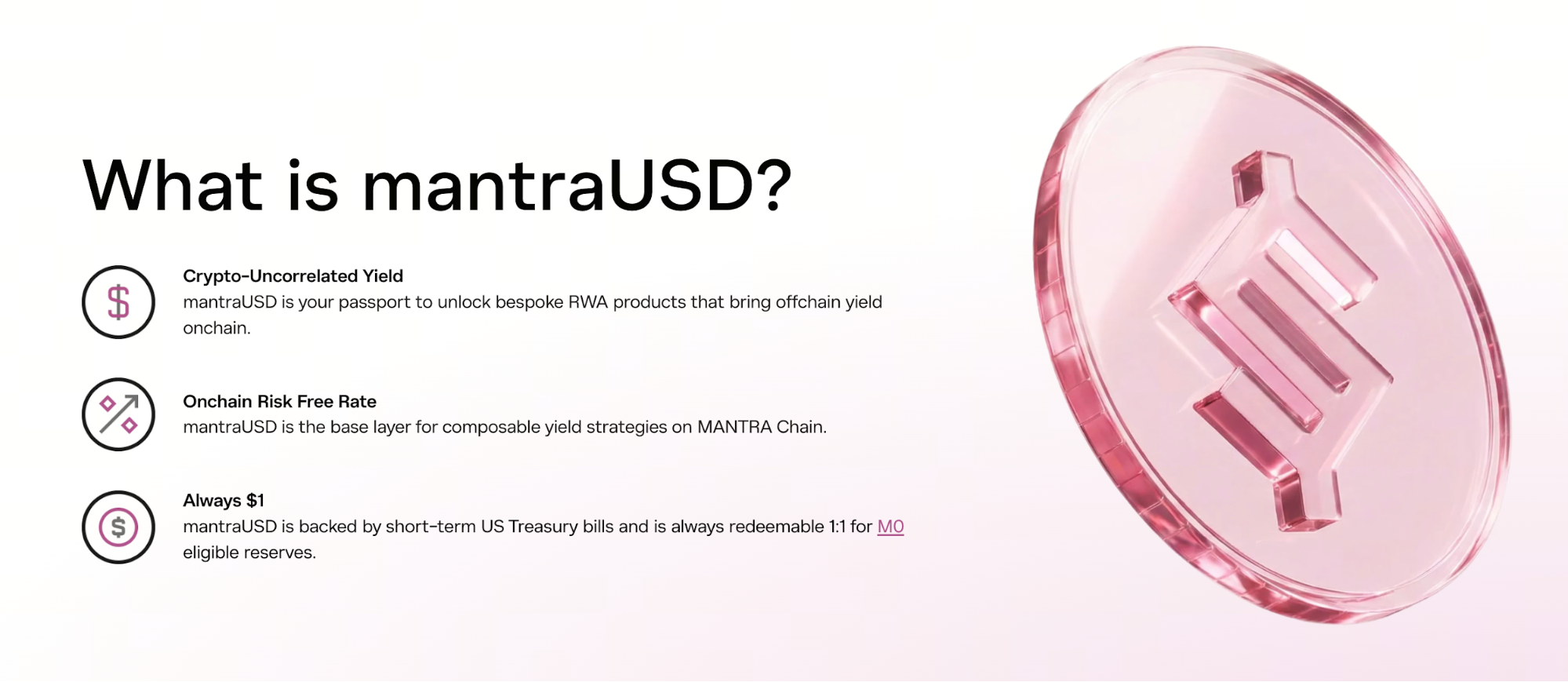
At the mechanism level, this stablecoin is linked to the value of fiat currency, allowing onchain assets to be exchanged in a stable unit and reducing the impact of price volatility on transactions.
Structurally, the MANTRA ecosystem can be divided into an asset layer and a settlement layer. RWA assets sit in the asset layer, while mantraUSD sits in the settlement layer. The two are connected through the trading system, allowing assets to circulate on the basis of stable pricing.
The importance of this positioning lies in providing a unified value standard for complex RWA assets, which in turn improves overall system efficiency.
How mantraUSD Maintains Its Peg to the US Dollar
The core function of a stablecoin is to maintain its value relationship with the US dollar. mantraUSD achieves this through collateral and reserve mechanisms.
At the mechanism level, the system holds reserve assets that correspond to the amount issued, supporting the token’s value. These reserves are typically held in low volatility assets to reduce price deviation.
From a structural perspective, the peg mechanism consists of an issuance module, a reserve module, and a market adjustment mechanism. The issuance module controls supply, the reserve module provides value backing, and the market mechanism helps maintain price stability through trading activity.
The significance of this design is that it allows the stablecoin to remain relatively stable during market fluctuations, making it a reliable medium of exchange.
How the Collateral and Reserve Structure Is Designed
The stability of mantraUSD depends on its reserve structure. The system generally supports issuance through collateralized assets.
At the mechanism level, each unit of stablecoin corresponds to a certain proportion of reserve assets, which may include real world financial assets or other low risk instruments.
Structurally, the reserve system consists of an asset pool, a management module, and an audit mechanism. The asset pool stores the collateral, the management module adjusts the structure, and the audit mechanism verifies its authenticity.
The significance of this design is that it improves user trust in the stablecoin through transparency while also reducing systemic risk.
The Role of mantraUSD in RWA Trading
In RWA trading scenarios, mantraUSD is mainly used for pricing and settlement.
At the mechanism level, users can use this stablecoin to buy or sell onchain assets and complete the exchange of value. Because its price is stable, both sides of the transaction avoid taking on additional volatility risk.
From a structural perspective, mantraUSD sits in the middle layer of the trading path, linking buyers and sellers of assets. This structure is similar to the role of settlement currency in traditional finance.
The importance of this role is that it allows complex assets to be traded under a unified standard, improving both liquidity and market efficiency.
How It Differs from USDT, USDC, and Other Stablecoins
The main differences between mantraUSD and major stablecoins lie in their use cases and structural design.
| Dimension |
mantraUSD |
USDT / USDC |
| Use case |
RWA trading |
General payments |
| Structural focus |
Asset settlement |
Liquidity |
| Collateral source |
RWA related assets |
Fiat reserves |
| Ecosystem positioning |
Specialized stablecoin |
General purpose stablecoin |
| System relationship |
Internal settlement |
Cross platform use |
As the table shows, mantraUSD is more of a specialized stablecoin, while USDT and USDC are general purpose stablecoins. This difference determines both its range of use and its design priorities.
How the Yield Distribution Mechanism Affects Ecosystem Participants
In some designs, stablecoins may be linked to a yield distribution mechanism.
At the mechanism level, the system may distribute part of the value back to participants through asset yields or fee allocation. This mechanism is usually tied to the asset pool or protocol revenue.
Structurally, yield distribution involves the asset source, distribution rules, and participant roles. Together, these factors determine how value flows through the system.
The significance of this design is that it increases user participation and strengthens the system’s long term stability.
Comparative Summary Table
| Module |
mantraUSD |
General Purpose Stablecoin |
| Design goal |
RWA settlement |
Cross scenario use |
| Value backing |
Asset collateral |
Fiat reserves |
| Usage path |
Internal trading |
Multi platform circulation |
| Risk structure |
Asset related |
Reserve related |
| Ecosystem role |
Settlement layer |
General layer |
This comparison shows that mantraUSD places greater emphasis on internal system functionality rather than cross ecosystem circulation. That structure gives it an advantage in specific use cases.
Conclusion
Through its collateral and peg mechanisms, mantraUSD establishes stable value and serves as the settlement asset within the MANTRA ecosystem, allowing RWA assets to be traded under a unified standard.
FAQ
What is the main purpose of mantraUSD?
It is used for pricing and settling RWA assets.
How does it stay stable?
It maintains its peg through reserve assets and issuance controls.
How is it different from USDT?
The main differences lie in its use case and structural design.
Can it be used for ordinary transactions?
It is primarily used for internal transactions within the MANTRA ecosystem.
Why are stablecoins important?
They help reduce price volatility and improve trading efficiency.