Warning! When BTC Falls Below $100,000: Is the Next Wave of Risk Coming?

Last Updated 2026-03-28 01:44:34
Reading Time: 1m
Bitcoin (BTC) just dropped below $100,000, and the market is entering a correction phase. This article analyzes the reasons behind the move and its impact. It also provides practical tips for newcomers on how to respond to this key pullback.

BTC Drops Below $100,000: What’s Going On?

On November 5, 2025, Bitcoin (BTC) plunged to approximately $99,900 across major trading platforms, marking its first return to this level since June. From its October peak near $126,000, BTC has now declined by over 20%. This drop isn’t just about the numbers—it signals a breach of key support, with the market showing signs of panic and intensified selling pressure.

Three Core Drivers Behind the Decline

Technical Support Breakdown: The $100,000 level was widely seen as both a psychological and technical floor. Once breached, a wave of stop-loss orders triggered, accelerating the slide.

Weak Macro Backdrop: Factors including interest rate expectations, tighter liquidity, and heightened global economic uncertainty are weighing on risk assets such as Bitcoin.

Leverage and Liquidations: Heavy use of leverage in the market led to forced liquidations, with estimates reaching several billion dollars, fueling the panic sell-off.

Technical Analysis: Bearish Momentum Leads, Short-Term Downside Risks Persist
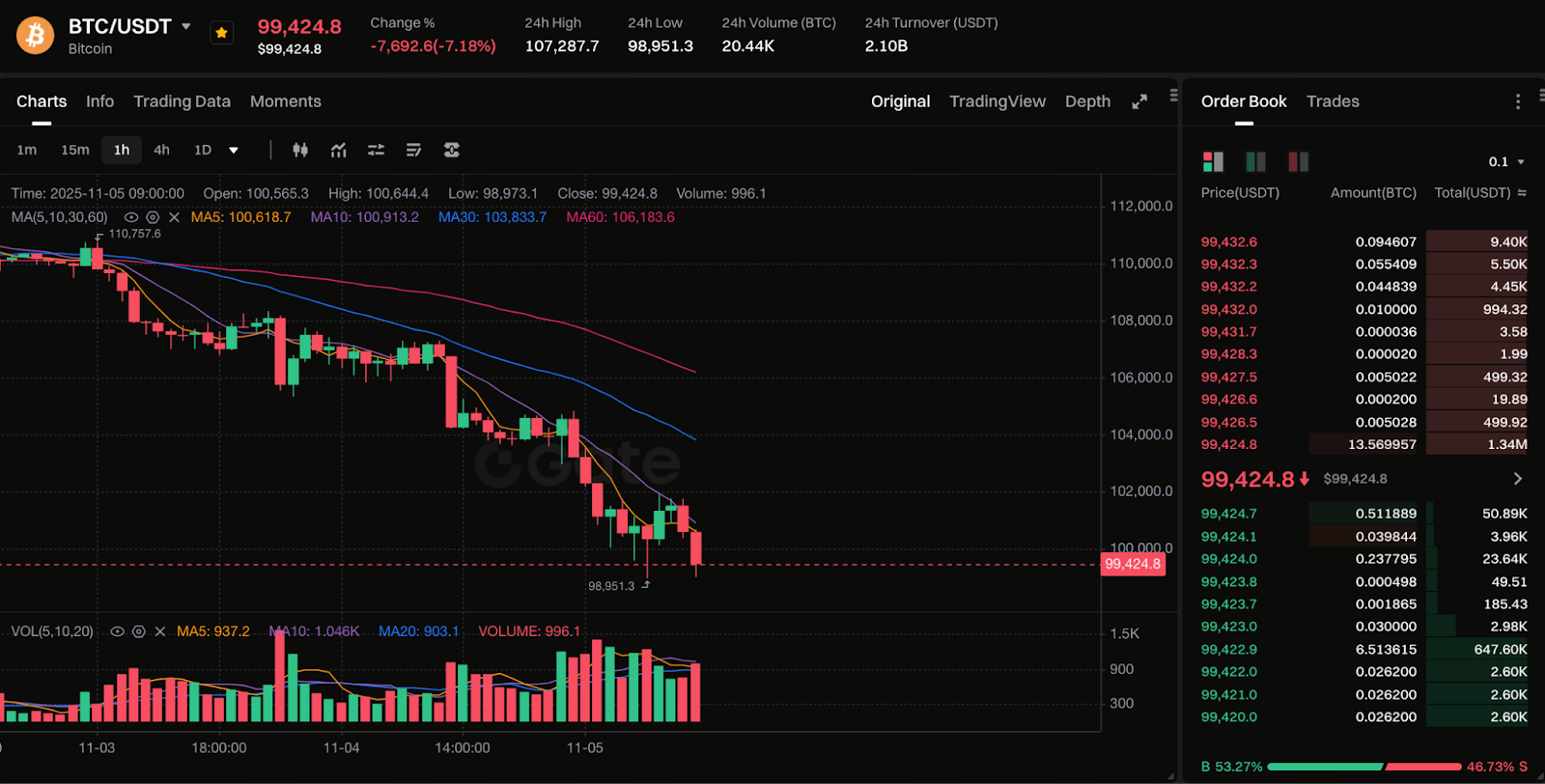

Chart: https://www.gate.com/trade/BTC_USDT

On the 1-hour candlestick chart, BTC currently sits near 99,357 USDT, down about 7.3%. The short-term pattern shows a clear downward trend:

  • Moving averages (MA5/10/30/60) are fully aligned in bearish formation. The short-term MA5 sits at $100,605, breaking below the mid-term MA30 (≈ $103,832), signaling ongoing downward pressure.
  • Trading volume has picked up, confirming sellers are in control. Notably, a high-volume lower wick formed near $98,951—showing some support exists, but rebound strength is limited.
  • Candlestick Pattern: Multiple consecutive bearish candles with short-term rallies capped by moving averages, forming a classic “descending channel.”
  • Support & Resistance: Near-term support sits at $98,950 (if breached, $97,000 may be tested). Resistance above is at $101,000–$102,500.

Overall verdict: If BTC fails to reclaim MA10, short-term momentum remains weak. New investors should avoid blind “bottom fishing” and wait for signs of declining volume and moving average convergence before acting.

How Does This Impact New Investors?

For those just entering the crypto space, this breakdown carries several implications:

  • Psychological Stress: Seeing the iconic $100,000 level breached can spark fear or anxiety, leading to impulsive decisions.
  • Heightened Risk Exposure: If holding large positions or having entered at high prices, losses can quickly mount as prices fall.
  • Opportunities and Traps: A support break could be a buying opportunity (if you’re bullish long-term) or signal deeper declines (if trend reverses). Some institutional analysts warn that if $100,000 fails, BTC could drop to $72,000.

How to Build a Simple Strategy in This Market?

  • Set Stop-Loss/Take-Profit Levels: Choose exit points based on your risk tolerance, such as “exit below $90,000” or “sell part at $110,000.”
  • Staggered Entry Instead of Lump Sum: If you’re bullish long-term, consider entering in batches to reduce single-entry risk.
  • Adjust Expectations: Don’t treat $100,000 as a guaranteed bottom—focus on market trends, not just price levels.
  • Maintain Liquidity and Emergency Reserves: Avoid going “all in”—keep some cash or stable assets on hand for volatility.

Conclusion: What’s the Next Move?

In summary, BTC’s drop below $100,000 is more than a short-term fluctuation—it could signal a key shift in market structure. For new investors, the main takeaway is: don’t panic, don’t chase rallies, focus on risk management, and keep room for opportunity. If your long-term thesis remains intact, crypto can still be part of your portfolio—but remember, it’s a high-risk, high-volatility asset. If prices stabilize and rebound, the next bull run may begin; if support continues to fail, further declines are possible. We’ll keep monitoring market signals closely.

Author: Max
Disclaimer
* The information is not intended to be and does not constitute financial advice or any other recommendation of any sort offered or endorsed by Gate.
* This article may not be reproduced, transmitted or copied without referencing Gate. Contravention is an infringement of Copyright Act and may be subject to legal action.

Related Articles

What is Fartcoin? All You Need to Know About FARTCOIN
Intermediate

What is Fartcoin? All You Need to Know About FARTCOIN

Fartcoin (FARTCOIN) is a representative meme coin within the Solana ecosystem based on an AI-driven narrative. Its core concept originated from an experiment aimed at exploring the "boundaries between AI Agents and humor." More than just a digital asset with social attributes, the project deeply couples absurd humor culture with on-chain financial logic by integrating autonomous AI interaction models.
2026-04-04 22:01:19
Gold Price Forecast for the Next Five Years: 2026–2030 Trend Outlook and Investment Implications, Could It Reach $6,000?
Beginner

Gold Price Forecast for the Next Five Years: 2026–2030 Trend Outlook and Investment Implications, Could It Reach $6,000?

Analyze current gold price trends alongside authoritative five-year forecasts, integrating an evaluation of market risks and opportunities. This gives investors insight into the potential trajectory of gold prices and the main drivers expected to shape the market over the next five years.
2026-03-25 18:13:30
Aster vs Hyperliquid: Which Perp DEX Will Prevail?
Beginner

Aster vs Hyperliquid: Which Perp DEX Will Prevail?

Aster and Hyperliquid are the two representative protocols of the "purpose-built L1 path" within the current decentralized perpetual exchange (Perp DEX) sector. As a pioneer in the field, Hyperliquid has built a deep liquidity moat through its highly mature order book architecture and strong community consensus. Conversely, Aster, as a rising challenger, seeks to leapfrog the competition in high-performance trading through more aggressive multi-chain aggregation logic, private transaction modules, and an underlying execution environment optimized for 2026 market demands.
2026-03-24 11:58:33
AI-Native Settlement Layers: How United Stables Is Building the Next Financial Rail
Beginner

AI-Native Settlement Layers: How United Stables Is Building the Next Financial Rail

Stablecoins were originally designed as dollar substitutes within exchanges, primarily used for asset pricing and trade settlement. As on-chain financial ecosystems have matured, their role has expanded beyond simple payments to include collateral assets, cross-chain liquidity mediums, and unified settlement units. In particular, as AI systems and automated agents begin to participate directly in economic activity, demand has risen sharply for programmable value units capable of instant settlement. This shift is pushing stablecoins toward the role of foundational financial infrastructure.
2026-03-25 03:16:17
2026 Silver Price Forecast: Bull Market Continuation or High-Level Pullback? In-Depth Analysis of Silver Candlestick Chart
Beginner

2026 Silver Price Forecast: Bull Market Continuation or High-Level Pullback? In-Depth Analysis of Silver Candlestick Chart

2026 Silver Price Forecast: Latest Outlook This article integrates current market trends, silver candlestick chart analysis, and momentum factors to assess the potential key support and resistance levels, upside targets, and pullback risks for silver prices. The goal is to help investors make informed, rational decisions.
2026-03-25 16:08:59
ASTER Tokenomics: Buybacks, Burns, and Staking as the Value Foundation of ASTER in 2026
Beginner

ASTER Tokenomics: Buybacks, Burns, and Staking as the Value Foundation of ASTER in 2026

ASTER is the native equity and governance token of the Aster ecosystem, with its core value built upon a radical "Deflationary Engine." Beyond serving as a governance tool, ASTER integrates multiple utilities including staking rewards, trading fee discounts, and liquidity incentives. Through its deep integration with the upcoming dedicated Layer 1 mainnet, it enables direct value capture from protocol cash flow to token holders.
2026-03-25 07:38:07