U.S. Stocks Near Record Highs as 2025 Enters Its Final Stretch: Key Market Watchpoints This Week

Beginner
Quick Reads
Last Updated 2026-03-26 18:12:56
Reading Time: 1m
As 2025 enters its final trading phase, global stock indices remain near record highs. This article examines the critical factors investors should monitor in the stock market this week, focusing on market trends, macroeconomic data, and the performance of the technology and AI sectors.

Year-End Approaches: Global Equities in a High-Level Trading Range
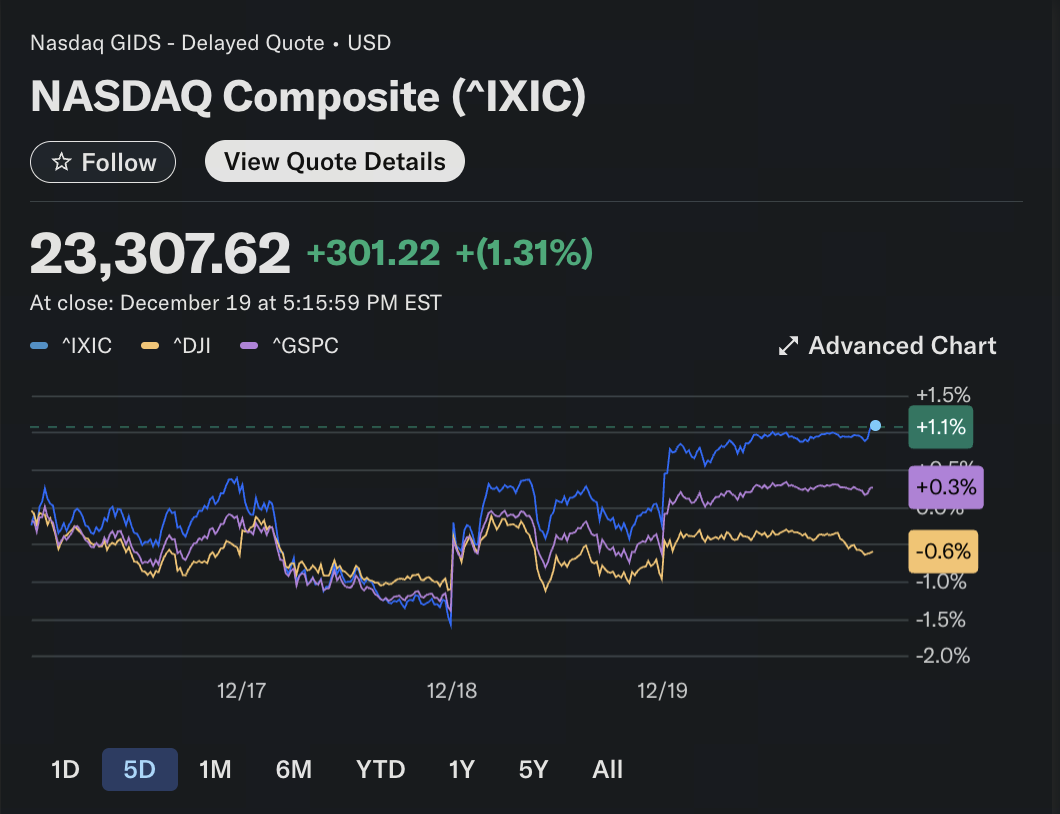
As 2025 comes to a close, global equity markets are entering a pivotal year-end phase. Major indices remain near record highs, but market momentum has slowed compared to mid-year. The current environment reflects a high-level trading range, making risk management and certainty top priorities for investors at year-end.

During this period, holidays often play a significant role in shaping market conditions. Trading volumes typically decline in phases, and volatility can occasionally spike—both are common features of year-end market activity. As a result, elevated index levels do not guarantee a one-sided market trend will continue.

Major Indices Near Record Highs, Valuation Sensitivity Rises

Most core equity indices are just shy of all-time highs. This reflects continued optimism in the market, but also signals that valuations are historically elevated.

In this environment, markets are highly sensitive to macroeconomic variables. Even marginal changes in economic data or slight shifts in policy expectations can be amplified and quickly reflected in asset price volatility.

As the year ends, capital flows are diverging: some investors are locking in annual gains and reducing risk, while others are positioning early for the next year. This divergence is adding complexity to overall market structure.

Macroeconomic Data Is This Week’s Key Short-Term Variable

Year-end brings increased importance for macroeconomic data in shaping market sentiment. This week’s releases on consumer spending, employment, and inflation will serve as critical indicators of economic resilience.

If the data is solid, it could support markets at current highs. But any significant downside surprises may trigger a short-term correction. Policy expectations remain a central focus, and market views on next year’s policy direction are often priced in ahead of time during year-end trading.

Technology and AI Sectors Remain Core Index Drivers

Throughout 2025, the technology sector—especially AI-related segments—has driven major indices higher. Market capital continues to flow into computing infrastructure, semiconductors, and data-centric industries.

However, after substantial gains in select stocks this year, market attitudes toward AI have shifted from broad pursuit to more selective allocation. This internal differentiation could persist through year-end and into 2026.

Market Sentiment Shifts and Faster Sector Rotation

At elevated index levels, sector rotation has accelerated. Some capital is moving out of high-valuation, high-volatility sectors and into more defensive industries with stable cash flows to hedge against potential volatility.

This rotation does not necessarily signal a trend reversal. Instead, it represents a market-wide risk rebalancing at high levels.

Year-End Risks and Outlook

In summary, global equities retain some support as 2025 ends. However, high valuations, shifts in liquidity, and macroeconomic uncertainty remain key risks for investors to monitor.

In an environment where opportunity and risk coexist, year-end trading puts a premium on allocation timing and portfolio structure. Staying flexible and closely tracking both data and policy changes will be critical strategies heading into 2026.

Author: Max
Disclaimer
* The information is not intended to be and does not constitute financial advice or any other recommendation of any sort offered or endorsed by Gate.
* This article may not be reproduced, transmitted or copied without referencing Gate. Contravention is an infringement of Copyright Act and may be subject to legal action.

Related Articles

What is Fartcoin? All You Need to Know About FARTCOIN
Intermediate

What is Fartcoin? All You Need to Know About FARTCOIN

Fartcoin (FARTCOIN) is a representative meme coin within the Solana ecosystem based on an AI-driven narrative. Its core concept originated from an experiment aimed at exploring the "boundaries between AI Agents and humor." More than just a digital asset with social attributes, the project deeply couples absurd humor culture with on-chain financial logic by integrating autonomous AI interaction models.
2026-04-04 22:01:19
Gold Price Forecast for the Next Five Years: 2026–2030 Trend Outlook and Investment Implications, Could It Reach $6,000?
Beginner

Gold Price Forecast for the Next Five Years: 2026–2030 Trend Outlook and Investment Implications, Could It Reach $6,000?

Analyze current gold price trends alongside authoritative five-year forecasts, integrating an evaluation of market risks and opportunities. This gives investors insight into the potential trajectory of gold prices and the main drivers expected to shape the market over the next five years.
2026-03-25 18:13:30
Aster vs Hyperliquid: Which Perp DEX Will Prevail?
Beginner

Aster vs Hyperliquid: Which Perp DEX Will Prevail?

Aster and Hyperliquid are the two representative protocols of the "purpose-built L1 path" within the current decentralized perpetual exchange (Perp DEX) sector. As a pioneer in the field, Hyperliquid has built a deep liquidity moat through its highly mature order book architecture and strong community consensus. Conversely, Aster, as a rising challenger, seeks to leapfrog the competition in high-performance trading through more aggressive multi-chain aggregation logic, private transaction modules, and an underlying execution environment optimized for 2026 market demands.
2026-03-24 11:58:33
AI-Native Settlement Layers: How United Stables Is Building the Next Financial Rail
Beginner

AI-Native Settlement Layers: How United Stables Is Building the Next Financial Rail

Stablecoins were originally designed as dollar substitutes within exchanges, primarily used for asset pricing and trade settlement. As on-chain financial ecosystems have matured, their role has expanded beyond simple payments to include collateral assets, cross-chain liquidity mediums, and unified settlement units. In particular, as AI systems and automated agents begin to participate directly in economic activity, demand has risen sharply for programmable value units capable of instant settlement. This shift is pushing stablecoins toward the role of foundational financial infrastructure.
2026-03-25 03:16:17
Aerodrome Tokenomics: How ve(3,3) Powers Base's Most Profitable DEX
Beginner

Aerodrome Tokenomics: How ve(3,3) Powers Base's Most Profitable DEX

AERO is the native token of Aerodrome Finance, a core decentralized exchange and liquidity protocol in the Base ecosystem. It is primarily used for liquidity incentives and ecosystem operations. veAERO is a governance NFT that users receive by locking AERO, representing both voting power and the right to share protocol revenue. Through a dual track structure of AERO as a utility token and veAERO as a governance credential, Aerodrome separates liquidity usage value from long term governance power, allowing participants to act as liquidity providers, governance decision makers, and revenue sharers within the same system.
2026-03-25 06:40:31
The ve(3,3) Flywheel Explained: How AERO Tokenomics Powers Aerodrome’s DeFi Economy
Beginner

The ve(3,3) Flywheel Explained: How AERO Tokenomics Powers Aerodrome’s DeFi Economy

In the competition for DeFi liquidity, high-inflation mining alone is no longer enough to build lasting advantages. Aerodrome applies the ve(3,3) economic model to redesign token emissions, voting mechanisms, and revenue distribution, creating a liquidity flywheel centered on governance and cash flow. This article examines AERO tokenomics, the veAERO locking mechanism, and protocol revenue models to explain how Aerodrome builds a sustainable DeFi economic system.
2026-03-25 06:41:58





