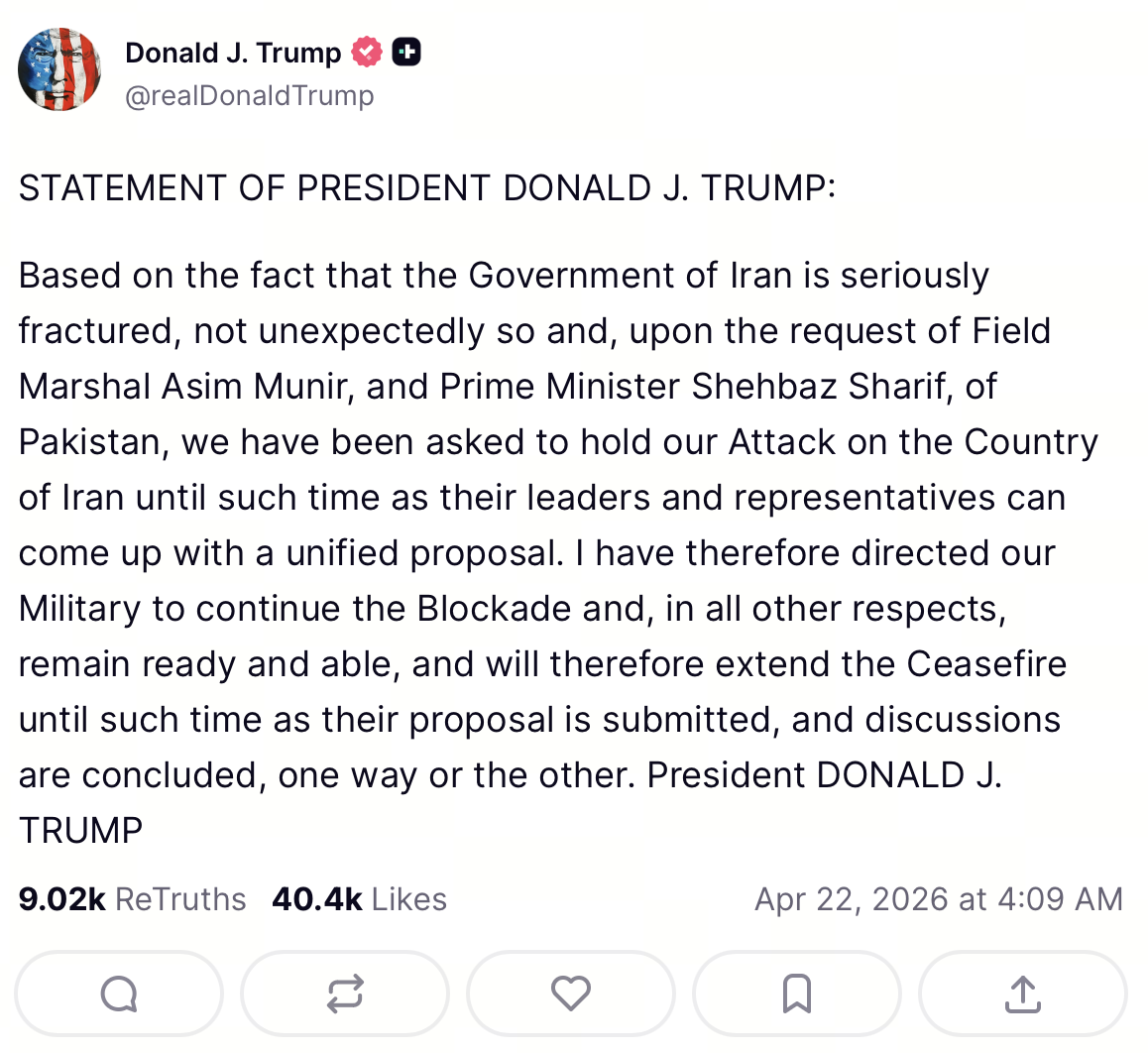
Image source: Trump Truth Social Post
On the morning of April 22, Trump signaled a hardline stance on the US-Iran situation during a CNBC "Squawk Box" phone interview—publicly expressing reluctance to extend the ceasefire and stressing that the US retained military options and was prepared to act. Just hours later, he posted on Truth Social announcing an indefinite extension of the ceasefire, tying it to conditions such as "Iran submitting a proposal and related discussions ending in some way."
From the perspective of information flow and market response, this "tough in the morning, softer in the afternoon" communication cadence can sharply increase intraday volatility: risk-on assets often rebound as tail risks are repriced, while safe-haven and inflation-hedge narratives may see temporary pullbacks. Importantly, this article is based solely on public reporting and common market mechanisms and does not constitute investment advice.
At the same time, major international news agencies and mainstream media have added further nuance: updated ceasefire language does not mean maritime blockades and military readiness are lifted simultaneously. Reports from the Associated Press and others emphasize that extending the ceasefire can coexist with continued pressure through port blockades on Iran, directly impacting the market's interpretation of whether "de-escalation" means a broad reduction in tensions or simply a shift from conflict de-escalation to increased sanctions and blockade pressure.
Conditional Structure: "Parallel Pressure" Between Ceasefire Extension, Maritime Blockade, and Negotiations
If we abstract this round of negotiations into a "terms sheet," the structure typically looks like:
- Ceasefire: Reduces the probability of direct clashes and escalation of airstrikes, creating a window for diplomatic engagement.
- Blockade/Embargo: Continues to constrain Iran's trade and fiscal flexibility, forcing negotiations under adverse conditions.
- Negotiations: Whether a second round of talks occurs, both delegations attend, and the agenda remains controllable are hard metrics for assessing the sustainability of "de-escalation."
According to BBC and others, the diplomatic process was anything but smooth around Trump's ceasefire extension announcement: Vice President JD Vance's trip to Pakistan was delayed, talks in Islamabad stalled, and Iran expressed rejection or strong reservations about "negotiations under threat." Such developments undermine the market's ability to extrapolate a "certain de-escalation," making pricing more prone to back-and-forth moves.
Trump publicly linked the ceasefire extension to requests from Pakistani Prime Minister Shehbaz Sharif and senior military leaders (such as the Army Chief of Staff and other key defense figures). For global market participants, this narrative carries at least three implications:
- Face-saving: Third-party requests provide an "external rationale" for policy shifts, reducing the cost for the US to be seen as backing down unilaterally.
- Broker credibility: Whether the intermediary can manage communication pace, deliver credible commitments, and avoid information distortion will directly affect risk premium stability.
- Regional spillover: Security issues in South Asia and the Middle East are intertwined with energy, shipping, and capital flows, so markets often price Hormuz risk and broader geopolitical uncertainty in tandem.
Thus, Pakistan’s mediation does not automatically mean "the conflict is over." Rather, it creates a negotiating table during a high-risk window—where the terms (blockades, sanctions, military postures) can still drive the main trend in asset prices.
Policy Communication and Market Discounting: High-Frequency Statements, Conditionality, and "Verifiable Commitments"
In high-stress geopolitical environments, leaders making statements via TV interviews and social media can dramatically accelerate information flow and increase interpretive divergence. Rather than focusing on personalities, a more trading- and risk management-aligned approach is to treat public statements as a blend of signals and noise—using observable variables for verification.
From an information economics perspective, market participants tend to raise discount rates for high-frequency, directionally inconsistent statements: the same "ceasefire extension," if paired with continued blockades, delayed talks, and absent delegations, is likely to be priced as an incomplete de-escalation, not a straightforward "peace dividend."
For crypto and broad risk assets, three mechanisms are especially relevant:
- Cross-asset consistency: If risk assets rebound but oil prices, shipping premiums, and related sovereign CDS do not ease, it often signals layered pricing or crowded short-term trades—making subsequent pullbacks more likely.
- Liquidity and leverage structure: Perpetual funding rates, open interest, liquidation patterns, and spot premiums can amplify macro headlines into short-term volatility. This volatility may not shift the medium-term narrative but does affect execution costs and risk parameters.
- Verifiable proxies for institutional constraints: For example, whether talks actually occur, blockades are relaxed, or military deployments are visibly adjusted. The market ultimately trusts these "verifiable facts" over one-off statements.
So, rather than reducing policy communication to a "dove/hawk" binary, it's more accurate to see it as a Bayesian updating process: as new information arrives, participants adjust their expectations for "war probability," "stalemate probability," and "sanctions/blockade intensity." For crypto—high-volatility, high-leverage assets—the true driver of volatility is the speed of these expectation shifts, not the headlines themselves.
Market Impact: Oil, Equity Risk Premium, and Crypto’s High Beta Spillover
At the level of public information and market narrative, the typical price transmission chains in this news window are:
- Short-term repricing of tail risks: Ceasefire extension lowers the perceived probability of "immediate large-scale escalation," boosting risk appetite for global equities and crypto.
- Oil and inflation expectations: If markets trade on "eased supply shock/shipping risk," oil prices may fall, reducing short-term inflation fears and supporting rate-sensitive assets. Industry media noted risk asset rebounds and sharp oil volatility around the news window, but actual moves should be confirmed with exchange and official data.
- Leverage and crowded trades: If the market was positioned bearish or over-hedged ahead of the deadline, positive news can trigger short covering and liquidations, amplifying short-term gains.
Latest Market Data: BTC Remains in the "Macro Game Zone," News Amplifies Intraday Swings
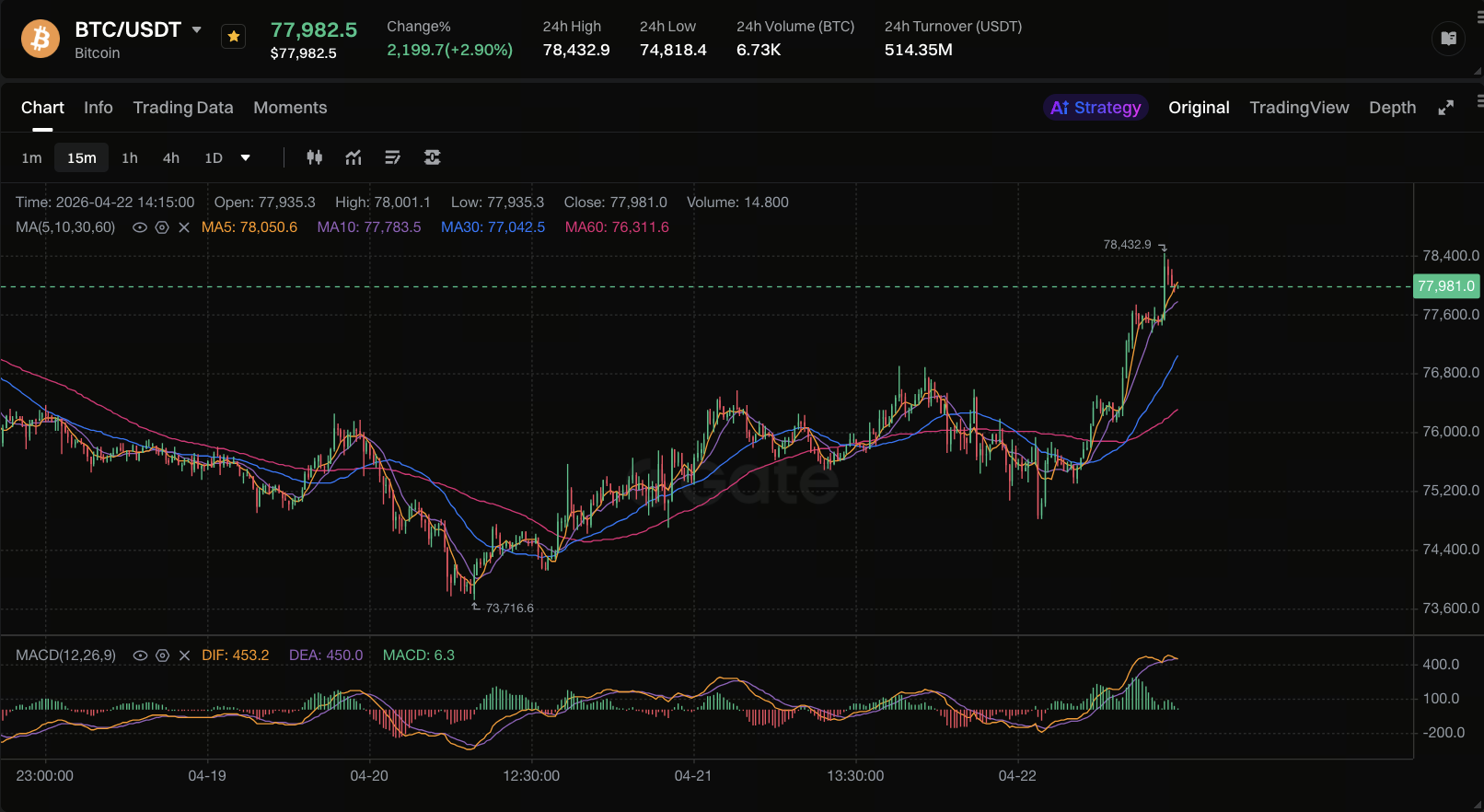
Image source: Gate Market Page
During such windows, BTC typically acts as a Beta proxy for macro risk assets: when risk appetite improves, short-term rebounds are swift; but if the rate trajectory (especially volatility in Fed rate cut expectations) shifts, gains can quickly reverse. As of April 22, 2026, BTC traded around $77,000–$78,000. If ETF net inflows recover, sentiment repair could be more durable, but confirmation via filled amount and market structure remains essential.
ETH, L1/L2, and altcoins often show structural divergence: beyond systemic factors, they're influenced by on-chain activity, ecosystem incentives, token unlocks, and liquidity depth, making their short-term correlation with BTC unstable.
Market outlook (mechanism-focused, not price-targeting):
- De-escalation trades mainly reflect tail risk repricing and short-term rebounds; distinguish "event-driven" from "trend-confirming" moves.
- Monitor leverage and liquidation risk (perpetual fee rates, crowded positioning) to avoid mistaking volatility for a structural breakout.
- Prioritize risk budgeting: preset stop-losses and position limits are more effective than chasing round numbers.
(Trading ranges are based on public media sources; for intraday data, refer to exchange-aggregated quotes. This article does not constitute investment advice.)
Forward Risks: Negotiations Fail, Signals Misread, and Volatility Surges Again
Even with a ceasefire extension, the following risks could shift the market from "de-escalation trades" back to "escalation trades":
- Negotiations stall: Iran refuses delegation talks or insists on lifting blockades as a precondition, widening the gap between "verbal de-escalation" and "real friction."
- Misjudgment and accidents: Maritime standoffs or incidents during blockade enforcement could rapidly rewrite risk pricing.
- Policy reversals: High-frequency statements on Truth Social and in TV interviews will keep noise levels high; for both quant and discretionary strategies, the key is establishing verifiable hard metrics (whether talks occur, blockades change, military deployments adjust).
In summary, the core impact of this event on the crypto market is not whether "Trump is typical," but how the market prices ceasefire, blockade, and negotiations separately: short-term risk appetite can recover quickly, but if these three lines diverge over the long term, risk premiums will repeatedly expand and contract, and volatility may not structurally decline. For market participants, rather than betting on a single narrative, it is more effective to track verifiable conditions and cross-asset consistency (oil, equity indices, dollar liquidity, crypto perpetual funding rates, and liquidation data) and manage uncertainty with a systematic, engineering-driven approach.







