Trump Warns Credit Card Companies: Plans to Impose a 10% Interest Rate Cap After Taking Office, Triggering Market Turmoil

Beginner
Quick Reads
Last Updated 2026-03-26 02:42:02
Reading Time: 1m
Trump’s proposal to cap credit card interest rates at 10% upon taking office has caused bank stocks to tumble and sparked widespread concerns over tighter credit and the effects on consumers. This comprehensive analysis examines the latest developments, explores opposing perspectives, and addresses the key challenges in implementing the proposed legislation.

Trump’s Latest Policy Direction: Context of the Proposed 10% Credit Card Rate Cap
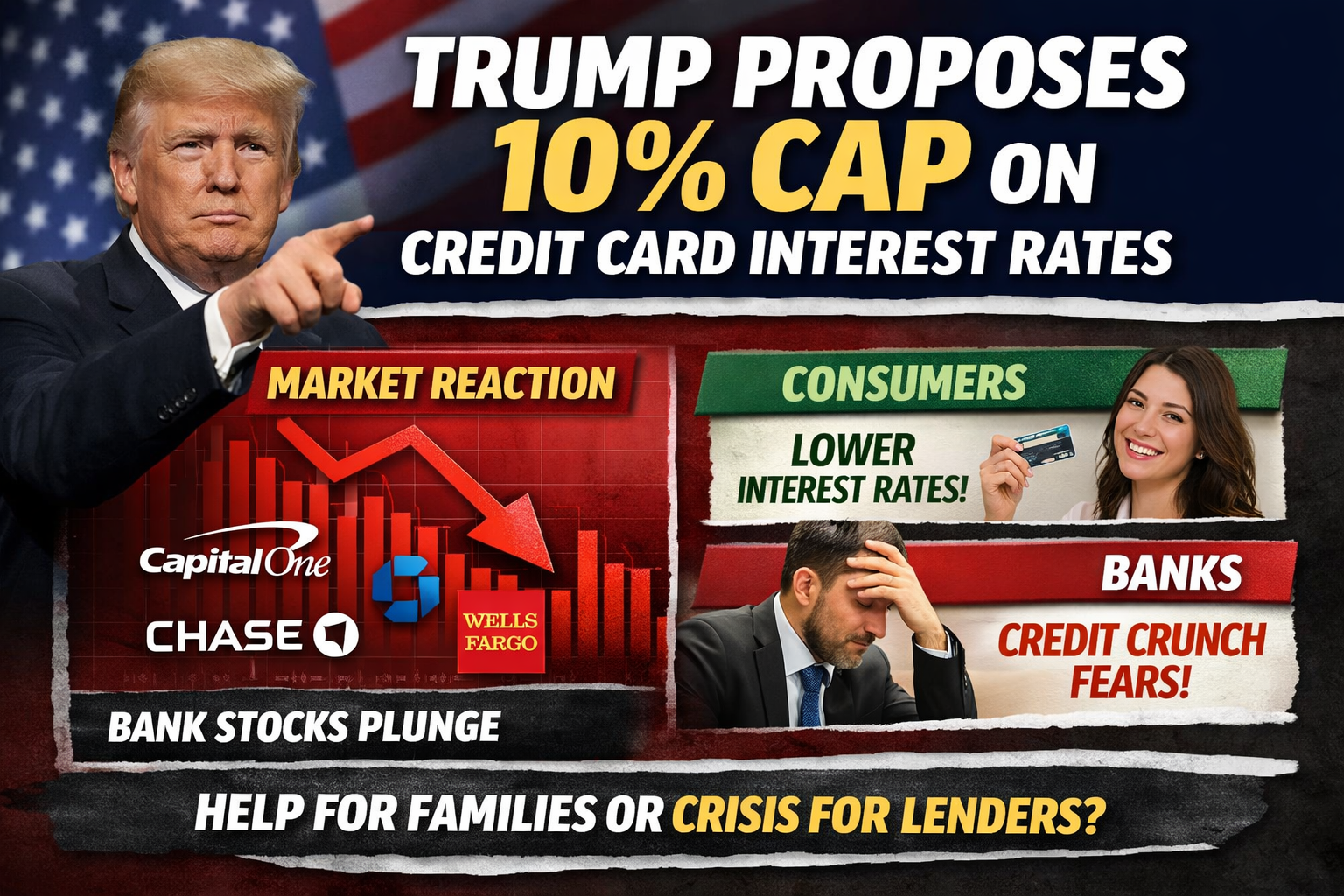
US President Donald Trump has recently reaffirmed on social media and in public statements that he plans to formally implement a one-year temporary cap on credit card interest rates, setting the annual maximum at 10%. Trump emphasized that current credit card rates have persistently remained in the 20%–30% range, or even higher, posing an unfair burden for ordinary consumers. He stated that if credit card companies fail to comply, such actions would be deemed “illegal.”

This initiative is being proposed against the backdrop of ongoing inflationary pressures and rising household debt costs. The intent is to ease the strain of high-interest debt on consumer cash flow, while also supporting his 2024 campaign commitment to reinforce the policy narrative of “lowering the cost of living.”

Policy Impact: Immediate Reaction from Bank Stocks and the Credit Card Sector

Following the policy announcement, financial markets responded swiftly. Financial institutions with significant credit card operations saw their stock prices come under pressure, with Capital One and Synchrony Financial experiencing notable declines. Major banks such as JPMorgan Chase and Citigroup also recorded substantial pullbacks.

Investors are primarily concerned about:

  • Mandatory narrowing of credit spreads, threatening the high-profit model of credit card businesses;
  • Potential disruption to banks’ overall profitability structures, especially those dependent on consumer finance;
  • Pressure on financial sector valuations and increased short-term volatility.

Because high credit card rates have long been a major profit driver for banks, a steep reduction would force a rebalancing of profitability and capital allocation strategies.

Contrasting Positions: Consumer Support vs. Industry Opposition

From the consumer standpoint, the policy has won support from certain groups. For families struggling with high-interest credit card debt, the rate cap is viewed as a direct and tangible relief.

In contrast, financial institutions and industry groups have voiced clear opposition, citing several reasons:

  • Potential tightening of credit supply: Lower rate caps reduce risk compensation, which may exclude borrowers with weaker credit histories;
  • Cost shifting: Banks may compensate by raising annual fees, reducing cashback and rewards, or tightening card issuance standards;
  • Shadow credit risks: Some consumers may be forced to turn to more expensive, less regulated alternative lending channels.

Organizations such as the Consumer Bankers Association have noted that while the goal is greater affordability, an excessively low mandatory cap could result in outcomes contrary to the original intent.

Legal and Regulatory Constraints: Significant Implementation Challenges

From an institutional standpoint, the president cannot unilaterally impose a nationwide rate cap through executive order. Such measures require legislation by the US Congress to have legal force.

Although proposals to limit credit card rates have been introduced in Congress:

  • The legislative process is lengthy and marked by political divisions;
  • The financial industry wields strong lobbying influence;
  • There is considerable debate about potential side effects on the economy and credit system.

As a result, the market generally views the likelihood of this policy being enacted in the short term as limited.

Market Outlook and Summary

Overall, the 10% credit card rate cap is best seen as a policy proposal with strong political signaling. Its immediate effects are primarily reflected in market sentiment and stock price volatility, rather than in institutional changes.

  • For investors, it’s important to monitor subsequent legislative developments, bank earnings, and shifts in credit data;
  • For consumers, understanding the implications can help inform more rational decisions regarding interest rates, annual fees, and credit access.

If the policy moves forward, the US credit card and consumer finance industry could undergo a structural transformation, with impacts extending well beyond the rate itself.

Author:  Max
Disclaimer
* The information is not intended to be and does not constitute financial advice or any other recommendation of any sort offered or endorsed by Gate.
* This article may not be reproduced, transmitted or copied without referencing Gate. Contravention is an infringement of Copyright Act and may be subject to legal action.

Related Articles

What is Fartcoin? All You Need to Know About FARTCOIN
Intermediate

What is Fartcoin? All You Need to Know About FARTCOIN

Fartcoin (FARTCOIN) is a representative meme coin within the Solana ecosystem based on an AI-driven narrative. Its core concept originated from an experiment aimed at exploring the "boundaries between AI Agents and humor." More than just a digital asset with social attributes, the project deeply couples absurd humor culture with on-chain financial logic by integrating autonomous AI interaction models.
2026-04-04 22:01:19
Gold Price Forecast for the Next Five Years: 2026–2030 Trend Outlook and Investment Implications, Could It Reach $6,000?
Beginner

Gold Price Forecast for the Next Five Years: 2026–2030 Trend Outlook and Investment Implications, Could It Reach $6,000?

Analyze current gold price trends alongside authoritative five-year forecasts, integrating an evaluation of market risks and opportunities. This gives investors insight into the potential trajectory of gold prices and the main drivers expected to shape the market over the next five years.
2026-03-25 18:13:30
Aster vs Hyperliquid: Which Perp DEX Will Prevail?
Beginner

Aster vs Hyperliquid: Which Perp DEX Will Prevail?

Aster and Hyperliquid are the two representative protocols of the "purpose-built L1 path" within the current decentralized perpetual exchange (Perp DEX) sector. As a pioneer in the field, Hyperliquid has built a deep liquidity moat through its highly mature order book architecture and strong community consensus. Conversely, Aster, as a rising challenger, seeks to leapfrog the competition in high-performance trading through more aggressive multi-chain aggregation logic, private transaction modules, and an underlying execution environment optimized for 2026 market demands.
2026-03-24 11:58:33
AI-Native Settlement Layers: How United Stables Is Building the Next Financial Rail
Beginner

AI-Native Settlement Layers: How United Stables Is Building the Next Financial Rail

Stablecoins were originally designed as dollar substitutes within exchanges, primarily used for asset pricing and trade settlement. As on-chain financial ecosystems have matured, their role has expanded beyond simple payments to include collateral assets, cross-chain liquidity mediums, and unified settlement units. In particular, as AI systems and automated agents begin to participate directly in economic activity, demand has risen sharply for programmable value units capable of instant settlement. This shift is pushing stablecoins toward the role of foundational financial infrastructure.
2026-03-25 03:16:17
Aerodrome Tokenomics: How ve(3,3) Powers Base's Most Profitable DEX
Beginner

Aerodrome Tokenomics: How ve(3,3) Powers Base's Most Profitable DEX

AERO is the native token of Aerodrome Finance, a core decentralized exchange and liquidity protocol in the Base ecosystem. It is primarily used for liquidity incentives and ecosystem operations. veAERO is a governance NFT that users receive by locking AERO, representing both voting power and the right to share protocol revenue. Through a dual track structure of AERO as a utility token and veAERO as a governance credential, Aerodrome separates liquidity usage value from long term governance power, allowing participants to act as liquidity providers, governance decision makers, and revenue sharers within the same system.
2026-03-25 06:40:31
Hybrid Collateral Stablecoins: Inside United Stables' Stability and Yield Architecture
Beginner

Hybrid Collateral Stablecoins: Inside United Stables' Stability and Yield Architecture

In the early stages of the crypto market, traditional stablecoins mainly relied on single-reserve or single-collateral models. Their primary focus was price stability and payment convenience, which allowed them to become foundational tools for on-chain trading and capital flows. As the market has entered a more mature financial phase, however, this structure has begun to reveal limitations, including high concentration risk and the difficulty of balancing liquidity with yield. These constraints have driven the evolution toward multi-layer collateral and portfolio-based designs, such as the dual-layer hybrid collateral architecture proposed by United Stables, which seeks to redefine the underlying logic of stable assets.
2026-03-25 03:17:39





