Tether Expands into User-Facing Products
(Source: Tether)
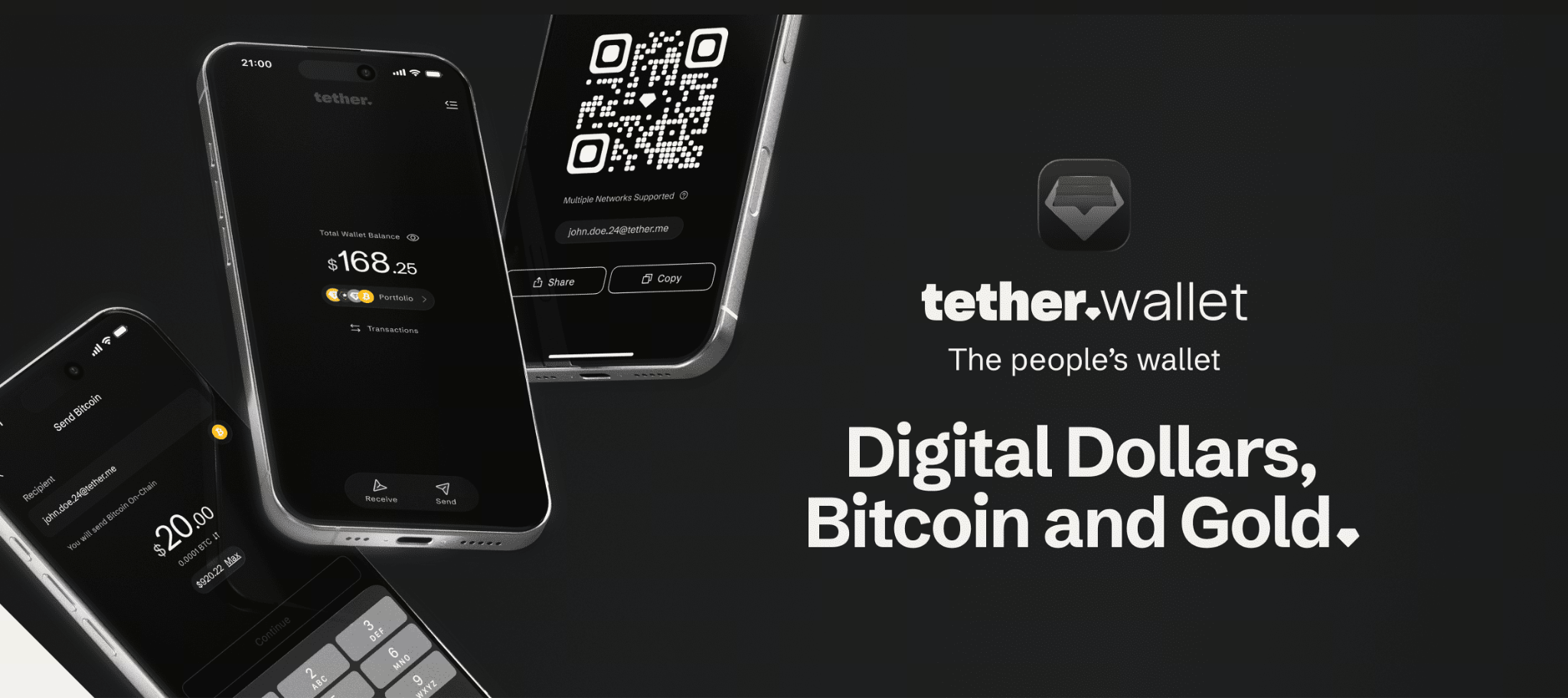
Tether, the issuer behind the world’s largest stablecoin, USDT, has recently launched a new self-custody Wallet application, tether.wallet. This move marks Tether’s evolution from a provider of financial infrastructure to a direct player in the user application space.
Historically, Tether’s technology has been primarily used to support liquidity and payment settlements in the crypto market. With this new product, these capabilities are now placed directly in users’ hands, allowing everyday individuals to interact with digital assets more intuitively.
Reaching the Unbanked
Tether notes that one of the core goals of this application is to serve populations not fully covered by traditional financial systems. Official statements indicate that Tether’s network already reaches over 570 million users, and tether.wallet aims to further extend this reach.
Supported Assets: Focused on Core Offerings
Unlike most multi-asset Wallets, tether.wallet does not support a wide variety of tokens. Instead, it focuses on a select group of primary assets:
This approach reflects Tether’s commitment to practicality, prioritizing the essential needs of the majority of users.
Streamlined Transfers: Everyday Usability
To make transfers more accessible, tether.wallet introduces several user experience optimizations:
- Readable names instead of Wallet Addresses
Users can send transfers using account-like names, eliminating the need to enter complicated Wallet Addresses.
- Intuitive Trading Fee payments
Transaction fees are paid directly with the asset being transferred, removing the requirement to hold extra Gas tokens.
- Messaging-like experience
According to Tether CEO Paolo Ardoino, the goal is to make digital asset transfers as easy as sending a message.
Self-Custody: Full User Control
From a security perspective, tether.wallet employs a self-custody model:
-
Private Keys are fully managed by the user
-
All transactions are signed locally on the device
-
No reliance on third-party intermediaries
This architecture enhances user control over their assets while minimizing platform risk.
Strategic Shift: From Infrastructure to Applications
The launch of this Wallet signals Tether’s strategic pivot—from a pure stablecoin issuer to a comprehensive financial services provider.
Recent initiatives include:
-
Open-source Wallet Development Kit
-
Integration of Wallet features into platforms (such as media platforms)
-
Investments in stablecoin payment system projects
Looking Ahead: AI and Machine Payments
Tether has long anticipated that the future of finance will extend beyond human users. As AI and automation advance, machines will increasingly require value exchange capabilities. In this context, self-custody Wallets will become foundational tools for AI, with Bitcoin and stablecoins serving as payment media for machine-to-machine transactions. tether.wallet is designed with this vision, supporting both human and machine transaction needs.
Technical Architecture and Network Support
tether.wallet is built on Tether’s open-source Wallet Development Kit and supports multiple blockchains, including Ethereum, Polygon, Arbitrum, and the Bitcoin Lightning Network. This multi-chain support delivers greater flexibility for payments across diverse scenarios.
Conclusion
The launch of tether.wallet marks Tether’s expansion beyond stablecoin liquidity provision into the user application market. By streamlining the user experience, enhancing asset control, and supporting a variety of payment scenarios, tether.wallet aims to lower the barriers to digital asset adoption and lay the foundation for future AI and automated payments.







