SHIB Price Prediction: Shiba Inu Burns 1.3 Billion Tokens — How Is the Market Reacting?

Last Updated 2026-03-30 04:10:22
Reading Time: 1m
Shiba Inu burned 1.3 billion tokens. Will this move affect its price trend? This article analyzes the Shiba Inu burning event and its impact on the market.

The Shiba Inu token burn initiative marks the project’s commitment to future development. Recently, Shiba Inu destroyed 1.3 billion tokens in order to reduce the number of tokens circulating in the market, thereby increasing the scarcity of each token. Similar to other cryptocurrency projects, Shiba Inu hopes to enhance the value of its tokens by reducing supply through its burn mechanism.

The background of Shiba Inu token burn

The token burn of Shiba Inu is part of the project’s ecological adjustment mechanism. This burn process is achieved by sending a portion of the tokens to an address that cannot be used, thereby permanently “destroying” them from the market. The purpose of this operation is to maintain the token’s scarcity by controlling the supply, thereby promoting its long-term value growth.

This initiative has received widespread support from the community, as burning tokens can enhance the appeal of the Shiba Inu project and boost investor confidence. However, at the same time, some investors and analysts have indicated that while the burning actions may create expectations for price increases in the short term, the actual market response is often more complex and requires a comprehensive consideration of other market factors.

Shiba Inu Price Performance Overview
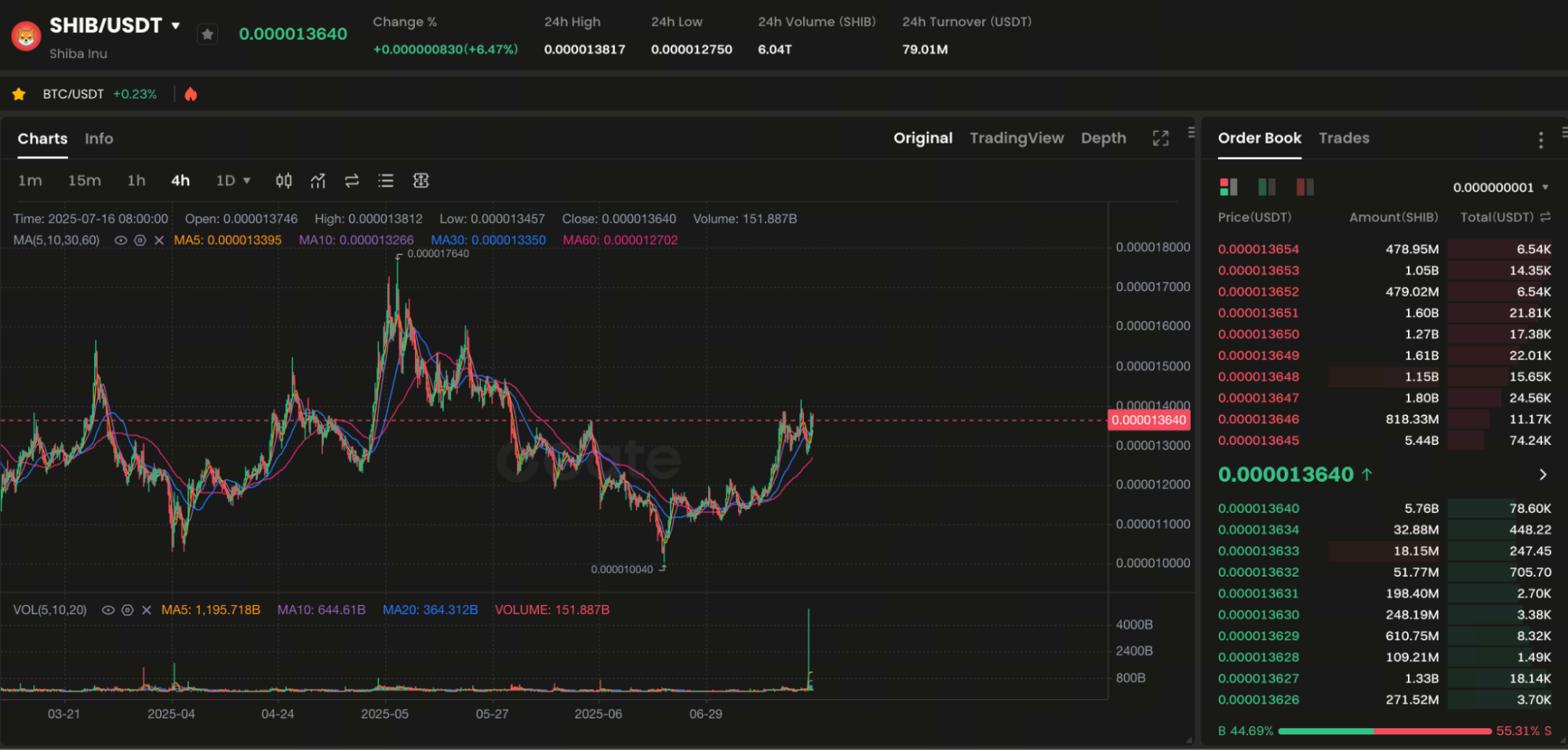

Figure:https://www.gate.com/trade/SHIB_USDT

Despite the large number of SHIB tokens destroyed, its price has not risen as strongly as expected. According to the latest market data, the price of Shiba Inu has actually shown a certain downward trend. This phenomenon has sparked discussions about whether the burning mechanism is truly effective. It is worth noting that the price performance of Shiba Inu is not solely determined by supply, as market sentiment, fluctuations in Bitcoin prices, and other factors also have an impact.

Market Reaction to Shiba Inu Token Burn

In the short term after the token burn, the market’s reaction has not been strong, and the price of Shiba Inu has not seen a significant increase. In this regard, some analysts believe that although burning tokens can reduce market supply, short-term price fluctuations are more influenced by overall market sentiment. For example, price fluctuations in Bitcoin, the overall trend of the crypto market, and investors’ views on the macroeconomy can all affect the market performance of Shiba Inu to a certain extent.

The long-term impact of the burning mechanism

Although the price has not seen an increase in the short term, the token burn actions of Shiba Inu may have a positive impact on its price in the long term. The prices in the cryptocurrency market are often influenced by supply and demand, and token burns effectively reduce the number of tokens in circulation, which may help increase the value of each token in the long run. Additionally, the burn mechanism also helps enhance investor confidence, further attracting the attention of long-term investors.

The future outlook of Shiba Inu

Overall, the token burning activities of Shiba Inu have injected new vitality into the project. Although the market reaction has been tepid in the short term, from a long-term development perspective, this initiative may lead to better market prospects. If Shiba Inu can continue to optimize its economic model, enhance its application scenarios, and maintain community enthusiasm, then its future remains promising.

Author: Max
Disclaimer
* The information is not intended to be and does not constitute financial advice or any other recommendation of any sort offered or endorsed by Gate.
* This article may not be reproduced, transmitted or copied without referencing Gate. Contravention is an infringement of Copyright Act and may be subject to legal action.

Related Articles

What is Fartcoin? All You Need to Know About FARTCOIN
Intermediate

What is Fartcoin? All You Need to Know About FARTCOIN

Fartcoin (FARTCOIN) is a representative meme coin within the Solana ecosystem based on an AI-driven narrative. Its core concept originated from an experiment aimed at exploring the "boundaries between AI Agents and humor." More than just a digital asset with social attributes, the project deeply couples absurd humor culture with on-chain financial logic by integrating autonomous AI interaction models.
2026-04-04 22:01:19
Gold Price Forecast for the Next Five Years: 2026–2030 Trend Outlook and Investment Implications, Could It Reach $6,000?
Beginner

Gold Price Forecast for the Next Five Years: 2026–2030 Trend Outlook and Investment Implications, Could It Reach $6,000?

Analyze current gold price trends alongside authoritative five-year forecasts, integrating an evaluation of market risks and opportunities. This gives investors insight into the potential trajectory of gold prices and the main drivers expected to shape the market over the next five years.
2026-03-25 18:13:30
Aster vs Hyperliquid: Which Perp DEX Will Prevail?
Beginner

Aster vs Hyperliquid: Which Perp DEX Will Prevail?

Aster and Hyperliquid are the two representative protocols of the "purpose-built L1 path" within the current decentralized perpetual exchange (Perp DEX) sector. As a pioneer in the field, Hyperliquid has built a deep liquidity moat through its highly mature order book architecture and strong community consensus. Conversely, Aster, as a rising challenger, seeks to leapfrog the competition in high-performance trading through more aggressive multi-chain aggregation logic, private transaction modules, and an underlying execution environment optimized for 2026 market demands.
2026-03-24 11:58:33
AI-Native Settlement Layers: How United Stables Is Building the Next Financial Rail
Beginner

AI-Native Settlement Layers: How United Stables Is Building the Next Financial Rail

Stablecoins were originally designed as dollar substitutes within exchanges, primarily used for asset pricing and trade settlement. As on-chain financial ecosystems have matured, their role has expanded beyond simple payments to include collateral assets, cross-chain liquidity mediums, and unified settlement units. In particular, as AI systems and automated agents begin to participate directly in economic activity, demand has risen sharply for programmable value units capable of instant settlement. This shift is pushing stablecoins toward the role of foundational financial infrastructure.
2026-03-25 03:16:17
Aerodrome Tokenomics: How ve(3,3) Powers Base's Most Profitable DEX
Beginner

Aerodrome Tokenomics: How ve(3,3) Powers Base's Most Profitable DEX

AERO is the native token of Aerodrome Finance, a core decentralized exchange and liquidity protocol in the Base ecosystem. It is primarily used for liquidity incentives and ecosystem operations. veAERO is a governance NFT that users receive by locking AERO, representing both voting power and the right to share protocol revenue. Through a dual track structure of AERO as a utility token and veAERO as a governance credential, Aerodrome separates liquidity usage value from long term governance power, allowing participants to act as liquidity providers, governance decision makers, and revenue sharers within the same system.
2026-03-25 06:40:31
Hybrid Collateral Stablecoins: Inside United Stables' Stability and Yield Architecture
Beginner

Hybrid Collateral Stablecoins: Inside United Stables' Stability and Yield Architecture

In the early stages of the crypto market, traditional stablecoins mainly relied on single-reserve or single-collateral models. Their primary focus was price stability and payment convenience, which allowed them to become foundational tools for on-chain trading and capital flows. As the market has entered a more mature financial phase, however, this structure has begun to reveal limitations, including high concentration risk and the difficulty of balancing liquidity with yield. These constraints have driven the evolution toward multi-layer collateral and portfolio-based designs, such as the dual-layer hybrid collateral architecture proposed by United Stables, which seeks to redefine the underlying logic of stable assets.
2026-03-25 03:17:39