SEC Chair Clarifies Crypto Asset Categories: NFTs, Network Tokens, and Digital Tools Are Not

Beginner
Quick Reads
Last Updated 2026-03-27 20:28:40
Reading Time: 1m
The new token classification framework redefines the Howey Test into four distinct categories. Only security tokens must maintain ongoing compliance with securities regulations. The remaining three categories are exempt, providing Web3 with a clear and predictable regulatory pathway. This change marks a pivotal shift in U.S. cryptocurrency regulation. It transforms the environment, shifting it from constraint to encouragement of innovation.

SEC Chairman Outlines Clear Regulatory Classification Framework

(Source: SEC / Paul S. Atkins, Chairman)

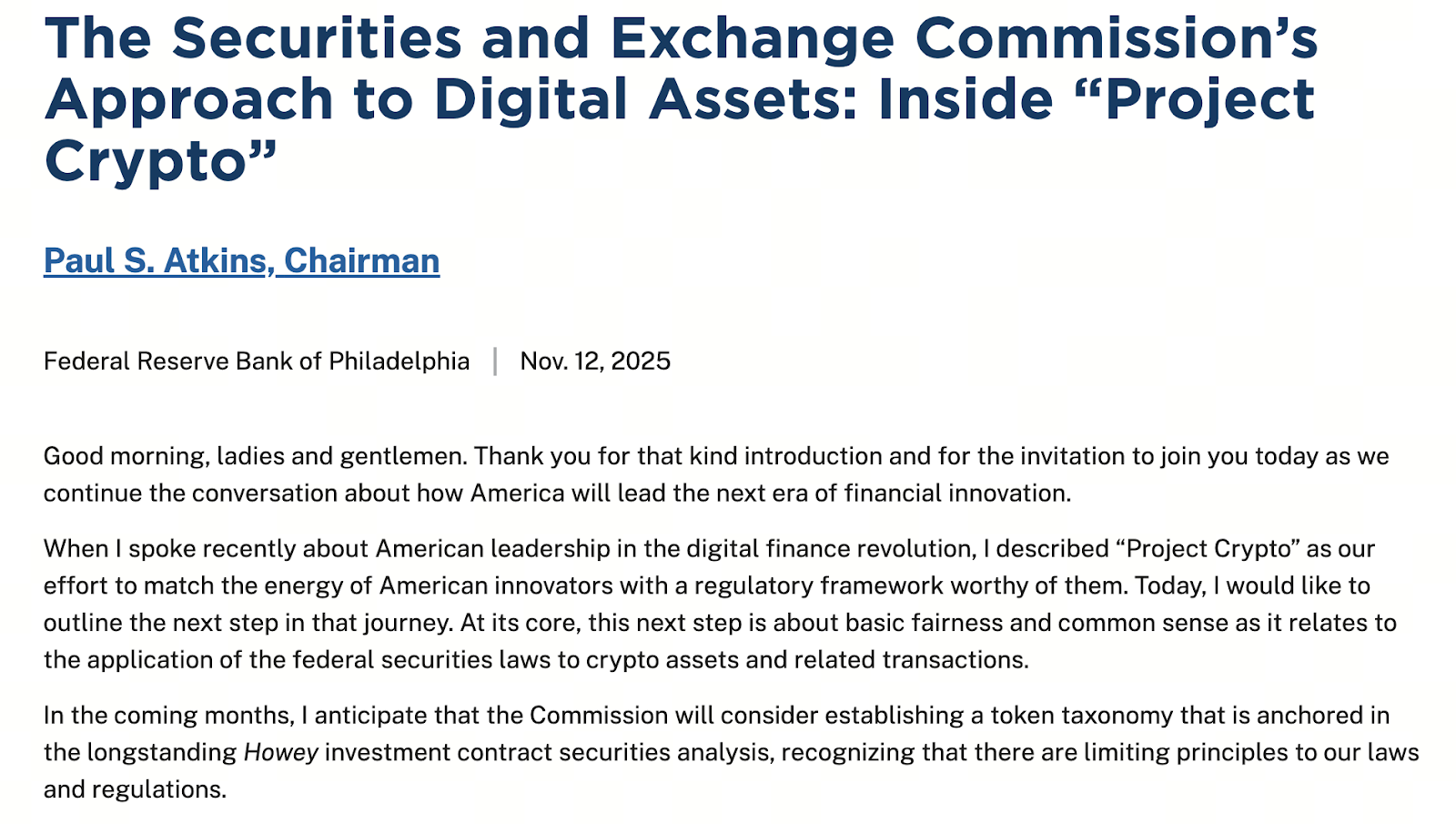
The Chairman of the U.S. Securities and Exchange Commission (SEC) recently delivered a landmark address, clarifying that not all crypto assets should be classified as securities. Specifically, NFTs (Non-Fungible Tokens), Network Tokens, and Digital Tools are characterized by utility and functional value rather than investment characteristics. This announcement signals a significant shift in the SEC’s regulatory stance toward Web3 and the broader crypto industry, aiming to establish a foundation that supports both innovation and compliance.

SEC Introduces Token Classification Framework

During his remarks, the Chairman emphasized that the SEC is developing a definitive token classification framework centered on the established Howey Test to re-evaluate which crypto assets fall under securities regulation. He noted that, for years, the market has operated under the misconception that any token issued as part of an investment contract is permanently deemed a security.

This viewpoint contradicts established legal principles and impedes market innovation. The Chairman underscored, “An investment contract is a relationship, not a label. Once that relationship concludes, the asset itself should no longer be considered a security.”

Four Primary Categories of Crypto Assets

Under the Chairman’s proposed framework, crypto assets are broadly divided into four categories:

  1. Digital Commodities / Network Tokens
    These tokens are integral to blockchain system operations, deriving value from the decentralized network itself rather than managerial efforts, and thus are excluded from securities classification.
  2. Digital Collectibles
    Assets such as artwork, music, and gaming items possess cultural or entertainment value. Buyers do not expect investment returns, so these are not considered securities.
  3. Digital Tools
    Examples include memberships, tickets, credentials, or identity verifications—utility tokens designed for functional use rather than investment purposes.
  4. Tokenized Securities
    These represent traditional financial instruments (like stocks or bonds) represented on the blockchain, remaining subject to securities law oversight.

This classification aims to eliminate regulatory ambiguity, enabling innovators and investors to operate within a transparent legal environment.

A New Take on the Howey Test

The SEC Chairman stressed that investment contracts are not perpetual. As projects mature, code is completed, and governance is decentralized, market reliance on the issuer naturally diminishes. This ends the original investment relationship. At this point, tokens should lose their securities status.

He referenced the Howey case: once the Florida orange grove investment plan concluded, the land itself ceased to be part of the investment contract; likewise, when a blockchain project achieves decentralization, its tokens should no longer be treated as securities. The market has widely accepted this perspective, viewing it as an encouraging signal from the SEC to the crypto sector.

Clear Rules Foster Innovation

The SEC Chairman also stated that regulation is not intended to stifle innovation but to establish predictable, actionable guidelines. Moving forward, the SEC will advance a series of exemptions and support measures. This will allow developers to issue tokens within a well-defined regulatory framework, rather than dealing with regulatory uncertainty.

This reform enables innovators to concentrate on technology and products instead of dealing with regulatory uncertainty. The Chairman emphasized, “Our objective is not to expand our jurisdiction, but to ensure capital formation can thrive while safeguarding investor interests.”

To learn more about Web3, click to register: https://www.gate.com/

Conclusion

The SEC Chairman’s remarks mark a pivotal shift in U.S. regulatory attitudes—from skepticism to understanding, and from vague oversight to clear categorization. The SEC no longer automatically classifies NFTs, Network Tokens, and Digital Tools as securities, which brings unprecedented clarity and confidence to the blockchain industry. Token economies and decentralized applications are evolving rapidly. Transparent regulation will drive innovation and support shared investment growth. As the Chairman stated, “Our mission is not to let the future remain bound to the past, but to ensure that freedom and innovation flourish under sound rules.”

Author: Allen
Disclaimer
* The information is not intended to be and does not constitute financial advice or any other recommendation of any sort offered or endorsed by Gate.
* This article may not be reproduced, transmitted or copied without referencing Gate. Contravention is an infringement of Copyright Act and may be subject to legal action.

Related Articles

What is Fartcoin? All You Need to Know About FARTCOIN
Intermediate

What is Fartcoin? All You Need to Know About FARTCOIN

Fartcoin (FARTCOIN) is a representative meme coin within the Solana ecosystem based on an AI-driven narrative. Its core concept originated from an experiment aimed at exploring the "boundaries between AI Agents and humor." More than just a digital asset with social attributes, the project deeply couples absurd humor culture with on-chain financial logic by integrating autonomous AI interaction models.
2026-04-04 22:01:19
Gold Price Forecast for the Next Five Years: 2026–2030 Trend Outlook and Investment Implications, Could It Reach $6,000?
Beginner

Gold Price Forecast for the Next Five Years: 2026–2030 Trend Outlook and Investment Implications, Could It Reach $6,000?

Analyze current gold price trends alongside authoritative five-year forecasts, integrating an evaluation of market risks and opportunities. This gives investors insight into the potential trajectory of gold prices and the main drivers expected to shape the market over the next five years.
2026-03-25 18:13:30
Aster vs Hyperliquid: Which Perp DEX Will Prevail?
Beginner

Aster vs Hyperliquid: Which Perp DEX Will Prevail?

Aster and Hyperliquid are the two representative protocols of the "purpose-built L1 path" within the current decentralized perpetual exchange (Perp DEX) sector. As a pioneer in the field, Hyperliquid has built a deep liquidity moat through its highly mature order book architecture and strong community consensus. Conversely, Aster, as a rising challenger, seeks to leapfrog the competition in high-performance trading through more aggressive multi-chain aggregation logic, private transaction modules, and an underlying execution environment optimized for 2026 market demands.
2026-03-24 11:58:33
ASTER Tokenomics: Buybacks, Burns, and Staking as the Value Foundation of ASTER in 2026
Beginner

ASTER Tokenomics: Buybacks, Burns, and Staking as the Value Foundation of ASTER in 2026

ASTER is the native equity and governance token of the Aster ecosystem, with its core value built upon a radical "Deflationary Engine." Beyond serving as a governance tool, ASTER integrates multiple utilities including staking rewards, trading fee discounts, and liquidity incentives. Through its deep integration with the upcoming dedicated Layer 1 mainnet, it enables direct value capture from protocol cash flow to token holders.
2026-03-25 07:38:07
AI-Native Settlement Layers: How United Stables Is Building the Next Financial Rail
Beginner

AI-Native Settlement Layers: How United Stables Is Building the Next Financial Rail

Stablecoins were originally designed as dollar substitutes within exchanges, primarily used for asset pricing and trade settlement. As on-chain financial ecosystems have matured, their role has expanded beyond simple payments to include collateral assets, cross-chain liquidity mediums, and unified settlement units. In particular, as AI systems and automated agents begin to participate directly in economic activity, demand has risen sharply for programmable value units capable of instant settlement. This shift is pushing stablecoins toward the role of foundational financial infrastructure.
2026-03-25 03:16:17
2026 Silver Price Forecast: Bull Market Continuation or High-Level Pullback? In-Depth Analysis of Silver Candlestick Chart
Beginner

2026 Silver Price Forecast: Bull Market Continuation or High-Level Pullback? In-Depth Analysis of Silver Candlestick Chart

2026 Silver Price Forecast: Latest Outlook This article integrates current market trends, silver candlestick chart analysis, and momentum factors to assess the potential key support and resistance levels, upside targets, and pullback risks for silver prices. The goal is to help investors make informed, rational decisions.
2026-03-25 16:08:59