SBF Speaks Out from Prison: FTX Funds “Were Never Lost,” Rekindling Bankruptcy Repayment Debate

Beginner
Quick Reads
Last Updated 2026-03-27 20:20:33
Reading Time: 1m
FTX founder Sam Bankman-Fried (SBF) recently released a statement via his monitored X account (formerly Twitter), asserting that FTX never actually lost user funds and that the company has repaid almost all legitimate claims. Despite this, the crypto community continues to question his claims. Investigator ZachXBT disclosed that SBF transferred $40 million to Chinese authorities to unlock frozen assets. This development has sparked renewed controversy.

SBF Makes Another Appearance: Addresses Fund Flows and FTX Repayment Status

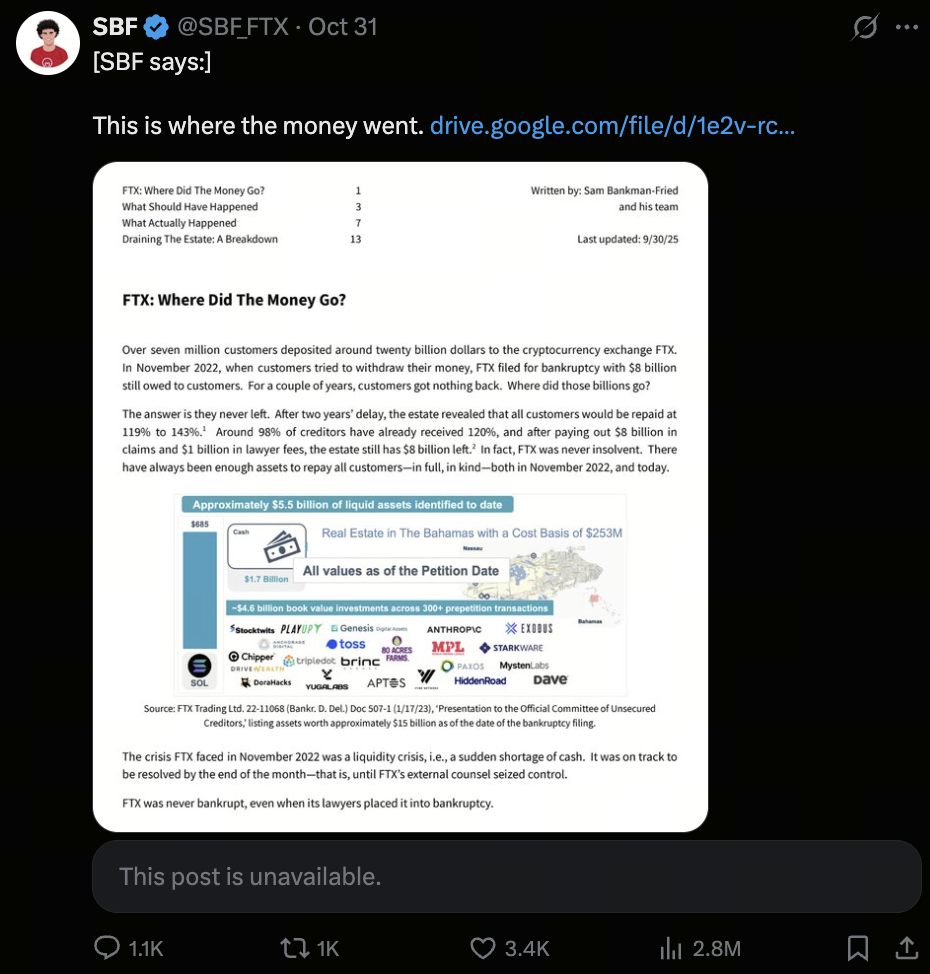
FTX founder Sam Bankman-Fried (SBF) recently released a statement via a monitored X (formerly Twitter) account operated by associates, addressing public concerns over alleged fund misappropriation and the progress of FTX’s bankruptcy proceedings. The controversy, involving approximately $10 billion in lost customer assets, represents a significant event in recent crypto history.

(Source: SBF_FTX)

SBF asserted in his statement that most customer funds never actually vanished, emphasizing that nearly all legitimate claims have received full repayment. He highlighted that, before bankruptcy attorneys became involved, FTX was solvent with sufficient assets to reimburse all users, maintaining a reserve of approximately $6.5 billion for disputed claims.

Bankruptcy Contradictions: Repayment Priorities and Legal Liability

These comments come at a pivotal point in FTX’s bankruptcy restructuring and SBF’s criminal trial. SBF criticized current bankruptcy attorneys for prioritizing multi-billion-dollar fees and settlements for themselves and the U.S. government. This has delayed user reimbursements. He specifically pointed out that Chinese creditors recently achieved a partial legal victory. A judge denied the bankruptcy attorneys’ motion to withhold refunds from creditors in 49 countries. This signals a shift in favor of creditor interests.

An active creditor known as “Will’s Tossing Notes” is leading a coalition of Chinese creditors pushing for every claimant to receive their entitled repayments. SBF backed this position in his statement, asserting FTX’s solvency both before and after filing for bankruptcy, and accusing the current management of withholding funds that could have been returned immediately.

Investigators Uncover $40 Million Transfer

The crypto community has rejected SBF’s narrative. Prominent blockchain investigator ZachXBT revealed that SBF had covertly transferred approximately $40 million to Chinese authorities to unfreeze Alameda Research’s accounts, which at the time were holding nearly $1 billion in frozen cryptocurrency assets.

ZachXBT, citing @DeFiSquared’s on-chain analysis, found that the $40 million was linked to wallet addresses associated with the Multichain attacker, further casting doubt on SBF’s explanation regarding user reimbursement.

SBF Responds: Transfer Was for Asset Recovery

Confronted with these allegations, SBF responded that a Chinese exchange had liquidated roughly $1 billion in cryptocurrency and agreed to return $960 million. He insisted that the transfer was “not a bribe, but rather for the purpose of recovering user assets.” However, ZachXBT countered with a pointed comparison: “If someone embezzled $8 billion from a Bahamian exchange and only returned part of it, would the public still accept it?” This debate underscores ongoing divisions regarding transparency, trust, and accountability in the FTX case.

Voices from Prison: SBF’s Public Narrative

Even behind bars, SBF continues to use social media to shape his public image and present his version of events surrounding FTX. He maintains that he never attempted to conceal funds, instead accusing bankruptcy attorneys of distorting facts and hiding the truth. These statements have brought renewed attention to the FTX case, underscoring unresolved issues in the crypto sector: fund transparency, legal oversight, and the ambiguous nature of cross-border accountability.

To learn more about Web3, register at: https://www.gate.com/

Summary

SBF’s statements have likely provided strategic advantages for his defense, but regulators and the market remain focused on the facts. Regardless of the final outcome, this event has become a landmark case in the crypto industry, raising crucial questions about trust and regulatory boundaries. The FTX bankruptcy is more than a repayment dispute—it is a collective examination of integrity in the crypto market.

Author: Allen
Disclaimer
* The information is not intended to be and does not constitute financial advice or any other recommendation of any sort offered or endorsed by Gate.
* This article may not be reproduced, transmitted or copied without referencing Gate. Contravention is an infringement of Copyright Act and may be subject to legal action.

Related Articles

What is Fartcoin? All You Need to Know About FARTCOIN
Intermediate

What is Fartcoin? All You Need to Know About FARTCOIN

Fartcoin (FARTCOIN) is a representative meme coin within the Solana ecosystem based on an AI-driven narrative. Its core concept originated from an experiment aimed at exploring the "boundaries between AI Agents and humor." More than just a digital asset with social attributes, the project deeply couples absurd humor culture with on-chain financial logic by integrating autonomous AI interaction models.
2026-04-04 22:01:19
Gold Price Forecast for the Next Five Years: 2026–2030 Trend Outlook and Investment Implications, Could It Reach $6,000?
Beginner

Gold Price Forecast for the Next Five Years: 2026–2030 Trend Outlook and Investment Implications, Could It Reach $6,000?

Analyze current gold price trends alongside authoritative five-year forecasts, integrating an evaluation of market risks and opportunities. This gives investors insight into the potential trajectory of gold prices and the main drivers expected to shape the market over the next five years.
2026-03-25 18:13:30
Aster vs Hyperliquid: Which Perp DEX Will Prevail?
Beginner

Aster vs Hyperliquid: Which Perp DEX Will Prevail?

Aster and Hyperliquid are the two representative protocols of the "purpose-built L1 path" within the current decentralized perpetual exchange (Perp DEX) sector. As a pioneer in the field, Hyperliquid has built a deep liquidity moat through its highly mature order book architecture and strong community consensus. Conversely, Aster, as a rising challenger, seeks to leapfrog the competition in high-performance trading through more aggressive multi-chain aggregation logic, private transaction modules, and an underlying execution environment optimized for 2026 market demands.
2026-03-24 11:58:33
AI-Native Settlement Layers: How United Stables Is Building the Next Financial Rail
Beginner

AI-Native Settlement Layers: How United Stables Is Building the Next Financial Rail

Stablecoins were originally designed as dollar substitutes within exchanges, primarily used for asset pricing and trade settlement. As on-chain financial ecosystems have matured, their role has expanded beyond simple payments to include collateral assets, cross-chain liquidity mediums, and unified settlement units. In particular, as AI systems and automated agents begin to participate directly in economic activity, demand has risen sharply for programmable value units capable of instant settlement. This shift is pushing stablecoins toward the role of foundational financial infrastructure.
2026-03-25 03:16:17
Aerodrome Tokenomics: How ve(3,3) Powers Base's Most Profitable DEX
Beginner

Aerodrome Tokenomics: How ve(3,3) Powers Base's Most Profitable DEX

AERO is the native token of Aerodrome Finance, a core decentralized exchange and liquidity protocol in the Base ecosystem. It is primarily used for liquidity incentives and ecosystem operations. veAERO is a governance NFT that users receive by locking AERO, representing both voting power and the right to share protocol revenue. Through a dual track structure of AERO as a utility token and veAERO as a governance credential, Aerodrome separates liquidity usage value from long term governance power, allowing participants to act as liquidity providers, governance decision makers, and revenue sharers within the same system.
2026-03-25 06:40:31
The ve(3,3) Flywheel Explained: How AERO Tokenomics Powers Aerodrome’s DeFi Economy
Beginner

The ve(3,3) Flywheel Explained: How AERO Tokenomics Powers Aerodrome’s DeFi Economy

In the competition for DeFi liquidity, high-inflation mining alone is no longer enough to build lasting advantages. Aerodrome applies the ve(3,3) economic model to redesign token emissions, voting mechanisms, and revenue distribution, creating a liquidity flywheel centered on governance and cash flow. This article examines AERO tokenomics, the veAERO locking mechanism, and protocol revenue models to explain how Aerodrome builds a sustainable DeFi economic system.
2026-03-25 06:41:58





