Optimism Proposes Using 50% of Superchain Revenue to Buy Back OP Tokens: A Deep Dive into a New Era of Value Capture

Beginner
Quick Reads
Last Updated 2026-03-26 04:54:37
Reading Time: 1m
The Optimism Foundation has proposed using 50% of Superchain revenue to buy back OP tokens. This initiative is designed to tightly align OP's value with the growth of the ecosystem, fostering both network economic development and an increase in the token's value.

Proposal Background and Core Content: Optimism Proposes to Repurchase OP with 50% of Superchain Revenue
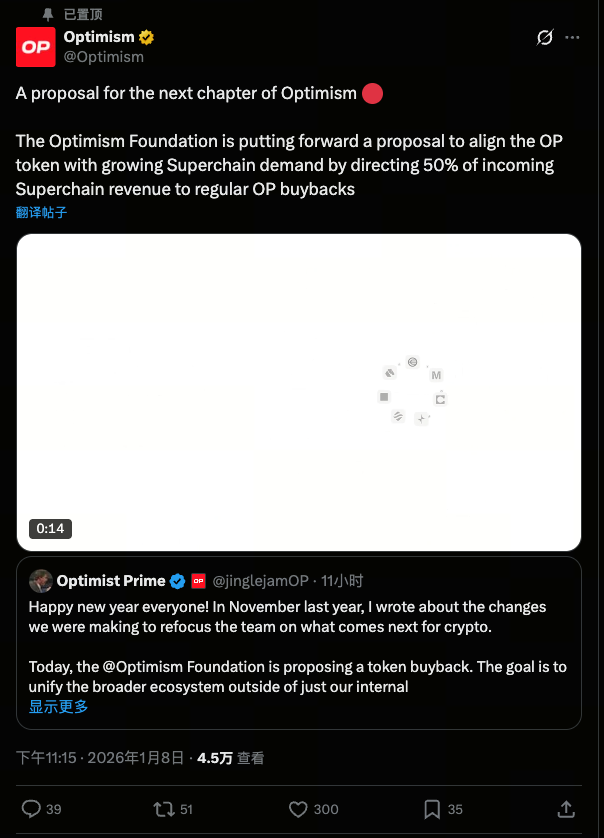

Image: https://x.com/Optimism/status/2009282745466503506

In January 2026, the Optimism Foundation formally submitted a milestone proposal to its governance community: to allocate 50% of Superchain network revenue for regular OP token buybacks.

The proposal’s core aim is to shift OP from a governance-centric utility token to a value asset directly tied to ecosystem economic growth.

As outlined in the proposal’s execution framework, if approved in the governance vote (scheduled for January 22):

  • The buyback program will commence in February 2026
  • The execution period will last 12 months
  • Repurchased OP will be returned to the Collective Treasury
  • The final use of these tokens will be determined by community governance, including: burning; staking rewards; ecosystem incentives; and public goods funding

This structure establishes a direct income anchor for OP’s value capture mechanism.

Superchain Ecosystem Revenue and Historical Data Overview

Superchain is an ecosystem of multiple Layer-2 networks built on the OP Stack. Key members currently include:

  • OP Mainnet
  • Base
  • Unichain
  • Ink
  • World Chain
  • Soneium, among others

Over the past 12 months, the Superchain ecosystem generated approximately 5,868 ETH in Sequencer (block ordering) revenue, amounting to tens of millions of dollars at current prices. All revenue is managed within a public treasury governed by the Optimism system.

From a market structure perspective:

  • Superchain accounts for roughly 61.4% of Layer-2 transaction fee market share
  • It processes approximately 13% of total crypto ecosystem trading volume

Data shows Superchain has progressed from the conceptual stage to scaled operations, with the capacity to generate sustainable cash flow.

Why 50% Buyback? How Does the Mechanism Work?

Buyback mechanisms are established tools for value capture and distribution in both traditional finance and crypto. Optimism’s choice to allocate 50% of Superchain revenue to OP buybacks is driven by several key factors:

Buyback Execution Logic

  • Each month, 50% of actual Superchain revenue will be used to repurchase OP
  • Buybacks will primarily occur via over-the-counter (OTC) transactions to minimize market disruption
  • Acquired OP will be deposited into the treasury, not immediately burned

Value Pathways After Buyback

OP returned to the treasury can be allocated to various uses via governance:

  • Burning to reduce circulating supply
  • Distribution to long-term staking or governance participants
  • Providing ecosystem incentives to developers and supporting public goods

This creates a clear positive feedback loop: ecosystem usage growth → increased revenue → larger buybacks → stronger support for OP value.

This approach transforms OP from representing only “governance rights” to being directly linked to Superchain’s real economic activity.

Potential Impact on OP Price and Market Sentiment
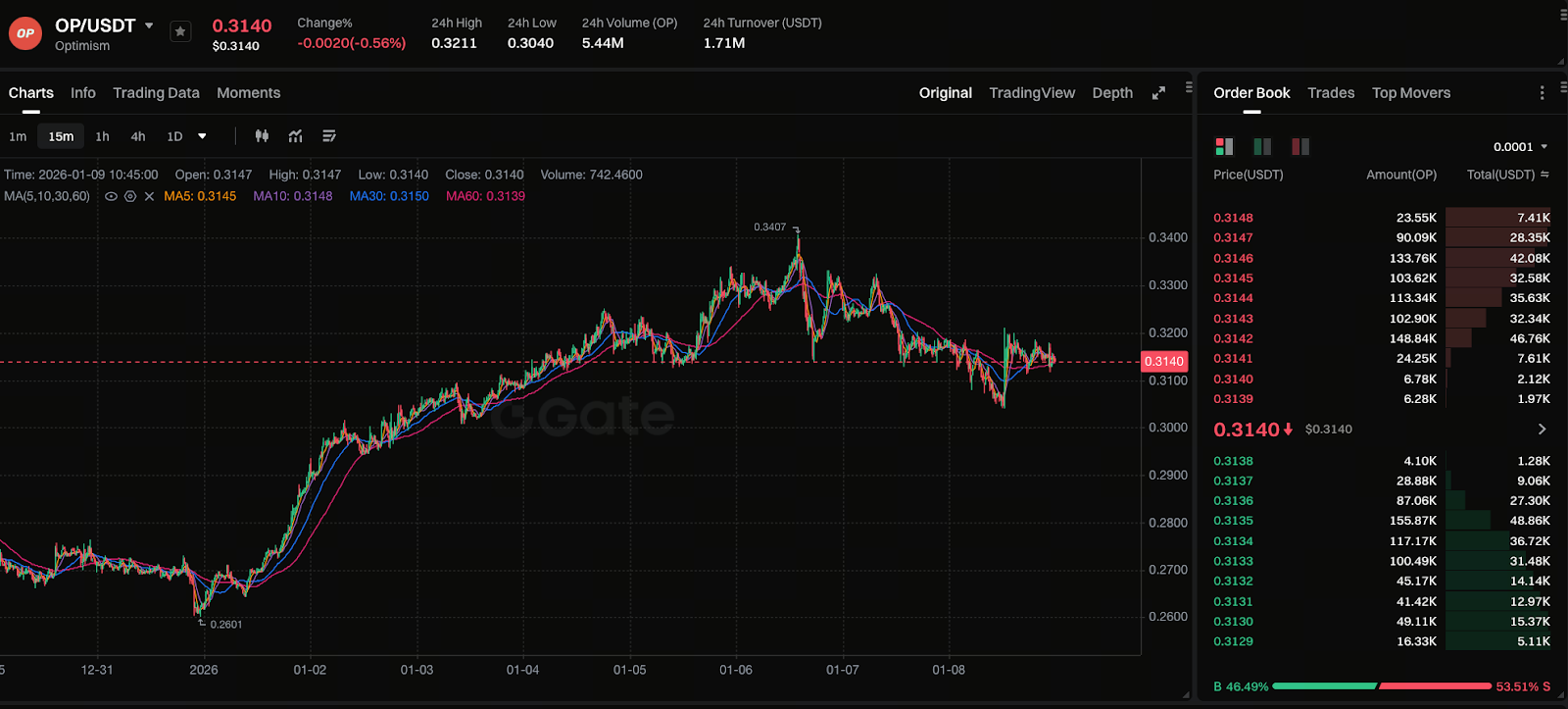

Image: https://www.gate.com/trade/OP_USDT

From a market perspective, OP’s price action has faced pressure in recent years. After reaching a historical high of about $4.69 in March 2024, the token saw a substantial correction, with current prices well below previous highs. This reflects a disconnect between network growth and token value.

If the buyback proposal is implemented, the following changes may occur:

  • Strengthened market confidence: predictable buyback demand helps establish a price floor
  • Improved capital efficiency: network-generated cash flow feeds directly into the token system
  • Enhanced long-term expectations: combining buybacks with burning or lock-up mechanisms may ease circulation pressure

However, these effects depend on actual Superchain adoption and the formation of market consensus.

Community Feedback and Potential Risks

While some community members support the proposal, discussion has centered on several key risks:

1. Token Unlocks and Sustained Sell Pressure

OP has undergone multiple large-scale unlocks in the past. Whether continued supply releases will weaken the buyback effect remains a core issue in governance debates.

2. Governance Trade-Offs

Using 50% of revenue for buybacks reduces available funding for other uses (such as public goods or ecosystem subsidies). Governance must balance short-term value support against long-term ecosystem investment.

3. Long-Term Sustainability of the Mechanism

The current proposal is set for 12 months. Whether buybacks become a permanent policy or remain a temporary experiment will depend on future governance decisions.

Conclusion: A Key Step from Governance Token to Economic Asset

In summary, Optimism’s proposal to use 50% of Superchain revenue for OP buybacks is not merely a capital operation. It’s a systematic effort to define how decentralized ecosystems allocate economic returns and establish token value loops.

If implemented, this proposal could become a landmark example of value capture mechanism evolution in the Layer-2 space. Regardless of the final outcome, this initiative signals that the Layer-2 ecosystem is moving beyond mere scalability narratives toward mature economic system design.

Author: Max
Disclaimer
* The information is not intended to be and does not constitute financial advice or any other recommendation of any sort offered or endorsed by Gate.
* This article may not be reproduced, transmitted or copied without referencing Gate. Contravention is an infringement of Copyright Act and may be subject to legal action.

Related Articles

What is Fartcoin? All You Need to Know About FARTCOIN
Intermediate

What is Fartcoin? All You Need to Know About FARTCOIN

Fartcoin (FARTCOIN) is a representative meme coin within the Solana ecosystem based on an AI-driven narrative. Its core concept originated from an experiment aimed at exploring the "boundaries between AI Agents and humor." More than just a digital asset with social attributes, the project deeply couples absurd humor culture with on-chain financial logic by integrating autonomous AI interaction models.
2026-04-04 22:01:19
Gold Price Forecast for the Next Five Years: 2026–2030 Trend Outlook and Investment Implications, Could It Reach $6,000?
Beginner

Gold Price Forecast for the Next Five Years: 2026–2030 Trend Outlook and Investment Implications, Could It Reach $6,000?

Analyze current gold price trends alongside authoritative five-year forecasts, integrating an evaluation of market risks and opportunities. This gives investors insight into the potential trajectory of gold prices and the main drivers expected to shape the market over the next five years.
2026-03-25 18:13:30
Aster vs Hyperliquid: Which Perp DEX Will Prevail?
Beginner

Aster vs Hyperliquid: Which Perp DEX Will Prevail?

Aster and Hyperliquid are the two representative protocols of the "purpose-built L1 path" within the current decentralized perpetual exchange (Perp DEX) sector. As a pioneer in the field, Hyperliquid has built a deep liquidity moat through its highly mature order book architecture and strong community consensus. Conversely, Aster, as a rising challenger, seeks to leapfrog the competition in high-performance trading through more aggressive multi-chain aggregation logic, private transaction modules, and an underlying execution environment optimized for 2026 market demands.
2026-03-24 11:58:33
AI-Native Settlement Layers: How United Stables Is Building the Next Financial Rail
Beginner

AI-Native Settlement Layers: How United Stables Is Building the Next Financial Rail

Stablecoins were originally designed as dollar substitutes within exchanges, primarily used for asset pricing and trade settlement. As on-chain financial ecosystems have matured, their role has expanded beyond simple payments to include collateral assets, cross-chain liquidity mediums, and unified settlement units. In particular, as AI systems and automated agents begin to participate directly in economic activity, demand has risen sharply for programmable value units capable of instant settlement. This shift is pushing stablecoins toward the role of foundational financial infrastructure.
2026-03-25 03:16:17
Aerodrome Tokenomics: How ve(3,3) Powers Base's Most Profitable DEX
Beginner

Aerodrome Tokenomics: How ve(3,3) Powers Base's Most Profitable DEX

AERO is the native token of Aerodrome Finance, a core decentralized exchange and liquidity protocol in the Base ecosystem. It is primarily used for liquidity incentives and ecosystem operations. veAERO is a governance NFT that users receive by locking AERO, representing both voting power and the right to share protocol revenue. Through a dual track structure of AERO as a utility token and veAERO as a governance credential, Aerodrome separates liquidity usage value from long term governance power, allowing participants to act as liquidity providers, governance decision makers, and revenue sharers within the same system.
2026-03-25 06:40:31
Hybrid Collateral Stablecoins: Inside United Stables' Stability and Yield Architecture
Beginner

Hybrid Collateral Stablecoins: Inside United Stables' Stability and Yield Architecture

In the early stages of the crypto market, traditional stablecoins mainly relied on single-reserve or single-collateral models. Their primary focus was price stability and payment convenience, which allowed them to become foundational tools for on-chain trading and capital flows. As the market has entered a more mature financial phase, however, this structure has begun to reveal limitations, including high concentration risk and the difficulty of balancing liquidity with yield. These constraints have driven the evolution toward multi-layer collateral and portfolio-based designs, such as the dual-layer hybrid collateral architecture proposed by United Stables, which seeks to redefine the underlying logic of stable assets.
2026-03-25 03:17:39





