Analysis of the New York Fed’s $6.8 Billion Treasury Purchase
In mid-December 2025, the Federal Reserve Bank of New York announced it would inject approximately $6.8 billion in short-term liquidity into the financial system via repurchase agreements (repos). This move aimed to ease potential year-end funding market stress. Market participants viewed this as the most notable temporary liquidity intervention by the Fed in the repo market since 2020.
It’s important to note that these actions are technical liquidity management tools, not a policy shift. The primary objective is to stabilize short-term funding markets and prevent abnormal interest rate swings due to liquidity mismatches—not to signal a long-term easing stance.
How Repurchase Agreements Work and Their Policy Nature
A repurchase agreement involves the central bank providing short-term funds to financial institutions in exchange for high-quality collateral—usually U.S. Treasuries or Treasury bills—and reversing the transaction on a set date. This mechanism is fundamentally a short-term funding adjustment tool with the following characteristics:
- Fixed term, making the liquidity injection temporary;
- Does not permanently expand the central bank’s balance sheet;
- Fundamentally distinct from Quantitative Easing (QE) in policy terms.
As a result, while markets are highly sensitive to Fed liquidity injections, repo operations primarily serve as “technical maintenance” of the funding market, not a redefinition of monetary policy direction.
Why Does Year-End Liquidity Stress Keep Reappearing?
At year-end, banks and financial institutions typically face multiple funding constraints:
- Regulatory ratio and capital adequacy assessments;
- Tax settlements and year-end balance sheet adjustments;
- Balance sheet management and risk exposure reduction.
These factors combine to drive up short-term funding demand, increasing volatility in repo rates and short-term funding costs. Without timely intervention, this can trigger abnormal spikes in short-term rates and threaten overall financial market stability.
In this context, the Fed’s repo operations act as a liquidity backstop—a routine response to seasonal pressures, not a direct economic outlook signal.
The Fed’s Toolkit: Treasuries and Repo Operations
For this round of liquidity management, the Fed primarily used:
- Repurchase Agreements (Repo): Providing cash to the market and temporarily receiving collateral;
- Treasury Bill Operations: Using short-term government securities to optimize the system’s cash supply structure.
The December 2025 operation stood out due to its relatively large scale, highlighting the Fed’s focus on the year-end liquidity gap and ongoing pressure in the short-term funding market.
Market Reactions and Price Dynamics
Market feedback showed that this liquidity injection had varied effects across asset classes:
Bond Market: Short-term interest rates and repo rates declined, reflecting eased funding stress and increased downward pressure on short-term yields.
Risk Assets: Some risk assets saw modest sentiment improvements, but gains were limited. The reaction was mostly short-term, driven by better funding conditions rather than a change in trend.
Crypto Market: Opinions were split. Improved liquidity benefits volatile assets, but a one-off, temporary operation isn’t enough to change the medium- or long-term price structure of crypto assets. Traders remained cautious overall.
In sum, the price impact of such operations is mostly short-term and structural. The durability of these effects remains to be seen.
Implications for Crypto Assets and Risk Markets
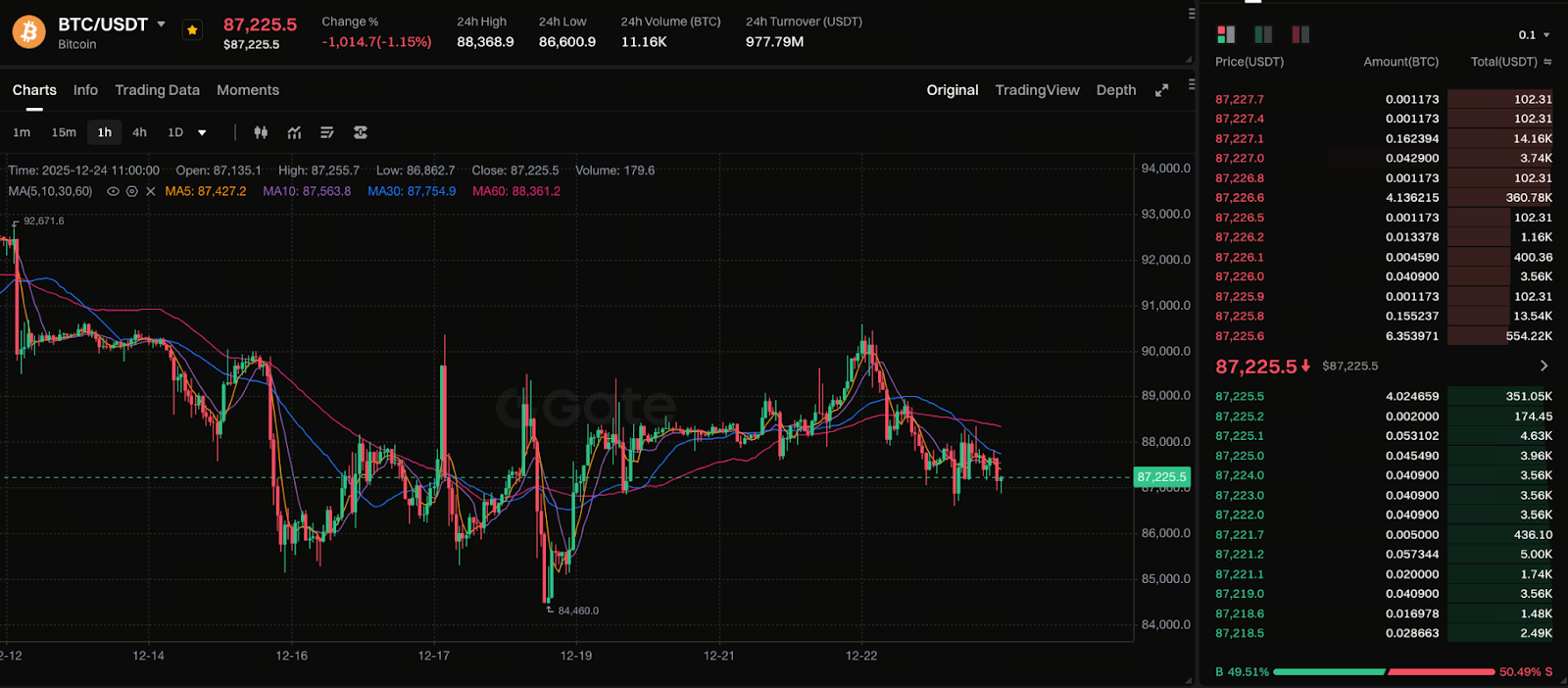
Chart: https://www.gate.com/trade/BTC_USDT
Some market participants see the Fed’s liquidity operation as a “leading indicator” for a rebound in risk assets, especially as macro risk sentiment eases. However, a more cautious view holds that:
- Repo operations address technical imbalances in funding markets;
- They are clearly distinct from broad-based monetary easing;
- Support for risk assets is typically limited and short-lived.
Even so, this move sends a clear message: short-term funding conditions are under active management, which helps contain the spread of extreme risk aversion.
Key Takeaways for Investors
When interpreting liquidity events like this, investors should maintain a structural perspective and focus on:
- Changes in repo rates and short-term funding costs as liquidity indicators;
- Whether operations are ongoing or increasing in scale;
- The distinction between technical liquidity management and policy-driven easing;
- Shifts in macro data, inflation trends, and future interest rate expectations.
It’s crucial for risk management not to overinterpret a single liquidity operation as a long-term asset allocation signal.
Conclusion
The New York Fed’s $6.8 billion Treasury purchase and year-end liquidity support via repo agreements represent a highly targeted technical funding operation. In the short term, this helps relieve funding market stress and stabilize interest rates, but it does not indicate a change in monetary policy direction.
For investors, this event is best used as a reference for marginal changes in funding conditions—not as a standalone basis for long-term investment decisions. Ultimately, market trends will continue to be shaped by the broader evolution of macro fundamentals, policy expectations, and risk appetite.







