IMF Warns of Global Stablecoin Gaps and Rising Cross-Border Risks

Beginner
Quick Reads
Last Updated 2026-03-27 04:27:11
Reading Time: 1m
The International Monetary Fund's (IMF) latest stablecoin market assessment report highlights significant disparities in regulatory standards across countries, which creates structural barriers. These challenges not only reduce regulatory effectiveness but also have the potential to destabilize cross-border payment systems.

IMF’s Latest Stablecoin Assessment

The IMF’s recent report, “Understanding Stablecoins,” provides an overview of the regulatory landscape in key economies, including the United States, United Kingdom, European Union, and Japan. The analysis reveals significant disparities in regulatory approaches. Some countries classify stablecoins as securities, others regulate them as payment instruments, and some restrict oversight to tokens issued by banks. In certain cases, comprehensive regulations are still absent. This lack of alignment has resulted in no unified standards for the global market.

(Source: IMFNews)

Cross-Border Circulation Outpaces Regulation

The IMF highlights that stablecoins can easily operate in jurisdictions with lax regulation while serving global markets, which makes it challenging for regulators to monitor the following aspects:

  • Reserve assets
  • Settlement and redemption processes
  • Liquidity management
  • Anti-money laundering controls

These regulatory gaps described above expand opportunities for arbitrage and undermine oversight across the global financial system.

Interoperability Between Blockchains Remains Limited

The IMF further notes that, beyond regulatory inconsistencies, stablecoins face technical challenges. The lack of interoperability among public blockchains, exchanges, and cross-chain frameworks leads to the following challenges:

  • Higher transaction costs
  • Slower market integration
  • Reduced global payment efficiency

As regulatory differences persist, this makes cross-border usage and settlement even more complex.

US Dollar Stablecoins Continue to Dominate

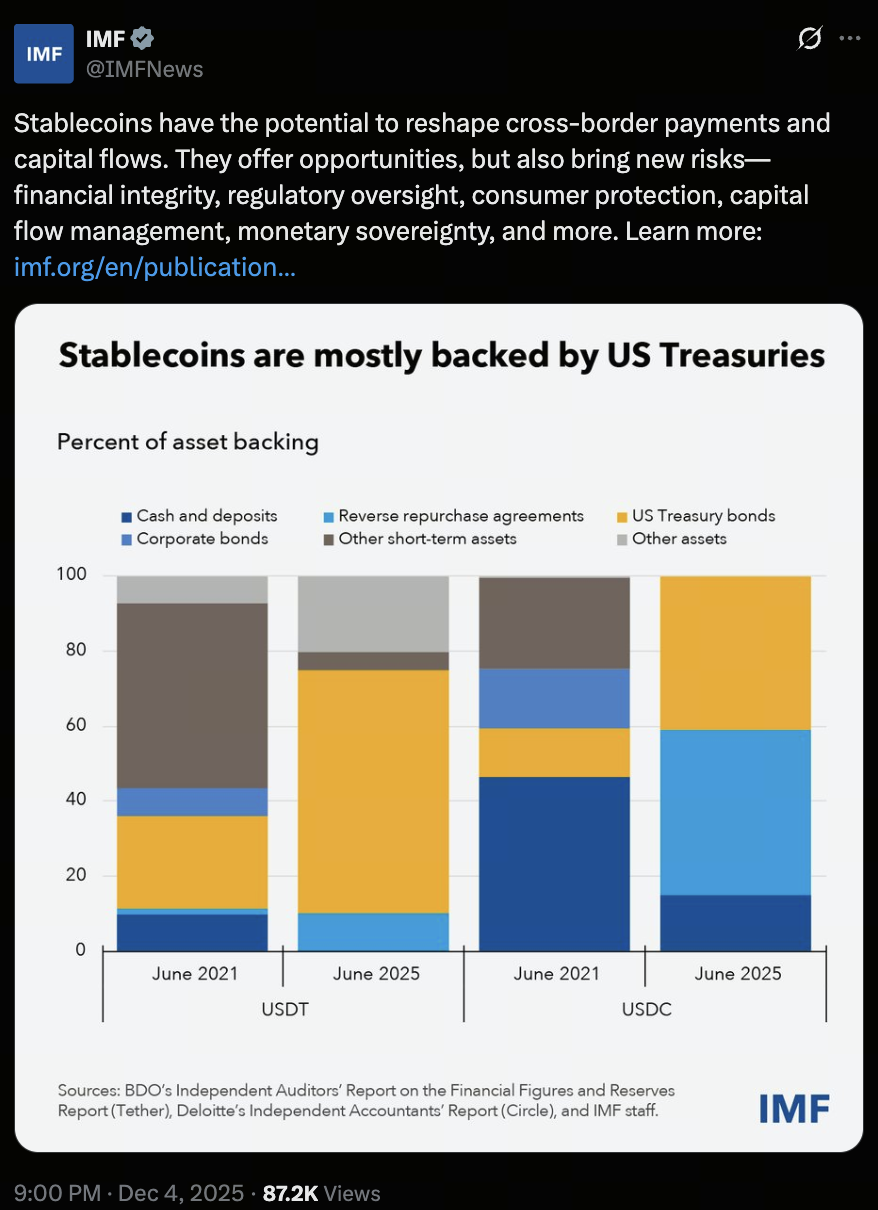
Global stablecoin market capitalization now exceeds $300 billion, with USDT and USDC, both backed by the US dollar, remaining the primary market leaders. The IMF outlines the reserve structures of these stablecoins:

  • Approximately 40% of USDC’s reserves are in short-term U.S. Treasuries
  • Approximately 75% of USDT’s reserves are in short-term government bonds, with around 5% held in Bitcoin

A closer link between stablecoins and government bond markets increases their potential impact on traditional financial systems.

Stablecoins May Undermine Monetary Sovereignty and Capital Controls

The IMF warns that widespread use of foreign currency-denominated stablecoins could threaten national financial stability, including:

  • Decreased demand for domestic currency
  • Reduced effectiveness of monetary policy
  • Accelerated Digital Dollarization
  • Heightened risk of circumventing capital controls (especially via self-custodied wallets and offshore platforms)

If large-scale redemptions occur, issuers may rapidly sell significant quantities of short-term U.S. Treasuries, which could disrupt global short-term funding markets. Stronger ties between stablecoin issuers, banks, custodians, trading platforms, and funds may cause volatility to spill over from the crypto sector into broader financial markets.

Conclusion

The IMF concludes that, without harmonized international regulatory standards, stablecoins could bypass national security mechanisms, increase pressure on fragile economies, and rapidly transmit risk through cross-border transactions.

Author: Max
Disclaimer
* The information is not intended to be and does not constitute financial advice or any other recommendation of any sort offered or endorsed by Gate.
* This article may not be reproduced, transmitted or copied without referencing Gate. Contravention is an infringement of Copyright Act and may be subject to legal action.

Related Articles

What is Fartcoin? All You Need to Know About FARTCOIN
Intermediate

What is Fartcoin? All You Need to Know About FARTCOIN

Fartcoin (FARTCOIN) is a representative meme coin within the Solana ecosystem based on an AI-driven narrative. Its core concept originated from an experiment aimed at exploring the "boundaries between AI Agents and humor." More than just a digital asset with social attributes, the project deeply couples absurd humor culture with on-chain financial logic by integrating autonomous AI interaction models.
2026-04-04 22:01:19
Gold Price Forecast for the Next Five Years: 2026–2030 Trend Outlook and Investment Implications, Could It Reach $6,000?
Beginner

Gold Price Forecast for the Next Five Years: 2026–2030 Trend Outlook and Investment Implications, Could It Reach $6,000?

Analyze current gold price trends alongside authoritative five-year forecasts, integrating an evaluation of market risks and opportunities. This gives investors insight into the potential trajectory of gold prices and the main drivers expected to shape the market over the next five years.
2026-03-25 18:13:30
Aster vs Hyperliquid: Which Perp DEX Will Prevail?
Beginner

Aster vs Hyperliquid: Which Perp DEX Will Prevail?

Aster and Hyperliquid are the two representative protocols of the "purpose-built L1 path" within the current decentralized perpetual exchange (Perp DEX) sector. As a pioneer in the field, Hyperliquid has built a deep liquidity moat through its highly mature order book architecture and strong community consensus. Conversely, Aster, as a rising challenger, seeks to leapfrog the competition in high-performance trading through more aggressive multi-chain aggregation logic, private transaction modules, and an underlying execution environment optimized for 2026 market demands.
2026-03-24 11:58:33
AI-Native Settlement Layers: How United Stables Is Building the Next Financial Rail
Beginner

AI-Native Settlement Layers: How United Stables Is Building the Next Financial Rail

Stablecoins were originally designed as dollar substitutes within exchanges, primarily used for asset pricing and trade settlement. As on-chain financial ecosystems have matured, their role has expanded beyond simple payments to include collateral assets, cross-chain liquidity mediums, and unified settlement units. In particular, as AI systems and automated agents begin to participate directly in economic activity, demand has risen sharply for programmable value units capable of instant settlement. This shift is pushing stablecoins toward the role of foundational financial infrastructure.
2026-03-25 03:16:17
ASTER Tokenomics: Buybacks, Burns, and Staking as the Value Foundation of ASTER in 2026
Beginner

ASTER Tokenomics: Buybacks, Burns, and Staking as the Value Foundation of ASTER in 2026

ASTER is the native equity and governance token of the Aster ecosystem, with its core value built upon a radical "Deflationary Engine." Beyond serving as a governance tool, ASTER integrates multiple utilities including staking rewards, trading fee discounts, and liquidity incentives. Through its deep integration with the upcoming dedicated Layer 1 mainnet, it enables direct value capture from protocol cash flow to token holders.
2026-03-25 07:38:07
2026 Silver Price Forecast: Bull Market Continuation or High-Level Pullback? In-Depth Analysis of Silver Candlestick Chart
Beginner

2026 Silver Price Forecast: Bull Market Continuation or High-Level Pullback? In-Depth Analysis of Silver Candlestick Chart

2026 Silver Price Forecast: Latest Outlook This article integrates current market trends, silver candlestick chart analysis, and momentum factors to assess the potential key support and resistance levels, upside targets, and pullback risks for silver prices. The goal is to help investors make informed, rational decisions.
2026-03-25 16:08:59