How to Do Copy Trading: A Complete Guide to Gate Futures Copy Trading

Beginner
Quick Reads
Last Updated 2026-03-26 20:03:58
Reading Time: 1m
How to Copy Trade? This article uses Gate contract copy trading as a case study to explain the operational steps, strategy selection, and risk management involved in copy trading. It aims to help beginners develop a solid understanding of Copy Trading.

What Is Copy Trading
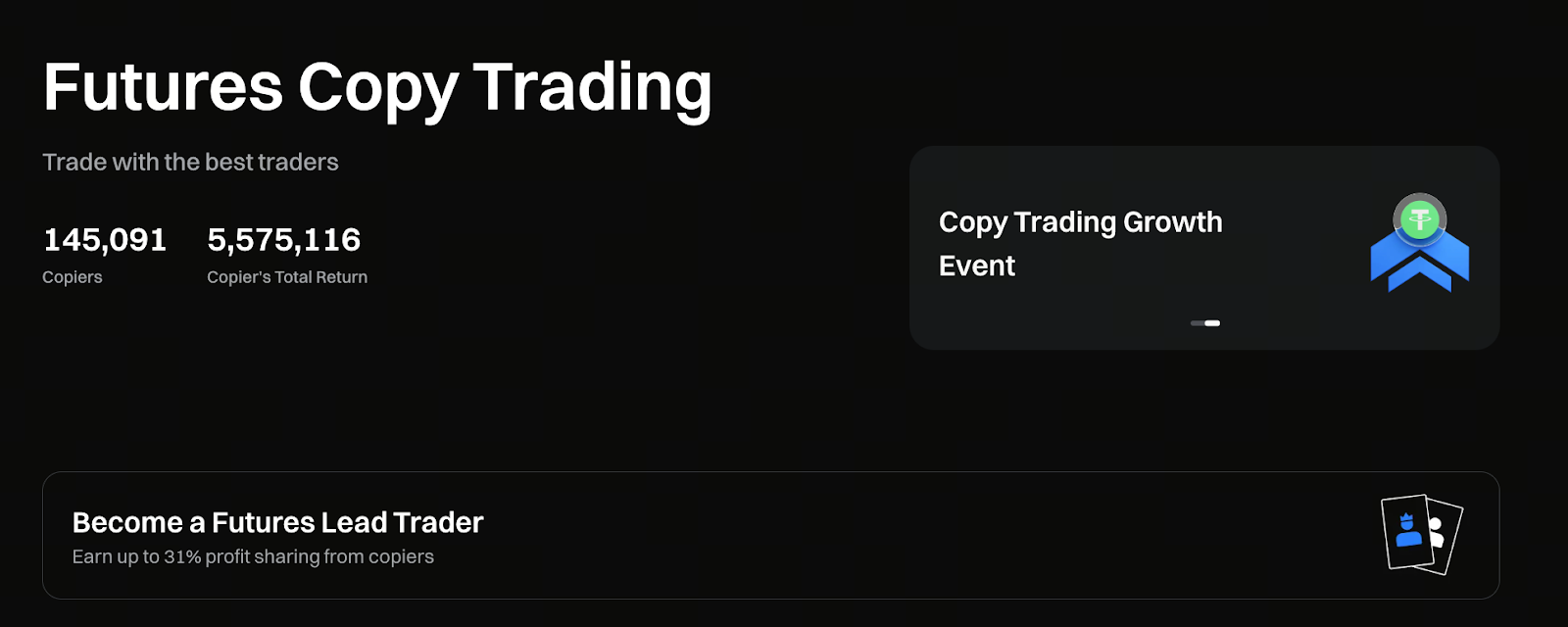

Image source: https://www.gate.com/copytrading

Copy Trading is a mechanism that enables investors to automatically mirror the trades of other market participants, most commonly found in crypto derivatives markets.

With this approach, followers can forgo their own market analysis. The system synchronizes the trader’s opening and closing positions, as well as any changes in their portfolio.

Understanding the underlying logic of Copy Trading is the essential first step in answering “how to copy trade.”

Why Are More People Searching “How to Copy Trade”

As volatility in the crypto market intensifies, contract trading demands sharper timing, deeper experience, and stronger emotional discipline.

Copy Trading appeals to many newcomers because it’s straightforward to execute and offers transparent strategies, making it a preferred entry point in derivatives trading.

However, Copy Trading is not a guaranteed profit tool. Success depends on following correct procedures and setting appropriate risk parameters.

Gate Copy Trading for Contracts: An Overview

Gate’s contract Copy Trading features:

  • Access to major crypto derivatives trading pairs
  • Full transparency of trader historical performance
  • Customizable copy amounts and risk management settings
  • Users can stop or adjust copy trades at any time

These capabilities provide users with significant flexibility as they learn how to copy trade.

How to Copy Trade: Gate Copy Trading Step-by-Step

To execute contract Copy Trading on Gate, follow these steps:

Step 1: Visit the Gate Copy Trading page. Review the list of available traders and evaluate their returns, drawdowns, and trading styles.

Step 2: Select traders. Focus on those with consistent long-term results and well-managed drawdowns, rather than short-term top performers.

Step 3: Configure copy parameters, including copy amount, maximum position ratio, and stop-loss limits.

Step 4: Confirm and activate copy trading. The system will automatically mirror the trader’s subsequent actions.

How to Select the Right Trader to Copy

Choosing the right trader is often more critical than the copying process itself.

Key metrics to assess include:

  • Complete historical trading cycles
  • Maximum drawdown within acceptable limits
  • Stable profit curve
  • Avoidance of frequent heavy-position trading

These factors directly impact the long-term success of Copy Trading.

Copy Amount, Leverage, and Risk Management Settings

Proper risk parameter configuration is vital for Gate contract Copy Trading:

  • Do not invest all capital in one go
  • Avoid excessive leverage
  • Set clear maximum loss thresholds

Most Copy Trading failures stem from poor risk management rather than flawed strategies.

Common Copy Trading Mistakes and How to Avoid Them

Typical errors for beginners learning how to copy trade include:

  • Focusing solely on returns while ignoring drawdowns
  • Copying too many high-risk strategies simultaneously
  • Overlooking changes in market conditions
  • Neglecting regular reviews of copy trading performance

Avoiding these pitfalls can help stabilize your Copy Trading outcomes.

How to Continuously Improve Copy Trading Performance

Copy Trading requires ongoing adjustment, not just a one-time setup:

  • Periodically evaluate trader performance
  • Update strategies in response to market trends
  • Diversify your copy trading portfolio
  • Maintain emotional discipline and avoid frequent intervention

Continuous optimization increases the sustainability of Copy Trading.

Summary: How to Approach Copy Trading Rationally?

Success in Copy Trading requires more than simply clicking to copy. You need to understand the mechanism, carefully select traders, set risk parameters, and manage your positions over time. In Gate contract Copy Trading, maintaining rational expectations and prioritizing risk management can make Copy Trading an effective way to participate in the crypto derivatives market.

Author: Allen
Disclaimer
* The information is not intended to be and does not constitute financial advice or any other recommendation of any sort offered or endorsed by Gate.
* This article may not be reproduced, transmitted or copied without referencing Gate. Contravention is an infringement of Copyright Act and may be subject to legal action.

Related Articles

What is Fartcoin? All You Need to Know About FARTCOIN
Intermediate

What is Fartcoin? All You Need to Know About FARTCOIN

Fartcoin (FARTCOIN) is a representative meme coin within the Solana ecosystem based on an AI-driven narrative. Its core concept originated from an experiment aimed at exploring the "boundaries between AI Agents and humor." More than just a digital asset with social attributes, the project deeply couples absurd humor culture with on-chain financial logic by integrating autonomous AI interaction models.
2026-04-04 22:01:19
Gold Price Forecast for the Next Five Years: 2026–2030 Trend Outlook and Investment Implications, Could It Reach $6,000?
Beginner

Gold Price Forecast for the Next Five Years: 2026–2030 Trend Outlook and Investment Implications, Could It Reach $6,000?

Analyze current gold price trends alongside authoritative five-year forecasts, integrating an evaluation of market risks and opportunities. This gives investors insight into the potential trajectory of gold prices and the main drivers expected to shape the market over the next five years.
2026-03-25 18:13:30
Aster vs Hyperliquid: Which Perp DEX Will Prevail?
Beginner

Aster vs Hyperliquid: Which Perp DEX Will Prevail?

Aster and Hyperliquid are the two representative protocols of the "purpose-built L1 path" within the current decentralized perpetual exchange (Perp DEX) sector. As a pioneer in the field, Hyperliquid has built a deep liquidity moat through its highly mature order book architecture and strong community consensus. Conversely, Aster, as a rising challenger, seeks to leapfrog the competition in high-performance trading through more aggressive multi-chain aggregation logic, private transaction modules, and an underlying execution environment optimized for 2026 market demands.
2026-03-24 11:58:33
AI-Native Settlement Layers: How United Stables Is Building the Next Financial Rail
Beginner

AI-Native Settlement Layers: How United Stables Is Building the Next Financial Rail

Stablecoins were originally designed as dollar substitutes within exchanges, primarily used for asset pricing and trade settlement. As on-chain financial ecosystems have matured, their role has expanded beyond simple payments to include collateral assets, cross-chain liquidity mediums, and unified settlement units. In particular, as AI systems and automated agents begin to participate directly in economic activity, demand has risen sharply for programmable value units capable of instant settlement. This shift is pushing stablecoins toward the role of foundational financial infrastructure.
2026-03-25 03:16:17
Aerodrome Tokenomics: How ve(3,3) Powers Base's Most Profitable DEX
Beginner

Aerodrome Tokenomics: How ve(3,3) Powers Base's Most Profitable DEX

AERO is the native token of Aerodrome Finance, a core decentralized exchange and liquidity protocol in the Base ecosystem. It is primarily used for liquidity incentives and ecosystem operations. veAERO is a governance NFT that users receive by locking AERO, representing both voting power and the right to share protocol revenue. Through a dual track structure of AERO as a utility token and veAERO as a governance credential, Aerodrome separates liquidity usage value from long term governance power, allowing participants to act as liquidity providers, governance decision makers, and revenue sharers within the same system.
2026-03-25 06:40:31
The ve(3,3) Flywheel Explained: How AERO Tokenomics Powers Aerodrome’s DeFi Economy
Beginner

The ve(3,3) Flywheel Explained: How AERO Tokenomics Powers Aerodrome’s DeFi Economy

In the competition for DeFi liquidity, high-inflation mining alone is no longer enough to build lasting advantages. Aerodrome applies the ve(3,3) economic model to redesign token emissions, voting mechanisms, and revenue distribution, creating a liquidity flywheel centered on governance and cash flow. This article examines AERO tokenomics, the veAERO locking mechanism, and protocol revenue models to explain how Aerodrome builds a sustainable DeFi economic system.
2026-03-25 06:41:58





