Gate Metals Hub: Rethinking Metal Assets in Times of Market Uncertainty

Beginner
Quick Reads
Last Updated 2026-03-24 15:59:28
Reading Time: 1m
Amid ongoing uncertainty in the global economy, metal assets are once again at the forefront of investor interest. Precious metals, valued for their safe-haven properties, and industrial metals, which are deeply connected to economic cycles, each demonstrate unique roles across different market conditions. Digital trading platforms now enable investors to monitor market movements and engage with the metals market more flexibly, creating new opportunities for diversified asset allocation.

In recent years, the global economy has become increasingly fragmented. Inflation, shifting interest rate policies, and evolving geopolitical risks have fueled persistent swings in financial market sentiment. As investors reassess risk, capital frequently moves toward asset classes with tangible value—metals being a prime example.

Metals continue to attract attention across economic cycles due to their diverse functions. Some serve as defensive assets during market turmoil, while others are closely linked to periods of economic growth. This diversity enables the sector to offer distinct investment rationales in varying macro environments.
The Roles of Precious and Industrial Metals

The metals market consists of two main categories: precious metals and industrial metals. Each plays a unique role in investment and the broader economy.

Precious metals are typically associated with value preservation. Gold, for instance, has long been considered a key hedge against inflation and financial risk. It often attracts safe-haven flows during market instability or shifts in monetary policy. Silver combines investment appeal with industrial utility, so its price reflects not only market sentiment but also real-world manufacturing demand.

Industrial metals, by contrast, are directly tied to the real economy. Copper is often called the “thermometer of economic activity” because its demand tracks infrastructure and manufacturing trends. Aluminum is widely used in transportation and construction, with prices often responding early when markets anticipate economic recovery.

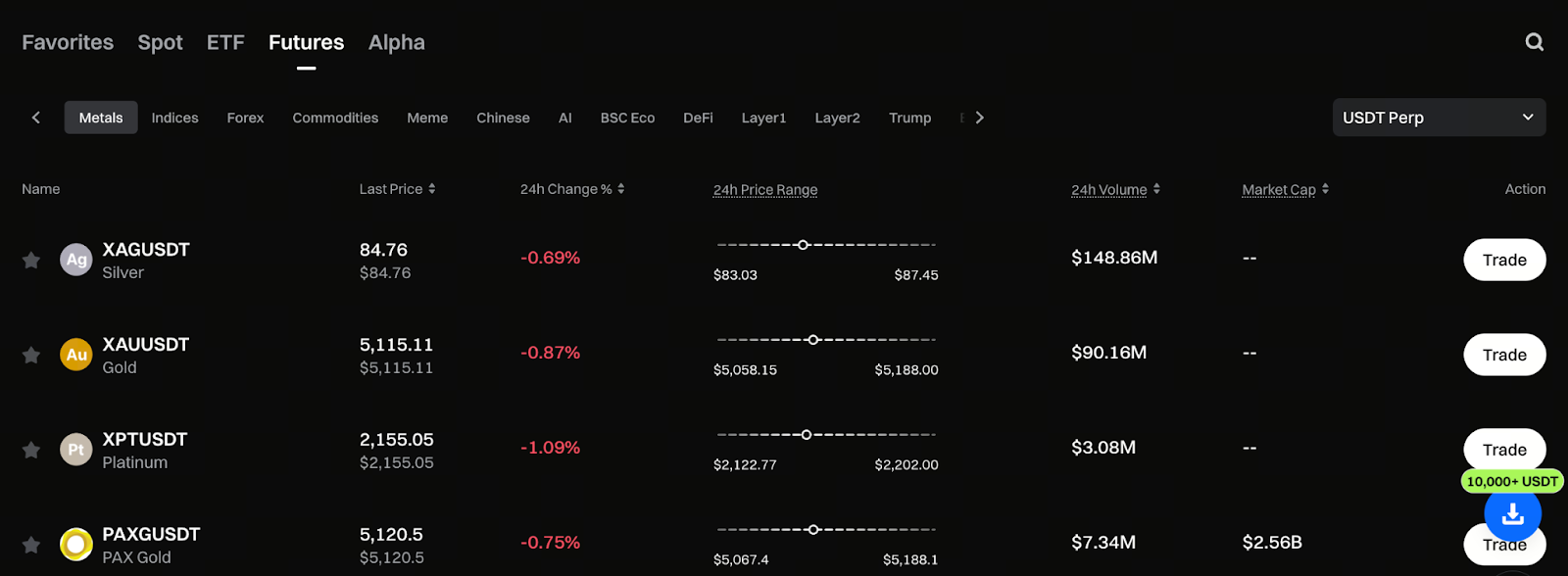
Explore the Gate Metals Section to trade metals: https://www.gate.com/price/futures/category-metals/usdt

Multiple Drivers of Metal Price Volatility

Metal prices have seen heightened volatility recently, typically driven by a combination of factors rather than single events.

Frequent revisions to global economic data shape expectations for future demand, resulting in ongoing price adjustments. Fluctuations in energy and logistics costs also reshape the overall cost structure for mining and smelting.

Policy signals and interest rate changes further influence capital allocation. When large institutions and quantitative strategies respond rapidly to market developments, price reactions can be amplified, leading to pronounced short-term swings.

Trading Dynamics in Volatile Markets

As volatility rises, the pace of metals trading changes significantly. Price ranges form and break more rapidly, with trends reversing multiple times in short periods. Capital rotates faster between different types of metals, with funds moving swiftly between precious and industrial categories.

In this environment, market participants must monitor information and price movements in real time to maintain decision-making efficiency in rapidly shifting markets.

Digital Trading: Transforming Market Participation

The ongoing digitization of financial markets is transforming commodity trading. Integrated platforms now enable investors to monitor markets and execute trades within a single interface—eliminating the need to juggle multiple systems.

Gate, for example, consolidates metals trading products into a dedicated section, allowing users to track the performance and trading opportunities of various metals clearly. When sudden events occur, a stable trading system and transparent information structure support rapid strategy adjustments.

Digital trading also extends market access hours. Investors can react in real time to international policy changes or major events, even outside traditional trading sessions, without waiting for markets to reopen.

Metals’ Enduring Role in Portfolio Allocation

Despite ongoing innovation in trading tools, metals continue to serve as a core component in investment portfolios. Some metals offer protection against inflation, helping preserve value when purchasing power declines. Their correlations with equities and crypto assets are not perfectly aligned, allowing metals to diversify portfolio risk.

Because industrial metals are closely tied to economic activity, they are also used to gauge global economic cycles. By allocating metals strategically, investors can balance defensive positions with opportunities for growth.

Conclusion

In a constantly evolving macroeconomic landscape, the metals market stands out for its dual role as a safe-haven and a barometer of growth. Precious and industrial metals each respond to different economic scenarios, keeping the market active throughout various cycles. As trading becomes increasingly digital, investors gain real-time access to price changes and greater flexibility in market participation. Whether for long-term portfolio allocation or to capture cyclical opportunities, metals remain a key component in diversified investment strategies.

Author:  Allen
Disclaimer
* The information is not intended to be and does not constitute financial advice or any other recommendation of any sort offered or endorsed by Gate.
* This article may not be reproduced, transmitted or copied without referencing Gate. Contravention is an infringement of Copyright Act and may be subject to legal action.

Related Articles

What is Fartcoin? All You Need to Know About FARTCOIN
Intermediate

What is Fartcoin? All You Need to Know About FARTCOIN

Fartcoin (FARTCOIN) is a representative meme coin within the Solana ecosystem based on an AI-driven narrative. Its core concept originated from an experiment aimed at exploring the "boundaries between AI Agents and humor." More than just a digital asset with social attributes, the project deeply couples absurd humor culture with on-chain financial logic by integrating autonomous AI interaction models.
2026-04-04 22:01:19
Gold Price Forecast for the Next Five Years: 2026–2030 Trend Outlook and Investment Implications, Could It Reach $6,000?
Beginner

Gold Price Forecast for the Next Five Years: 2026–2030 Trend Outlook and Investment Implications, Could It Reach $6,000?

Analyze current gold price trends alongside authoritative five-year forecasts, integrating an evaluation of market risks and opportunities. This gives investors insight into the potential trajectory of gold prices and the main drivers expected to shape the market over the next five years.
2026-03-25 18:13:30
Aster vs Hyperliquid: Which Perp DEX Will Prevail?
Beginner

Aster vs Hyperliquid: Which Perp DEX Will Prevail?

Aster and Hyperliquid are the two representative protocols of the "purpose-built L1 path" within the current decentralized perpetual exchange (Perp DEX) sector. As a pioneer in the field, Hyperliquid has built a deep liquidity moat through its highly mature order book architecture and strong community consensus. Conversely, Aster, as a rising challenger, seeks to leapfrog the competition in high-performance trading through more aggressive multi-chain aggregation logic, private transaction modules, and an underlying execution environment optimized for 2026 market demands.
2026-03-24 11:58:33
AI-Native Settlement Layers: How United Stables Is Building the Next Financial Rail
Beginner

AI-Native Settlement Layers: How United Stables Is Building the Next Financial Rail

Stablecoins were originally designed as dollar substitutes within exchanges, primarily used for asset pricing and trade settlement. As on-chain financial ecosystems have matured, their role has expanded beyond simple payments to include collateral assets, cross-chain liquidity mediums, and unified settlement units. In particular, as AI systems and automated agents begin to participate directly in economic activity, demand has risen sharply for programmable value units capable of instant settlement. This shift is pushing stablecoins toward the role of foundational financial infrastructure.
2026-03-25 03:16:17
ASTER Tokenomics: Buybacks, Burns, and Staking as the Value Foundation of ASTER in 2026
Beginner

ASTER Tokenomics: Buybacks, Burns, and Staking as the Value Foundation of ASTER in 2026

ASTER is the native equity and governance token of the Aster ecosystem, with its core value built upon a radical "Deflationary Engine." Beyond serving as a governance tool, ASTER integrates multiple utilities including staking rewards, trading fee discounts, and liquidity incentives. Through its deep integration with the upcoming dedicated Layer 1 mainnet, it enables direct value capture from protocol cash flow to token holders.
2026-03-25 07:38:07
Hybrid Collateral Stablecoins: Inside United Stables' Stability and Yield Architecture
Beginner

Hybrid Collateral Stablecoins: Inside United Stables' Stability and Yield Architecture

In the early stages of the crypto market, traditional stablecoins mainly relied on single-reserve or single-collateral models. Their primary focus was price stability and payment convenience, which allowed them to become foundational tools for on-chain trading and capital flows. As the market has entered a more mature financial phase, however, this structure has begun to reveal limitations, including high concentration risk and the difficulty of balancing liquidity with yield. These constraints have driven the evolution toward multi-layer collateral and portfolio-based designs, such as the dual-layer hybrid collateral architecture proposed by United Stables, which seeks to redefine the underlying logic of stable assets.
2026-03-25 03:17:39