Evolving Safe-Haven Strategies in a Changing Global Landscape
When markets contend with rising inflation, slowing economic growth, or escalating geopolitical tensions, capital often gravitates toward relatively stable asset classes—gold and silver being among the most prominent. These assets have long served as key instruments for wealth preservation and as indicators of market risk sentiment.
Precious metals are not immune to downturns. As economic outlooks improve or market sentiment turns optimistic, capital may shift to riskier assets, putting downward pressure on gold and silver prices. Consequently, their performance is closely linked to broader economic conditions.
Key Drivers of Gold and Silver Prices
The precious metals market is shaped by a complex interplay of factors rather than any single event. The primary drivers include:
- Macroeconomic Indicators
Fluctuations in inflation, interest rates, and employment figures directly influence asset allocation decisions, fueling price volatility in precious metals.
- Monetary Policy Direction
Central bank policy shifts—especially toward monetary easing or tightening—can have a pronounced impact on gold prices.
- Geopolitical Developments
Geopolitical conflicts or unexpected crises typically heighten demand for safe havens, channeling capital into the precious metals market.
These factors interact dynamically, producing distinct cycles of market volatility over time.
Greater Flexibility: Perpetual Futures in Action
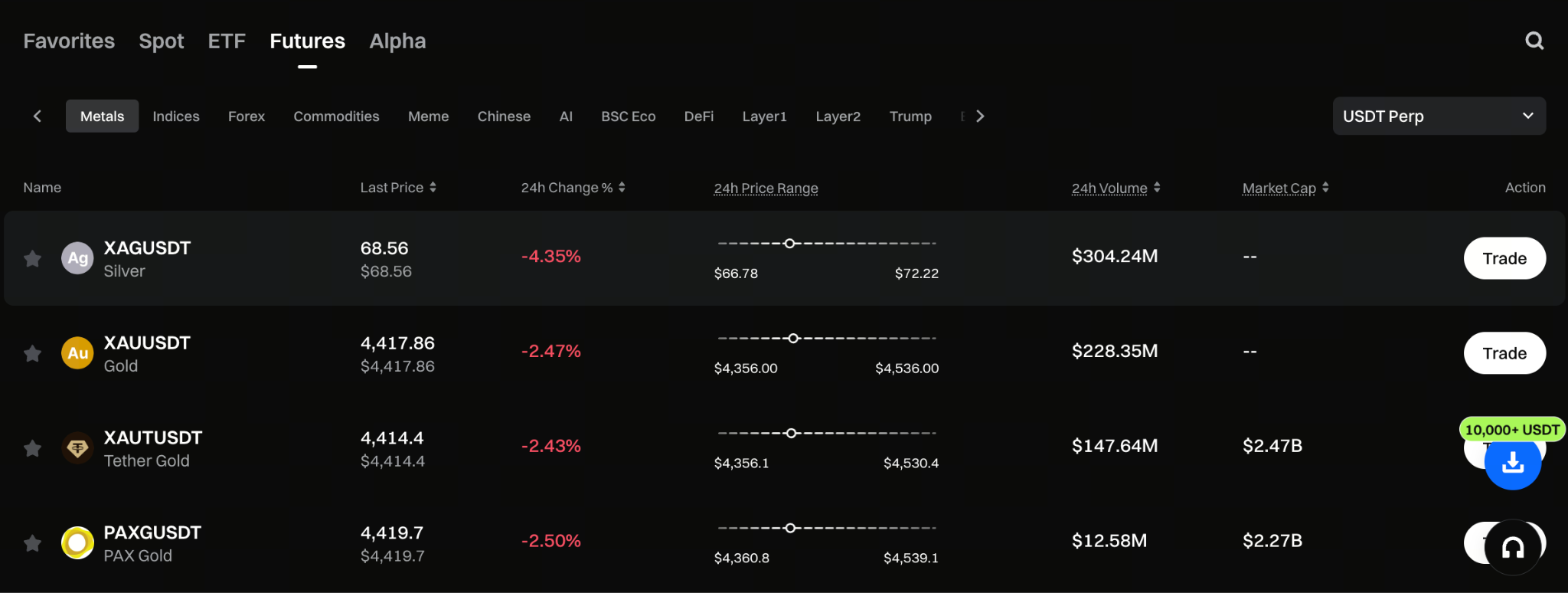
In fast-moving markets, flexible trading tools are essential. Gate’s Metals section offers perpetual futures, allowing investors to access the precious metals market without time constraints.
Unlike traditional futures, perpetual futures have no expiration date, giving traders the freedom to adjust holding periods as market conditions evolve. Whether pursuing short-term trades or medium-term strategies, all can be managed within the same instrument.
USDT settlement further streamlines fund management, enabling traders to quickly adjust capital and positions during periods of heightened volatility.
Start trading now in the Gate Metals section: https://www.gate.com/price/futures/category-metals/usdt
Advantages and Risks of Perpetual Futures
Perpetual futures attract attention for their high flexibility and diverse applications. Their main advantage lies in unrestricted holding periods—eliminating delivery concerns—and the ability to maximize capital efficiency through leverage. However, leverage also magnifies potential risks, making disciplined capital management essential. In volatile markets, prudent use of leverage and careful position sizing are key to sustaining long-term performance.
Risk Control: The Pillar of Trading Stability
As markets become more volatile, risk management takes center stage. A robust trading system employs multiple risk control mechanisms.
A dynamic margin system adjusts capital requirements in real time to buffer against extreme market moves. Auto close position features enable immediate stop-losses when risk thresholds are breached. Funding rates reflect changes in market sentiment and impact the cost of holding positions.
Together, these mechanisms form the backbone of trading security, empowering investors to pursue returns while maintaining risk discipline.
Multi-Faceted Trading Strategies for Volatile Markets
In the precious metals market, traders deploy a range of strategies to adapt to shifting conditions.
- Short-Term Trading
Seizing short-term price movements for rapid entry and exit, often with strict stop-loss and take-profit parameters.
- Trend Following
Establishing positions in the direction of prevailing trends and expanding profits as trends continue.
- Asset Hedging
Allocating precious metals to mitigate overall portfolio volatility.
- Arbitrage
Leveraging price discrepancies across markets or instruments to pursue low-risk returns.
By applying these strategies flexibly, traders can identify optimal approaches for varying market environments.
Conclusion
In a world of persistent economic and market uncertainty, precious metals remain a vital component of asset allocation. Their price dynamics reflect macro trends and provide diverse trading opportunities. By utilizing flexible tools like perpetual futures—combined with robust risk management and strategic planning—investors can navigate market volatility with greater confidence. In an era where uncertainty is the norm, building a disciplined and adaptive trading system is crucial for long-term success.