Market Phenomenon: Low-Market-Cap Altcoins Enter High-Frequency Pulse Phase
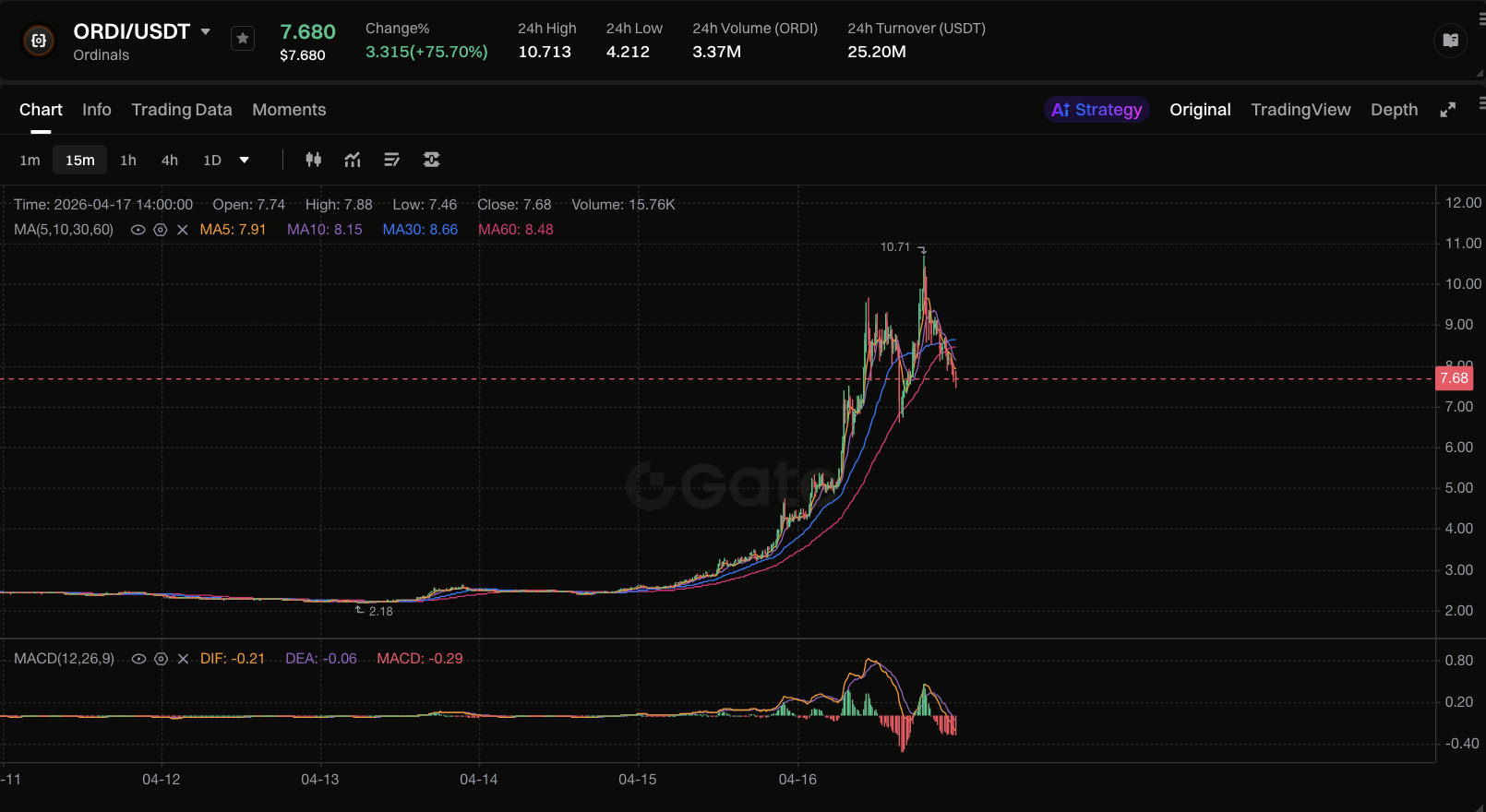
Image source: Gate Market Page
In recent weeks, the spotlight hasn’t been on major coins trending in one direction, but rather on several low-market-cap altcoins repeatedly displaying extreme candlestick patterns—“vertical surges followed by swift pullbacks.”
Take ORDI, for example: its price surged sharply in a short window, then whipsawed violently. SIREN, ARIA, and ENJ also experienced similar nonlinear volatility over the same period.
While each asset has its own narrative, their price action shares striking similarities:
- Surges happen fast, with the main rally often completed within 24 hours;
- Filled amount spikes instantly, but sustained turnover remains weak;
- Selling pressure concentrates near the highs, leading to deep and rapid retracements.
This suggests the market is exhibiting a “pulse-driven” short-cycle structure, not a “broad diffusion” mid-cycle structure.
This Is Not a Broad Altcoin Season—It’s a Pricing Depth Dislocation
Many observers have rushed to call this an “altcoin season comeback,” but that conclusion is premature. More accurately, low-market-cap assets are experiencing amplified price swings due to a break in pricing depth. A pricing depth dislocation means the asset’s tradable depth doesn’t match the impact of marginal orders.
When BTC consolidates at elevated levels and major new capital stays on the sidelines, short-term funds pivot to smaller caps that are easier to move. The result: rapid surges in select coins, creating the illusion of a broad-based “profit effect.”
A true altcoin season requires three key elements:
- Sustained stablecoin inflows into risk assets;
- Capital spreading in an orderly fashion from BTC and ETH to a wider range of altcoins;
- Gains that persist week-over-week, not just intraday pulses.
What we’re seeing now is more of a structural anomaly in specific assets, with limited breadth and staying power.
How Prices Get Amplified: Thin Depth, Crowded Shorts, and Narrative Ignition
Sharp rallies in low-market-cap coins typically follow a three-stage process:
Stage 1: Thin Depth Magnifies Marginal Bids
For coins with daily filled amounts in the low millions, concentrated buying dramatically increases price elasticity.
This isn’t a “sudden surge in consensus”—it’s “insufficient depth causing higher impact costs.”
Stage 2: Crowded Shorts Trigger Cascade Covering
If the funding rate is negative and short positions are piling up, breaking key price levels triggers forced covering.
This is when prices move fastest, as the buy pressure comes from forced liquidations, not discretionary allocation.
Stage 3: Narrative Spread Ignites FOMO
Once price action leads, old narratives are quickly revived—inscriptions, memes, AI, or historical bull run tags.
As traffic chases in, the market enters a “sentiment-driven” phase. Volatility expands further, but sustainability usually wanes.
Case Study: Four Scenarios—ORDI, SIREN, ARIA, ENJ
ORDI: Memory-Driven Pulse
ORDI’s move is a classic case of “historical narrative reactivation.”
When price rebounds sharply from a deep decline, the market is buying expectations and memories—not new fundamentals.
SIREN: High Concentration-Induced Volatility
When holdings are highly concentrated, price becomes hypersensitive to large, one-sided orders.
This structure allows for rapid rallies and equally swift declines—volatility itself becomes the main trading variable.
ARIA: Pump-and-Distribution Reversal
The typical path: a fast surge, insufficient liquidity at the top, then concentrated selling.
The key risk here is that those chasing the rally often end up holding the riskiest positions when trading is hottest.
ENJ: Short Squeeze-Induced Surge
When an oversold backdrop meets crowded shorts, a breakout triggers a series of short covers, producing a steep rebound.
But a short squeeze is just position rebalancing—it’s rarely enough for a long-term value reset.
Why “Calling the Market Right” Still Leads to Losses
The most common mistake isn’t getting the direction wrong—it’s using the wrong trading framework.
Many treat structural trades as trend investments, resulting in:
- Late entries, with the P/L Ratio deteriorating rapidly;
- No batch profit-taking, so unrealized gains vanish in the drawdown;
- Confusing short-term sentiment for long-term logic, misaligning position size and holding period.
In pulse-driven markets, being right on direction doesn’t guarantee trading success.
True results depend on position management, execution discipline, and having a concrete exit plan.
Practical Framework: 5 Indicators to Identify the Next Pulse
To systematically track these opportunities, focus on these five data sets:
- Circulating market cap and order book depth: First, assess whether price can be supported, then look at rise %.
- Top 10 address holding percentage: The higher the concentration, the more likely nonlinear volatility becomes.
- Funding rate and open interest (OI) linkage: Negative funding rate + OI buildup + key breakout often signals a short squeeze.
- Net exchange inflows and outflows: After a surge, if net inflows to exchanges persist, potential selling pressure usually builds.
- Quality of turnover at highs: A healthy structure requires ample turnover near the top, not just fading liquidity after a one-way rally.
Focus on structure before narrative; on support before price targets.
Risk Control First: Surviving Nonlinear Volatility
The biggest risks in these markets are emotional chase orders and holding positions unconditionally.
Mitigate errors with these rules:
- Set a hard cap on single-asset position size—don’t add passively just because price rises;
- Build and unwind positions in batches to avoid all-or-nothing decisions;
- Rigorously execute stop-losses when key structural levels break—don’t bet against fragile depth;
- Watch out for “consecutive long upper wicks with high volume but stalled gains”;
- Document trigger and invalidation conditions for every trade.
In low-market-cap pulse markets, returns come from discipline—not from adrenaline.
Conclusion: Treat Small-Cap Moves as Structural Trades, Not Trend Investments
From ORDI to SIREN, ARIA, and ENJ, recent small-cap surges all point to the same answer: price can detach from fundamentals in the short term, but rarely escapes liquidity constraints for long.
The most practical strategy isn’t debating whether it’s “altcoin season,” but identifying:
- Which rallies are supported by real bids;
- Which are driven by position squeezes;
- Which are merely echoes of sentiment.
For low-market-cap altcoins, the main logic is a structural game under pricing depth dislocation. They’re tradable—but timing your exit is critical.