Fundamentals? Analyzing the Current Dilemma and Future OpportunitiesEthereum’s “Barrier Lake” Moment: Why Is ETH Falling Despite Strengthening

Beginner
Quick Reads
Last Updated 2026-03-25 18:59:21
Reading Time: 1m
Ethereum Reaches a Critical Juncture: Fundamental Metrics Hit All-Time Highs While ETH Price Declines. This in-depth analysis examines TVL, staking volume, DVT proposals, and the current price dislocation, alongside Ethereum price forecast trends for 2026.

What Is Ethereum’s “Dammed Lake Moment”?

At the start of 2026, Ethereum’s ecosystem saw an unexpected development: key fundamental metrics surged, yet ETH’s market price failed to rise accordingly. This sharp divergence between fundamentals and price has been described by the media as Ethereum’s “dammed lake moment.” The term captures a sense of capital being “blocked” and “backlogged”—like water building up energy behind a dam, unable to flow freely.

Staking Volume and TVL Reach Record Highs as Fundamentals Strengthen

On-chain data shows both Ethereum’s staking volume and total value locked (TVL) have hit new highs. As of January 2026, roughly 36 million ETH were staked globally, valued at nearly $120 billion and representing about 30% of circulating supply—demonstrating strong market confidence in Ethereum’s long-term prospects and ecosystem value. At the same time, ecosystem-wide TVL broke the $300 billion threshold, with stablecoins accounting for 58%. This underscores Ethereum’s growing role as a core infrastructure for global on-chain finance.

Traditionally, these figures signal notable increases in network activity, capital accumulation, and depth of usage. High staking volumes indicate investors are willing to lock ETH for the long term, while large TVL reflects substantial capital powering DeFi, stablecoin, and RWA asset applications on Ethereum.

Weak Price Performance: Why Is the Market Misaligned?
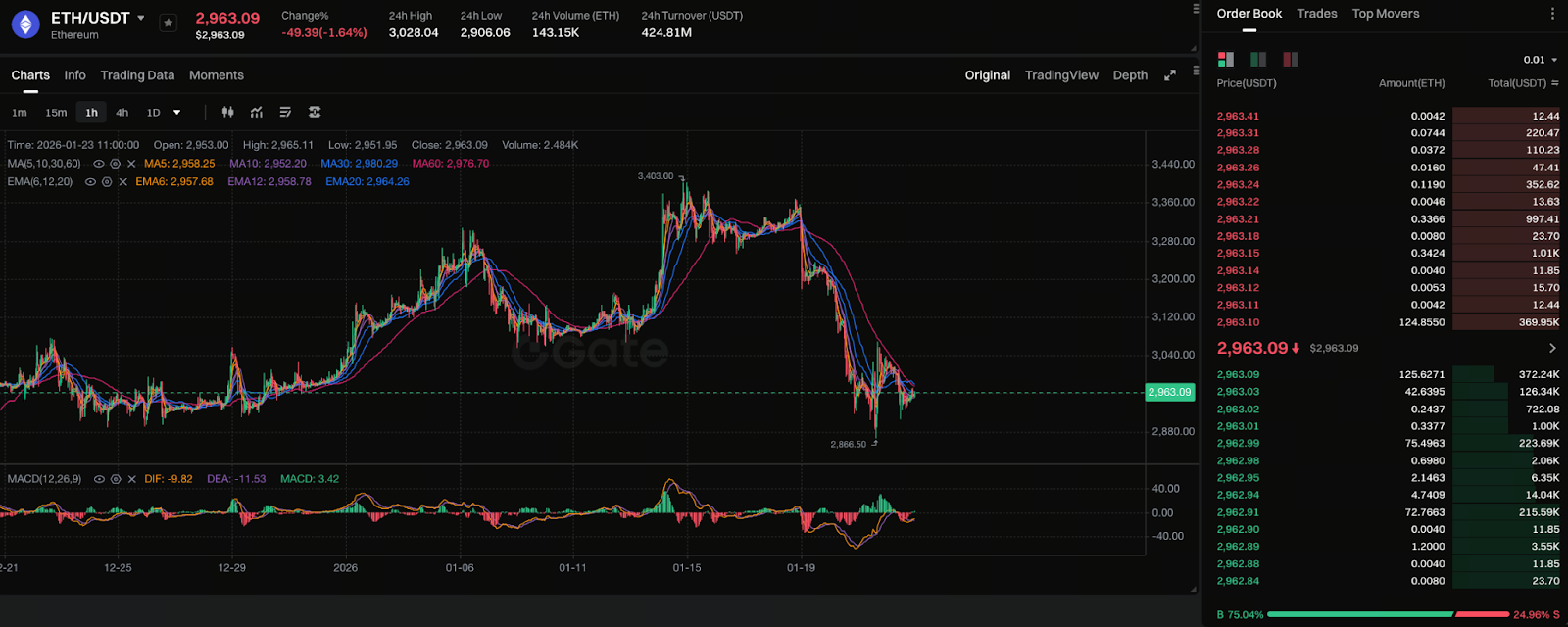

Chart: https://www.gate.com/trade/ETH_USDT

Despite the strong fundamentals, ETH’s price remains subdued. As of January 2026, ETH continues to trade in the $2,900–$3,300 range. Several factors explain this disconnect:

  • Market price misalignment: While on-chain data is positive, trading sentiment hasn’t fully reflected fundamental improvements. Investors may be focused on macro capital flows and short-term risk appetite.
  • Spam transactions and distorted data: Spikes in on-chain volume may be driven by “address poisoning” and other spam transactions, potentially inflating growth figures and undermining confidence in real demand.
  • Weakened value capture: As Layer-2 solutions absorb most transaction activity, mainnet fee revenue has dropped, reducing Ethereum’s ability to capture profits and putting pressure on ETH’s price.

Even as on-chain activity and ecosystem assets expand, market participants remain cautious about revaluing ETH. This caution is a key reason ETH’s price hasn’t kept pace with its fundamental growth.

Technical and Ecosystem Challenges: Transaction Volume and Value Capture

The Fusaka upgrade further lowered Ethereum transaction fees, making Layer-2 solutions more efficient and driving costs down. However, this also diluted the mainnet’s value capture capacity. Significantly reduced gas fees have weakened ETH’s economic role as both a store and medium of value. Meanwhile, while transaction counts have surged, much of the increase stems from low-value spam transactions that offer little support for price formation.

As a result, the ETH ecosystem currently faces a paradox: technical efficiency is rising, but value capture is declining. In the near term, this contradiction may continue to manifest as strong fundamentals but weak pricing.

Ethereum Price Outlook and Investment Logic for 2026

For 2026, mainstream price forecasts suggest a broad trading range. Market analysts expect ETH to fluctuate between $2,500 and $12,000, with a base scenario in the $4,000–$8,000 range and an optimistic case potentially breaking above $10,000.

Key scenarios include:

  • Conservative: Tighter regulation or delayed tech rollouts could push ETH down to $2,500–$4,000.
  • Base case: Continued ETF, RWA, and DeFi growth, alongside stable staking, could see ETH settle in the $6,000–$8,000 range.
  • Optimistic: Full-stack sharding, large-scale application launches, and strong institutional inflows could drive ETH to $10,000 or higher.

This multi-scenario approach highlights the need for investors to track macro capital flows, regulatory developments, and real on-chain demand—not just fundamental data alone.

Conclusion: When Will Fundamentals and Price Realign?

Ethereum’s current “dammed lake” phenomenon shows that market pricing has yet to fully reflect improvements in ecosystem fundamentals. As the network continues to upgrade, optimize value capture, and attract institutional capital, ETH’s price may gradually realign with its fundamentals. However, this process won’t be linear—it requires time and incremental market confidence. When assessing Ethereum’s 2026 price trend, investors should weigh fundamentals, technical indicators, and the global macroeconomic backdrop.

Author: Max
Disclaimer
* The information is not intended to be and does not constitute financial advice or any other recommendation of any sort offered or endorsed by Gate.
* This article may not be reproduced, transmitted or copied without referencing Gate. Contravention is an infringement of Copyright Act and may be subject to legal action.

Related Articles

What is Fartcoin? All You Need to Know About FARTCOIN
Intermediate

What is Fartcoin? All You Need to Know About FARTCOIN

Fartcoin (FARTCOIN) is a representative meme coin within the Solana ecosystem based on an AI-driven narrative. Its core concept originated from an experiment aimed at exploring the "boundaries between AI Agents and humor." More than just a digital asset with social attributes, the project deeply couples absurd humor culture with on-chain financial logic by integrating autonomous AI interaction models.
2026-04-04 22:01:19
Gold Price Forecast for the Next Five Years: 2026–2030 Trend Outlook and Investment Implications, Could It Reach $6,000?
Beginner

Gold Price Forecast for the Next Five Years: 2026–2030 Trend Outlook and Investment Implications, Could It Reach $6,000?

Analyze current gold price trends alongside authoritative five-year forecasts, integrating an evaluation of market risks and opportunities. This gives investors insight into the potential trajectory of gold prices and the main drivers expected to shape the market over the next five years.
2026-03-25 18:13:30
Aster vs Hyperliquid: Which Perp DEX Will Prevail?
Beginner

Aster vs Hyperliquid: Which Perp DEX Will Prevail?

Aster and Hyperliquid are the two representative protocols of the "purpose-built L1 path" within the current decentralized perpetual exchange (Perp DEX) sector. As a pioneer in the field, Hyperliquid has built a deep liquidity moat through its highly mature order book architecture and strong community consensus. Conversely, Aster, as a rising challenger, seeks to leapfrog the competition in high-performance trading through more aggressive multi-chain aggregation logic, private transaction modules, and an underlying execution environment optimized for 2026 market demands.
2026-03-24 11:58:33
AI-Native Settlement Layers: How United Stables Is Building the Next Financial Rail
Beginner

AI-Native Settlement Layers: How United Stables Is Building the Next Financial Rail

Stablecoins were originally designed as dollar substitutes within exchanges, primarily used for asset pricing and trade settlement. As on-chain financial ecosystems have matured, their role has expanded beyond simple payments to include collateral assets, cross-chain liquidity mediums, and unified settlement units. In particular, as AI systems and automated agents begin to participate directly in economic activity, demand has risen sharply for programmable value units capable of instant settlement. This shift is pushing stablecoins toward the role of foundational financial infrastructure.
2026-03-25 03:16:17
ASTER Tokenomics: Buybacks, Burns, and Staking as the Value Foundation of ASTER in 2026
Beginner

ASTER Tokenomics: Buybacks, Burns, and Staking as the Value Foundation of ASTER in 2026

ASTER is the native equity and governance token of the Aster ecosystem, with its core value built upon a radical "Deflationary Engine." Beyond serving as a governance tool, ASTER integrates multiple utilities including staking rewards, trading fee discounts, and liquidity incentives. Through its deep integration with the upcoming dedicated Layer 1 mainnet, it enables direct value capture from protocol cash flow to token holders.
2026-03-25 07:38:07
Hybrid Collateral Stablecoins: Inside United Stables' Stability and Yield Architecture
Beginner

Hybrid Collateral Stablecoins: Inside United Stables' Stability and Yield Architecture

In the early stages of the crypto market, traditional stablecoins mainly relied on single-reserve or single-collateral models. Their primary focus was price stability and payment convenience, which allowed them to become foundational tools for on-chain trading and capital flows. As the market has entered a more mature financial phase, however, this structure has begun to reveal limitations, including high concentration risk and the difficulty of balancing liquidity with yield. These constraints have driven the evolution toward multi-layer collateral and portfolio-based designs, such as the dual-layer hybrid collateral architecture proposed by United Stables, which seeks to redefine the underlying logic of stable assets.
2026-03-25 03:17:39