Image: https://www.gate.com/trade/ETH_USDT
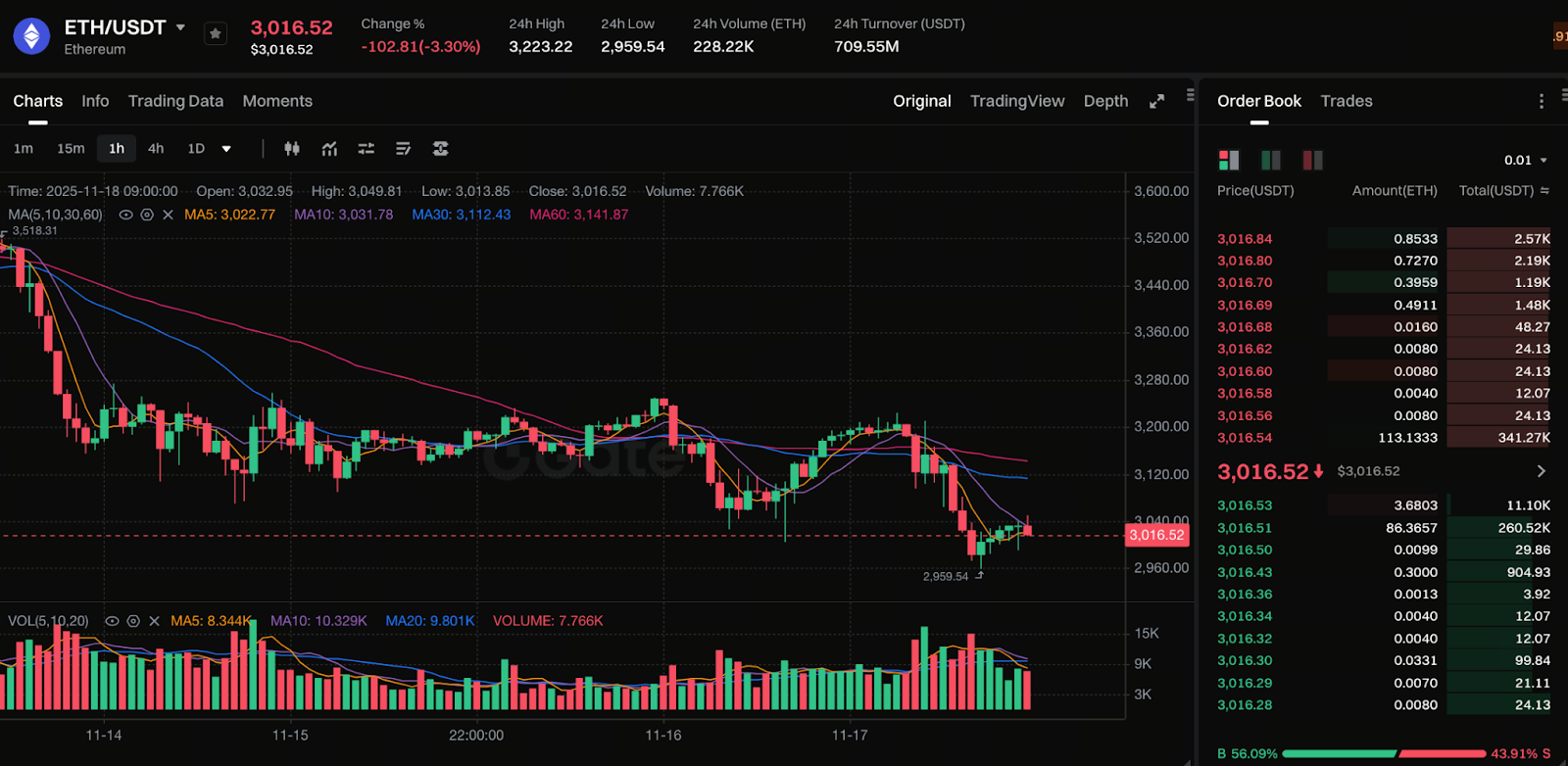
Ethereum (ETH) has taken the spotlight in the recent crypto market correction. Over the past few weeks, ETH’s price has plunged from earlier highs, now fluctuating between $3,000 and $3,100—a notable drop from its monthly peak. This downturn has sparked widespread debate: Whether ETH has topped out or is consolidating ahead of a major breakout.
Despite the weak price action, many institutions and top analysts remain extremely bullish in their long-term outlooks. Some are forecasting an ambitious $12,000 ETH price target for 2025.
ETH Price Update: Sharp Decline to the $3,000 Range
Several factors have driven Ethereum’s recent decline:
- Broad crypto market retreat. Interest in risk assets has temporarily weakened, leading BTC and other major coins to correct.
- Fund rotation into Bitcoin. Capital has flowed from ETH into BTC, creating liquidity pressure for ETH.
- Short-term ETF outflows. Some ETF investors have exited after taking profits, increasing selling pressure.
- Macroeconomic uncertainty. Changing rate expectations, dollar strength, and inflation have fueled market anxiety.
These combined forces have triggered ETH’s rapid pullback. However, on-chain data shows no signs of panic selling or mass exits; rather, there are signs of market digestion and adjustment.
Analysts Maintain $12,000 ETH Price Forecast
Analysts’ bullish views on ETH are well-supported. They argue that while prices are currently subdued, the long-term trajectory remains upward. Key points include:
- Institutional demand: More institutions are allocating ETH as a long-term asset. As crypto infrastructure matures, ETH’s utility grows in importance.
- Supply-side advantages: EIP-1559’s fee burn reduces supply, and significant ETH is staked and locked, shrinking the circulating supply.
- Ecosystem growth: Layer 2 networks (such as Arbitrum and Optimism) are expanding rapidly, with more transactions moving to L2—driving sustained ETH demand.
Based on these fundamentals, analysts maintain that ETH’s upside potential remains intact despite recent weakness.
Three Structural Forces Driving ETH’s Long-Term Growth
ETH Emerges as a Core Institutional Allocation
The spot ETH ETF launch has fundamentally shifted institutional involvement:
- ETH is now integrated into asset allocation models
- ETF inflows generate real buying pressure
- The amount of capital locked for the long term continues to increase
Even with short-term outflows, institutions are positioning for multi-year investment cycles.
Deflationary Supply Structure
EIP-1559’s burn mechanism has set ETH’s supply on a long-term contraction path. Rising staking rates further reduce circulating supply. As demand increases, the price is more likely to experience a decisive breakout.
Layer 2 Expansion Amplifies ETH Network Value
Chains like Arbitrum, Optimism, Base, and Linea are posting record highs in transaction volume and total value locked (TVL). Layer 2 growth is expanding the ETH ecosystem rather than ceding ground to competitors. Ecosystem expansion leads to increased transaction demand, which results in higher gas usage and more ETH being burned.
On-Chain Activity: Healthy Despite Pullback
On-chain metrics show that while some ETH indicators have cooled, overall network health remains strong:
- L2 daily transaction volume is slightly down but still robust.
- Total value locked (TVL) in DeFi has dipped, but there’s no dramatic collapse.
- ETH burn rates are below bull market peaks, but burning continues steadily.
- The amount of ETH staked keeps rising, signaling persistent long-term investor confidence.
These signals indicate that the pullback likely represents a corrective move, not a loss of fundamental support.
Technical Outlook: Key Support and Potential Rebound Levels
Support Levels
- $2,950 (major support)
- $2,850 (a breakdown at this level could lead to further decline)
Resistance Levels
- $3,300–$3,350 (initial resistance zone)
- $3,500 (key trend reversal level)
A break above $3,500 would restore the medium-term uptrend.
Risk Factors: Variables That Could Impact the Uptrend
Despite a clear bullish case, several risks remain:
- Macro risks persist: Higher rates and economic volatility are ongoing threats.
- Institutional hesitation: If major investors wait for confirmation instead of buying, upside momentum may stall.
- Technical upgrade risks: Delays or issues with Ethereum upgrades (such as scaling and sharding) could weaken market confidence.
- Regulatory changes: Stricter crypto regulation could slow capital inflows.
These factors could delay ETH’s progress toward higher price targets.
2025 Outlook: Can ETH Really Hit $12,000?
If the following conditions materialize, ETH could enter an accelerated rally:
- Macro environment improves and major capital returns
- ETH ETF flows turn positive and sustained
- Layer 2s see another surge in growth
- ETH burn rate rises sharply
- Institutions begin active buying
Structurally, $12,000 is not an unrealistic expectation; it is a realistic and achievable target if these factors align.







