In the early stages of blockchain, assets were primarily issued as fungible tokens. Over time, non-fungible assets—such as in-game items, collectibles, and digital rights—have become key components. The “definition, verification, and circulation” of these assets require a unified, verifiable mechanism. Enjin’s system is specifically designed to address this, enabling digital assets to be standardized and managed directly on-chain.
Viewed from a digital asset perspective, ENJ functions not only as a medium of exchange but also as a fundamental element in asset creation and structural design. It interacts with asset standards (like ERC-1155) and application scenarios (such as blockchain gaming asset usage), forming an integrated framework that underpins digital ownership infrastructure.
What Is Enjin Coin (ENJ)?
ENJ serves as the core token within the Enjin digital asset ecosystem, providing structural support and value stability for various asset types on-chain. Unlike tokens used solely for transfer or payment, ENJ is incorporated into the asset creation and management process, becoming an integral part of the digital asset system.
Here, assets are more than just “ownership records”—they can be linked to tokens, giving them a more defined value structure. This “asset layer + token layer” model positions ENJ as a connector within the ecosystem, directly contributing to both asset generation and system operations.
How Has Enjin Evolved Into a Digital Asset Ecosystem?
Enjin’s evolution illustrates the shift from “application tool” to “asset infrastructure.” Initially, Enjin focused on gaming community services. It later integrated blockchain technology for game asset management, allowing virtual items to have on-chain ownership and portability.
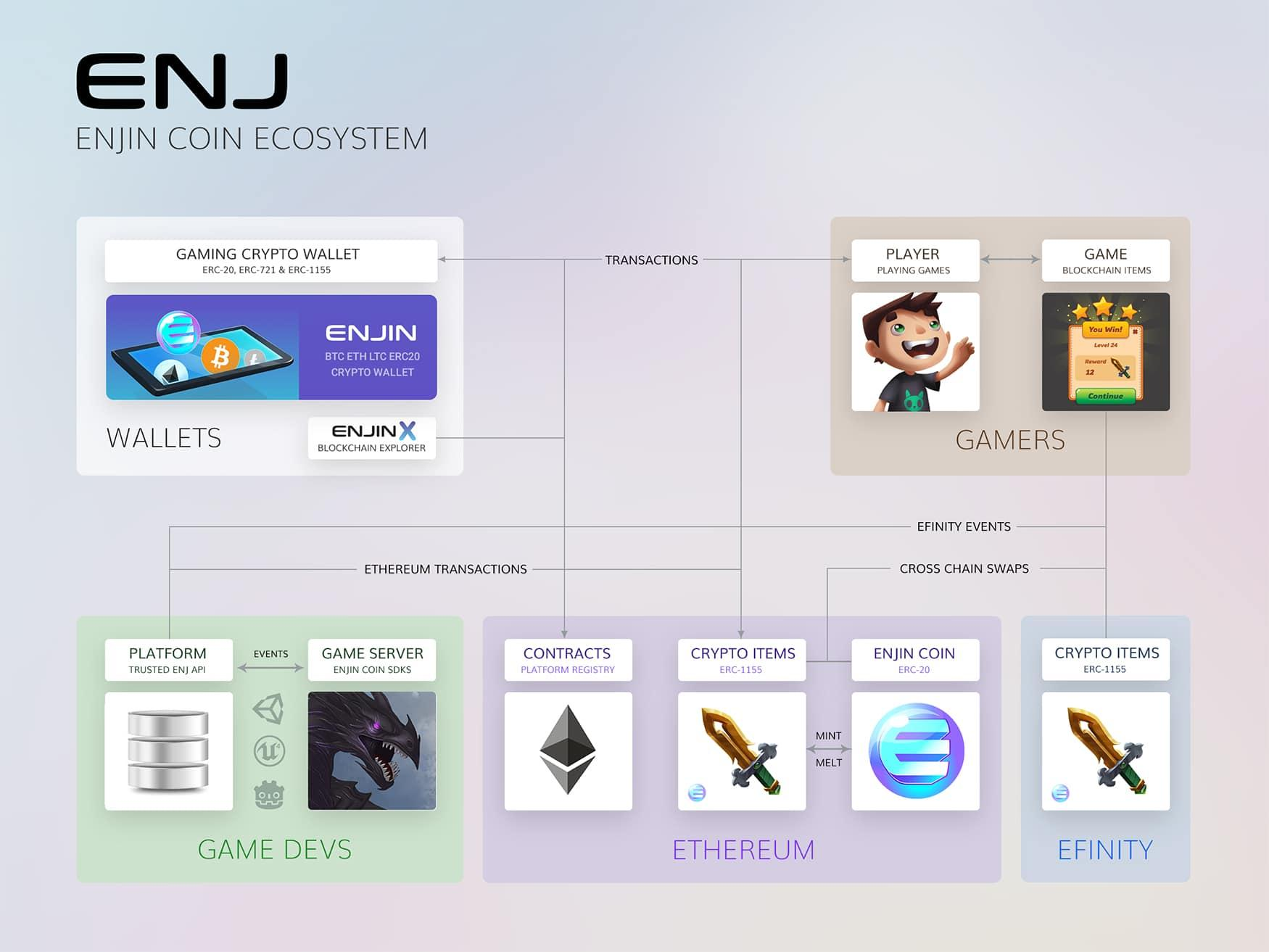
As asset standards and toolchains matured, Enjin developed an ecosystem encompassing asset issuance, wallet management, and developer frameworks, enabling creators to efficiently build and manage digital assets. This progression transformed assets previously confined to single applications into on-chain resources usable across multiple contexts.
What Is ENJ’s Role in the Enjin Ecosystem?
ENJ fulfills dual functions as the ecosystem’s “asset support layer” and “system connection layer.”
At the asset layer, ENJ is integral to the creation logic of digital assets, establishing a value foundation by linking assets to tokens at inception. At the system layer, ENJ connects asset creation, management, and usage modules, ensuring seamless operation within a unified structure.
ENJ also powers incentive and distribution mechanisms, allowing ecosystem participants to earn rewards via tokens and sustaining overall system functionality.
ENJ Token Mechanism: Supply, Distribution, and Structure
ENJ’s utility is closely tied to its supply structure. Designed as an “ecosystem-driven token mechanism,” it emphasizes liquidity and application involvement, rather than serving a single purpose.
ENJ has a fixed initial cap of approximately one billion tokens, creating a foundation of scarcity. As the ecosystem expands, network growth and structural adjustments may alter total supply at different phases.
Distribution is not centralized but allocated to support ecosystem development:
| Distribution Category |
Distribution Range (Approximate) |
Function |
| Public Sale |
40%–60% |
Initial circulation and market distribution |
| Team & Development |
15%–20% |
Long-term development and operations support |
| Ecosystem Growth |
10%–20% |
Incentives for developers and application building |
| Community & Promotion |
5%–15% |
User and community expansion support |
| Reserve & Liquidity |
Small amount |
System stability maintenance |
This distribution is “ecosystem participation-oriented” rather than focused solely on fundraising. The majority is allocated to markets and ecosystem growth, encouraging asset utilization and application expansion.
The design makes ENJ an “asset infrastructure token,” with supply and distribution directly supporting digital asset system operations, rather than serving as a simple value transfer mechanism.
How Does Enjin’s Digital Asset Mechanism Work?
Enjin’s asset mechanism follows a comprehensive path: “creation—binding—holding—circulation.”
During creation, developers define asset properties and issue them on-chain. Assets can be linked to ENJ in this process, establishing value backing.
During holding, assets are managed by users via on-chain addresses, with ownership recorded and verified by the blockchain.
During circulation, assets can be transferred between users and utilized across multiple applications, increasing their composability.
A deeper understanding is possible by analyzing Enjin’s asset creation workflow and on-chain asset lifecycle.
ENJ’s relationship to NFTs is defined by its “support mechanism versus asset form.” NFTs represent unique assets, while ENJ is involved in their creation and structural design.
ERC-1155 is a multi-asset standard that allows for the management of different asset types within a single contract. Enjin’s integration with ERC-1155 enables the ecosystem to support complex asset structures, including both fungible and non-fungible assets.
Compared to traditional standards, ERC-1155 offers greater efficiency and flexibility, which is why ENJ is frequently discussed alongside it.
What Are the Use Cases for Enjin Coin?
ENJ’s applications center on digital assets and cover multiple contexts.
In blockchain gaming, ENJ supports the creation and circulation of in-game items, ensuring on-chain ownership. In digital collectibles, ENJ enables asset issuance with uniqueness and verifiability.
ENJ is also used to build verifiable asset systems in digital certificates, membership programs, and virtual asset management.
These use cases demonstrate ENJ’s role in the cross-context circulation of blockchain assets.
How Does Enjin Coin Differ From Other Digital Asset Projects?
ENJ stands apart from other digital asset projects in its functional scope and design objectives.
| Comparison Dimension |
Enjin Coin (ENJ) |
General Token |
| Core Positioning |
Asset infrastructure |
Payment or circulation tool |
| Functional Scope |
Asset creation and management |
Transaction and value transfer |
| Asset Relationship |
Supports asset structure |
Not directly involved in asset creation |
| Application Range |
Multi-context asset system |
Single-function scenario |
The comparison highlights ENJ’s role as a “fundamental asset support mechanism,” whereas general tokens act as “application layer tools.” This distinction defines their roles within the ecosystem.
How Should You Understand Enjin Coin’s Advantages, Limitations, and Common Misconceptions?
ENJ’s advantages include its ability to support digital asset structures, enabling verifiability and composability. Its integration with standards like ERC-1155 allows it to handle complex asset types.
Its limitations include a high dependency on the ecosystem; asset value and utility must be realized through practical applications. Its role is often misunderstood as a typical game token or NFT, but it is fundamentally infrastructure.
Common misconceptions include equating ENJ with NFTs or believing it is only for gaming. These misunderstandings are due to a lack of awareness about its asset support mechanism.
Summary
Enjin Coin (ENJ) is a blockchain infrastructure token designed to support digital assets, with its core function facilitating asset creation and structural design. This enables diverse digital assets to be managed and circulated within a unified ecosystem.
Understanding its token mechanism, asset logic, and ecosystem structure provides clarity on blockchain’s applications in the digital asset sector and how assets achieve interoperability and expansion across contexts.
FAQ
What is the primary function of Enjin Coin (ENJ)?
ENJ supports digital asset creation, management, and value structure design.
Are ENJ and NFT the same?
No. NFTs are asset forms; ENJ is a token that supports asset mechanisms.
Is ENJ only used for gaming?
It originated in gaming but is applicable to a wide range of digital asset contexts.
Is ENJ’s value tied to applications?
ENJ’s utility is realized through specific application scenarios.
What is the relationship between ERC-1155 and ENJ?
ERC-1155 is an asset standard; the ENJ ecosystem leverages this standard to support multi-asset structures.