Cloudflare Outage Triggers Global Web Disruptions, Exposing Web3’s Single Point of Failure

Beginner
Quick Reads
Last Updated 2026-03-27 17:05:03
Reading Time: 1m
Cloudflare, a major global provider of network infrastructure, recently suffered a significant outage, disrupting access to many websites, trading platforms, and Web3 service interfaces. The incident impacted key crypto projects such as Coinbase, Ledger, BitMEX, and Arbiscan.

Cloudflare Outage Triggers Major Internet Disruptions

Recently, a significant number of websites and applications worldwide experienced outages caused by a system failure at Cloudflare, a leading internet infrastructure provider. The incident impacted both Web2 and Web3 services, leaving users temporarily unable to access front-end interfaces or interact with platforms.

Cloudflare’s official statement reported the disruption occurred at 11:48 UTC. Their team resolved the issue quickly and noted:

The issue has been resolved. We will continue to monitor the system to ensure full restoration of services. This episode underscores how a breakdown in the internet’s core infrastructure can instantly affect the entire web, not just a single platform.
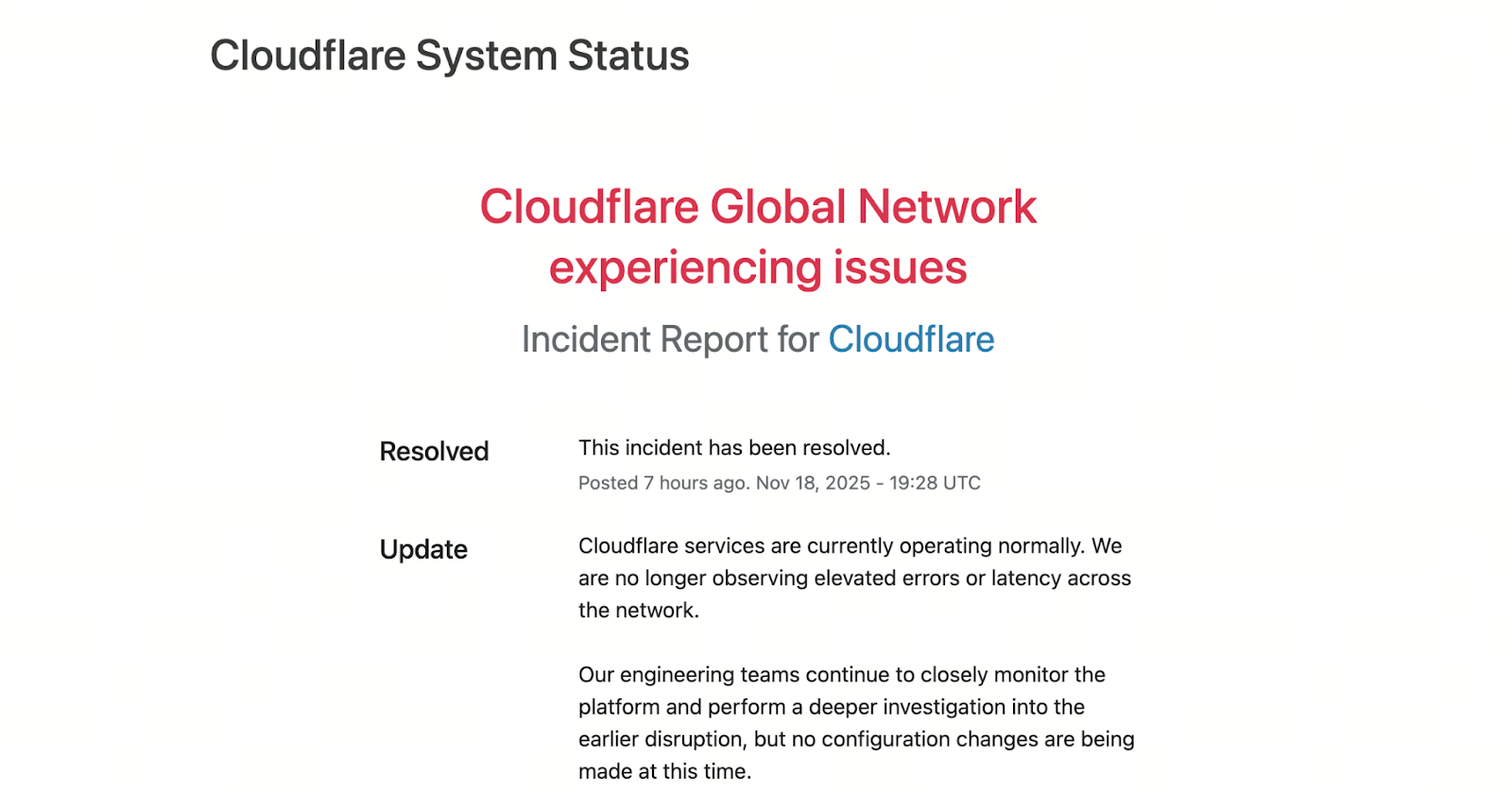

(Source: Cloudflare)

Numerous Crypto and Mainstream Platforms Go Offline

During the Cloudflare outage, many users reported that websites’ front ends failed to load. Both Web2 and Web3 platforms were affected, including X (Twitter), Truth Social, Coinbase, Ledger, BitMEX, TMON (TON), Arbiscan, and DeFiLlama.

Some platforms quickly restored operations and confirmed a smooth recovery. BlueSky and Reddit remained mostly unaffected, highlighting that architectural differences can create varying levels of resilience when core infrastructure fails.

Root Cause of the Outage Identified

In a statement to Cointelegraph, Cloudflare clarified that the outage resulted from an internal configuration issue rather than a cyberattack. Automatically generated configuration files responsible for managing threat traffic exceeded anticipated size limits, causing the traffic processing module to fail. This means the problem stemmed from Cloudflare’s own system capacity limits, which were unable to handle an unusual traffic spike.

Web3 Remains Dependent on Centralized Core Infrastructure

This incident exposes an unavoidable truth: decentralized applications still depend heavily on centralized internet infrastructure. Even DEXs, DeFi aggregators, blockchain explorers, and crypto wallets face single point of failure risks if their front-end services depend on Cloudflare.

While on-chain elements may be decentralized, most Web3 user gateways still use Web2 architectures. Until these entry points are decentralized, achieving true censorship resistance and reliability will remain out of reach.

Conclusion

Cloudflare’s large-scale outage has made it clear once again that, despite Web3’s focus on decentralization and censorship resistance, its real-world operations still rely heavily on Web2 infrastructure providers like Cloudflare and AWS. When these infrastructure providers encounter issues, on-chain applications, trading platforms, browsers, and wallet front ends can go offline instantly. This incident reveals that, although Web3 has advanced at the consensus and computation layers, real decentralization does not yet extend to user gateways, front ends, traffic routing, or API services. For true end-to-end decentralization, the industry must transition network infrastructure beyond the Web2 model. It should build a foundation that is more distributed, verifiable, and resilient.

Disclaimer
* The information is not intended to be and does not constitute financial advice or any other recommendation of any sort offered or endorsed by Gate.
* This article may not be reproduced, transmitted or copied without referencing Gate. Contravention is an infringement of Copyright Act and may be subject to legal action.

Related Articles

What is Fartcoin? All You Need to Know About FARTCOIN
Intermediate

What is Fartcoin? All You Need to Know About FARTCOIN

Fartcoin (FARTCOIN) is a representative meme coin within the Solana ecosystem based on an AI-driven narrative. Its core concept originated from an experiment aimed at exploring the "boundaries between AI Agents and humor." More than just a digital asset with social attributes, the project deeply couples absurd humor culture with on-chain financial logic by integrating autonomous AI interaction models.
2026-04-04 22:01:19
Gold Price Forecast for the Next Five Years: 2026–2030 Trend Outlook and Investment Implications, Could It Reach $6,000?
Beginner

Gold Price Forecast for the Next Five Years: 2026–2030 Trend Outlook and Investment Implications, Could It Reach $6,000?

Analyze current gold price trends alongside authoritative five-year forecasts, integrating an evaluation of market risks and opportunities. This gives investors insight into the potential trajectory of gold prices and the main drivers expected to shape the market over the next five years.
2026-03-25 18:13:30
Aster vs Hyperliquid: Which Perp DEX Will Prevail?
Beginner

Aster vs Hyperliquid: Which Perp DEX Will Prevail?

Aster and Hyperliquid are the two representative protocols of the "purpose-built L1 path" within the current decentralized perpetual exchange (Perp DEX) sector. As a pioneer in the field, Hyperliquid has built a deep liquidity moat through its highly mature order book architecture and strong community consensus. Conversely, Aster, as a rising challenger, seeks to leapfrog the competition in high-performance trading through more aggressive multi-chain aggregation logic, private transaction modules, and an underlying execution environment optimized for 2026 market demands.
2026-03-24 11:58:33
AI-Native Settlement Layers: How United Stables Is Building the Next Financial Rail
Beginner

AI-Native Settlement Layers: How United Stables Is Building the Next Financial Rail

Stablecoins were originally designed as dollar substitutes within exchanges, primarily used for asset pricing and trade settlement. As on-chain financial ecosystems have matured, their role has expanded beyond simple payments to include collateral assets, cross-chain liquidity mediums, and unified settlement units. In particular, as AI systems and automated agents begin to participate directly in economic activity, demand has risen sharply for programmable value units capable of instant settlement. This shift is pushing stablecoins toward the role of foundational financial infrastructure.
2026-03-25 03:16:17
2026 Silver Price Forecast: Bull Market Continuation or High-Level Pullback? In-Depth Analysis of Silver Candlestick Chart
Beginner

2026 Silver Price Forecast: Bull Market Continuation or High-Level Pullback? In-Depth Analysis of Silver Candlestick Chart

2026 Silver Price Forecast: Latest Outlook This article integrates current market trends, silver candlestick chart analysis, and momentum factors to assess the potential key support and resistance levels, upside targets, and pullback risks for silver prices. The goal is to help investors make informed, rational decisions.
2026-03-25 16:08:59
ASTER Tokenomics: Buybacks, Burns, and Staking as the Value Foundation of ASTER in 2026
Beginner

ASTER Tokenomics: Buybacks, Burns, and Staking as the Value Foundation of ASTER in 2026

ASTER is the native equity and governance token of the Aster ecosystem, with its core value built upon a radical "Deflationary Engine." Beyond serving as a governance tool, ASTER integrates multiple utilities including staking rewards, trading fee discounts, and liquidity incentives. Through its deep integration with the upcoming dedicated Layer 1 mainnet, it enables direct value capture from protocol cash flow to token holders.
2026-03-25 07:38:07