Bull Market Return? Bitcoin Rebounds Back to $90,000 — Did You Buy the Dip?

Beginner
Quick Reads
Last Updated 2026-03-27 08:54:49
Reading Time: 1m
Bitcoin has surged in recent trading, breaking above the $90,000 threshold. Has bullish momentum returned? In this article, we examine the latest price trends and market sentiment to help you assess whether now is the ideal moment to buy the dip.


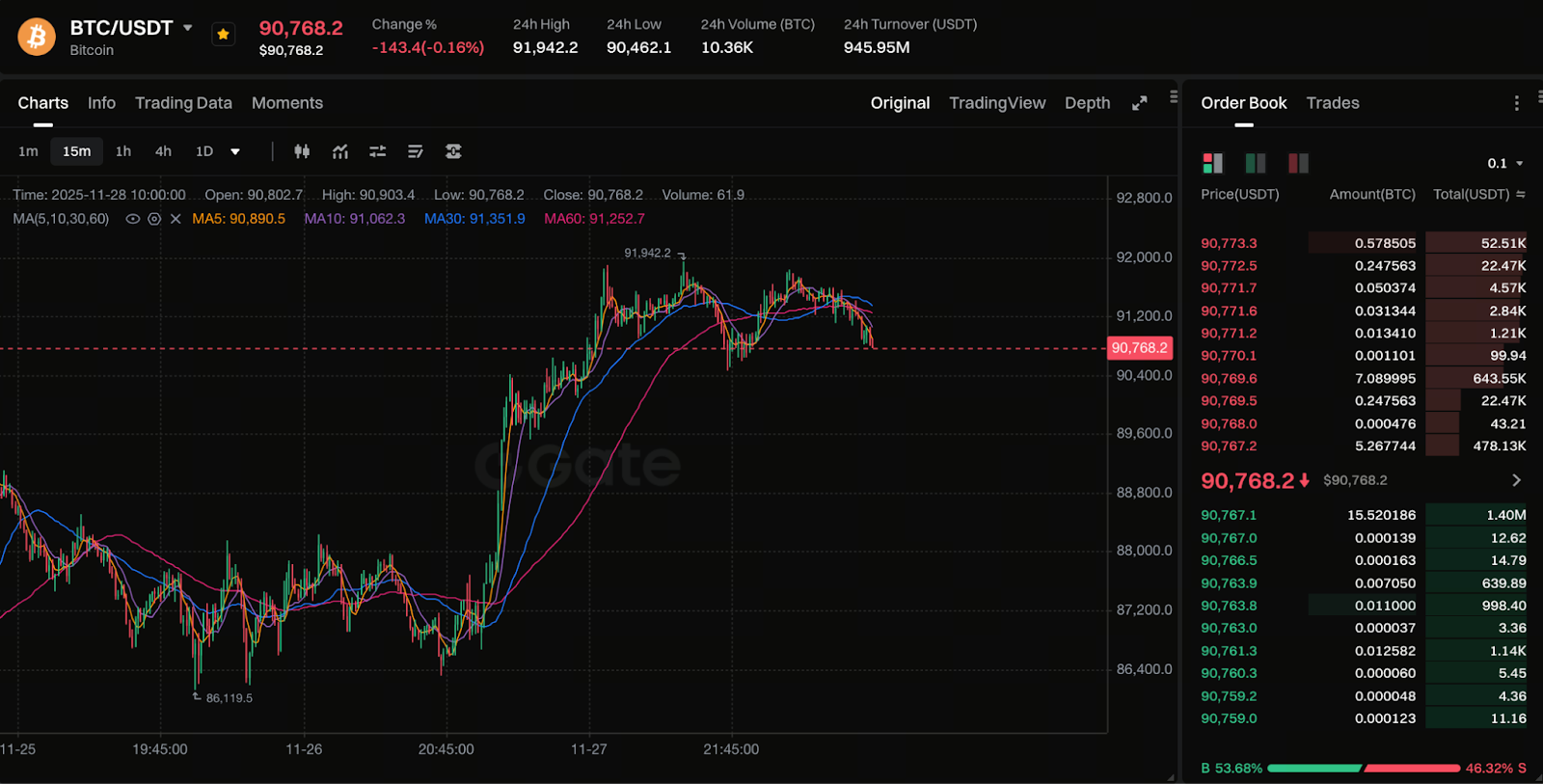
Image: https://www.gate.com/trade/BTC_USDT

After several weeks of sideways volatility, Bitcoin staged a powerful comeback by rebounding quickly from its recent low near $80,000 and repeatedly testing and holding above the $90,000 threshold. This surge sparked intense market debate: Is the bull market about to reignite?

Meanwhile, “Did you buy at the bottom?” has become the most common question in the community.

To make sense of this rally, we need to break down the changes happening in the market from several angles.

Bitcoin Reclaims $90,000: Latest Market Action and Rebound Drivers

Bitcoin surged 8%–12% in just a few days in late November 2025, reaching an intraday high of nearly $91,000 and fully recovering prior losses to set a new rebound peak.

Several core factors fueled this price move:

  • Before the rebound, the market faced persistent selling pressure and waves of panic.
  • Capital flows shifted from panic-driven selling to aggressive buying at lower levels.
  • Long-term holders not only maintained their positions but actually increased their holding periods.

This dynamic triggered a short-term rapid rally, with prices accelerating sharply in a short window.

Three Key Drivers Behind the Rebound

While the rally may seem sudden, it’s driven by clear underlying logic:

1. Improved macro outlook and renewed risk appetite: The market is once again betting on a shift to looser monetary policy, with expectations for increased global liquidity. In this environment, Bitcoin—as a risk asset—typically leads the response.

2. Short squeeze accelerates the move: A large build-up of speculative shorts at lower levels set the stage. As Bitcoin rallied and broke through key resistance, the following unfolded:

  • Short sellers were forced to cover
  • Algorithmic trading systems triggered buybacks
  • Liquidations of leveraged shorts drove prices even higher

The result: a sharp rally that propelled the price upward at an unusually fast pace.

3. Medium- and long-term buyers find value in the current price range: Institutions, long-term holders, and major players increased their positions during the decline, reinforcing the bottom.

Did You Really Buy the Bottom? Insights from Data and Sentiment Analysis

Many investors wonder: “Did I buy at the bottom?” In reality, bottoms are only clear in hindsight. However, a few indicators can help you gauge whether you entered near a bottom:

1. Sentiment hits extreme pessimism: Most investors exit in panic, while long-term capital steps in—typically a sign the bottom is near.

2. On-chain data shows increased concentration of holdings: This means buyers are willing to hold at higher prices rather than waiting for a deeper drop.

3. Large transfers and long-term wallet balances continue to increase: This signals strong conviction buying. If you purchased during a sharp sell-off amid overwhelmingly negative sentiment, you are likely closer to the bottom zone than most investors.

Is the Bull Trend Back? Key Resistance and Future Risks

Despite clear positive signals, confirming a full bull market recovery requires watching critical levels and conditions.

Key resistance: The $95,000 to $100,000 zone is a major psychological barrier and a dense cluster of prior positions. Only a decisive break above this range would open the door to higher targets.

Potential risk factors:

  • Negative macro news could quickly cool the market
  • Excessive leverage could trigger renewed volatility
  • Large profit-taking could spark a significant pullback

While the rebound is robust, a confirmed bull market still needs more time and a sustained uptrend.

Investor Strategy: How to Avoid Chasing Highs and Panic Selling

  • Avoid going all-in during periods of extreme optimism
  • Staggered entries are always safer than a single large purchase
  • Set clear take-profit and stop-loss levels
  • Medium- and long-term investors should focus on broader trends rather than short-term swings

If you already bought at lower levels, congratulations on your entry. If you’re still on the sidelines, stay patient—waiting for a pullback or confirmation is much wiser than blindly chasing the rally.

Author: Max
Disclaimer
* The information is not intended to be and does not constitute financial advice or any other recommendation of any sort offered or endorsed by Gate.
* This article may not be reproduced, transmitted or copied without referencing Gate. Contravention is an infringement of Copyright Act and may be subject to legal action.

Related Articles

What is Fartcoin? All You Need to Know About FARTCOIN
Intermediate

What is Fartcoin? All You Need to Know About FARTCOIN

Fartcoin (FARTCOIN) is a representative meme coin within the Solana ecosystem based on an AI-driven narrative. Its core concept originated from an experiment aimed at exploring the "boundaries between AI Agents and humor." More than just a digital asset with social attributes, the project deeply couples absurd humor culture with on-chain financial logic by integrating autonomous AI interaction models.
2026-04-04 22:01:19
Gold Price Forecast for the Next Five Years: 2026–2030 Trend Outlook and Investment Implications, Could It Reach $6,000?
Beginner

Gold Price Forecast for the Next Five Years: 2026–2030 Trend Outlook and Investment Implications, Could It Reach $6,000?

Analyze current gold price trends alongside authoritative five-year forecasts, integrating an evaluation of market risks and opportunities. This gives investors insight into the potential trajectory of gold prices and the main drivers expected to shape the market over the next five years.
2026-03-25 18:13:30
Aster vs Hyperliquid: Which Perp DEX Will Prevail?
Beginner

Aster vs Hyperliquid: Which Perp DEX Will Prevail?

Aster and Hyperliquid are the two representative protocols of the "purpose-built L1 path" within the current decentralized perpetual exchange (Perp DEX) sector. As a pioneer in the field, Hyperliquid has built a deep liquidity moat through its highly mature order book architecture and strong community consensus. Conversely, Aster, as a rising challenger, seeks to leapfrog the competition in high-performance trading through more aggressive multi-chain aggregation logic, private transaction modules, and an underlying execution environment optimized for 2026 market demands.
2026-03-24 11:58:33
AI-Native Settlement Layers: How United Stables Is Building the Next Financial Rail
Beginner

AI-Native Settlement Layers: How United Stables Is Building the Next Financial Rail

Stablecoins were originally designed as dollar substitutes within exchanges, primarily used for asset pricing and trade settlement. As on-chain financial ecosystems have matured, their role has expanded beyond simple payments to include collateral assets, cross-chain liquidity mediums, and unified settlement units. In particular, as AI systems and automated agents begin to participate directly in economic activity, demand has risen sharply for programmable value units capable of instant settlement. This shift is pushing stablecoins toward the role of foundational financial infrastructure.
2026-03-25 03:16:17
Aerodrome Tokenomics: How ve(3,3) Powers Base's Most Profitable DEX
Beginner

Aerodrome Tokenomics: How ve(3,3) Powers Base's Most Profitable DEX

AERO is the native token of Aerodrome Finance, a core decentralized exchange and liquidity protocol in the Base ecosystem. It is primarily used for liquidity incentives and ecosystem operations. veAERO is a governance NFT that users receive by locking AERO, representing both voting power and the right to share protocol revenue. Through a dual track structure of AERO as a utility token and veAERO as a governance credential, Aerodrome separates liquidity usage value from long term governance power, allowing participants to act as liquidity providers, governance decision makers, and revenue sharers within the same system.
2026-03-25 06:40:31
The ve(3,3) Flywheel Explained: How AERO Tokenomics Powers Aerodrome’s DeFi Economy
Beginner

The ve(3,3) Flywheel Explained: How AERO Tokenomics Powers Aerodrome’s DeFi Economy

In the competition for DeFi liquidity, high-inflation mining alone is no longer enough to build lasting advantages. Aerodrome applies the ve(3,3) economic model to redesign token emissions, voting mechanisms, and revenue distribution, creating a liquidity flywheel centered on governance and cash flow. This article examines AERO tokenomics, the veAERO locking mechanism, and protocol revenue models to explain how Aerodrome builds a sustainable DeFi economic system.
2026-03-25 06:41:58





