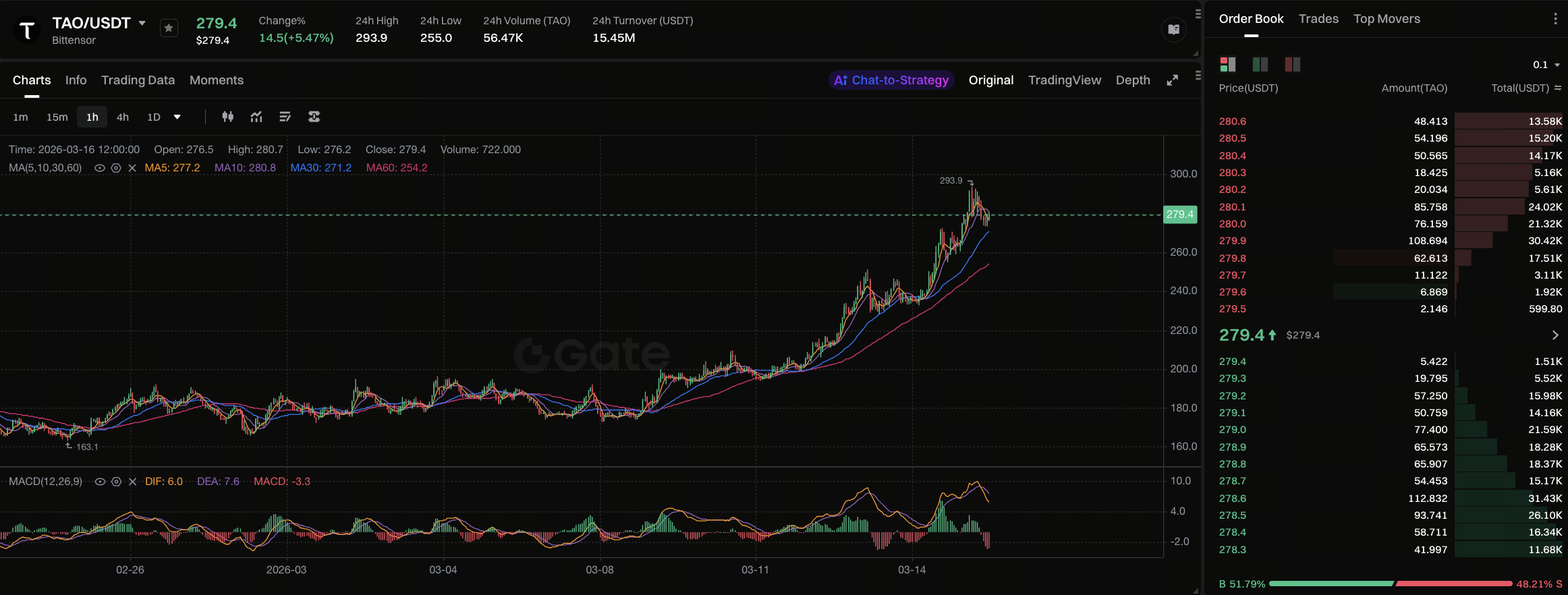
 Image: Gate Market Page
As AI narratives gain renewed momentum, the Bittensor ecosystem has become a central focus in the market.
According to data, TAO reached a new interim high of $293.8 on the morning of March 16, 2026, rising more than 46% since the beginning of the month. This performance places TAO among the leading gainers in the AI + Crypto sector.
TAO’s price rally is not the result of a single event, but rather a combination of several factors, including:
- Increased liquidity following exchange listings
- Growing attention to Bittensor’s subnet economic model
- The resurgence of AI narratives in the crypto market
With the convergence of AI and blockchain emerging as a key industry trend, many investors now regard Bittensor as a major project representing decentralized AI networks.
Market Impact of Upbit Listing
TAO’s listing on Korea’s leading exchange, Upbit, is widely seen as a primary catalyst for this price movement. The Korean market has long maintained high activity in crypto asset trading, and projects often attract new trading volume and capital after listing on Korean exchanges. Historically, several projects have experienced interim price rallies following their debut in Korea, making TAO’s post-listing performance consistent with established market patterns.
Additionally, exchange listings typically spark renewed market discussions, prompting more investors to re-examine Bittensor’s technical architecture and economic model.
Subnet Token Rally: Ecosystem Capital Expansion
Alongside TAO’s surge, several Bittensor subnet project tokens have recorded significant gains.
Recent standout subnets include:
- Chutes: Up approximately 40.1% in the past 7 days
- Templar: Up approximately 194% in the past 7 days
- TARGON: Up approximately 60.3% in the past 7 days
- Affine: Up approximately 42.7% in the past 7 days
Templar’s nearly twofold increase has made it one of the most closely watched subnet projects. This pattern is common in crypto ecosystems: when a foundational asset (like TAO) rises, capital often flows into other assets within the ecosystem, resulting in an ecosystem-wide rally.
For Bittensor, the rise in subnet tokens also signals a shift in investor focus toward the intrinsic value of the AI task market, rather than just the network’s base token.
Note: This article does not constitute investment advice. Tokens with substantial gains are often susceptible to rapid corrections. Please trade with caution and be mindful of risk.
What Is a Bittensor Subnet? AI Market Mechanism Explained
 Image: Bittensor Official Website
To understand this market movement, it’s essential to grasp Bittensor’s core structure—the subnet. In the Bittensor network, each subnet operates as an independent AI market. These markets specialize in producing specific types of AI digital goods, including:
- AI model inference capabilities
- AI search capabilities
- AI data processing
- AI content generation
Participants within each subnet generally fall into two categories:
- Miner Nodes: Provide AI model capabilities, such as generating answers or performing inference.
- Validator Nodes: Evaluate the quality of model outputs and allocate rewards based on performance.
This mechanism establishes a competitive market incentive structure: higher model quality leads to greater rewards, which enhances overall network performance.
Bittensor’s objective is not simply to create an AI model, but to build a decentralized AI economic network.
How Dynamic TAO (dTAO) Upgrades Reshape Token Economics
One of the most significant recent upgrades in the Bittensor ecosystem is the Dynamic TAO (dTAO) mechanism.
Previously, the Bittensor network primarily used TAO as its reward and value carrier. Following the dTAO upgrade, each subnet can now issue its own independent token, with market prices reflecting the value of its AI services.
This shift brings several key changes:
-
Greater Independence for Subnet Economies
Each subnet can design its own incentive mechanism to better suit specific AI tasks.
Examples include:
- Inference subnets
- Data subnets
- AI search subnets
The value of different tasks is directly reflected in token prices.
-
More Precise Capital Allocation
With the dTAO mechanism, investors are no longer limited to TAO. They can invest in a specific subnet token based on their assessment of the AI sector.
This evolution positions Bittensor as an AI industry marketplace rather than a single protocol.
-
TAO Remains the Network’s Core Asset
While subnets may have independent tokens, TAO continues to play a central role in the network.
TAO remains:
- The foundational asset for network incentives
- The primary value anchor for subnet economies
- The reserve asset of the Bittensor ecosystem
As the number of subnets grows, TAO may take on the role of an AI market reserve asset within the ecosystem.
Bittensor’s Position in the AI + Crypto Sector
In recent years, the convergence of AI and blockchain has become a major theme in the Web3 space. Bittensor’s positioning is closest to an AI model market network.
Under this model, Bittensor aims to build a global, open AI training and inference marketplace.
Any developer can:
- Deploy AI models
- Provide computing power
- Earn network rewards
If this model succeeds, Bittensor could become a critical infrastructure for decentralized AI compute markets.
Potential Development Paths for the Bittensor Ecosystem
As AI and crypto technologies continue to merge, several important trends may emerge within the Bittensor ecosystem.
Continued Growth in AI Subnet Numbers
As more developers participate, the ecosystem may see an increasing number of specialized subnets, such as:
- AI search subnets
- AI data labeling subnets
- AI Agent inference subnets
The expansion of subnet numbers will further enrich Bittensor’s ecosystem.
Integration of AI Agents and Subnet Ecosystem
With the rise of AI Agent concepts, more automated AI systems will require access to external model capabilities. Bittensor subnets may become essential infrastructure for AI Agents to access model capabilities.
If a sufficient number of subnets are established, the Bittensor network may gradually develop into an AI goods trading marketplace. In this market, different types of AI services will have distinct prices and demand.
Conclusion
TAO’s latest rally is more than a short-term market event—it signals growing interest in decentralized AI networks. With the implementation of the dTAO mechanism, Bittensor is systematically building an ecosystem of AI service markets composed of multiple subnets.
If this model continues to attract developers and capital, Bittensor could secure a prominent position in the future competition for AI infrastructure.







