Bitcoin Surges Toward $94,000 — Why the Fed’s Hawkish Stance Could Be the Biggest Risk to the Crypto Rally

Beginner
Quick Reads
Last Updated 2026-03-27 01:43:38
Reading Time: 1m
Bitcoin has recently soared to approximately $94,000. However, hawkish signals from the Federal Reserve could restrain the bullish momentum in the cryptocurrency market. This article offers a comprehensive examination of the policy risks and future market prospects.

Why Did Bitcoin Powerfully Return to $94,000?
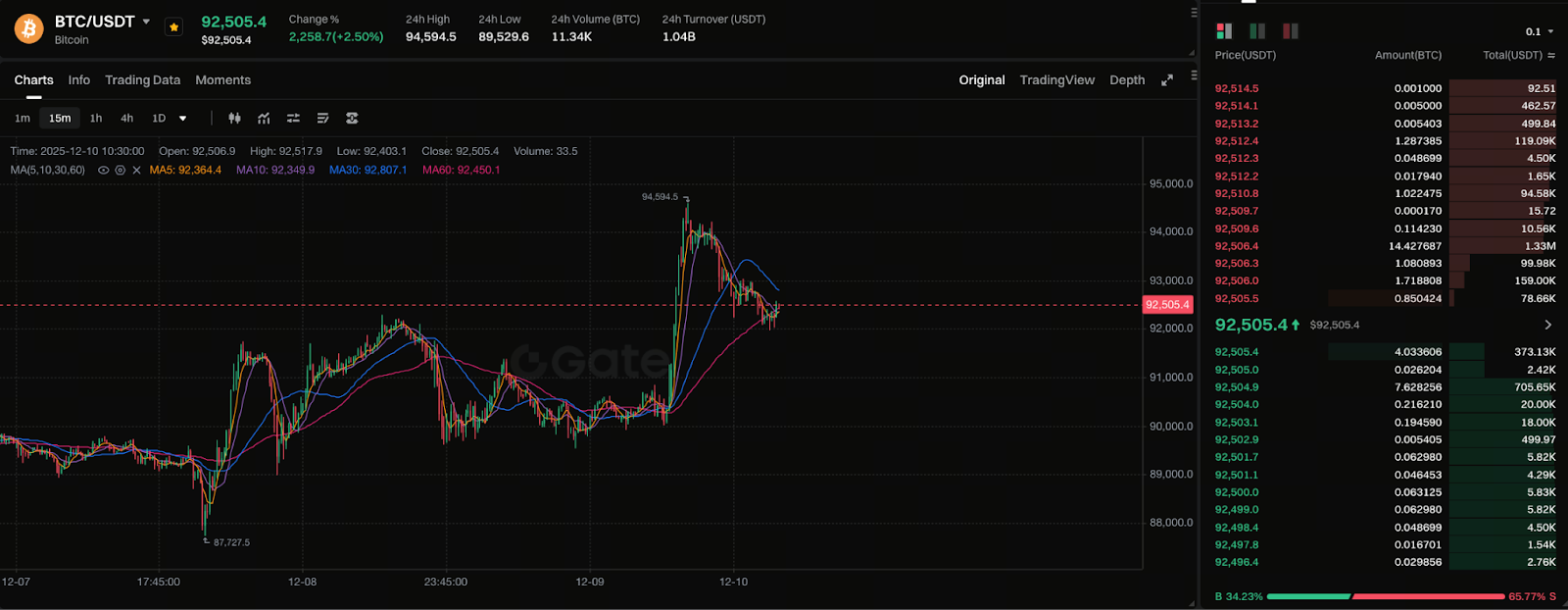

Chart: https://www.gate.com/trade/BTC_USDT

After a period of volatility and correction, Bitcoin has regained momentum, swiftly rebounding from below $90,000 and surging to test the $94,000 threshold. This rally is not just a simple emotional rebound; it’s driven by a combination of multiple factors.

Rate Cut Expectations Are Heating Up Again: Recent macro data points to a cooling economy, prompting the market to revisit the possibility of a “monetary policy pivot.” As an asset highly sensitive to liquidity, Bitcoin is naturally the first target for capital seeking speculative opportunities.

Spot Capital Is Returning: After consecutive adjustments, some medium- and long-term funds have gradually accumulated positions in the $88,000–$92,000 range, solidifying buying interest at lower levels. This increase in “bottom support” is a key driver for price advances.

Rapid Sentiment Recovery: As Bitcoin repeatedly held above $90,000, renewed confidence in an ongoing bull market has emerged. Both speculative and trend-driven capital have entered the market, amplifying the rally’s magnitude.

What Does a “Hawkish Rate Cut” Actually Mean?

Many investors see the term “rate cut” and instinctively view it as a major tailwind for the crypto market. In reality:

A rate cut does not automatically equal true liquidity easing.

The defining features of a “hawkish rate cut” are:

  • Modest rate reduction: The Federal Reserve may only make a symbolic, minor adjustment, not a return to aggressive monetary expansion.
  • Prolonged high interest rates: Policymakers emphasize that “high rates will remain for an extended period,” dampening overall risk appetite.
  • Tight balance sheet: Even if rates are cut, ongoing quantitative tightening means the actual money supply may not increase meaningfully.

For Bitcoin, this means price gains are primarily “expectation-driven” rather than fueled by real capital inflows. If those expectations are invalidated, corrections tend to be swift.

Bitcoin’s True Position in the Current Market Cycle

From a cycle perspective, Bitcoin is now in a classic “post-halving consolidation and uplift stage”:

  • The halving has occurred
  • The market has experienced its first emotional peak
  • It has entered a phase of high-level, wide-range turnover
  • Awaiting confirmation of genuine liquidity to trigger the main uptrend

This stage is characterized by repeated surges and pullbacks, extreme sentiment polarization, and intense battles between bulls and bears.

Bulls believe the bull market is still in its early phase, viewing any pullback as a “golden buying opportunity.” Bears argue that the macro environment does not support sustained strength in risk assets.

Key Technical Zones and Market Psychology

Technically, Bitcoin is now in a critical “decision zone”:

  • Major resistance above: $94,000–$100,000
  • Core support below: $88,000–$90,000

If $88,000 holds, the medium-term uptrend remains intact. If this level is breached, a retracement to the deeper support band at $82,000–$85,000 is possible.

Meanwhile, $100,000 is both a technical resistance and a psychological ceiling for global investors. Without genuine policy easing, a clean breakout is unlikely.

Optimal Strategies for Retail Investors Right Now

In today’s environment—marked by “uncertain policy and high-level volatility”—the top priority is not predicting market direction, but managing risk and pacing trades:

  • Long-term investors: Use a dollar-cost averaging approach to avoid going all-in at elevated prices.
  • Short- and medium-term traders: Set strict stop-losses and stay alert to sharp moves triggered by macro headlines.
  • Asset allocation: Maintaining a balanced mix of stablecoins, Bitcoin, and select mainstream assets is a prudent strategy at this stage.
Author: Max
Disclaimer
* The information is not intended to be and does not constitute financial advice or any other recommendation of any sort offered or endorsed by Gate.
* This article may not be reproduced, transmitted or copied without referencing Gate. Contravention is an infringement of Copyright Act and may be subject to legal action.

Related Articles

What is Fartcoin? All You Need to Know About FARTCOIN
Intermediate

What is Fartcoin? All You Need to Know About FARTCOIN

Fartcoin (FARTCOIN) is a representative meme coin within the Solana ecosystem based on an AI-driven narrative. Its core concept originated from an experiment aimed at exploring the "boundaries between AI Agents and humor." More than just a digital asset with social attributes, the project deeply couples absurd humor culture with on-chain financial logic by integrating autonomous AI interaction models.
2026-04-04 22:01:19
Gold Price Forecast for the Next Five Years: 2026–2030 Trend Outlook and Investment Implications, Could It Reach $6,000?
Beginner

Gold Price Forecast for the Next Five Years: 2026–2030 Trend Outlook and Investment Implications, Could It Reach $6,000?

Analyze current gold price trends alongside authoritative five-year forecasts, integrating an evaluation of market risks and opportunities. This gives investors insight into the potential trajectory of gold prices and the main drivers expected to shape the market over the next five years.
2026-03-25 18:13:30
Aster vs Hyperliquid: Which Perp DEX Will Prevail?
Beginner

Aster vs Hyperliquid: Which Perp DEX Will Prevail?

Aster and Hyperliquid are the two representative protocols of the "purpose-built L1 path" within the current decentralized perpetual exchange (Perp DEX) sector. As a pioneer in the field, Hyperliquid has built a deep liquidity moat through its highly mature order book architecture and strong community consensus. Conversely, Aster, as a rising challenger, seeks to leapfrog the competition in high-performance trading through more aggressive multi-chain aggregation logic, private transaction modules, and an underlying execution environment optimized for 2026 market demands.
2026-03-24 11:58:33
AI-Native Settlement Layers: How United Stables Is Building the Next Financial Rail
Beginner

AI-Native Settlement Layers: How United Stables Is Building the Next Financial Rail

Stablecoins were originally designed as dollar substitutes within exchanges, primarily used for asset pricing and trade settlement. As on-chain financial ecosystems have matured, their role has expanded beyond simple payments to include collateral assets, cross-chain liquidity mediums, and unified settlement units. In particular, as AI systems and automated agents begin to participate directly in economic activity, demand has risen sharply for programmable value units capable of instant settlement. This shift is pushing stablecoins toward the role of foundational financial infrastructure.
2026-03-25 03:16:17
Aerodrome Tokenomics: How ve(3,3) Powers Base's Most Profitable DEX
Beginner

Aerodrome Tokenomics: How ve(3,3) Powers Base's Most Profitable DEX

AERO is the native token of Aerodrome Finance, a core decentralized exchange and liquidity protocol in the Base ecosystem. It is primarily used for liquidity incentives and ecosystem operations. veAERO is a governance NFT that users receive by locking AERO, representing both voting power and the right to share protocol revenue. Through a dual track structure of AERO as a utility token and veAERO as a governance credential, Aerodrome separates liquidity usage value from long term governance power, allowing participants to act as liquidity providers, governance decision makers, and revenue sharers within the same system.
2026-03-25 06:40:31
Hybrid Collateral Stablecoins: Inside United Stables' Stability and Yield Architecture
Beginner

Hybrid Collateral Stablecoins: Inside United Stables' Stability and Yield Architecture

In the early stages of the crypto market, traditional stablecoins mainly relied on single-reserve or single-collateral models. Their primary focus was price stability and payment convenience, which allowed them to become foundational tools for on-chain trading and capital flows. As the market has entered a more mature financial phase, however, this structure has begun to reveal limitations, including high concentration risk and the difficulty of balancing liquidity with yield. These constraints have driven the evolution toward multi-layer collateral and portfolio-based designs, such as the dual-layer hybrid collateral architecture proposed by United Stables, which seeks to redefine the underlying logic of stable assets.
2026-03-25 03:17:39





