Bitcoin Price Prediction: BTC Drops Below $100K Amid $797M ETF Outflows but Long-Term Outlook Remains Bullish

Last Updated 2026-03-28 01:24:27
Reading Time: 1m
Recently, U.S. spot Bitcoin and Ethereum ETFs have seen substantial capital outflows. Data from SoSoValue shows that net outflows on Tuesday totaled $797 million. Spot Bitcoin ETFs alone recorded outflows of $578 million. This marked the highest single-day outflow since August 1.

Bitcoin ETFs Mark Fifth Straight Day of Outflows

The U.S. market is once again grappling with renewed panic. Data from SoSoValue shows that U.S. spot Bitcoin and Ethereum ETFs recorded a combined net outflow of $797 million on Tuesday—the largest institutional retreat in nearly two months. Spot Bitcoin ETFs led the outflows with $578 million, the highest single-day amount since August 1.

Fidelity’s FBTC saw $357 million exit, Ark & 21Shares’ ARKB shed $128 million, and Grayscale’s GBTC lost $48.9 million. In total, seven Bitcoin funds have posted net outflows for five consecutive days, amounting to $1.9 billion.

Institutional Capital Repositioning

BTC Markets analyst Rachael Lucas emphasized that five days of outflows signal institutional rebalancing rather than a market pause, driven by macroeconomic pressures. She highlighted that Fed Chair Jerome Powell’s hawkish stance last month dashed hopes for a December rate cut, pushing the U.S. Dollar Index (DXY) back above 100 and heightening risk aversion. With tech stocks and crypto closely linked, corrections in the AI sector have further amplified Bitcoin’s volatility.

The Fear & Greed Index plunged to 21 (Extreme Fear) on Tuesday, down from 42 just a day prior. Derek Lim, Head of Research at Caladan, noted that ETF outflows intensified this fear, while escalating U.S. government shutdown risks compounded market uncertainty.

Market Correction Retains Healthy Structure

Despite short-term pressure, Lim maintains that the overall structure reflects a healthy correction. Although postponing rate cuts is a short-term headwind for risk assets, the broader macro outlook remains intact. The market is nearing the end of quantitative tightening (QT), and rate reductions are inevitable. Bitcoin has retraced about 21.5% from its $125,000 peak to $99,000—a moderate pullback compared to the 31% correction in Q1. Lim characterizes this phase as a necessary shakeout.

Short-Term Bitcoin Price Outlook

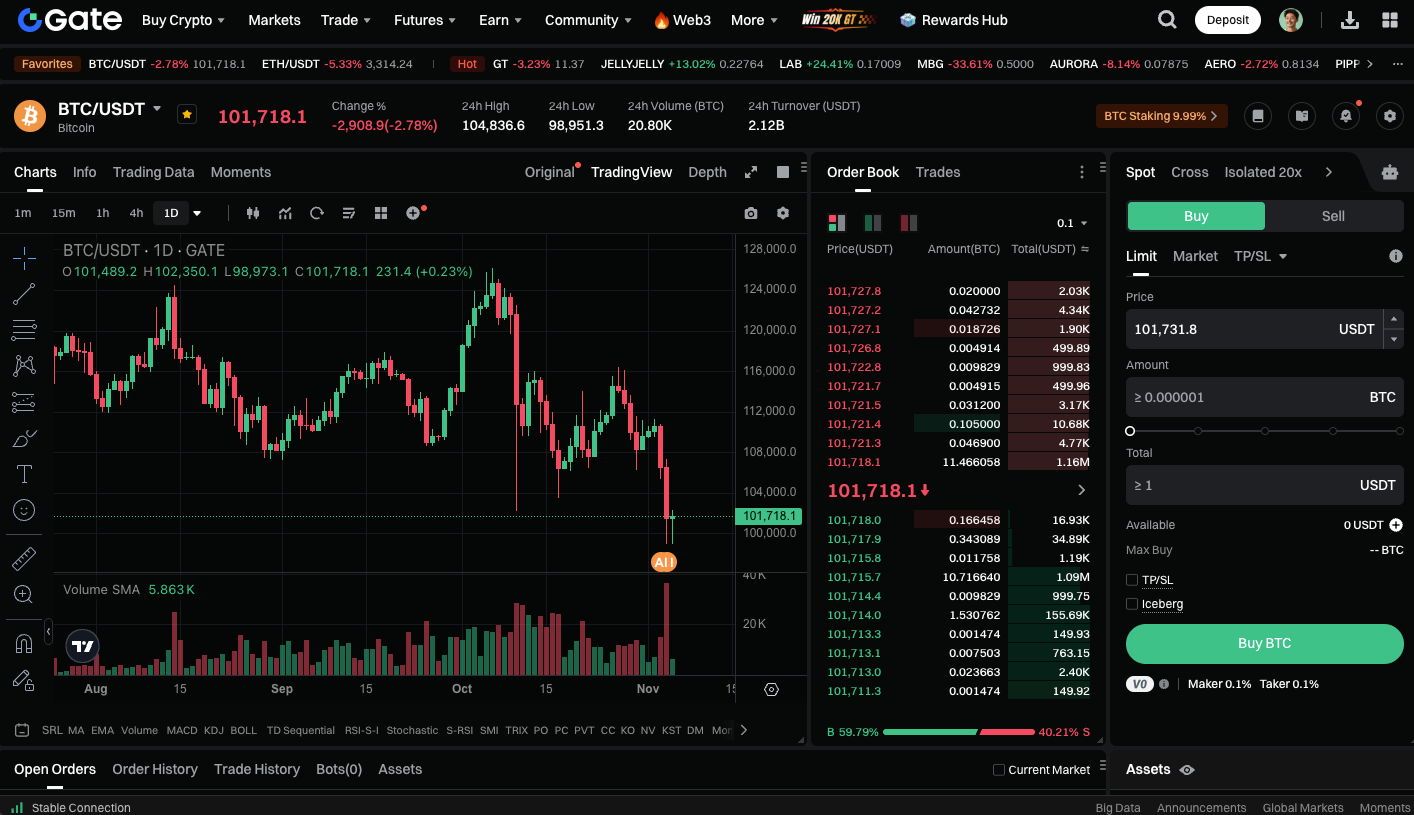
At the time of writing, Bitcoin had dropped roughly 6.5% in the past 24 hours to around $99,000 before rebounding. Technically, if BTC breaks below the $99,000 support again, it could retest the $95,000 zone. A stable base here may pave the way for Bitcoin to challenge the $110,000–$115,000 range as sentiment improves.

Start trading BTC spot instantly: https://www.gate.com/trade/BTC_USDT
Conclusion

This downturn reflects institutional capital rotation and evolving macro policy expectations—not a long-term trend reversal. As the Fed’s monetary stance gradually eases and dollar strength moderates, Bitcoin remains poised to resume its uptrend. For long-term investors, this volatility could present a strategic entry point.

Author: Allen
Disclaimer
* The information is not intended to be and does not constitute financial advice or any other recommendation of any sort offered or endorsed by Gate.
* This article may not be reproduced, transmitted or copied without referencing Gate. Contravention is an infringement of Copyright Act and may be subject to legal action.

Related Articles

What is Fartcoin? All You Need to Know About FARTCOIN
Intermediate

What is Fartcoin? All You Need to Know About FARTCOIN

Fartcoin (FARTCOIN) is a representative meme coin within the Solana ecosystem based on an AI-driven narrative. Its core concept originated from an experiment aimed at exploring the "boundaries between AI Agents and humor." More than just a digital asset with social attributes, the project deeply couples absurd humor culture with on-chain financial logic by integrating autonomous AI interaction models.
2026-04-04 22:01:19
Gold Price Forecast for the Next Five Years: 2026–2030 Trend Outlook and Investment Implications, Could It Reach $6,000?
Beginner

Gold Price Forecast for the Next Five Years: 2026–2030 Trend Outlook and Investment Implications, Could It Reach $6,000?

Analyze current gold price trends alongside authoritative five-year forecasts, integrating an evaluation of market risks and opportunities. This gives investors insight into the potential trajectory of gold prices and the main drivers expected to shape the market over the next five years.
2026-03-25 18:13:30
Aster vs Hyperliquid: Which Perp DEX Will Prevail?
Beginner

Aster vs Hyperliquid: Which Perp DEX Will Prevail?

Aster and Hyperliquid are the two representative protocols of the "purpose-built L1 path" within the current decentralized perpetual exchange (Perp DEX) sector. As a pioneer in the field, Hyperliquid has built a deep liquidity moat through its highly mature order book architecture and strong community consensus. Conversely, Aster, as a rising challenger, seeks to leapfrog the competition in high-performance trading through more aggressive multi-chain aggregation logic, private transaction modules, and an underlying execution environment optimized for 2026 market demands.
2026-03-24 11:58:33
AI-Native Settlement Layers: How United Stables Is Building the Next Financial Rail
Beginner

AI-Native Settlement Layers: How United Stables Is Building the Next Financial Rail

Stablecoins were originally designed as dollar substitutes within exchanges, primarily used for asset pricing and trade settlement. As on-chain financial ecosystems have matured, their role has expanded beyond simple payments to include collateral assets, cross-chain liquidity mediums, and unified settlement units. In particular, as AI systems and automated agents begin to participate directly in economic activity, demand has risen sharply for programmable value units capable of instant settlement. This shift is pushing stablecoins toward the role of foundational financial infrastructure.
2026-03-25 03:16:17
Aerodrome Tokenomics: How ve(3,3) Powers Base's Most Profitable DEX
Beginner

Aerodrome Tokenomics: How ve(3,3) Powers Base's Most Profitable DEX

AERO is the native token of Aerodrome Finance, a core decentralized exchange and liquidity protocol in the Base ecosystem. It is primarily used for liquidity incentives and ecosystem operations. veAERO is a governance NFT that users receive by locking AERO, representing both voting power and the right to share protocol revenue. Through a dual track structure of AERO as a utility token and veAERO as a governance credential, Aerodrome separates liquidity usage value from long term governance power, allowing participants to act as liquidity providers, governance decision makers, and revenue sharers within the same system.
2026-03-25 06:40:31
The ve(3,3) Flywheel Explained: How AERO Tokenomics Powers Aerodrome’s DeFi Economy
Beginner

The ve(3,3) Flywheel Explained: How AERO Tokenomics Powers Aerodrome’s DeFi Economy

In the competition for DeFi liquidity, high-inflation mining alone is no longer enough to build lasting advantages. Aerodrome applies the ve(3,3) economic model to redesign token emissions, voting mechanisms, and revenue distribution, creating a liquidity flywheel centered on governance and cash flow. This article examines AERO tokenomics, the veAERO locking mechanism, and protocol revenue models to explain how Aerodrome builds a sustainable DeFi economic system.
2026-03-25 06:41:58





