Bitcoin Price Prediction: BlackRock Holds Over 662,000 BTC as Institutional Growth Sparks Decentralization Debate

Last Updated 2026-03-29 15:59:56
Reading Time: 1m
The world’s largest asset management firm now manages more than 660,000 BTC. As a result, Bitcoin’s decentralized ethos is facing new challenges. The market appears to be shifting toward a hybrid model: while decentralization is preserved at the protocol layer, significant capital is increasingly directed toward ETFs and institutional platforms.

BlackRock’s Bitcoin Strategy

Since its debut on January 11, 2024, IBIT has shattered ETF growth records, reaching $72.4 billion in assets under management in just 341 trading days—far surpassing the pace set by gold ETFs in their heyday. This extraordinary momentum not only highlights the rapid adoption of Bitcoin by institutional investors, but also marks a clear evolution in financial market attitudes toward digital assets. The focus has shifted from the question of whether to invest to determining the optimal allocation.

BlackRock positions Bitcoin as a long-term asset allocation vehicle, seeking equilibrium between volatility and scarcity. The firm recommends that investors allocate 1% to 2% of a traditional 60/40 stock-bond portfolio to Bitcoin, aiming to enhance portfolio diversification and bolster resilience against inflation.

Challenges to Bitcoin’s Decentralization Ethos

Bitcoin was conceived as a counter to the centralization prevalent in traditional finance. Yet, with the world’s largest asset manager now holding over 660,000 BTC, the inherent tension between decentralization and institutional concentration has come to the forefront. While Coinbase Custody provides secure storage, insurance and compliance for these holdings, most investors are still exposed to Bitcoin through centralized channels.

This dynamic lowers the entry barrier for participants but also draws criticism for potentially undermining Bitcoin’s core principle of decentralization. The market appears to be gravitating toward a hybrid model. Decentralization serves as the foundational layer, while large-scale capital is primarily funneled through ETFs and institutional platforms.

Market Impact and Future Outlook

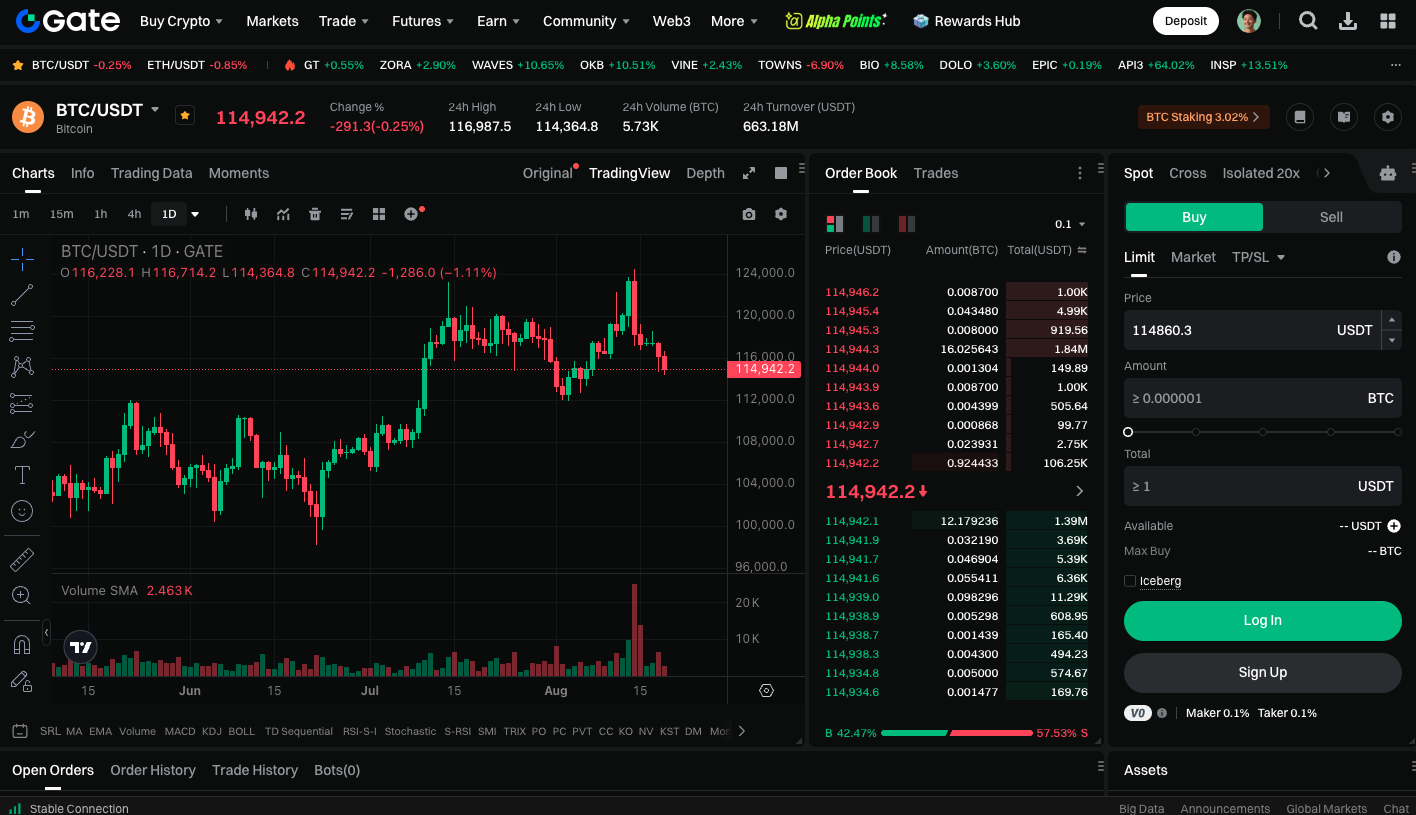
Market forces are currently putting short-term pressure on Bitcoin prices. If the $115,000 support level holds, a rebound may follow. If selling pressure intensifies, Bitcoin will likely test even lower support thresholds.

At the same time, the explosive growth of ETFs demonstrates an unstoppable wave of institutionalization. ETF issuers such as VanEck have projected that Bitcoin could approach $180,000 in 2025. This projection aligns with BlackRock’s aggressive accumulation strategy. However, some academics warn that excessive financialization could introduce risks from traditional markets, including flash crashes triggered by algorithmic trading or liquidity imbalances in ETFs—potentially shifting Bitcoin’s volatility drivers from retail sentiment to systemic risk factors.

To start BTC spot trading, visit: https://www.gate.com/trade/BTC_USDT
Conclusion

Bitcoin is at a decisive crossroads. On one side, institutional momentum is cementing its legitimacy in mainstream finance; on the other, its fundamental ethos of decentralization faces dilution. For investors, this moment represents both risk and a once-in-a-generation opportunity.

Author: Allen
Disclaimer
* The information is not intended to be and does not constitute financial advice or any other recommendation of any sort offered or endorsed by Gate.
* This article may not be reproduced, transmitted or copied without referencing Gate. Contravention is an infringement of Copyright Act and may be subject to legal action.

Related Articles

What is Fartcoin? All You Need to Know About FARTCOIN
Intermediate

What is Fartcoin? All You Need to Know About FARTCOIN

Fartcoin (FARTCOIN) is a representative meme coin within the Solana ecosystem based on an AI-driven narrative. Its core concept originated from an experiment aimed at exploring the "boundaries between AI Agents and humor." More than just a digital asset with social attributes, the project deeply couples absurd humor culture with on-chain financial logic by integrating autonomous AI interaction models.
2026-04-04 22:01:19
Gold Price Forecast for the Next Five Years: 2026–2030 Trend Outlook and Investment Implications, Could It Reach $6,000?
Beginner

Gold Price Forecast for the Next Five Years: 2026–2030 Trend Outlook and Investment Implications, Could It Reach $6,000?

Analyze current gold price trends alongside authoritative five-year forecasts, integrating an evaluation of market risks and opportunities. This gives investors insight into the potential trajectory of gold prices and the main drivers expected to shape the market over the next five years.
2026-03-25 18:13:30
Aster vs Hyperliquid: Which Perp DEX Will Prevail?
Beginner

Aster vs Hyperliquid: Which Perp DEX Will Prevail?

Aster and Hyperliquid are the two representative protocols of the "purpose-built L1 path" within the current decentralized perpetual exchange (Perp DEX) sector. As a pioneer in the field, Hyperliquid has built a deep liquidity moat through its highly mature order book architecture and strong community consensus. Conversely, Aster, as a rising challenger, seeks to leapfrog the competition in high-performance trading through more aggressive multi-chain aggregation logic, private transaction modules, and an underlying execution environment optimized for 2026 market demands.
2026-03-24 11:58:33
AI-Native Settlement Layers: How United Stables Is Building the Next Financial Rail
Beginner

AI-Native Settlement Layers: How United Stables Is Building the Next Financial Rail

Stablecoins were originally designed as dollar substitutes within exchanges, primarily used for asset pricing and trade settlement. As on-chain financial ecosystems have matured, their role has expanded beyond simple payments to include collateral assets, cross-chain liquidity mediums, and unified settlement units. In particular, as AI systems and automated agents begin to participate directly in economic activity, demand has risen sharply for programmable value units capable of instant settlement. This shift is pushing stablecoins toward the role of foundational financial infrastructure.
2026-03-25 03:16:17
ASTER Tokenomics: Buybacks, Burns, and Staking as the Value Foundation of ASTER in 2026
Beginner

ASTER Tokenomics: Buybacks, Burns, and Staking as the Value Foundation of ASTER in 2026

ASTER is the native equity and governance token of the Aster ecosystem, with its core value built upon a radical "Deflationary Engine." Beyond serving as a governance tool, ASTER integrates multiple utilities including staking rewards, trading fee discounts, and liquidity incentives. Through its deep integration with the upcoming dedicated Layer 1 mainnet, it enables direct value capture from protocol cash flow to token holders.
2026-03-25 07:38:07
Hybrid Collateral Stablecoins: Inside United Stables' Stability and Yield Architecture
Beginner

Hybrid Collateral Stablecoins: Inside United Stables' Stability and Yield Architecture

In the early stages of the crypto market, traditional stablecoins mainly relied on single-reserve or single-collateral models. Their primary focus was price stability and payment convenience, which allowed them to become foundational tools for on-chain trading and capital flows. As the market has entered a more mature financial phase, however, this structure has begun to reveal limitations, including high concentration risk and the difficulty of balancing liquidity with yield. These constraints have driven the evolution toward multi-layer collateral and portfolio-based designs, such as the dual-layer hybrid collateral architecture proposed by United Stables, which seeks to redefine the underlying logic of stable assets.
2026-03-25 03:17:39