Blockchain was originally designed around complete transparency. This allowed all transactions and data to be publicly verifiable, forming a trustless system. However, as DeFi, on-chain finance, and institutional participation continue to expand, the limitations of full transparency have become increasingly clear.
In traditional financial systems, privacy is essential. Personal assets, trading strategies, and corporate data cannot realistically be fully exposed. As blockchain begins to support more complex economic activity, privacy is no longer optional; it becomes a foundational requirement. As a result, a range of privacy solutions has emerged, gradually forming distinct technical paths.
Industry Positioning and Importance of Zcash, Tornado Cash, and Aztec
Today’s mainstream blockchain privacy solutions can broadly be grouped into three categories: privacy-focused public chains represented by Zcash, mixing protocols represented by Tornado Cash, and privacy Layer2 solutions represented by Aztec.
Each of these paths reflects a different stage of development and a different goal. Privacy public chains attempt to redesign transaction models at the base layer. Mixing protocols add privacy features on top of existing blockchains. Privacy Layer2 solutions aim to provide privacy capabilities across the ecosystem without modifying the underlying chain.
This divergence not only reflects differing technical approaches but also highlights the growing demand for privacy within the industry. Privacy has evolved from simple anonymous transfers to privacy-enabled applications, and now toward programmable privacy infrastructure.
Core Differences Between Zcash, Tornado Cash, and Aztec
From an architectural perspective, these three solutions start from fundamentally different design philosophies. Zcash, as an independent public chain, is built to support anonymous transactions as a cryptocurrency system. Tornado Cash operates as a utility protocol on Ethereum, using pooled funds to obscure transaction links. Aztec, on the other hand, introduces zero-knowledge proofs at the Layer2 level, extending privacy capabilities into the smart contract layer.
From a functional standpoint, Zcash focuses primarily on payment privacy, enabling untraceable transfers. Tornado Cash emphasizes unlinkability by breaking the flow of funds. Aztec goes further by supporting not only private transfers, but also private DeFi, identity systems, and complex on-chain logic.
In terms of implementation, all three rely on zero-knowledge proofs, but in different ways. Zcash integrates zkSNARKs deeply into its protocol, Tornado Cash uses them to validate deposit and withdrawal relationships, while Aztec extends them into general-purpose computation proofs, enabling programmable privacy.
Architecture and Capability Comparison
| Dimension |
Aztec |
Zcash |
Tornado Cash |
| Type |
Privacy Layer2 (zkRollup) |
Privacy Public Chain |
Mixing Protocol |
| Architecture Layer |
Ethereum Layer2 |
Independent Network |
Ethereum Application Layer |
| Privacy Model |
Default privacy with selective disclosure |
Optional shielded addresses |
Mixing to break linkability |
| Core Technology |
zkRollup + zkSNARK |
zkSNARK |
zkSNARK + Mixer |
| Function Scope |
Private smart contracts, DeFi, identity |
Anonymous payments |
Private transfers |
| Programmability |
High |
Low |
Very low |
| Compliance Capability |
Strong (supports proofs) |
Moderate |
Weak |
| Complexity |
Medium |
Medium |
Low |
| Long-Term Positioning |
Privacy infrastructure |
Privacy currency |
Utility protocol |
This comparison makes it clear that Aztec has a much broader capability range. It not only addresses transaction privacy, but also enables developers to build fully featured private applications. In contrast, Zcash and Tornado Cash are more focused, single-purpose solutions.
Compliance and Regulatory Perspective
Privacy technologies have always faced regulatory challenges. Tornado Cash, due to its complete anonymity and lack of control mechanisms, has encountered significant regulatory pressure. Zcash offers transparent address options, but its overall design still leans toward strong privacy.
Aztec takes a different approach by incorporating selective disclosure. This allows users to prove transaction or asset information when necessary. Such a mechanism makes it more compatible with institutional requirements and offers a practical pathway for integrating privacy technology into real-world financial systems.
Looking ahead, privacy solutions are likely to emphasize verifiable privacy rather than complete anonymity.
The Evolution of Privacy Technology
From a historical perspective, these three solutions represent different stages in the evolution of privacy technology. Zcash reflects early exploration into anonymous payments. Tornado Cash introduces privacy tools into public blockchain ecosystems. Aztec advances further by positioning itself as privacy infrastructure.
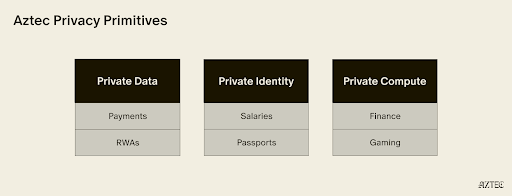
This progression shows how privacy is gradually being integrated into the foundational layers of blockchain. In the future, Web3 applications may include privacy by default rather than relying on add-on tools.
Conclusion
Aztec, Zcash, and Tornado Cash each represent a distinct approach to blockchain privacy. Their differences go beyond technical implementation and extend to their goals and long-term vision.
Zcash offers privacy as a currency, Tornado Cash provides it as a tool, while Aztec aims to build a full privacy computation platform. As applications grow more complex, privacy infrastructure with programmability is likely to have the greatest long-term potential.
For this reason, the direction represented by Aztec may well define the next phase of blockchain privacy evolution.
FAQs
What is the core difference between Aztec and Zcash?
Aztec is a privacy Layer2 built on Ethereum that supports smart contracts and application development. Zcash is an independent public chain primarily designed for anonymous transfers. Their functional scope differs significantly.
Is Tornado Cash still usable?
Tornado Cash smart contracts still exist on-chain. However, their use is subject to varying regulatory restrictions depending on the jurisdiction, so users must assess the risks themselves.
Do all three use zero-knowledge proofs?
Yes, all three use zkSNARK technology, but in different ways. Zcash applies it to private transactions, Tornado Cash uses it to verify deposit and withdrawal relationships, and Aztec extends it to general-purpose computation proofs.
Which privacy solution is more suitable for DeFi?
Aztec is better suited for DeFi because it supports programmable private smart contracts, while Zcash and Tornado Cash have limited capabilities in this area.
Does privacy reduce blockchain transparency?
Privacy solutions typically reduce data visibility. However, zero-knowledge proofs allow systems to remain verifiable without revealing underlying data, which is a central direction in modern privacy technology.







