Arbitrum 2025 Price Prediction: Trends, Catalysts, and Investment Opportunities

Beginner
Quick Reads
Last Updated 2026-03-29 22:27:08
Reading Time: 1m
Will Arbitrum (ARB) break out of its prolonged consolidation phase in 2025? This article delivers an in-depth analysis of the latest ecosystem upgrades, market trends, and on-chain data to provide a thorough outlook on Arbitrum’s 2025 price forecasts and investment strategies—empowering you to capture the next bull market opportunity.

Arbitrum Overview and Ecosystem Position

Arbitrum stands out as a leading Optimistic Rollup solution within the Ethereum ecosystem. Since its debut in 2021, Arbitrum’s high throughput, low fees, and robust security have attracted a wide array of DeFi, NFT, and GameFi projects. As of 2025, the ARB token is actively traded on major global exchanges including Gate, Binance, and Coinbase, with ARB_USDT currently priced around $1.7. Arbitrum commands over 45% of the Rollup sector’s market share, firmly securing its position among the industry leaders.

Key 2025 Developments and Bullish Catalysts

  • Nitro v3 upgrade go-live: In March 2025, Arbitrum launched Nitro v3, further optimizing its validation engine—resulting in a 15% reduction in transaction confirmation times and an additional 20% cut in gas fees.
  • ArbiBridge cross-chain bridge launch: In April, the official rollout of multi-chain swap functionality enabled seamless one-click bridging to major networks like BNB and Polygon, enhancing liquidity and user experience.
  • $50 million ecosystem fund launch: In June, Arbitrum DAO announced a fresh $50 million ecosystem fund focused on supporting Layer 2 gaming DApps and privacy computing projects.

These positive developments should increase trading volumes on-chain and ARB demand, providing solid support for the token over the medium to long term.

On-Chain Data and Market Sentiment Analysis
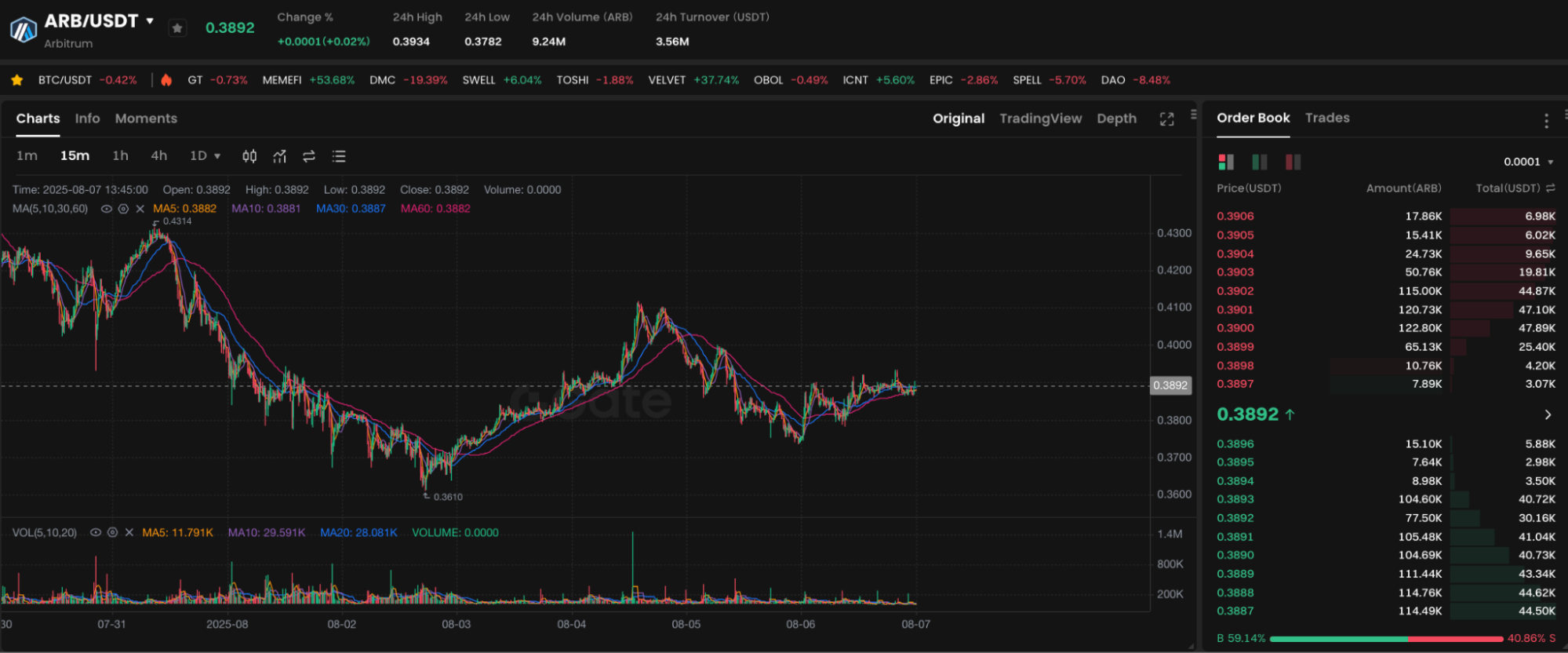

Figure: https://www.gate.com/trade/ARB_USDT

  • Average daily transactions: In June, the network’s average daily on-chain transactions climbed from 800,000 to 950,000, marking an 18.75% month-over-month increase.
  • Active addresses: Over the past 30 days, active addresses grew from 400,000 to 480,000, signaling sustained and growing user demand for Arbitrum applications.
  • Token distribution: The number of whale addresses (holding at least 1,000,000 ARB) rose from 12 to 15, indicating increased participation from institutional investors.
  • Social sentiment: Conversations about Arbitrum on Twitter and Reddit surged by 30% compared to the start of the month, reflecting a notable uptick in positive market sentiment.

Price Forecast Models and Main Drivers

Integrating the above data and market trends, we can outline the following forecast scenarios:

  • Conservative case: If on-chain activity maintains its current pace, ARB’s price could reach $2.2-$2.5 by the end of 2025.
  • Bullish case: Should Nitro v3 trigger exponential growth and if capital continues to flow in, ARB could potentially surge to as high as $3.0.
  • Downside risk: Delays in Ethereum mainnet upgrades, aggressive moves from competitors like Optimism, or tighter regulatory policies could see ARB pull back to the $1.2-$1.4 range.

Key drivers include:

  • Successful technical upgrades (e.g., Nitro v3, ArbiBridge)
  • Expansion of multi-chain ecosystem (new bridges, cross-chain asset integration)
  • Macro and regulatory environment (interest rates, policy changes)
  • Competitive dynamics (progress of other Layer 2 projects)

Investment Risk Disclosure

Disclaimer: Delays in project milestones, intensified competition, or major macro volatility may cause significant price swings.

Strategy suggestions for newcomers:

  • Dollar-cost averaging: Divide capital into 3-5 allocations and buy steadily on dips to reduce cost pressure.
  • Set take-profit and stop-loss levels: Consider reducing holdings if the price hits $2.5; implement stop-loss strategies if the price drops below $1.3.
  • Monitor on-chain indicators: Regularly track average daily transactions, active address counts, and social sentiment to identify potential turning points in market mood.
Author: Max
Disclaimer
* The information is not intended to be and does not constitute financial advice or any other recommendation of any sort offered or endorsed by Gate.
* This article may not be reproduced, transmitted or copied without referencing Gate. Contravention is an infringement of Copyright Act and may be subject to legal action.

Related Articles

What is Fartcoin? All You Need to Know About FARTCOIN
Intermediate

What is Fartcoin? All You Need to Know About FARTCOIN

Fartcoin (FARTCOIN) is a representative meme coin within the Solana ecosystem based on an AI-driven narrative. Its core concept originated from an experiment aimed at exploring the "boundaries between AI Agents and humor." More than just a digital asset with social attributes, the project deeply couples absurd humor culture with on-chain financial logic by integrating autonomous AI interaction models.
2026-04-04 22:01:19
Gold Price Forecast for the Next Five Years: 2026–2030 Trend Outlook and Investment Implications, Could It Reach $6,000?
Beginner

Gold Price Forecast for the Next Five Years: 2026–2030 Trend Outlook and Investment Implications, Could It Reach $6,000?

Analyze current gold price trends alongside authoritative five-year forecasts, integrating an evaluation of market risks and opportunities. This gives investors insight into the potential trajectory of gold prices and the main drivers expected to shape the market over the next five years.
2026-03-25 18:13:30
Aster vs Hyperliquid: Which Perp DEX Will Prevail?
Beginner

Aster vs Hyperliquid: Which Perp DEX Will Prevail?

Aster and Hyperliquid are the two representative protocols of the "purpose-built L1 path" within the current decentralized perpetual exchange (Perp DEX) sector. As a pioneer in the field, Hyperliquid has built a deep liquidity moat through its highly mature order book architecture and strong community consensus. Conversely, Aster, as a rising challenger, seeks to leapfrog the competition in high-performance trading through more aggressive multi-chain aggregation logic, private transaction modules, and an underlying execution environment optimized for 2026 market demands.
2026-03-24 11:58:33
AI-Native Settlement Layers: How United Stables Is Building the Next Financial Rail
Beginner

AI-Native Settlement Layers: How United Stables Is Building the Next Financial Rail

Stablecoins were originally designed as dollar substitutes within exchanges, primarily used for asset pricing and trade settlement. As on-chain financial ecosystems have matured, their role has expanded beyond simple payments to include collateral assets, cross-chain liquidity mediums, and unified settlement units. In particular, as AI systems and automated agents begin to participate directly in economic activity, demand has risen sharply for programmable value units capable of instant settlement. This shift is pushing stablecoins toward the role of foundational financial infrastructure.
2026-03-25 03:16:17
Aerodrome Tokenomics: How ve(3,3) Powers Base's Most Profitable DEX
Beginner

Aerodrome Tokenomics: How ve(3,3) Powers Base's Most Profitable DEX

AERO is the native token of Aerodrome Finance, a core decentralized exchange and liquidity protocol in the Base ecosystem. It is primarily used for liquidity incentives and ecosystem operations. veAERO is a governance NFT that users receive by locking AERO, representing both voting power and the right to share protocol revenue. Through a dual track structure of AERO as a utility token and veAERO as a governance credential, Aerodrome separates liquidity usage value from long term governance power, allowing participants to act as liquidity providers, governance decision makers, and revenue sharers within the same system.
2026-03-25 06:40:31
Hybrid Collateral Stablecoins: Inside United Stables' Stability and Yield Architecture
Beginner

Hybrid Collateral Stablecoins: Inside United Stables' Stability and Yield Architecture

In the early stages of the crypto market, traditional stablecoins mainly relied on single-reserve or single-collateral models. Their primary focus was price stability and payment convenience, which allowed them to become foundational tools for on-chain trading and capital flows. As the market has entered a more mature financial phase, however, this structure has begun to reveal limitations, including high concentration risk and the difficulty of balancing liquidity with yield. These constraints have driven the evolution toward multi-layer collateral and portfolio-based designs, such as the dual-layer hybrid collateral architecture proposed by United Stables, which seeks to redefine the underlying logic of stable assets.
2026-03-25 03:17:39





