Altcoin Month Index Signals Bullish Momentum: Seize the Opportunities of Altseason

Beginner
Quick Reads
Last Updated 2026-04-03 15:39:28
Reading Time: 1m
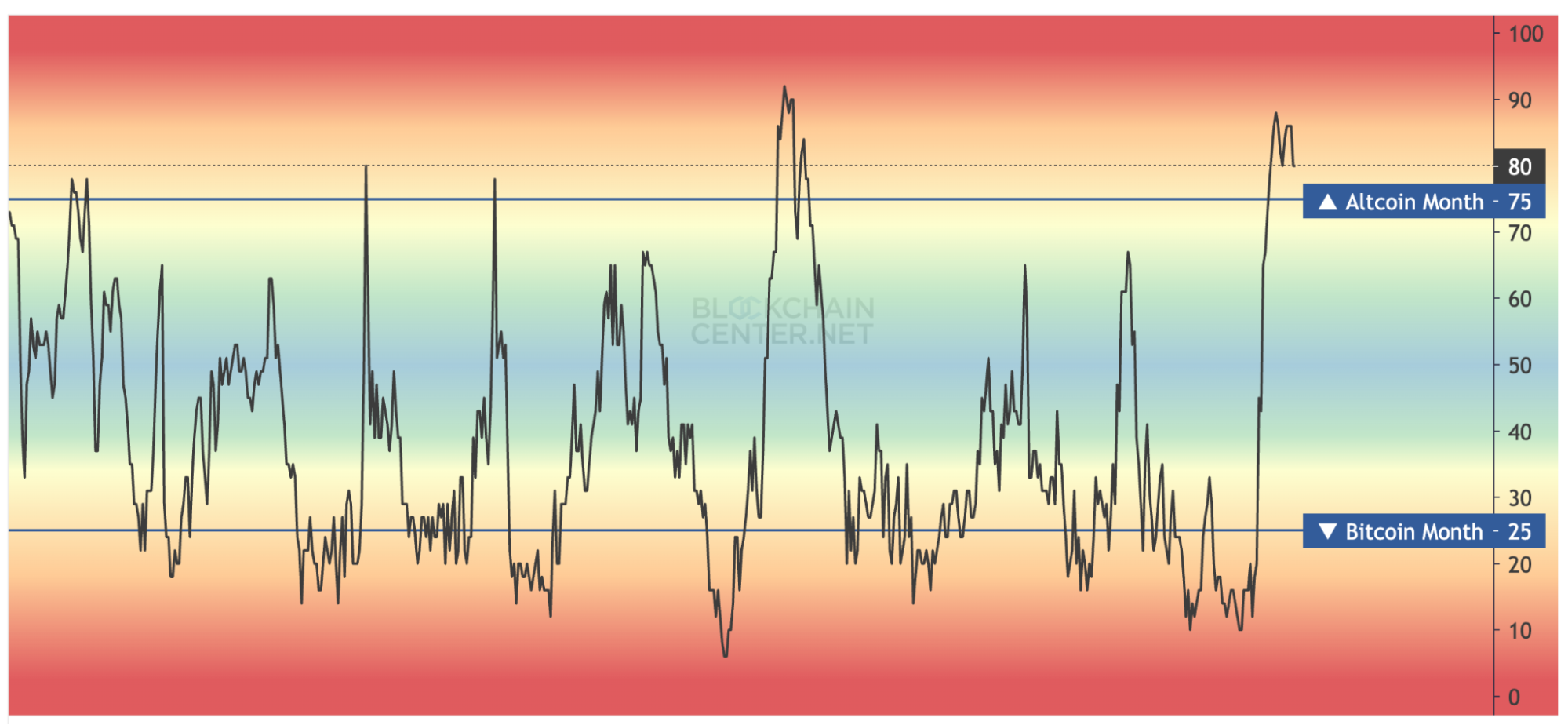
On July 30, 2025, the Altcoin Month Index surged to 80, signaling the onset of Altcoin Month as major projects achieved standout performance. We explain the meaning of the index and examine the recent price movements of Bitcoin and Ethereum. We also offer newcomers guidance on timing their entry into Altcoin Month and understanding its associated risks.


Image source: https://www.blockchaincenter.net/en/altcoin-season-index/

1. What Is the Altcoin Month Index?

The Altcoin Month Index serves as a key benchmark for assessing the overall performance of altcoins within the crypto market. Developed by the analytics platform Blockchaincenter, this index tracks whether the top 50 altcoins by market capitalization (excluding Bitcoin) have outperformed Bitcoin over the past 30 days. If more than 75% of these altcoins outperform BTC, the Altcoin Month Index rises above 75, indicating the onset of an “Altcoin Month.”

An index reading above 75 reflects a surge in market risk appetite, indicating that investors are increasingly allocating capital to higher-potential, higher-volatility altcoin projects.

2. Current Market Overview and Index Analysis

As of July 30, 2025, the Altcoin Month Index is at 80, signaling a classic “Altcoin Month” scenario. Bitcoin is consolidating around $118,000, while Ethereum remains steady near $3,700. With Bitcoin lacking short-term breakout momentum, investors are rotating capital into higher-return opportunities, making altcoins favored assets in this environment.

The latest broad-based rally in altcoins has been fueled by several factors, including booming new blockchain ecosystems, continued momentum in DeFi and GameFi, increasing hype around AI and Web3 social tokens, and innovative launches within stablecoin protocols.

3. Major Altcoin Prices and Market Movement

With the Altcoin Month Index at elevated levels, several well-known altcoins have posted strong gains. For example, Stellar (XLM), driven by rapid advances in cross-border payments and stablecoin integration, soared 74% over the past 30 days, currently trading around $0.53. Cardano (ADA), boosted by ongoing upgrades to its smart contract platform, climbed to $1.00. This represents a jump of over 23% within the month.

Ripple (XRP) saw investor confidence rise sharply following progress in its legal battle with the US SEC. Its price rose to $3.92, up about 21%. Meanwhile, Dogecoin (DOGE) has attracted renewed retail interest, with the price now at $0.33, attributable to ongoing community engagement.

Among newer projects, Sei (SEI) and Ethena (ENA) have garnered attention due to Sei’s high-performance blockchain and Ethena’s synthetic stablecoin mechanism, rising 27% and 21%, respectively. These standout performers have become popular rotation targets, supporting the elevated Altcoin Month Index.

4. Investment Strategies for Altcoin Month

For those new to the market, the following approaches may be considered:

  • Focus on high-liquidity projects: Top-tier altcoins like SOL offer active trading and lower risk exposure.
  • Use a dollar-cost averaging approach: To avoid timing the peak, invest at regular intervals to average your entry cost.
  • Monitor hot sectors: AI, meme tokens, and blockchain gaming often lead short-term market surges.
  • Set disciplined take-profit and stop-loss levels: Define your target gains and maximum acceptable losses in advance to maintain disciplined trading.

5. Risks and Precautions

While altcoins can see sharp rallies, their volatility is significantly higher than Bitcoin’s. Key risks include:

  • The altcoin market often moves in tandem with Bitcoin and may drop sharply if BTC declines.
  • Some newer projects may carry liquidity or security concerns.
  • Steep price declines can result from diminishing airdrop expectations or unsuccessful mainnet launches.
  • Avoid allocating all capital to a single asset—maintain a balanced portfolio and manage risk appropriately.
Author: Max
Disclaimer
* The information is not intended to be and does not constitute financial advice or any other recommendation of any sort offered or endorsed by Gate.
* This article may not be reproduced, transmitted or copied without referencing Gate. Contravention is an infringement of Copyright Act and may be subject to legal action.

Related Articles

What is Fartcoin? All You Need to Know About FARTCOIN
Intermediate

What is Fartcoin? All You Need to Know About FARTCOIN

Fartcoin (FARTCOIN) is a representative meme coin within the Solana ecosystem based on an AI-driven narrative. Its core concept originated from an experiment aimed at exploring the "boundaries between AI Agents and humor." More than just a digital asset with social attributes, the project deeply couples absurd humor culture with on-chain financial logic by integrating autonomous AI interaction models.
2026-04-04 22:01:19
Gold Price Forecast for the Next Five Years: 2026–2030 Trend Outlook and Investment Implications, Could It Reach $6,000?
Beginner

Gold Price Forecast for the Next Five Years: 2026–2030 Trend Outlook and Investment Implications, Could It Reach $6,000?

Analyze current gold price trends alongside authoritative five-year forecasts, integrating an evaluation of market risks and opportunities. This gives investors insight into the potential trajectory of gold prices and the main drivers expected to shape the market over the next five years.
2026-03-25 18:13:30
Aster vs Hyperliquid: Which Perp DEX Will Prevail?
Beginner

Aster vs Hyperliquid: Which Perp DEX Will Prevail?

Aster and Hyperliquid are the two representative protocols of the "purpose-built L1 path" within the current decentralized perpetual exchange (Perp DEX) sector. As a pioneer in the field, Hyperliquid has built a deep liquidity moat through its highly mature order book architecture and strong community consensus. Conversely, Aster, as a rising challenger, seeks to leapfrog the competition in high-performance trading through more aggressive multi-chain aggregation logic, private transaction modules, and an underlying execution environment optimized for 2026 market demands.
2026-03-24 11:58:33
AI-Native Settlement Layers: How United Stables Is Building the Next Financial Rail
Beginner

AI-Native Settlement Layers: How United Stables Is Building the Next Financial Rail

Stablecoins were originally designed as dollar substitutes within exchanges, primarily used for asset pricing and trade settlement. As on-chain financial ecosystems have matured, their role has expanded beyond simple payments to include collateral assets, cross-chain liquidity mediums, and unified settlement units. In particular, as AI systems and automated agents begin to participate directly in economic activity, demand has risen sharply for programmable value units capable of instant settlement. This shift is pushing stablecoins toward the role of foundational financial infrastructure.
2026-03-25 03:16:17
Aerodrome Tokenomics: How ve(3,3) Powers Base's Most Profitable DEX
Beginner

Aerodrome Tokenomics: How ve(3,3) Powers Base's Most Profitable DEX

AERO is the native token of Aerodrome Finance, a core decentralized exchange and liquidity protocol in the Base ecosystem. It is primarily used for liquidity incentives and ecosystem operations. veAERO is a governance NFT that users receive by locking AERO, representing both voting power and the right to share protocol revenue. Through a dual track structure of AERO as a utility token and veAERO as a governance credential, Aerodrome separates liquidity usage value from long term governance power, allowing participants to act as liquidity providers, governance decision makers, and revenue sharers within the same system.
2026-03-25 06:40:31
The ve(3,3) Flywheel Explained: How AERO Tokenomics Powers Aerodrome’s DeFi Economy
Beginner

The ve(3,3) Flywheel Explained: How AERO Tokenomics Powers Aerodrome’s DeFi Economy

In the competition for DeFi liquidity, high-inflation mining alone is no longer enough to build lasting advantages. Aerodrome applies the ve(3,3) economic model to redesign token emissions, voting mechanisms, and revenue distribution, creating a liquidity flywheel centered on governance and cash flow. This article examines AERO tokenomics, the veAERO locking mechanism, and protocol revenue models to explain how Aerodrome builds a sustainable DeFi economic system.
2026-03-25 06:41:58





