Golem (GLM) is a decentralized computing marketplace launched in 2016 on Ethereum, addressing inefficiencies in centralized cloud computing. As of January 2026, it operates with 19,951 token holders and a fixed supply of 1 billion GLM tokens. The platform enables peer-to-peer computational resource sharing through blockchain-based settlement, allowing users to rent idle computing power for CGI rendering, machine learning, and scientific simulations. GLM tokens can be purchased on Gate and other exchanges, demonstrating accessibility across 36 trading venues. Recent market performance shows 45.76% gains over 30 days with $160,579.56 daily trading volume. Golem's ecosystem supports decentralized infrastructure through smart contracts and community governance, while facing competition from traditional cloud providers and regulatory considerations. The project maintains active community engagement on X and GitHub, positioning itself as a viable alternative to centralized computing services.
Golem's Positioning and Significance
In 2016, the Golem team launched Golem (GLM), aiming to address inefficiencies in computing resource allocation and high costs of centralized cloud computing services.
As a decentralized computing power marketplace built on Ethereum, Golem plays a key role in distributed computing and resource sharing.
As of 2026, Golem has evolved into a mature decentralized computing platform with a complete token economy, featuring 19,951 holders and an active developer community.
This article will provide an in-depth analysis of its technical architecture, market performance, and future potential.
Origin and Development History
Birth Background
Golem was created by the Golem team in 2016, aiming to solve the inefficiency and high cost of traditional centralized computing resource allocation.
It emerged during the blockchain technology boom, with the goal of democratizing access to computing power by creating a global, peer-to-peer marketplace to change the status quo.
The launch of Golem brought new possibilities for individuals and organizations requiring computing resources for tasks such as CGI rendering, machine learning, and scientific computing.
Key Milestones
- 2016: Project launch with the initial GNT token, establishing the vision of a decentralized supercomputer.
- 2020: Major rebranding on November 19, with GNT renamed to GLM in a 1:1 ratio, introducing improved tokenomics and platform architecture.
- 2018: Price reached a significant level of $1.32 during the crypto market expansion.
- The platform continues to develop under community governance and the Golem Foundation, continuously optimizing its technical framework, security protocols, and real-world applications.
How Golem Works?
No Central Control
Golem operates on a decentralized network of computers (nodes) distributed globally, free from the control of banks or governments.
These nodes collaborate to validate computing task requests and completions, ensuring the system remains transparent and attack-resistant, granting users greater autonomy and enhancing network resilience.
Blockchain Core
Golem's blockchain foundation is built on Ethereum, utilizing a public, immutable digital ledger that records transactions and computing task settlements.
Transactions are grouped into blocks and linked through cryptographic hashes to form a secure chain.
Anyone can view the records, establishing trust without intermediaries.
The Ethereum-based transaction system settles payments between computing power providers and users.
Ensuring Fairness
Golem leverages Ethereum's consensus mechanism to validate transactions and prevent fraudulent activities.
Computing power providers maintain network security by offering their idle computing resources and completing assigned tasks, earning GLM tokens as rewards.
Its innovation includes creating an open marketplace where any user can become either a computing power provider or consumer.
Secure Transactions
Golem uses public-private key cryptography to protect transactions:
- Private keys (similar to secret passwords) are used to sign transactions
- Public keys (similar to account numbers) are used to verify ownership
This mechanism ensures fund security while maintaining pseudonymous transaction privacy.
The platform's smart contract-based settlement system automates payment distribution based on computing task completion.
Circulation Overview
As of 15 January 2026, Golem's circulating supply stands at 1,000,000,000 GLM tokens, with a total supply of 1,000,000,000 GLM, representing a fully diluted market. The token operates under a fixed supply model with no additional issuance mechanism.
Price Fluctuations
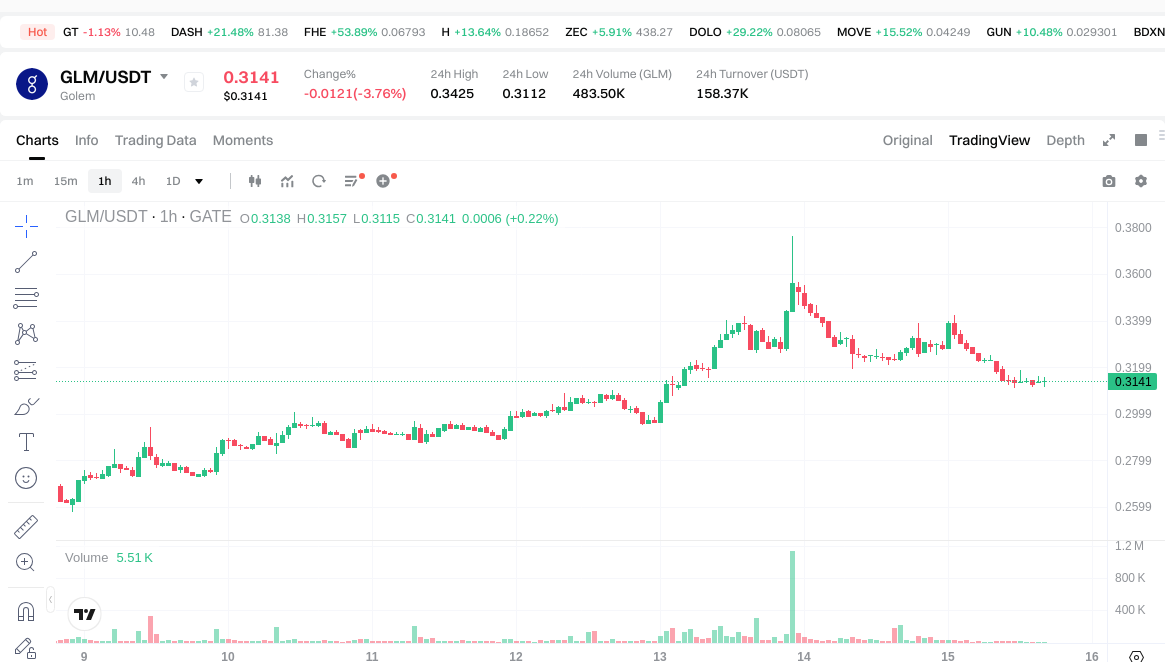
Golem reached a notable price level of $1.32 on 13 April 2018, driven by broader market momentum during that period. Its lowest recorded price was $0.00913753 on 12 December 2016, reflecting early-stage market conditions and limited adoption.
Recent price trends show varied performance across different timeframes. Over the past 30 days, GLM demonstrated an increase of 45.76%, while the 7-day period showed a gain of 14.53%. However, the 24-hour movement reflected a decline of 3.83%, and the 1-year performance indicated a decrease of 19.21%. These fluctuations reflect evolving market sentiment, adoption patterns, and external market factors.
Click to view current GLM market price
On-Chain Metrics
- Token Holders: 19,951 addresses (indicating community distribution)
- Trading Venues: Available on 36 exchanges (reflecting market accessibility)
- 24-Hour Trading Volume: $160,579.56 (demonstrating current market activity)
Golem Ecosystem Applications and Strategic Partners
Core Use Cases
Golem's ecosystem supports decentralized computing power rental applications:
- Decentralized Computing: Golem Network enables users to rent out idle computing resources from personal computers to data centers, providing distributed computational power for CGI rendering, machine learning, and scientific simulations.
- Resource Sharing Economy: The platform facilitates peer-to-peer computational resource exchange, driving cost-effective alternatives to centralized cloud computing services.
Strategic Partnerships
Golem continues to build its ecosystem through technical integrations within the Ethereum network and broader blockchain community.
These partnerships provide a foundation for Golem's ecosystem expansion in the decentralized computing market.
Challenges and Considerations
Golem faces the following challenges:
- Technical Considerations: Scaling computational task distribution and ensuring quality of service across diverse hardware configurations
- Market Competition: Competition from other decentralized computing projects and established cloud service providers
- Regulatory Environment: Evolving regulatory frameworks for decentralized networks and cryptocurrency-based payment systems
These considerations have prompted ongoing discussions within the community and drive Golem's continuous innovation.
Golem's community demonstrates active participation, with approximately 19,951 token holders as of January 2026.
On X platform, discussions around Golem and its technology frequently generate engagement among decentralized computing enthusiasts.
Community interest is driven by platform updates, computing power marketplace developments, and GLM token utility expansions.
Sentiment on X reflects diverse perspectives:
- Supporters highlight Golem's decentralized computing infrastructure and Ethereum-based settlement system, viewing it as a viable alternative to centralized cloud computing.
- Observers discuss market volatility, adoption rates, and competition from traditional cloud providers.
Recent trends indicate ongoing community interest in decentralized infrastructure projects.
Popular Discussion Topics
X users actively discuss Golem's computing power marketplace dynamics, GLM token economics, and platform development progress,
showcasing both its technological potential and considerations for broader market adoption.
Additional Resources for Golem
- Official Website: Visit Golem's official website for platform features, use cases, and latest developments.
- Whitepaper: The Golem Whitepaper outlines its technical architecture, goals, and vision for decentralized computing.
- X Platform: Golem maintains an active presence on X through @golemproject, sharing updates on technical developments, community initiatives, and ecosystem partnerships.
- GitHub: Access development repositories at Golem's GitHub to explore open-source code and contribute to the project.
- Community Forums: Engage with the community through Golem's blog and Reddit for discussions and updates.
Golem Future Roadmap
Golem continues to develop its decentralized computing infrastructure with ongoing platform enhancements.
The project aims to expand its computing marketplace and improve network efficiency for various computational workloads.
How to Participate in Golem?
- Purchase Options: Acquire GLM tokens on Gate.com and other supporting exchanges
- Storage Solutions: Securely store GLM using Ethereum-compatible wallets such as MetaMask or hardware wallets
- Network Participation: Contribute computing power to the Golem Network or utilize the platform for computational tasks
- Ecosystem Building: Visit Golem's developer documentation to build applications or contribute to the open-source codebase
Summary
Golem leverages blockchain technology to create a decentralized computing marketplace, offering transparent, peer-to-peer computational resource sharing.
Its active community, comprehensive resources, and established market presence position it within the decentralized infrastructure sector.
While facing competitive pressures and adoption challenges, Golem's focus on decentralized computing and clear development direction maintain its relevance in the evolving landscape of distributed computing technologies.
Whether you are exploring decentralized infrastructure or seeking alternatives to traditional cloud computing, Golem presents an interesting project to follow and engage with.
FAQ
What is Golem (GLM) and what problem does it solve?
Golem (GLM) is a decentralized computing platform creating a peer-to-peer marketplace for buying and selling computational power. It solves inefficient resource utilization by connecting users needing computing power with those offering unused capacity.
How can I buy and store GLM tokens?
You can purchase GLM tokens through cryptocurrency platforms that support the token. For storage, keep them in your exchange account or transfer to a personal cryptocurrency wallet for enhanced security and control.
What is the difference between GLM and other cryptocurrency projects?
GLM is a utility token for decentralized computing with a fixed supply. Unlike projects focused on synthetic assets or decentralized finance, GLM emphasizes distributed computing infrastructure. Its fixed supply model and computing-centric approach differentiate it from other blockchain projects.
What are the risks and security considerations of investing in GLM?
GLM investment risks include price volatility from computing demand fluctuations, smart contract vulnerabilities, regulatory uncertainties, and network adoption risks. Security depends on platform audits and user wallet protection practices.
How does the Golem network work and what are its use cases?
Golem is a decentralized computing network enabling users to buy and sell computational resources via blockchain. It supports AI processing, rendering, data analysis, and scientific computing, creating a peer-to-peer marketplace for computing power.
* The information is not intended to be and does not constitute financial advice or any other recommendation of any sort offered or endorsed by Gate.










