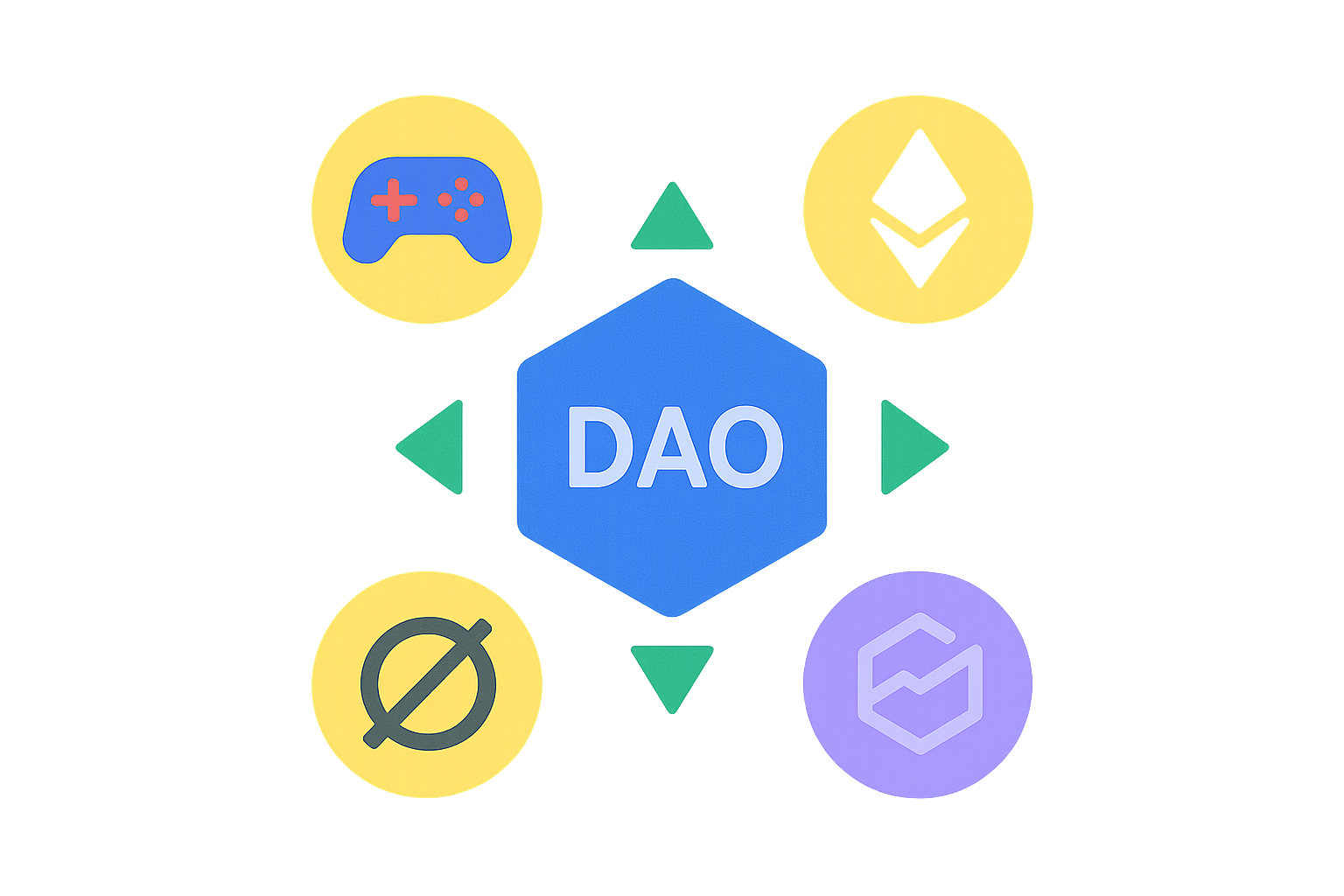
Discover DAOs and their role within Web3. Dive into Play-to-Earn gaming, decentralized governance structures, income opportunities in blockchain games, subDAOs, and the projected future of P2E gaming, which could reach $183 billion by 2034.
Introduction to DAO Investment Games
The emergence of Decentralized Autonomous Organizations (DAOs – Decentralized Autonomous Organization) is revolutionizing the gaming industry, particularly in the play-to-earn (P2E) space. The innovative concept of "DAO investment games" is rapidly gaining momentum among gamers and investors worldwide. This model leverages blockchain technology to build decentralized economies where genuine ownership and governance are in the hands of the players.
DAO investment games are distinguished by their creative integration of traditional gaming guilds with community-managed investment funds. Trailblazing organizations such as Yield Guild Games (YGG) are redefining how players and investors interact with digital assets and gaming ecosystems. Rather than relying on the centralized model—where game publishers retain full control—the DAO approach enables communities to collectively steer direction and share benefits equitably.
This article explores the critical facets of DAO investment games, including detailed operational mechanisms, substantial economic upside, the challenges that must be addressed, and the pivotal role of subDAOs in scaling. We also examine the transformative integration of blockchain and artificial intelligence (AI) within the gaming ecosystem, as well as the future prospects of web3 gaming amid ongoing technological advancement.
What Are DAO Investment Games?
DAO investment games represent a revolutionary, decentralized business model in which a DAO invests in assets capable of generating revenue within blockchain gaming ecosystems. These assets go far beyond virtual items; they include non-fungible tokens (NFTs), virtual real estate in the metaverse, income-generating game characters, and a broad spectrum of commercially valuable in-game assets.
The primary goal of this model is to create sustainable, stable income streams for all DAO participants, while fostering a community-driven approach to both gaming and investment. In practice, every major decision—from choosing investment assets to distributing profits—is made democratically via member voting.
A leading example of a successful DAO investment game is Yield Guild Games (YGG). YGG operates as a unique hybrid—both a large-scale gaming guild and a professional investment fund. The organization acquires high-value virtual assets such as land in metaverse platforms like The Sandbox and Decentraland. YGG also invests in breeding and renting game characters like Axies (from Axie Infinity), then equitably shares the resulting revenue among stakeholders: DAO members, scholarship providers, and actual players.
This model provides not only economic returns but also builds a sustainable ecosystem, where anyone can participate and benefit from the growth of blockchain gaming—regardless of initial capital.
How Does the DAO Investment Game Model Work?
The DAO investment game framework consists of several critical components, each playing a key role in ensuring the system's effective and sustainable operation:
Virtual Asset Acquisition
DAOs like YGG execute targeted investment strategies in high-value, long-term profitable NFTs. This includes acquiring prime virtual properties in leading metaverses, rare game characters with stable income potential, and other in-game assets that can be leased or traded for revenue. All investment activities are transparent and subject to strict community oversight through proposals and voting.
Scholarship Programs
This is one of the most impactful innovations in the DAO gaming model. Scholarship programs provide in-game assets (such as NFT characters) to skilled players who cannot afford the initial asset purchase. These players, known as "scholars," use the assets to play and earn. Revenue is then split according to agreed ratios among players, managers, and the DAO. This democratizes access to P2E gaming and creates employment opportunities for thousands worldwide—especially in developing regions.
Decentralized governance is the heart of the DAO model. DAO members, by holding governance tokens, participate in all major decisions, voting together on investment strategies, resource allocation, game selection, and other key policies. This ensures a democratic, transparent, and fair system—preventing any single party from holding total control.
SubDAO for Localization
To manage global operations effectively, large DAOs have developed subDAO structures. SubDAOs act as local branches, overseeing activities and communities in specific regions. Each subDAO tailors its strategies and operations to local language, culture, and community needs, while adhering to the parent DAO's guiding principles and objectives.
This comprehensive model democratizes access to P2E gaming, creates diverse and sustainable income opportunities for members, and fosters a unified, global community.
Economic Potential of Play-to-Earn Gaming
The global web3 gaming market is undergoing explosive growth, with remarkable statistics. Trusted market research forecasts the sector will grow from $37.5 billion in 2025 to $183 billion by 2034, with a compound annual growth rate (CAGR) of 19.24%—among the fastest in tech today.
This rapid growth is driven by several key factors:
Widespread Adoption of Blockchain Technology
Blockchain has demonstrated its value in delivering absolute transparency, robust security, and genuine digital asset ownership. Players now fully own in-game items as NFTs, trading them freely without dependence on game publishers. This marks a fundamental shift in how players perceive virtual asset value.
The Strong Rise of NFTs
Non-fungible tokens (NFTs) provide a new way to own, exchange, and generate value from in-game assets. NFTs confer not just ownership, but also uniqueness, scarcity, and verifiability—transforming in-game items from virtually worthless data into digital assets with real market value.
Integration of Decentralized Finance (DeFi)
DeFi features—staking, yield farming, liquidity mining—are increasingly integrated into gaming ecosystems. This creates additional, diverse revenue channels for players, not limited to gameplay but also through decentralized financial activity.
Despite major potential, the P2E model also faces key challenges:
Decreasing Income Over Time
As more players join P2E games, rewards are distributed among more participants, reducing individual earnings. This "dilution effect" can cause community dissatisfaction and lower engagement.
Legal and Regulatory Risks
Unclear legal frameworks for blockchain gaming, NFTs, and DAOs introduce significant uncertainty for investors and players. Different jurisdictions take different approaches, and regulatory shifts can dramatically affect project operations.
Concerns About Product Quality
The rapid expansion of blockchain gaming has produced many low-quality, unsustainable projects. This can erode community trust and deter new participants, undermining long-term industry growth.
Pay-to-Win Dynamics
In many P2E games, players and guilds with large capital dominate, creating high entry barriers for smaller players. This can destabilize the ecosystem and undermine fairness—a core principle of decentralization.
Effective solutions to these challenges are crucial for sustainable, long-term success across the P2E gaming industry.
The Role of SubDAO in DAO Investment Games
SubDAOs are a major innovation in the organizational structure of DAO investment games, functioning as localized operating units within the broader ecosystem. These entities operate under the parent DAO's principles, but with significant autonomy to focus on specific regions, language groups, or game verticals.
Key roles and functions of subDAOs include:
Deep Localization
SubDAOs are designed to address the unique needs and preferences of communities worldwide. Each region has distinct gaming cultures, languages, activity hours, and favored game genres. SubDAOs ensure cultural and regional fit by customizing strategy, content, and operational methods. For example, a Southeast Asian subDAO may focus on popular local mobile games and schedule events to suit local time zones.
Specialized and Efficient Management
Delegating decision-making to subDAOs enables much more focused and efficient management of assets and activities versus centralized models. Each subDAO can allocate resources to projects and investments best suited to its local market and react quickly to new opportunities. This maximizes global resource allocation, ensuring every dollar is invested efficiently.
Community Cohesion and Growth
One of the greatest strengths of the subDAO model is its ability to build and sustain strong local communities. By involving local members in decision-making, organizing culturally relevant events, and facilitating local activities, subDAOs foster greater ownership and responsibility. This enhances engagement, trust, and loyalty toward the DAO.
Sustainable Scaling
The decentralized subDAO model enables DAOs to scale sustainably and efficiently without sacrificing agility or local engagement. Instead of managing everything centrally, the parent DAO focuses on strategy and major decisions while subDAOs run daily operations and local community building. This approach has proven highly effective in maintaining strong engagement even as organizations expand globally.
Integration of Blockchain and AI in the Gaming Ecosystem
The powerful synergy of blockchain and artificial intelligence (AI) is driving a paradigm shift in the gaming ecosystem, unlocking new possibilities for truly decentralized economies owned and governed by players.
AI-Enhanced DAOs
Pioneering projects like DeFAI and AI16Z are at the forefront of using AI to optimize DAO operations. AI analyzes complex data, forecasts market trends, assesses investment opportunities, and supports community decision-making. Machine learning algorithms process vast amounts of blockchain, gameplay, and player behavior data to deliver smart investment recommendations and optimal strategies. This boosts operational efficiency and enables more informed, data-driven decision-making by DAOs.
Blockchain-Driven Transparent Economies
Blockchain is essential for ensuring secure, transparent, and immutable transactions and asset ownership. Every transaction—from NFT trading to reward distribution—is recorded and verifiable on-chain, creating a trustless environment for players and investors. This transparency strengthens community confidence and encourages broader participation.
AI-Powered Game Agents
One of AI's most exciting gaming applications is the development of automated game agents. These agents deliver highly personalized experiences tailored to each player's preferences and style. They can automate repetitive tasks—resource farming, asset management, basic trading—freeing players to enjoy more creative and engaging aspects of gameplay.
AI also enables smarter NPCs, dynamic quest systems, and self-adjusting game economies based on player activity, making games more immersive, vibrant, and accessible to a diverse player base.
Future Integration Outlook
These technological breakthroughs not only improve gameplay but also create new avenues for investment, community engagement, and sustainable economic models in the metaverse. The convergence of blockchain and AI is ushering in a new generation of gaming ecosystems that empower players and foster truly decentralized communities.
The Future of DAO Investment Games
As the web3 gaming market grows rapidly, DAO investment games are poised to become an increasingly central force shaping the industry's future. Current trends and emerging technologies point to several key developments in the coming years:
Intensifying Competition and Diversification
The success of DAOs like Yield Guild Games is inspiring communities worldwide to adopt similar models, fueling fierce competition for scarce, high-value digital assets and top talent. While this heightens competitive pressures, it also drives constant innovation in operating models, investment strategies, and community engagement.
Focus on Quality and Sustainability
The industry is moving from prioritizing volume to emphasizing quality and sustainable growth. Initiatives like Arbitrum Gaming Ventures—with $10 million allocated to support top-tier web3 gaming projects—are raising the bar for the entire sector. This shift reflects a maturing market where investors and players demand superior product quality, operational transparency, and lasting value.
Addressing Fairness and Accessibility Challenges
A top priority for the future of DAO investment games is resolving fairness and accessibility issues. Overcoming pay-to-win dynamics—where deep-pocketed players dominate—is essential for maintaining a healthy and attractive ecosystem. Solutions include smarter game balancing, expanded scholarship programs, and more sustainable in-game economies that reward skill and dedication over sheer capital.
Deeper Integration of Advanced Technologies
The future will bring ever-closer integration of AI, machine learning, and potentially VR/AR into DAO investment games. These technologies will elevate player experiences, unlock new investment and earning opportunities, and help DAOs operate more intelligently and efficiently.
Expansion into New Markets
As DAO gaming models mature, they are expected to reach new markets—especially developing regions where P2E gaming can generate significant socioeconomic impact. Localization through subDAOs will be key, ensuring services and opportunities are tailored to local needs and realities.
Conclusion
The DAO investment game model is a transformative leap in how we approach gaming and investment in the digital age. By harnessing blockchain, AI, and decentralized community governance, gaming DAOs are building a new ecosystem with more equitable power and benefit distribution—giving everyone the chance to participate and profit.
While challenges remain—from legal uncertainties and product quality to ecosystem fairness—the growth and innovation potential in this space is immense. With projected market size reaching $183 billion by 2034, web3 gaming and DAO investment games are positioned to become a cornerstone of the global digital economy.
As the industry matures, trailblazers such as Yield Guild Games and a new wave of DAOs will continue pushing the boundaries of play-to-earn gaming—creating new economic opportunities and building global communities where players collaborate, compete, and share success in a fairer, more transparent ecosystem.
FAQ
What is a DAO? How is it used in Play-to-Earn games?
A DAO is a decentralized autonomous organization that operates through smart contracts. In Play-to-Earn games, DAOs manage game resources and distribute rewards. Players earn rewards by participating in DAO decisions.
How does DAO game investment differ from traditional game investment?
DAO game investment enables players to own assets and have governance rights, whereas traditional games are controlled by developers. DAOs offer greater autonomy and real earning potential from digital assets.
How do I participate in DAO gaming investment? What steps and requirements are involved?
To participate in DAO gaming, you need a crypto wallet, purchase relevant tokens, and then join or vote on the DAO platform. The simplest way to start is by choosing a smaller DAO with lower entry costs.
What are the income sources for Play-to-Earn games? Can players really earn money?
Income primarily comes from trading in-game assets and NFTs. While some players profit, only a minority actually earn money—most may incur losses.
What risks are involved in DAO gaming project investment? How can they be avoided?
Key risks include unclear platforms, market competition, and technology issues. To reduce risk, conduct thorough due diligence and diversify your investments.
What is the purpose of DAO governance tokens? What benefits do holders receive?
DAO governance tokens give holders voting rights over major DAO decisions. Token holders can influence the organization's direction and decisions, representing their stake and impact within the DAO.
What successful DAO gaming projects exist today? How do their models work?
Projects such as Axie Infinity and CryptoKitties run on blockchain, allowing users to own, breed, and trade digital assets. Players earn crypto through gameplay and DAO participation.
What is the future outlook for DAO gaming ecosystems? How will this market evolve?
DAO gaming ecosystems have a bright future; the market will continue robust growth. The X-to-earn model drives innovation and mass participation, reshaping the future economy of work.
* The information is not intended to be and does not constitute financial advice or any other recommendation of any sort offered or endorsed by Gate.