Will Bitcoin Return to $120,000? 2025 Bitcoin Price Prediction — In-Depth Analysis

Beginner
Quick Reads
Last Updated 2026-03-27 18:53:25
Reading Time: 1m
This report provides a comprehensive analysis of the latest news on Bitcoin in 2025 and macroeconomic factors, integrating on-chain data and institutional insights. It offers various Bitcoin price prediction models to help inform investment decisions.

Market Overview and Latest News
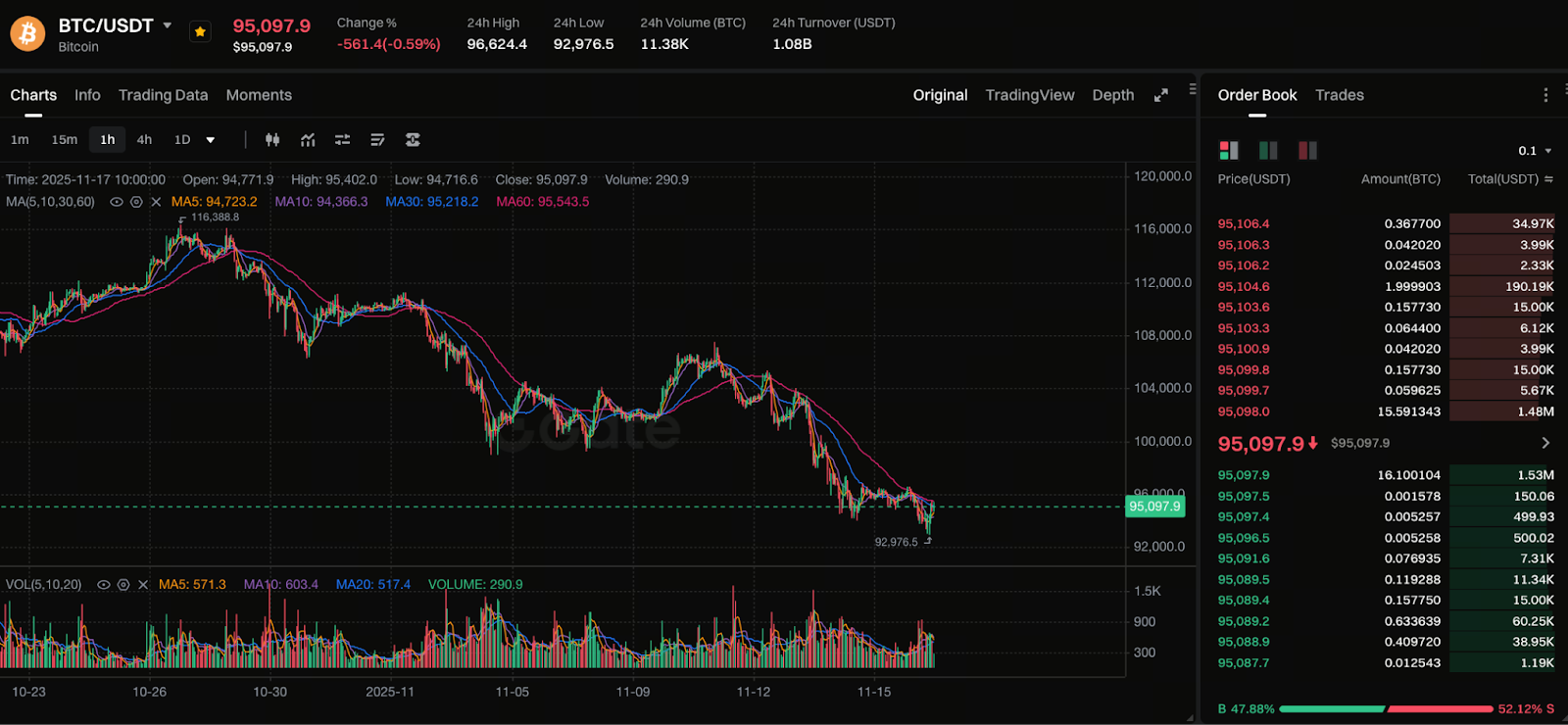

View live chart: https://www.gate.com/trade/BTC_USDT

In mid-November 2025, Bitcoin (BTC) experienced significant price swings. Its price briefly dropped to around $93,000—a six-month low—largely in response to hawkish remarks from the Federal Reserve. Chair Jerome Powell indicated that key economic data could be delayed due to a possible government shutdown, introducing uncertainty around a December rate cut. This development dampened risk appetite for crypto assets. Meanwhile, JPMorgan considers Bitcoin currently undervalued, with risk-adjusted returns now appearing more attractive than those of gold after marked deleveraging.

Macroeconomic policy and market sentiment are shaping a critical inflection point for Bitcoin’s price.

Key Drivers Analysis

  • Institutional Demand: Institutional investors are entering the Bitcoin market through ETFs. On-chain data shows that major holders (whales) and ETF products are actively accumulating BTC.
  • Supply Scarcity: With Bitcoin’s supply capped and institutions continuing to buy, tightening supply further underscores its digital gold status.
  • Macroeconomic Factors: Federal Reserve policy, inflation trends, and interest rate expectations remain pivotal. If rate cut expectations return, BTC’s rally could resume. Conversely, a rebound in inflation or rates could heighten volatility.

Multiple Bitcoin Price Prediction Models

Below are several mainstream and emerging forecasting models alongside institutional perspectives:

  • On-Chain Indicators & Historical Cycle Models: CoinDesk reports that if Bitcoin’s price holds above $116,000 for several weeks, this would set the stage for a year-end rally toward $160,000–$200,000.
  • Polymarket Predictions: Some participants on Polymarket anticipate Bitcoin will not surpass $138,000 in 2025.
  • Power-Law Model: Analysts using the power-law model project BTC could see substantial gains—potentially tripling—by the end of 2025.
  • Deep Learning / AI Models: Recent academic research indicates that hybrid models (like VMD + LSTM) can deliver reasonably reliable short-term Bitcoin price forecasts.

Other studies using synthetic control methods to analyze Bitcoin halvings suggest that these events may have a sustained positive impact on price.

In summary, conservative forecasts see BTC trading in the $130,000–$140,000 range, while more aggressive projections target $160,000–$200,000 or even higher.

Potential Risk Factors

Although many forecasts remain bullish on Bitcoin, the market also faces the following risks:

  • Macroeconomic Policy Uncertainty: Shifts in Fed policy or a resurgence in inflation could weigh heavily on the crypto market.
  • Risks related to deleveraging: While some deleveraging has already occurred, large holders taking profits or increasing exchange balances could trigger pullbacks.
  • Technical and Security Risks: Hacking, exchange vulnerabilities, and DeFi protocol security issues remain significant concerns.
  • Regulatory Pressure: Regulatory approaches to crypto assets differ worldwide, and abrupt policy changes could spark volatility.

Mid- to Long-Term Outlook and Strategic Recommendations

  • Mid- to long-term investors: If you see Bitcoin as “digital gold” and are prepared for volatility, this may be a favorable time to accumulate. Consider dollar-cost averaging, maintain long-term holdings and set clear take-profit and stop-loss levels.
  • Short-term traders: Focus on key support and resistance levels as well as macroeconomic data, such as Fed meetings and inflation statistics. Use technical analysis to inform your trading decisions.
  • Risk Management: Regardless of your strategy, keep allocations moderate and avoid excessive leverage; monitor sentiment indicators, such as the Fear & Greed Index, and adjust your approach as needed.
Author: Max
Disclaimer
* The information is not intended to be and does not constitute financial advice or any other recommendation of any sort offered or endorsed by Gate.
* This article may not be reproduced, transmitted or copied without referencing Gate. Contravention is an infringement of Copyright Act and may be subject to legal action.

Related Articles

AI-Native Settlement Layers: How United Stables Is Building the Next Financial Rail
Beginner

AI-Native Settlement Layers: How United Stables Is Building the Next Financial Rail

Stablecoins were originally designed as dollar substitutes within exchanges, primarily used for asset pricing and trade settlement. As on-chain financial ecosystems have matured, their role has expanded beyond simple payments to include collateral assets, cross-chain liquidity mediums, and unified settlement units. In particular, as AI systems and automated agents begin to participate directly in economic activity, demand has risen sharply for programmable value units capable of instant settlement. This shift is pushing stablecoins toward the role of foundational financial infrastructure.
2026-03-25 03:16:17
The ve(3,3) Flywheel Explained: How AERO Tokenomics Powers Aerodrome’s DeFi Economy
Beginner

The ve(3,3) Flywheel Explained: How AERO Tokenomics Powers Aerodrome’s DeFi Economy

In the competition for DeFi liquidity, high-inflation mining alone is no longer enough to build lasting advantages. Aerodrome applies the ve(3,3) economic model to redesign token emissions, voting mechanisms, and revenue distribution, creating a liquidity flywheel centered on governance and cash flow. This article examines AERO tokenomics, the veAERO locking mechanism, and protocol revenue models to explain how Aerodrome builds a sustainable DeFi economic system.
2026-03-25 06:41:58
Aerodrome Tokenomics: How ve(3,3) Powers Base's Most Profitable DEX
Beginner

Aerodrome Tokenomics: How ve(3,3) Powers Base's Most Profitable DEX

AERO is the native token of Aerodrome Finance, a core decentralized exchange and liquidity protocol in the Base ecosystem. It is primarily used for liquidity incentives and ecosystem operations. veAERO is a governance NFT that users receive by locking AERO, representing both voting power and the right to share protocol revenue. Through a dual track structure of AERO as a utility token and veAERO as a governance credential, Aerodrome separates liquidity usage value from long term governance power, allowing participants to act as liquidity providers, governance decision makers, and revenue sharers within the same system.
2026-03-25 06:40:31
DePIN Identity Network and Real World Applications: How Humanity Protocol Brings on-chain Identity Into the Physical World
Beginner

DePIN Identity Network and Real World Applications: How Humanity Protocol Brings on-chain Identity Into the Physical World

Most Web3 identity systems remain confined to on-chain environments and struggle to achieve meaningful adoption in real world settings. Through a DePIN architecture and physical verification hardware, Humanity Protocol aims to bring decentralized identity into access control systems, hospitality, public services, and offline events, allowing on-chain identity to function not just as a digital credential, but as foundational infrastructure for real world access.
2026-03-25 07:40:53
How is the price of PAXG determined? Pegging mechanism, trading depth, and influencing factors
Beginner

How is the price of PAXG determined? Pegging mechanism, trading depth, and influencing factors

PAXG (Pax Gold) is a tokenized asset backed by physical gold reserves, launched by fintech firm Paxos and issued as an ERC-20 token on the Ethereum blockchain. The core concept is to digitally represent real-world gold assets, allowing investors to hold and trade gold via the blockchain network. Because each PAXG token corresponds to a specific quantity of physical gold, its price is theoretically expected to closely track the global gold market.
2026-03-24 19:11:40
How Does PAXG Work? In-Depth Overview of the Physical Gold Tokenization Mechanism
Beginner

How Does PAXG Work? In-Depth Overview of the Physical Gold Tokenization Mechanism

PAXG (Pax Gold) is a tokenized asset backed by physical gold, issued by the fintech company Paxos and traded on the Ethereum blockchain as an ERC-20 token. The core concept is to tokenize physical gold on-chain, with each PAXG token representing ownership of a certain amount of gold. This structure enables investors to hold and trade gold in the form of a digital asset.
2026-03-24 19:12:51





