As the blockchain industry expands from simple transfers into more complex financial scenarios such as DeFi, payment networks, and real world assets, RWA, the market is placing higher demands on the performance of underlying public blockchains. In financial services such as asset issuance, payment settlement, and high frequency trading, networks must deliver high throughput, low latency, and scalability at the same time. Otherwise, they will struggle to support large scale financial activity on-chain.
Although traditional public blockchains have the advantages of decentralization and openness, they often face insufficient throughput, transaction congestion, and limited execution efficiency when handling complex financial scenarios. Protocols focused on bringing RWA assets on-chain, including Pharos and Plume, aim to address this pain point.
What Is Pharos’ Parallel Execution Architecture?
As one of the core designs that helps Pharos improve network performance, the parallel execution architecture differs from traditional blockchains, which usually process transactions serially. In a serial execution model, transactions are executed one by one in order. When network load increases, this model can easily lead to congestion, delayed transaction confirmation, and higher fees. Parallel execution, by contrast, allows multiple non conflicting transactions to be processed at the same time, thereby improving overall processing efficiency.
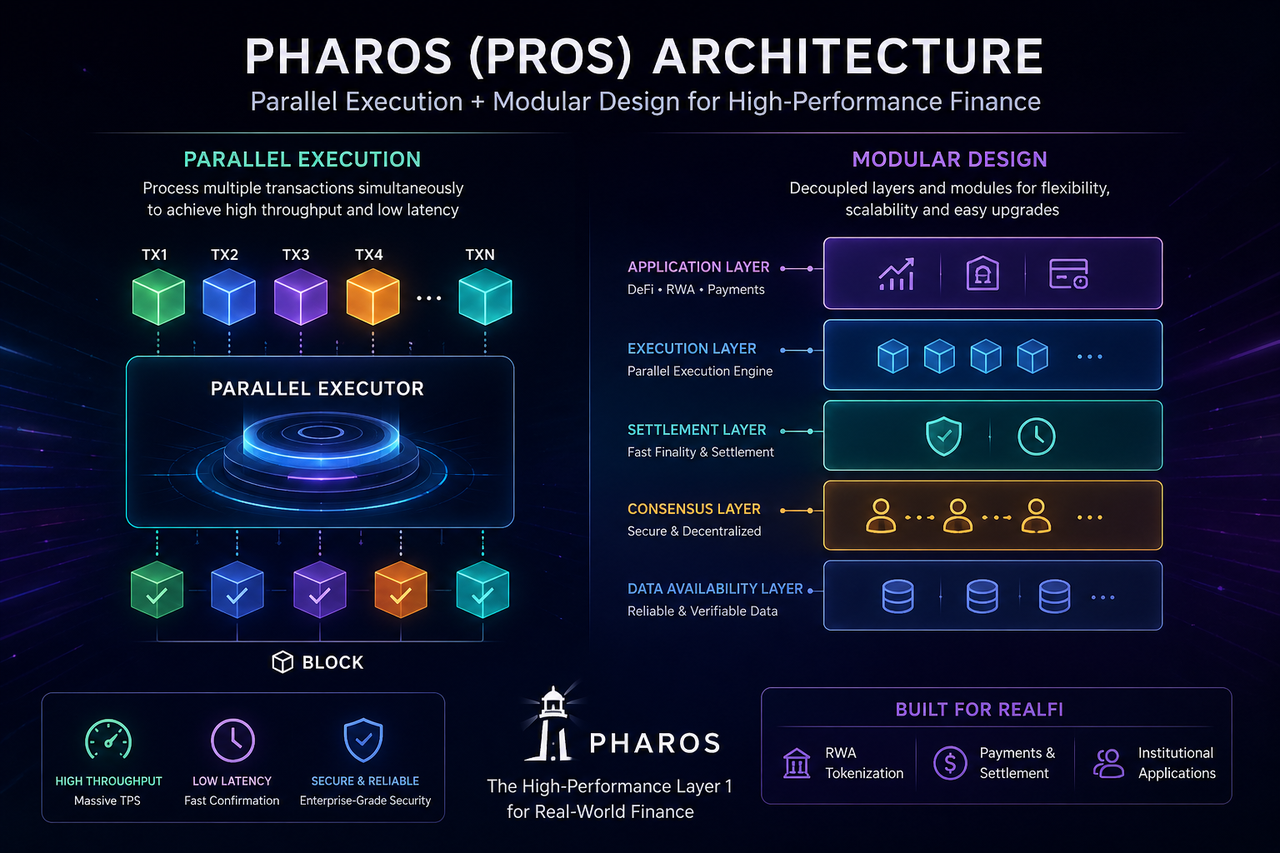
For financial scenarios, parallel execution is especially important. RWA asset transactions, payment settlement, and on-chain clearing often involve large volumes of high frequency transactions. If the underlying network still depends on serial processing, it will be difficult to meet financial grade throughput requirements. Through its parallel execution mechanism, Pharos improves network processing capacity and makes transaction confirmation more efficient, providing the performance foundation needed for large scale on-chain financial activity.
How Does Modular Design Improve Network Scalability?
In addition to parallel execution, another key technology in Pharos is modular design. The core idea of a modular architecture is to separate different functions within a blockchain network, such as the execution layer, consensus layer, and application layer, so that each module can be optimized and upgraded independently without disrupting the operation of the overall system.
This design is particularly important for financial applications, because financial businesses often require functional customization for different asset types and business processes. For example, RWA asset issuance may require compliance modules, while payment systems pay more attention to settlement efficiency. Through modular architecture, Pharos can flexibly expand functions according to different financial needs while keeping the underlying network stable. This gives it stronger scalability as financial applications continue to grow in the future.
Why Is Parallel Execution Better Suited to Financial Scenarios?
Financial services are characterized by large transaction volumes, high processing frequency, and sensitivity to confirmation time. Payment scenarios, for example, require transactions to be confirmed quickly. Asset clearing needs to process large amounts of data in a short period of time, while institutional capital flows require the network to remain continuously stable. Traditional public blockchains can experience delays under high concurrency, reducing financial service efficiency and increasing transaction costs.
Parallel execution can effectively address this problem. By processing multiple independent transactions at the same time, Pharos can increase throughput without sacrificing network efficiency, allowing it to better support high frequency financial operations. For RWA and payment networks that need to handle large scale transactions, a parallel execution architecture can significantly improve the on-chain financial experience and represents an important direction for financial infrastructure upgrades.
How Does Modular Architecture Support RWA and Institutional Grade Finance?
RWA and institutional grade financial scenarios place far higher demands on blockchain networks than ordinary on-chain applications. Beyond transaction performance, they also require compliance support, asset management, and business process flexibility. Traditional public blockchains, because their architectures are highly coupled, often struggle to adapt quickly to these complex needs. Modular design, however, can reserve expansion space for different financial modules.
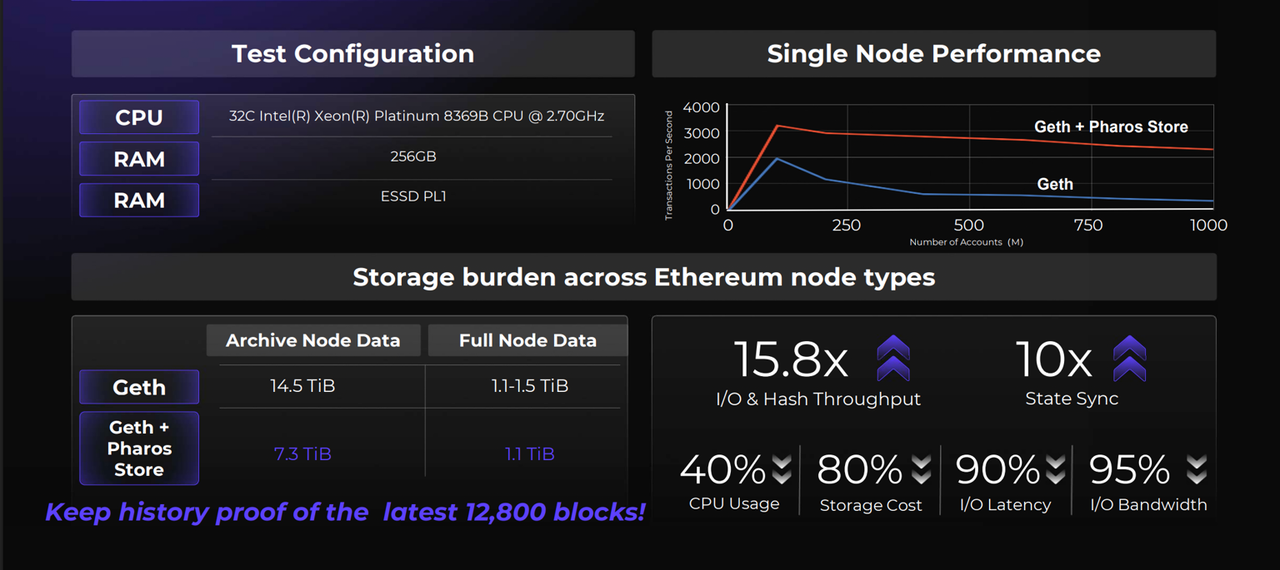
Pharos uses modular architecture to provide more flexible underlying support for RWA scenarios. For example, compliance modules can be added to asset issuance processes, settlement modules can be strengthened in payment scenarios, and interoperability modules can be expanded for cross chain asset circulation. This flexibility makes Pharos better suited as a financial infrastructure network, providing institutions and asset issuers with a more adaptable on-chain environment.
Where Are the Advantages of Pharos’ Technical Architecture Reflected?
Pharos’ technical advantage lies in the fact that it does not only focus on improving on-chain performance. It also optimizes the underlying architecture around the needs of financial businesses. Parallel execution addresses throughput bottlenecks in high frequency transaction scenarios, while modular design strengthens the network’s scalability and business adaptability. This combination makes Pharos better suited to supporting highly complex financial services such as payments, settlement, and real asset circulation.
For the rapidly growing RWA market, this technical architecture has strong practical significance. Only when the underlying network has both high performance and scalability can large scale on-chain circulation of real assets become feasible. Pharos’ architectural design is built around this goal, so its technical path is closely aligned with future demand for on-chain finance.
Conclusion
Pharos (PROS) provides more efficient and flexible underlying infrastructure for on-chain financial applications through a technical architecture based on parallel execution and modular design. Parallel execution improves transaction throughput and reduces latency in high frequency financial scenarios, while modular design strengthens the network’s ability to adapt to complex financial services and provides more room for RWA and institutional finance applications to scale.
As the on-chain finance market continues to expand, competition among public blockchain infrastructure will increasingly focus on performance and scalability. Through an architecture optimized for financial scenarios, Pharos is attempting to build an underlying network better suited to bringing real financial assets on-chain. If its ecosystem continues to advance, this technical architecture may become an important foundation for future RealFi development.
FAQs
What Is Pharos’ Parallel Execution Architecture?
Pharos’ parallel execution architecture is a mechanism that allows multiple transactions to be processed at the same time. Compared with traditional serial execution, it can improve throughput and reduce transaction latency, making it better suited to high frequency financial scenarios.
What Are the Advantages of Pharos’ Modular Design?
Modular design improves network scalability by separating the execution layer and functional modules, allowing Pharos to support different business needs such as RWA, payments, and institutional finance with greater flexibility.
Why Is Parallel Execution Suitable for Financial Applications?
Financial applications usually need to process large volumes of high frequency transactions and have high requirements for confirmation speed. Parallel execution can process multiple transactions at the same time, improving efficiency and reducing the risk of network congestion.
How Does Pharos’ Technical Architecture Help RWA?
Through high throughput and modular support, Pharos’ technical architecture provides a more stable and efficient infrastructure environment for RWA asset issuance, on-chain settlement, and institutional grade financial services.







